Film Buff Musings

by Michael Lawrence

List of "A" Movies


As Good as It Gets (1997) Poster
AS GOOD AS IT GETS (1997) A
dir. James L. Brooks
As Good as It Gets isn’t about transformation so much as erosion—watching someone wear down just enough to let another person in. On paper, it’s a romantic comedy. In practice, it’s closer to a barbed character piece—one that slips between cringe and sentiment without ever settling into either. Jack Nicholson plays Melvin Udall, a man so proudly unpleasant he treats decency like a flaw. Racist, sexist, homophobic, and compulsively regimented, he barrels through the world offending everyone in his path. And yet it’s compulsively watchable. Melvin has obsessive-compulsive disorder, though that’s just one part of the obstacle course. He eats breakfast at the same diner, at the same table, served by the same waitress—Carol (Helen Hunt), the only person willing to engage with him at all, let alone refill his coffee. He’s clearly infatuated, but too emotionally mangled to express it without accidentally insulting her mid-sentence. She endures it, barely. Across the hall from Melvin’s apartment is Simon (Greg Kinnear), a soft-spoken gay artist who receives the full force of Melvin’s bile until a string of events leaves him hospitalized. That’s when Melvin ends up taking care of Simon’s dog—the same one he once shoved down a garbage chute. And something changes. Not through confession or breakthrough, but through routine. Feed the dog. Walk the dog. Let a few of the walls crack. The film doesn’t chase redemption. Melvin stays difficult. He improves, reluctantly, and only as much as he absolutely has to. Nicholson is sharp as ever, but it’s in his interactions—brittle, biting, occasionally disarmed—that the film finds its rhythm. Hunt, in an Oscar-winning role, brings a kind of tired defiance to Carol that makes her believable as someone who knows better but chooses hope anyway. Kinnear is quietly affecting, and Cuba Gooding Jr., as Simon’s no-nonsense art dealer, delivers every line like he’s ready to drag the movie back to earth when it floats too high. It’s funny, sharp, awkward, sometimes even moving.
Starring: Jack Nicholson, Helen Hunt, Greg Kinnear, Cuba Gooding Jr., Skeet Ulrich, Shirley Knight, Yeardley Smith.
Rated PG-13. TriStar Pictures. USA. 139 mins.
Assault on Precinct 13 (2005) Poster
ASSAULT ON PRECINCT 13 (2005) C
dir. Jean-François Richet
A reasonably polished but thoroughly unremarkable genre exercise, Assault on Precinct 13 plays like a stripped-down siege thriller that’s been buffed too smooth to leave much of an impression at all. It’s a loose remake of John Carpenter’s lean and nasty 1976 cult film, though you wouldn’t guess it by the gloss—gone is the grimy menace of the original, replaced with the comforting sheen of a mid-2000s studio production with time to kill and no real point to prove. The cast is at least game. Ethan Hawke plays Sergeant Jake Roenick, a desk-bound Detroit cop with a past and a painkiller habit, spending New Year’s Eve babysitting a half-defunct precinct that’s hours away from being shuttered. The snowstorm outside has rerouted a prison transport inside, which is how Marion Bishop (Laurence Fishburne), a stone-cold crime boss with a philosophical bent, ends up cooling his heels in holding. The real trouble starts when masked gunmen surround the building—not street gangs, but crooked cops looking to clean up their own mess by eliminating Bishop and anyone who gets in the way. There’s a ticking clock, dwindling supplies, and the usual forced alliances between cops and criminals, all executed with a kind of anonymous efficiency. The actors—Hawke, Fishburne, Gabriel Byrne, Drea de Matteo—do what they can, but the script doesn’t give them enough texture to work with. You know who’s going to betray whom, who’s going to get shot mid-sentence, and who’s going to make it to the final standoff. It’s all perfectly adequate. That’s the problem. There’s no grit, no invention, no real tension beyond what we’ve already seen plenty of times from better films. You can eat your popcorn and let it play. Assault on Precinct 13 is not bad—it’s just entirely missable.
Starring: Ethan Hawke, Laurence Fishburne, Gabriel Byrne, Maria Bello, Drea de Matteo, John Leguizamo, Brian Dennehy.
Rated R. Rogue Pictures. USA. 109 mins.
Asylum (2008) Poster
ASYLUM (2008) D
dir. David R. Ellis
Some horror movies embrace camp with a wink, but Asylum takes the scenic route—playing it straight just long enough to convince you it’s serious, then veering so hard into absurdity it practically slaps you with a brick. Then you sit there, dazed, before finally muttering to yourself: Oh, this was supposed to be a joke? That’s a shame, because the premise—while hardly groundbreaking—could have worked, either as straight horror or parody, if only there were steadier hands at the wheel. At the center of the film is a group of emotionally scarred freshmen moving into a newly renovated dormitory, blissfully unaware that their new digs were once a mental asylum run by Dr. Burke (Mark Rolston), a sadistic psychiatrist with a penchant for gruesome experiments. His ghost, naturally, still lingers, looking upon these trauma-ridden residents as an all-you-can-eat buffet for his supernatural appetite. Our lead victim is Madison (Sarah Roemer), who arrives at school still reeling from witnessing her father’s and brother’s suicides. She barely has time to unpack before she’s mysteriously strangled by her own necklace. After something like that, any rational person would grab their things and hightail it out of there, but this wouldn’t be a horror film if she didn’t start sleuthing instead. While ghost hunting often makes for great horror films, this one is undone by characters who are as deep as a puddle, existing solely to scream, run, and die—and the framing is so amateurish that none of it is particularly fun to watch. The film’s one truly bright spot is Mark Rolston, who chews the scenery with the enthusiasm of a man who just discovered chewing. His mad doctor ghoul is so hammy you can practically taste the salt. Unfortunately, his kills only occasionally flirt with the grotesquely amusing—nothing like the disgusting midnight-movie gore-fest the film should have embraced. The problem with Asylum is that it can’t commit. It’s not scary enough to work as horror, not sharp enough to be satire, and not unhinged enough to be cult-worthy trash. It just sort of… exists, like a ghost that forgot what it was haunting.
Starring: Sarah Roemer, Jake Muxworthy, Mark Rolston, Travis Van Winkle, Ellen Hollman, Carolina Garcia, Cody Kasch, Lin Shaye, Joe Inscoe, Gabe Wood.
Rated R. Metro-Goldwyn-Mayer. USA. 93 mins.
At Sachem Farm (1998) Poster
AT SACHEM FARM (1998) C+
dir. John Huddles
The roly-poly of cinema. Just like those pill/potato/wood/doodle bugs, this film goes by more names than it knows what to do with. At Sachem Farm is what streaming platforms seem to have settled on, but Higher Love appears on the title card, and Uncorked is on the cover art. Some jurisdictions even call it Trade Winds. If I were to choose, I’d go with That Agreeable Independent British Film with Rufus Sewell at a Winery. Sewell plays a young man determined to sell off his family’s prized wine collection to fund a magnesium mine. Nigel Hawthorne is Cullen, the peculiar uncle who gets drunk and destroys the entire collection, then buys a gigantic Roman column just to sit on top of it. Minnie Driver turns up as his cousin—a grounded counterpoint to all the winery eccentricity—adding her own quiet shrewdness to the mix. It doesn’t pull you in—it drifts by, amiable and unobtrusive, like a weekend guest who never unpacks. The editing skips and clips in ways that can jar, but never in a way that feels aggressive. At heart, it’s a courteous little film, intent on being liked while tidily reminding you about decency, perspective, and how little material ambitions amount to in the end. Whether you buy in or not, it will have poured the wine, told the story, and sent you on your way before you’ve had time to complain.
Starring: Rufus Sewell, Nigel Hawthorne, Minnie Driver, Eric Stoltz, Amelia Heinle.
Rated PG-13. October Films. UK. 108 mins.
Atlantic City Poster
ATLANTIC CITY (1980) A-
dir. Louis Malle
Atlantic City was once a place where people came to feel important—now they come to get mugged by the past. The boardwalk, once a glitzy artery pulsing with gangsters, gamblers, and the kind of dames who could make a man forget his own name, has faded into something less romantic: a crumbling facade where old-timers sit and squint at the ocean, wondering when their ship will finally come in. That’s where we find Lou (Burt Lancaster), a man who still carries himself like he once mattered. He’ll tell anyone who’ll listen that he was a big shot, a name people feared, a presence that commanded respect. But the truth is, he was never more than a footnote—a man who loitered on the edges of history while the real mobsters wrote it. Now, he marks time running petty errands for Grace (Kate Reid), the widow of a long-dead crime boss, who treats him like a relic—dusty, worn down, taking up space but too familiar to throw away. Lou endures it because, well, what else is there? But then, across the way, a flicker of vitality—Sally (Susan Sarandon), younger, beautiful, methodical in her attempts to reinvent herself. She’s studying to be a croupier, practicing card flips and dreaming of Monte Carlo, where the air doesn’t smell like yesterday’s broken bets. Lou watches her from his window, but she’s unaware of his gaze—too busy trying to outrun her own past. Her estranged husband—a small-time crook, full-time dead weight—has stolen drugs from the wrong people, and now Sally is a marked woman. And Lou—good old Lou—sees his moment. Not to run. Not to hide. But to finally, at long last, step into the story he’s always told himself he was part of. If this were a different kind of movie, you’d be gearing up for the big shootout, the moral reckoning, the sudden, brutal punctuation that crime films love to throw in at the end. But this isn’t that kind of movie. Louis Malle isn’t interested in adrenaline or artifice—he’s after something finer, sadder, more human. Atlantic City isn’t about a once-great gangster making a comeback; it’s about a man who was never great to begin with, grasping at a fleeting, possibly illusory, shot at dignity. Lancaster plays Lou like a man who’s spent his whole life rehearsing for the moment the cameras would finally turn his way—only to find, when they do, that no one ever calls “action.” Sarandon, meanwhile, gives Sally a quiet ferocity, a survivor’s instinct wrapped in the soft glow of a woman who isn’t willing to be anyone’s tragic lesson. Malle directs with an unhurried rhythm, letting the city breathe, sigh, and sink under the weight of itself. The film moves like an old jazz record—elegant, melancholic, unexpectedly sharp. Atlantic City isn’t about gangsters. It’s about people who remember when they could have been gangsters. It’s about small lives pressing against the walls of a world that’s already moved on without them. And, just for a little while, it’s about what happens when those small lives take center stage.
Starring: Burt Lancaster, Susan Sarandon, Kate Reid, Robert Joy, Hollis McLaren, Michel Piccoli, Al Waxman, Sean Sullivan, Angus MacInnes.
Rated R. Paramount Pictures. France-Canada. 104 mins.
ATTACK OF THE 50-FOOT WOMAN (1958) Poster
ATTACK OF THE 50-FOOT WOMAN (1958) B-
dir. Nathan Juran
For a movie about a woman growing to astronomical proportions, Attack of the 50 Foot Woman spends a lot of time on small, petty people. It promises sci-fi spectacle but mostly delivers a pulpy domestic drama with a glowing UFO thrown in for seasoning. Nancy Archer (Allison Hayes) has wealth but no control, trapped in a marriage to Harry (William Hudson), a scheming philanderer who sees her as an obstacle between himself and her fortune. One night, she stumbles across a shimmering orb in the desert—and a towering, expressionless giant standing nearby, his papier-mâché hand outstretched like he’s trying to flag down a cab. She runs home, frantic, but when she recounts the story, Harry waves it off as hysteria. It’s a convenient excuse—Nancy has a history of mental instability, and he’s all too eager to weaponize it while sneaking off with his sneering mistress (Yvette Vickers). But then fate, or maybe cosmic justice, intervenes. When Nancy insists on returning to the site, the giant appears again—this time grabbing her, exposing her to whatever radioactive nonsense fuels the plot. Then, without warning, she’s towering over the town like a walking monolith. Her long-delayed rampage takes its time to arrive (it’s in the last 10 minutes), but when it finally does, it doesn’t disappoint. She stalks through town in a billowing nightgown, eyes blazing, and finally becomes the nightmare Harry deserves. The effects are gloriously awful (her oversized hand looks like a failed craft project), but none of that matters. Attack of the 50 Foot Woman might waste too much time on a sleazy love triangle, but it delivers in the end—the sheer catharsis of watching a woman, long dismissed and underestimated, finally take up as much space as she damn well pleases.
Starring: Allison Hayes, William Hudson, Yvette Vickers, Roy Gordon, George Douglas, Ken Terrell.
Not Rated. Allied Artists Pictures Corporation. USA. 66 mins.
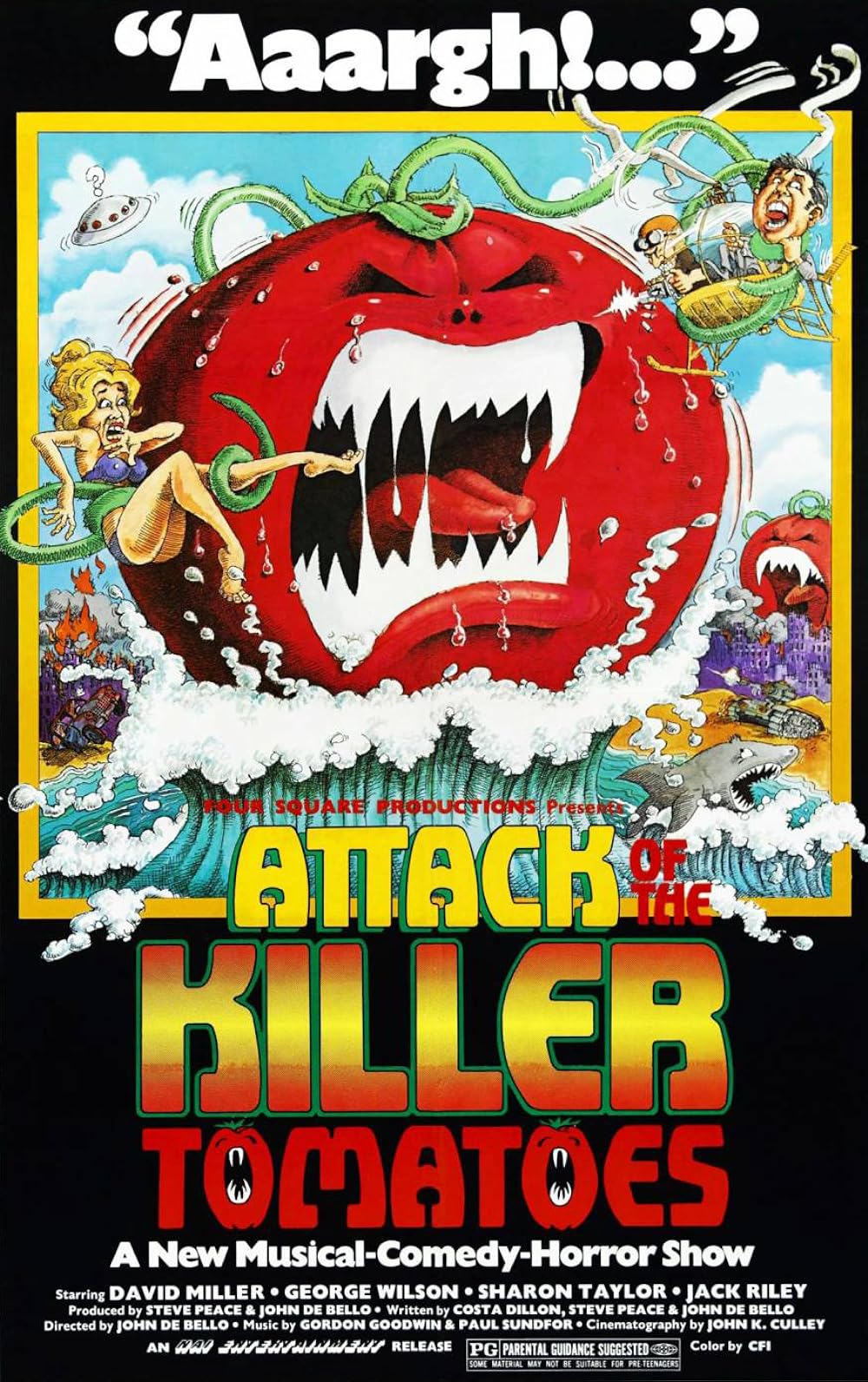
Attack of the Killer Tomatoes! (1978) Poster
ATTACK OF THE KILLER TOMATOES! (1978) B-
dir. John De Bello
It’s hard to parody bad movies without just becoming one. Attack of the Killer Tomatoes! solves the problem by going fully, proudly, brain-dead—and never blinking. The plot, such as it is, involves a wave of killer tomatoes terrorizing the populace. These are not particularly aggressive tomatoes. Some float benignly in swimming pools while children splash around them. Others roll quietly down the street like produce in search of purpose. The government panics anyway, unleashing a team of misfits, military dropouts, and one man in a tomato costume to stop the red menace. The jokes come fast and cheap. A paratrooper crashes through a roof and mistakes a man in blackface disguised as Hitler for the real thing. A classic establishing shot of San Francisco is labeled “New York City.” There’s a woman in a sash that reads “Miss Potato Famine 1922.” The film randomly breaks into musical numbers. Logic is not on the menu. What is on the menu is a level of stupidity so absolute it starts to feel like commitment. The tomato effects are hilariously inert—no one on Earth could convincingly be killed by one of these things—but the film doesn’t care. It builds to a finale where townspeople stampede through a parking lot, flattening tomatoes into marinara like it’s the climax of Spartacus reimagined by a salad bar. It doesn’t hold together. It barely qualifies as a movie. But it’s committed, it’s often funny, and it ends on a high note: a theme song so weirdly catchy it could’ve made Dr. Demento’s greatest hits. You may not remember the plot, but you’ll remember the chorus.
Starring: David Miller, George Wilson, Sharon Taylor, Jack Riley, Eric Christmas.
Rated PG. NAI Entertainment. USA. 83 mins.
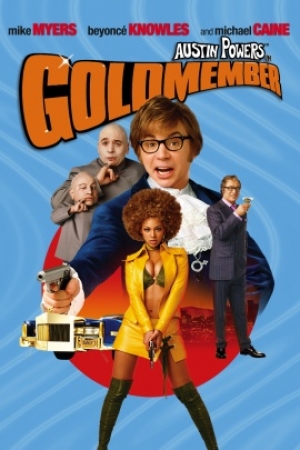
Austin Powers in Goldmember Poster
AUSTIN POWERS IN GOLDMEMBER (2002) B+
dir. Jay Roach
The first two Austin Powers films had their moments—sometimes riotous, sometimes excruciating—but Goldmember is the only one that’s consistently funny. From the opening number, a gloriously self-indulgent musical sequence that outdoes its predecessors in sheer exuberance (easily the highlights of those films), the pacing here is slicker and sharper. And unlike its predecessors, which occasionally hit dead spots, this one never loses its rhythm. Even the weaker elements from The Spy Who Shagged Me have been recalibrated. Fat Bastard, previously insufferable, somehow manages to land a few solid jokes. The cameos, often a lazy crutch in lesser comedies, are actually clever—particularly a scene where Beyoncé’s undercover spy feeds lines to Austin while Nathan Lane, at his hammiest, lip-syncs every word beside him. But the real MVP, once again, is Mini-Me (Verne Troyer), who gets his best arc yet—abandoning Dr. Evil and joining Austin. Naturally, he rebrands himself as a pint-sized Austin Powers. His silent, physical comedy is miles funnier than some of the film’s actual dialogue, and watching him strut around in velvet suits and oversized glasses is worth the price of admission alone. Meanwhile, Michael Caine arrives as Austin’s long-lost father and slides into this madcap spy series with the ease only Michael Caine can. He delivers one of the film’s best lines: “There are only two things I hate in this world: people who are intolerant of other people’s cultures and the Dutch.” And in case you were wondering, yes, he has a deeply personal reason for hating the Dutch—something about a stolen baby. Not everything works. Mike Myers’ newest character, the titular Goldmember, is more creepy than funny—a one-note joke stretched too thin. But overall, the good far outweighs the bad, and—surprisingly—it even manages to tack on a disarmingly sweet ending. While Goldmember isn’t a standalone masterpiece (many jokes rely on the first two films for context), it’s the smoothest, most effortlessly entertaining of the trilogy. The Austin Powers series has always been a mix of brilliance and nonsense, but finally, in this third entry, the nonsense feels well-oiled.
Starring: Mike Myers, Beyoncé Knowles, Michael York, Michael Caine, Robert Wagner, Rob Lowe, Seth Green, Verne Troyer, Mindy Sterling, Fred Savage, Brian Tee, Masi Oka, Clint Howard.
Rated PG-13. New Line Cinema. USA. 94 mins.
Austin Powers: International Man of Mystery Poster
AUSTIN POWERS: INTERNATIONAL MAN OF MYSTERY
(1997) B-
dir. Jay Roach
Austin Powers (Mike Myers) is a polyester-clad monument to ’60s excess—spy, swinger, and walking dental malpractice case—who struts through Carnaby Street like a man convinced he invented fun. But when his arch-nemesis, the cartoonishly inept Dr. Evil (also Myers), cryogenically freezes himself to hatch villainy in a more promising era, Austin follows suit, waking up in 1997 to find that the world has turned. Free love is out, political correctness is in, and suddenly, his lewd, groovy shtick gets about as warm a welcome as an unannounced IRS audit. And so begins the joke: the ultimate relic of the sexual revolution let loose in a world that now finds his brand of charm actionable. It’s a premise rich with possibility, but the film, much like its hero, often overstays its welcome. Myers’ comedy philosophy seems to be that if a joke isn’t funny the first time, he’ll tell it again—louder, longer, and with an increasing sense of obligation. Some bits stretch so far past their breaking point you can practically hear the film panting to keep up. (The infamous “shh” routine is less a gag than a hostage situation.) But just when you think the film has committed to the gag-for-gag’s-sake abyss, it pulls off something so perfectly absurd that you almost forgive it. Take the gleefully juvenile nude frolic, where Austin parades through a hotel suite in the buff, his modesty protected by a choreography of conveniently placed fruit, teapots, and passing waiters. It’s so immaculately timed it borders on art. And beneath all the hit-or-miss gags, there’s an undeniable affection for the deliriously kitschy spy flicks it parodies—villain lairs filled with impractical furniture, henchmen who exist solely to be karate-chopped, and world domination schemes so ludicrous they could have been conceived in a boardroom full of very tired screenwriters. If Austin Powers: International Man of Mystery is a mixed bag, at least it’s one stuffed with confetti. The film’s goofball energy and commitment to its own nonsense carry it through, even when the jokes don’t. It might be uneven, but it’s infectious—after all, Austin Powers became a ‘90s cultural icon in his own right.
Starring: Mike Myers, Elizabeth Hurley, Michael York, Mimi Rogers, Robert Wagner, Seth Green, Fabiana Udenio, Mindy Sterling, Paul Dillon, Will Ferrell.
Rated PG-13. New Line Cinema. USA. 89 mins.
Austin Powers: The Spy Who Shagged Me (1999) Poster
AUSTIN POWERS: THE SPY WHO SHAGGED ME (1999) B-
dir. Jay Roach
For a while, The Spy Who Shagged Me feels like a greatest-hits album that refuses to play anything new. The first act recycles so many gags from the original that it starts to seem less like a sequel and more like an extended encore for an audience that supposedly didn’t get enough the first time. But then, just when it starts losing steam, along comes Mini-Me (Verne Troyer), Dr. Evil’s mute, misbehaving clone, to shake things up. He’s part henchman, part housecat, and his very existence both baffles and delights his so-called father. Dr. Evil is inexplicably, almost tenderly, obsessed with him, much to the growing disgust of his actual son Scott (Seth Green), whose exasperation remains one of the franchise’s best running jokes. Less inspired is the introduction of Fat Bastard (Mike Myers, buried under latex), a sweaty, gluttonous assassin whose entire comedic identity revolves around being fat and Scottish, as though that alone is enough to sustain multiple scenes. The movie keeps giving him the spotlight, and he keeps using it to shout. The lone exception is his deranged “Get in my belly!” moment with Mini-Me, which works—though only because Mini-Me’s horrified reaction sells it. As for the plot, it’s almost aggressively secondary. Dr. Evil has stolen Austin’s mojo—because in this universe, libido is apparently a tangible substance that can be bottled like cologne—and without it, Austin finds himself struggling to woo his new partner, the ever-game Felicity Shagwell (Heather Graham). Meanwhile, Dr. Evil demands $100 billion to ransom Washington, D.C., blissfully unaware that his Number Two (Robert Wagner) made a small investment in Starbucks back in 1969, which has since made him a fortune beyond his wildest villainous dreams. Turns out world domination is just a side hustle when you have a coffee empire to run. Cameos from Burt Bacharach, Elvis Costello, Woody Harrelson, and Willie Nelson keep things lively, and even when the film overstays a joke by five minutes, its sheer goofball energy keeps it kinetic. The Spy Who Shagged Me isn’t as fresh as the original, but it compensates by being bigger, weirder, and just barely on the right side of ridiculous.
Starring: Mike Myers, Heather Graham, Michael York, Robert Wagner, Rob Lowe, Seth Green, Mindy Sterling, Verne Troyer, Will Ferrell.
Rated PG-13. New Line Cinema. USA. 95 mins.
Autumn in New York (2000) Poster
AUTUMN IN NEW YORK (2000) C
dir. Joan Chen
A romantic weeper with all the vitality of its title season—picturesque, melancholy, and on the brink of shutting down. Autumn in New York isn’t the worst of its kind, but it is one of the more tranquil—less howling melodrama than polite sadness, like someone mourning through a cashmere scarf. Richard Gere plays Will Keane, a Manhattan restaurateur with silver hair, a womanizing past, and the warmth of a marble countertop. He meets Charlotte Fielding (Winona Ryder), a 22-year-old with oversized hats, a delicate constitution, and a terminal heart condition. She also happens to be the daughter of one of his ex-girlfriends, which the movie acknowledges just long enough to make it more uncomfortable. He’s 48. She’s dying. Romance ensues. There’s some early-2000s time-capsule weirdness to it all—back when May-December relationships in movies were still treated as slightly rakish rather than ethically askew. But Gere and Ryder are both watchable, if not exactly persuasive as a couple. He squints and broods; she glows and withers. They drift into something like love—halting conversations, cautious gestures, a sense that time is already running out. What follows is less a romance than a test: will Will, who’s made a career out of leaving, finally stay? Doctors propose a risky transplant, but it’s a long shot. Charlotte resists. Tragedy, like dessert, is inevitable. Visually, the film lives up to its title. Cinematographer Changwei Gu composes some legitimately gorgeous images—Central Park dressed in gold, lovers framed against fading light. If only something compelling were happening inside the frame. The themes are all too familiar: love is fleeting, life is unfair, cherish what you have before the leaves turn. You’ve heard the song before. This one just plays it slower. It isn’t offensive. It isn’t even aggressively bad. But it is the kind of movie where people fall in love between blood tests, and every kiss feels like a farewell toast. There are worse ways to spend two hours. But not many slower ones.
Starring: Richard Gere, Winona Ryder, Anthony LaPaglia, Elaine Stritch, Sherry Stringfield, Jill Hennessy.
Rated PG-13. MGM. USA. 103 mins.
Avalon (1990) Poster
AVALON (1990) A-
dir. Barry Levinson
Some movies feel like a warm embrace. Avalon feels like being wrapped in a hand-knitted blanket while someone tells you a story that starts with “Back in my day…” and ends with you unexpectedly choking up. Barry Levinson spins a memory-soaked portrait of an immigrant family in America, a film so rich with sentiment that it should, by all rights, curdle into treacle. But it doesn’t. It glows. The story drifts through the decades in beautifully textured vignettes, centering on Sam Krichinsky (Armin Mueller-Stahl), a Jewish immigrant who arrived in the 1910s with little more than wide-eyed optimism. And for the most part, America gives him exactly what he dreamed—prosperity, family, a foothold in the land of possibility. But Avalon isn’t interested in easy nostalgia. The American Dream is a lovely idea, right up until you realize it’s a centrifugal force, spinning families further and further apart. Sam’s children chase their own success, moving into bigger houses, better neighborhoods, and away. American families, unlike their European counterparts, don’t stay nestled under the same roof for generations—they scatter, fragment, reinvent. Levinson doesn’t condemn this, but you can feel the ache of it. And then there’s television, the blinking neon idol that rewires the rhythms of family life. Sam remembers a time when stories were shared, not passively absorbed—when people gathered around each other, not a flickering screen. The unspoken tragedy isn’t just that families watch, but that something as small as a box can redefine the shape of human connection. But Avalon isn’t a funeral dirge for the past. The film breathes with humor, particularly in the quick, loving bickering between family members. Sam’s bond with his grandson (a young Elijah Wood) is so gentle, so full of unspoken understanding, that it feels like watching a secret language unfold. And then, when loss inevitably creeps in—because it always does—it lands with a quiet, devastating force. This is the cinematic equivalent of flipping through old family photos that don’t belong to you, yet by the time it’s over, you might find yourself longing for a past you never lived.
Starring: Armin Mueller-Stahl, Aidan Quinn, Eve Gordon, Elizabeth Perkins, Lou Jacobi, Leo L. Fuchs, Joan Plowright, Elijah Wood, Israel Rubinek, Kevin Pollack, Grant Gelt, Moishe Rosenfeld.
Rated PG. Tri-Star Pictures. USA. 126 mins.
Avatar (2009) Poster
AVATAR (2009) C+
dir. James Cameron
Avatar is a firework show in search of a soul—a technological marvel wrapped around a script that feels assembled from recycled parts. James Cameron plunges us into Pandora, a lush alien moon rendered with such obsessive precision it often feels more vivid than the characters moving through it. The floating mountains, the phosphorescent flora, the menagerie of winged and tusked creatures—every inch of it pulses with handcrafted awe. What doesn’t pulse is the story. At heart, this is Dances with Wolves in space, with a touch of FernGully and the subtlety of a blaster rifle. Sam Worthington plays Jake Sully, a paraplegic marine granted access to a Na’vi avatar—a lab-grown body he controls remotely to blend in with the locals. His assignment: win their trust, then help the humans uproot their sacred tree and dig up a mineral called unobtanium, the most lazily named plot device this side of sci-fi Mad Libs. The Na’vi themselves are gorgeously animated, but dramatically underwritten. Their culture, while rich in visual detail, feels like a mash-up of “spiritual native” clichés polished for export. The humans are worse—corporate goons and military brutes drawn with all the nuance of a theme park attraction. Cameron clearly spent years building the world, but the people in it behave like they were written on a deadline. By the time the climactic battle unfolds—arrows versus gunships, nature versus industry—you’ve long stopped caring who wins, as long as the camera keeps moving. Avatar is easy to admire, hard to feel. It leaves you with images, not characters. You walk away remembering the colors, the textures, the spectacle. The rest is just a bunch of lanky blue things, shouting their way through a script that never once surprises.
Starring: Sam Worthington, Zoë Saldana, Sigourney Weaver, Stephen Lang, Giovanni Ribisi.
Rated PG-13. 20th Century Fox. USA. 162 mins.
Avatar: The Way of Water (2022) Poster
AVATAR: THE WAY OF WATER (2022) C
dir. James Cameron
James Cameron returns to Pandora with a film that’s bigger, bluer, and somehow thinner than the original. It’s a staggering technical achievement—lavish, luminous, obsessively crafted—but the more it expands, the less it holds. For all its visual spectacle, The Way of Water doesn’t leave much behind. It’s impressive while it lasts, but hard to recall once it’s over. Visually, there’s no arguing with it. The CG characters have crossed into something close to lifelike, and the underwater sequences—dense with coral, shadow, and light—are among the most breathtaking images Cameron has ever put on screen. It’s immersive, meticulously rendered, and often jaw-dropping. You don’t just see the money; you see the years spent making sure every ripple behaves like a real one. The story picks up with the humans returning, the Na’vi resisting, and the Sully family caught in the middle. On paper, it’s structured and straightforward. But once the pieces are in motion, the film starts to sprawl—military revenge, teenage coming-of-age detours, aquatic rites of passage, and psychic whales all jostling for attention. It’s not incoherent, but it rarely feels focused. Subplots drift in and out, scenes wash over each other, and the emotional throughlines often get buried beneath world-building. There’s always something happening, but not always something to hold onto. To its credit, the film gestures toward intimacy: a father protecting his family, children carving out identity in a vast and dangerous world. Some of it connects, especially in quieter moments. But the writing flattens character into theme, and the performances—though committed—can’t always overcome the weight of exposition. Everyone seems to speak for the planet, the future, or the species. Rarely for themselves. Cameron’s still a master technician, but here he feels more like an architect than a storyteller. The Way of Water is magnificent to look at, built on cutting-edge innovation and world-class craft. But it moves like a guided tour through a world we’re supposed to admire, not inhabit. It’s a film of staggering beauty that never quite finds a heartbeat.
Starring: Sam Worthington, Zoe Saldaña, Sigourney Weaver, Stephen Lang, Kate Winslet, Cliff Curtis, Joel David Moore, CCH Pounder, Giovanni Ribisi, Edie Falco, Britain Dalton, Trinity Jo-Li Bliss, Jack Champion, Bailey Bass, Filip Geljo, Duane Evans Jr., Brendan Cowell, Jemaine Clement.
Rated PG-13. 20th Century Studios. USA. 192 mins.
The Avengers (1998) Poster
THE AVENGERS (1998) D
dir. Jeremiah Chechik
For a film that dresses itself in the tailored suits of a stylish spy caper, The Avengers moves with all the grace of a collapsing chandelier. It teeters between thriller and farce, never fully committing to either, lurching from action set pieces to winking absurdity with the coordination of a malfunctioning wind-up toy. Imagine a Bond movie with the script shredded, reassembled at random, and then fed through a malfunctioning teleprompter. That’s roughly the level of coherence we’re dealing with. The production is lavish—action sequences, ornate sets, a cast brimming with potential—but any intrigue, suspense, or reason to care at all is curiously absent. At its core, the plot is a wasteland of blundered opportunity. Sir August de Wynter (Sean Connery) is a megalomaniac who has harnessed the power of extreme weather. A discovery of limitless scientific and geopolitical significance—and what does he do with it? Holds the world for ransom. A setup that might have worked as satire, if only the film had the good sense to play along. Meanwhile, John Steed (Ralph Fiennes) and Emma Peel (Uma Thurman) wander through the movie with the charisma of mannequins. Then there’s the moment that seals the film’s fate: a boardroom of criminal masterminds, all dressed in full-body teddy bear suits. Was it a joke? A bet? A mistake no one had the guts to correct? Ultimately, this is a mess—the action is flat, the jokes thud like dropped silverware, and the entire film exists in a tonal purgatory of its own making.
Starring: Ralph Fiennes, Uma Thurman, Sean Connery, Jim Broadbent, Fiona Shaw, Eddie Izzard, Eileen Atkins, Carmen Ejogo.
Rated PG-13. Warner Bros. USA. 89 mins.
Avengers: Endgame (2019) Poster
AVENGERS: ENDGAME (2019) B+
dir. Anthony Russo, Joe Russo
A grand culmination? A bloated epilogue? A three-hour, nostalgia-laden curtain call for the franchise that ate Hollywood? Yes, yes, and yes. But whatever it is—whatever it means—one thing is certain: after 22 films and a decade of increasingly convoluted intergalactic soap opera, Marvel’s ultimate crossover event arrives with the weight of inevitability and the emotional baggage of a million internet theories. Picking up seconds after Infinity War slammed the universe into existential crisis, we find the survivors—conveniently, the original Avengers and a few stragglers—still reeling from Thanos’ dust-mop of doom. The Mad Titan himself, now fully in his “retired philosopher” era, puttering around his pastoral alien farm, tending to crops with the quiet satisfaction of a man who has finally completed his to-do list. (Buy groceries. Snap half of existence out of reality. Roast space potatoes.) The mission of the remaining Avengers should be quite clean and direct: find Thanos, un-snap the snapped, restore balance to the universe. Except the Stones? Gone. Pulverized. Reduced to atoms because Thanos, ever the minimalist, believes in no take-backs. And so, with a stomach-churning finality, we jump forward five years. The world is still broken. The heroes are less “saving the day” and more “coping in various stages of disarray.” What follows is a dizzying, self-referential spectacle, part Ocean’s Eleven, part greatest-hits tour, part emotional therapy session for a fandom that has spent ten years training for this moment. And somehow, despite its sheer hugeness—the multiple timelines, the paradoxes, the fan-service winks so blatant they might as well come with a subscription fee—it lands. Mostly. Endgame is, against all odds, introspective, willing to sit with its own devastation, to let its characters wear their failures like ill-fitting suits. And yes, it sometimes buckles under the weight of its own ambition—because how could it not?—but it is, at its core, a deeply satisfying finale (or is it?) to the most exhaustive, most expensive, and most aggressively destined cinematic saga of its time.
Starring: Robert Downey Jr., Chris Evans, Mark Ruffalo, Chris Hemsworth, Jeremy Renner, Don Cheadle, Paul Rudd, Brie Larson, Karen Gillan, Danai Gurira, Benedict Wong, Jon Favreau, Bradley Cooper, Gwyneth Paltrow, Josh Brolin.
Rated PG-13. Walt Disney Studios Motion Pictures. USA. 181 mins.
The Aviator (1985) Poster
THE AVIATOR (1985) C
dir. George T. Miller
A survival-adventure, a mismatched-travelers story, a film that flirts with romance but never quite seals the deal—The Aviator is all these things and yet, somehow, not much of anything at all. Christopher Reeve, doing his best rugged pragmatist, plays Edgar, a stiff-lipped mail pilot in the early 20th century, saddled with the dubious honor of escorting a high-maintenance heiress (Rosanna Arquette) across the Pacific Northwest. Naturally, the plane doesn’t cooperate. Down they go into the wilderness, and—miraculously, absurdly—Edgar emerges from the wreckage looking no worse than if he’d taken a tumble down the library steps. Now, civilization an impossible distance away, the two must navigate the elements, their mutual disdain, and the inevitable thawing that happens when attractive leads are forced into close proximity. The script understands this much. But here’s where it gets weird: the film, teed up for an old-fashioned opposites-attract romance, just… doesn’t. It flirts, it gestures, it dances around the possibility. Then it steps back. No sparks, no swelling strings. Just a sort of polite camaraderie, as if everyone involved feared getting too invested. Adventure-wise, it’s serviceable—no glaring missteps, no great triumphs. Reeve and Arquette are doing the work, even if the film isn’t always meeting them halfway. But what’s happening back home? Not much, apparently. Jack Warden, playing Edgar’s old pal, and Marcia Strassman, as his deeply unbothered fiancée, register mild concern, the kind one might feel when they misplace a nice winter coat. The stakes—emotional, dramatic, or otherwise—are barely felt. So what is The Aviator? Not a bad movie, just a weightless one, all set-up and no catharsis, content to idle when it should be soaring. It never nosedives, but it also never takes off—just a steady, uneventful roll into forgettability.
Starring: Christopher Reeve, Rosanna Arquette, Jack Warden, Sam Wanamaker, Scott Wilson, Tyne Daly, Marcia Strassman, Will Hare.
Rated PG. MGM/UA Entertainment Co. USA. 98 mins.
The Aviator (2004) Poster
THE AVIATOR (2004) A−
dir. Martin Scorsese
The Aviator is Scorsese’s glossy, high-speed glide through the golden age of Hollywood and the early years of aviation, seen through the lens of Howard Hughes—a man who seemed determined to outbuild, outspend, and outlast everyone. Leonardo DiCaprio plays him with a mix of boyish confidence and escalating panic, charting a performance that starts smooth and ends somewhere in the vicinity of a breakdown. The film opens with Hughes knee-deep in movie sets and airplane parts, making Hell’s Angels and pushing cameras as hard as he pushes his pilots. From there, it sprawls outward: the infamous Spruce Goose, his relationship with Katharine Hepburn (Cate Blanchett, doing something that isn’t quite mimicry but close enough), the war profiteering hearings, and the gradual, mirror-lit descent into obsessive rituals and shut-in paranoia. It’s a long movie—maybe too long, depending on your tolerance for plane talk and compulsive hand-washing—but it’s never dull. There’s a rhythm to it, though it sometimes races past major transitions like they were scene changes. You do occasionally wish it would slow down and let a moment breathe. Hughes builds, gambles, spirals, resurfaces—and the film moves right along with him, occasionally brushing past the emotional weight in favor of sheer spectacle. Still, it’s a slick production. The era is color-coded within an inch of its life, the costumes look expensive, and the planes are lovingly shot from angles that suggest both admiration and awe. Blanchett walks off with her scenes, Alan Alda turns a Senate hearing into a quiet chess match, and DiCaprio’s performance, twitchy and increasingly feral, manages to hold center. As a portrait of brilliance giving way to unraveling, it stays compelling—if slightly more interested in the headlines than the man underneath them.
Starring: Leonardo DiCaprio, Cate Blanchett, Kate Beckinsale, Alec Baldwin, Alan Alda, John C. Reilly, Danny Huston, Jude Law, Gwen Stefani, Ian Holm.
Rated PG-13. Miramax. USA. 170 mins.
The Awful Truth (1937) Poster
THE AWFUL TRUTH (1937) A
dir. Leo McCarey
Some comedies chase laughs. The Awful Truth barely has to try—it just radiates them, like heat off a summer sidewalk. A film that spins marital discord into pure, unfiltered delight, it stars Cary Grant as Jerry Warriner and Irene Dunne as Lucy Warriner—a couple so perfectly suited for each other that, naturally, they decide to get divorced. What follows is a staggeringly hilarious display of romantic sabotage: Jerry, cocky and wounded, sniffs around Lucy’s new suitors like a man searching for an insult he can’t quite put into words, while Lucy, sharper and funnier with every scene, parades increasingly ludicrously eligible bachelors just to see how far she can push his limits. Their biggest fight, though, isn’t over money or affairs—it’s over who gets custody of Mr. Smith, their Wire Fox Terrier, a dog so cute and expressive you half expect him to land a supporting actor nomination. The battle unfolds with all the dramatic intensity of a high-stakes courtroom thriller—except much, much funnier. Director Leo McCarey, who understood that great comedy lives as much in the way people listen as in the way they speak, keeps the whole thing in a state of controlled chaos, letting Grant and Dunne trade barbs with the kind of rhythm musicians envy. A big, bright, giddy masterpiece of a comedy—so quick, so crisp, so assured, it feels like it’s making up the rules as it goes.
Starring: Irene Dunne, Cary Grant, Ralph Bellamy, Alex D'Arcy, Cecil Cunningham, Molly Lamont, Esther Dale, Joyce Compton, Robert Allen, Robert Warwick, Mary Forbes, Skippy.
Not Rated. Columbia Pictures. USA. 91 mins.
Load Next Page