Film Buff Musings

by Michael Lawrence

List of "E" Movies


Enchanted (2007) Poster
ENCHANTED (2007) B+
dir. Kevin Lima
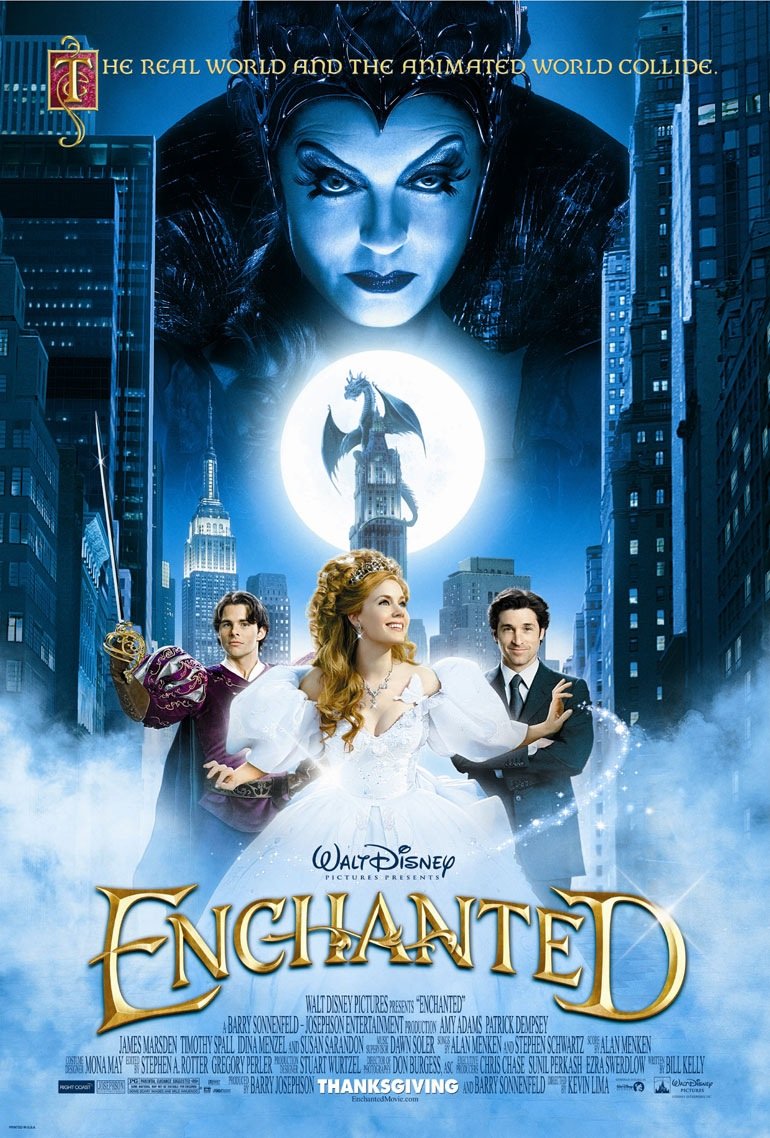
Enchanted has exactly one joke—but it’s a good one. Good enough that you can overlook how little else it tries to be. The premise: what if a wide-eyed cartoon princess got dumped into modern-day Manhattan with her personality intact? No irony, no adjustment. Just full-volume innocence colliding with commuter traffic. We begin in Andalasia, a hand-drawn fairy tale world where woodland creatures do chores and marriage proposals arrive before breakfast. Giselle (Amy Adams), a redheaded chorus of cheer in a dress made from curtains, dreams of marrying Prince Edward (James Marsden), who she meets and accepts within a single verse. The problem? His stepmother Queen Narissa (Susan Sarandon) isn’t ready to retire. If Edward gets married, she loses the throne—and more importantly, her magic. So she does what any self-respecting animated villain with inheritance anxiety would do: she shoves the bride into a wishing well that opens onto Times Square. She shows up in full regalia, blinking at Manhattan like it’s under a spell gone wrong. The setup’s familiar, but the movie doesn’t crowd it—it trusts the absurdity. She mistakes a castle-shaped casino ad for a real palace and attempts a formal entry. She sings to summon bluebirds and butterflies and ends up with rats, pigeons, cockroaches—not quite what she called for, but they get the job done. She puts them to work. The film runs the bit a few times, and it keeps landing—mostly because Adams never breaks. She says it like she means it, like rats and roaches taking cleaning orders is the most natural thing in the world. Of course, she eventually finds allies, of the human variety. A little girl (Rachel Covey) spots her floundering and introduces her to her father, a divorced lawyer (Patrick Dempsey), who takes her in with the wary hospitality of a man who once sued a puppet company. He’s seeing a fashion designer (Idina Menzel), who’s mostly there to look annoyed until the script needs to pair her off with Prince Edward. Meanwhile, Giselle learns how to walk in heels, process emotions, and win over New York City with pie and small woodland mammals. The movie isn’t flawless. Andalasia itself feels like a placeholder—less a parody of Snow White than a Xerox of its most forgettable parts. And Giselle, for all her cartoon purity, could use something—anything—beyond wide-eyed sweetness. There’s no real edge, no real curiosity. She’s a concept in motion. A very funny concept, but still. That said, the laughs are frequent and often unexpected. The tone is light without being smug. And Adams sells the whole thing like she was born animated and had to be reconstituted in flesh. The film gestures at satire but never leans on it too hard. It ends, as it must, with love triumphing, dresses twirling, and couples paired off in ways that make contractual sense. But even the fairy-tale ending feels earned enough to pass. Princess-obsessed kids will watch it until the DVD melts. Their parents will chuckle through most of it. And anyone else—anyone halfway allergic to Disney’s usual sugar rush—might be surprised at just how well this joke plays, even the tenth time it’s told.
Starring: Amy Adams, Patrick Dempsey, James Marsden, Susan Sarandon, Idina Menzel, Rachel Covey, Timothy Spall.
Rated PG. Walt Disney Studios Motion Pictures. USA. 107 mins.
Encino Man (1992) Poster
ENCINO MAN (1992) C+
dir. Les Mayfield
A caveman wakes up in Encino, California, and within days, he’s chugging Slurpees, pop-locking to early ‘90s jams, and passing driver’s ed. That’s the joke. But the movie handles it with all the caution of a science fair project: carefully assembled, mildly amusing, never in danger of going off the rails. Sean Astin, diligently humorless, plays Dave, a high school nobody who thinks digging a backyard pool will launch him into social relevance. Pauly Shore, an anthropomorphic hacky sack, is his best friend Stoney, drifting through scenes like a sentient lava lamp, vowels stretching into eternity. Then there’s Brendan Fraser, whose caveman, Link, is an evolutionary marvel—not in strength or survival skills, but in his ability to become prom royalty in record time. Link should be wreaking havoc on suburbia, hurling toasters through windows, trying to hunt the neighborhood cats. Instead, he skateboards, picks up slang like a sponge, and dresses like an MTV extra. A premise like this should sprint from the starting line. Instead, the film takes a leisurely stroll, more after-school special than comic mayhem. Link doesn’t terrorize the classroom or try to eat the teacher; he assimilates. The story doesn’t build into chaos; it settles into a recycled high school comedy where Dave sulks over a girl and learns a lesson about self-acceptance. By the third act, the caveman plot is little more than decorative. Only Shore seems to know what movie this should be. A living relic of early ‘90s weirdness, he bounces through the film like a glitch in the Matrix. The rest is strangely tame, hesitant to embrace the chaotic potential of its own premise. This is a movie about a wild man—except the wild man is tame, and the movie along with him.
Starring: Sean Astin, Brendan Fraser, Pauly Shore, Megan Ward, Robin Tunney, Michael DeLuise, Patrick Van Horn, Dalton James, Rick Ducommun, Jonathan Quan, Mariette Hartley.
Rated PG-13. Buena Vista Pictures Distribution. USA. 88 mins.
The End (1978) Poster
THE END (1978) B
dir. Burt Reynolds
A surprisingly dark comedy, directed by Burt Reynolds, who liked the script enough to call the shots—so the studio let him, provided he also starred in Hooper. Fair enough. The End is uneven but oddly focused: bleak premise, sitcom pacing, and just enough gallows wit to keep it interesting. Reynolds plays Wendell, a real estate promoter who’s told he has a terminal blood disease and decides he’d rather call it quits than wait around to fall apart. The early scenes are jarring—Reynolds blubbering on bathroom tile, begging for more time. Not because they’re poorly done, but because he was still the poster boy for tan, virile swagger. Watching him unravel is like watching a statue get a runny nose. But the tone shifts quickly, and so does Reynolds. Once Wendell pivots from grieving to scheming, the movie settles into a rhythm—grim but never serious, like a sitcom with a morbid streak. The suicide attempts pile up, each more deranged than the last—and more easily foiled. Eventually Wendell checks himself into a mental hospital, where he meets a grinning maniac played by Dom DeLuise, who treats murder like a party trick and violence like a hobby. He’s loud, unstable, weirdly loyal—and maybe the only person having a good time. Reynolds plays off him well. It’s not a duet so much as a tug-of-war, but it works. Sally Field appears briefly as Wendell’s mistress, mostly to look concerned, remind you of Smokey and the Bandit, and exit. There’s something bracing about how normal the film looks. The cinematography is bright, the music chipper, the colors borrowed from a much dumber movie. The darkness stays in the script—euthanasia, malpractice, suicidal ideation—played like setups for punchlines. It’s not subversive so much as uninterested in matching its tone to its content. Death is both a plot device and a punchline. Which, in a strange way, may be the smartest thing about it. Not everything clicks, but there’s something oddly compelling in how The End barrels forward. Reynolds wasn’t aiming for prestige—or even consistency. It’s weird and fast, somewhere between a breakdown and a vaudeville act. The kind of movie where you’ll laugh, flinch, and then laugh again—depending, of course, on how dark you like your comedies.
Starring: Burt Reynolds, Dom DeLuise, Sally Field, Joanne Woodward, Norman Fell, Carl Reiner, Myrna Loy.
Rated R. United Artists. USA. 100 mins.
The Endless Summer (1966) Poster
THE ENDLESS SUMMER (1966) A-
dir. Bruce Brown
An iconic documentary and love letter to surfing, this film sweeps us along as two young wave-chasers—Mike Hynson and Robert August—embark on a globe-trotting quest for the perfect wave. Just as the title suggests, their mission is to follow the sun from Southern California to Senegal, Hawaii, Tahiti, South Africa, Australia, and New Zealand, creating an “endless summer” of golden shores and azure waters. For surfers, this film is practically scripture, capturing a golden age of the sport, preserving it like a time capsule in amber. What elevates it beyond a niche relic is Bruce Brown’s narration—his casual, wry voice gives the film its soul. Brown’s offbeat humor and laid-back wit can draw even non-surfers into the experience, making it feel less like a documentary and more like a shared adventure. Not all his quips hit the mark, though—his clumsy attempt to liken the coexistence of porpoises and sharks to South African apartheid is tone-deaf. But that’s just a fleeting misstep and hardly takes anything away from this sun-soaked fantasy that invites you to imagine the sand between your toes, the salt in the air, and a life spent chasing an endless summer.
Starring: Mike Hynson, Robert August.
Not Rated. Cinema V. USA. 95 mins.
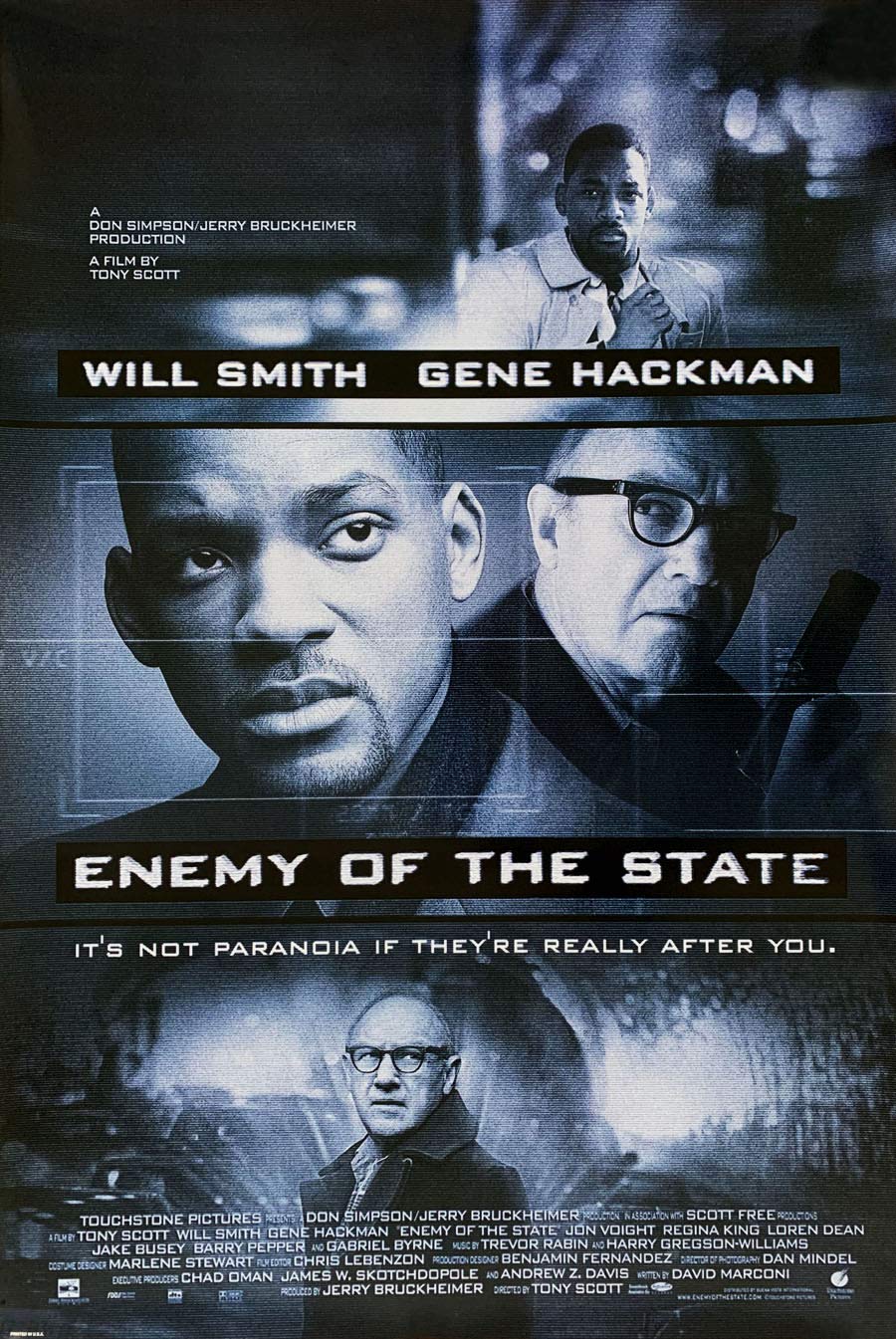
Enemy of the State (1998) Poster
ENEMY OF THE STATE (1998) B–
dir. Tony Scott
A high-gloss surveillance thriller that confuses escalation with suspense. Enemy of the State has energy to burn—crashing through traffic, flinging satellites across the screen—but it keeps layering plot on top of plot until the tension starts to buckle. Will Smith plays Robert Dean, a labor lawyer in D.C. whose life unravels after a chance encounter with a man on the run (Jason Lee). The man slips him a video—secretly, unknowingly—of a congressman’s assassination, captured by a wildlife camera. Within hours, Dean’s bank accounts are frozen, his phone is tapped, his reputation shredded, and every government-issued acronym is chasing him through shopping malls and alleyways. The agency behind the mess is a rogue division of the NSA, led by a glowering Jon Voight. They’ve decided Dean knows too much, even if he doesn’t know what he knows. Enter Gene Hackman as Brill, a surveillance expert with a bunker full of outdated tech and a long-standing grudge. He’s the only one who sees the full picture—or knows how to stay out of it. Hackman gives the movie its backbone. Smith gives it pace. But the story keeps overreaching. The script can’t resist stuffing in more twists, more cutaways, more faceless agents barking orders into headsets. The plot turns aren’t confusing, exactly—they’re just constant. And the length drags. There’s no excuse for a movie like this to cross the two-hour mark, especially when the setup is this clean. It should sprint. Instead, it jogs with weight plates. Still, it holds together more often than it doesn’t. The chase scenes hit. The surveillance gimmicks have style. And the cast keeps a straight face without overselling the tension. It’s bloated, but it stays quick on its feet—and in a film this overstuffed, momentum can make up for a lot, including clarity.
Starring: Will Smith, Gene Hackman, Jon Voight, Lisa Bonet, Regina King, Jake Busey, Barry Pepper, Jason Lee, Tom Sizemore, Jason Robards.
Rated R. Touchstone Pictures. USA. 132 mins.
Enola Holmes (2020) Poster
ENOLA HOLMES (2020) C
dir. Harry Bradbeer
A detective story where the detective barely needs to detect, a coming-of-age tale where the heroine already knows everything, a mystery too polished to be mysterious. Enola Holmes wants to be a riotous reinvention, a fresh spin on the Sherlock legacy, but it coasts on gloss and energy without ever breaking a sweat. Millie Bobby Brown, brimming with confidence, narrates like she’s two steps ahead of the audience—because she is. Her Enola, raised outside Victorian conventions by her eccentric mother (Helena Bonham Carter), has been trained in literature, chess, combat, and rebellion. When that same mother disappears, Enola is left with a cryptic clue and two meddling brothers—Sherlock (Henry Cavill, placid as a lake) and Mycroft (Sam Claflin, twirling his metaphorical mustache). Rather than endure finishing school, she bolts for London to track down her mother—only to be sidetracked by Viscount Tewkesbury (Louis Partridge), a doe-eyed runaway aristocrat fleeing an assassination attempt for reasons the film barely bothers to explain. Tewkesbury’s subplot drags the film away from its central mystery and never justifies the detour. Enola breezes through obstacles, outsmarts clueless adults, and faces so little resistance that adventure turns into routine. Even Sherlock, the world’s greatest detective, seems mildly amused rather than intrigued. Visually, Enola Holmes is lush with crisp costumes and a London that looks freshly unwrapped. Brown throws herself into the role with tireless energy, breaking the fourth wall, grinning through exposition, but the script never lets her struggle. Too effortless to be thrilling, too tidy to be immersive. It’s entertaining in the moment and forgotten just as quickly—a detective film where the greatest mystery is how it manages to feel so weightless.
Starring: Millie Bobby Brown, Henry Cavill, Sam Claflin, Helena Bonham Carter, Louis Partridge, Burn Gorman, Adeel Akhtar, Susie Wokoma, Hattie Morahan.
Rated PG-13. Netflix. UK-USA. 123 mins.
Enron: The Smartest Guys in the Room (2004) Poster
ENRON: THE SMARTEST GUYS IN THE ROOM (2004) A-
dir. Alex Gibney
A documentary that plays like a heist film where the crooks are already rich, and the victims don’t realize they’ve been robbed until it’s too late. Enron: The Smartest Guys in the Room dissects the rise and spectacular implosion of the energy giant, exposing how a group of overpaid con artists turned a failing business into a Wall Street juggernaut—until the numbers stopped adding up, and the whole thing collapsed in 2001, leaving thousands of employees with nothing. Director Alex Gibney doesn’t just recount the scandal—he lets the perpetrators hang themselves. Archival footage, damning interviews, and phone recordings of Enron traders gleefully scheming to drive up California’s energy prices make it clear: this wasn’t corporate mismanagement; it was a willful grift. Jeffrey Skilling, Enron’s CEO, peddled deregulation like a prophet and cashed out before reality set in. Ken Lay, the affable chairman, feigned ignorance while basking in the profits. CFO Andrew Fastow built an empire of shell companies so convoluted even Wall Street couldn’t untangle them. By the time it all collapsed, they had drained millions, while honest shareholders and employees were left holding the bag. Gibney stitches it together with the pacing of a thriller, punctuated by ironic pop songs that skewer Enron’s smug self-image. The film makes clear that this wasn’t just an isolated scandal—Enron was a preview of the 2008 financial crisis, a warning ignored in favor of the next big payout. Not just a documentary but an indictment of a system that rewards greed and punishes trust, The Smartest Guys in the Room is as infuriating as it is riveting. The story might be old, but the lesson remains the same: in corporate America, the biggest crimes rarely come with just consequences.
Rated R. Magnolia Pictures. USA. 109 mins.
Enter the Dragon (1973) Poster
ENTER THE DRAGON (1973) B+
dir. Robert Clouse
Enter the Dragon may be the most iconic martial arts film ever made, but it’s also a Bond film missing a few pages in the script. Lee plays a stoic instructor recruited by British Intelligence to infiltrate a mysterious island tournament hosted by Han (Shih Kien), a one-handed crime lord with a flair for theatrics and a suspiciously well-funded private army. The mission: expose Han’s operation and bring him down from the inside. The method: beat the living hell out of everyone in the room until someone confesses. There’s not much shading to the setup—Lee’s motivation gets a flashback or two, but the characters around him are mostly variations on “cocky,” “troubled,” or “marked for death.” It’s not exactly a film built on psychology. But Enter the Dragon isn’t aiming for nuance. It’s a showcase, and what it showcases is Bruce Lee moving like a weapon you don’t see until it’s already hit you. His fight scenes don’t just impress—they change the temperature of the screen. Still, the emotional stakes are paper-thin. You don’t watch these matches to see who survives; you watch to see how beautifully someone gets flattened. For the unconverted, that might feel like spectacle without tension. But for martial arts cinema, this is gospel—stylized, visceral, precise. The final showdown in a mirrored chamber has been parodied into oblivion, but it still works: pure cinematic geometry.
Starring: Bruce Lee, John Saxon, Jim Kelly, Shih Kien, Ahna Capri.
Rated R. Warner Bros. USA. 102 mins.
Ernest Saves Christmas (1988) Poster
ERNEST SAVES CHRISTMAS (1988) C+
dir. John R. Cherry
Santa Claus (Douglas Seale), face flushed with warmth and wisdom, steps into the modern world and immediately gets mistaken for a lunatic. No alias, no cash, just a firm belief in the kindness of strangers and the certainty that a children’s TV host is the right man to take over Christmas. He’s chosen Joe Carruthers (Oliver Clark) carefully—this is a man who preaches goodwill on local television, a natural successor. But Santa’s timing is off, his approach even worse, and before long, he’s behind bars, his magic sack confiscated, Christmas in limbo. Ernest P. Worrell (Jim Varney), cab driver, true believer, and human wrecking ball, doesn’t need much convincing to step in. He shuttles Santa around Florida, befriends a teenage runaway, Harmony Starr (Noelle Parker), who swipes the sack for herself, and eventually concocts a rescue plan. He moves between disguises—old ladies, snake farmers, the occasional distinguished gentleman—not just for laughs but to keep the film moving when it slows down. The slapstick is relentless, the sincerity full-throttle. Ernest takes the kind of pratfalls that look painful, Santa charms his way out of trouble, and Harmony wrestles with the choice between looking out for herself and believing in something bigger. The movie fumbles the pacing, letting stretches of dead air creep in, but Varney keeps the thing afloat through sheer force of will. Santa gets out, the sack is returned, Joe steps up, and somehow, Christmas still comes together. The film runs on goodwill, dipping in and out of slapstick, with Varney treating ridiculousness as sacred duty. For those raised on Ernest, it’s another round of the familiar, the kind of comedy that survives on a certain wavelength of childhood. For everyone else, it’s either cheerfully ridiculous or the longest 95 minutes of the season.
Starring: Jim Varney, Douglas Seale, Oliver Clark, Noelle Parker, Gailard Sartain, Billie Bird, Bill Byrge, Robert Lesser, Patty Maloney, Buddy Douglas.
Rated PG. Buena Vista Pictures Distribution. USA. 95 mins.
Escape from Alcatraz (1979) Poster
ESCAPE FROM ALCATRAZ (1979) B+
dir. Don Siegel
Escape from Alcatraz doesn’t settle for history. It wants tension, humor, pulp—something more satisfying than a dramatized reenactment. The film opens with a thunderclap right on cue: a guard sneers “Welcome to Alcatraz,” and lightning splits the sky. (A meteorological improbability in San Francisco, sure—but nature occasionally makes exceptions for men entering new levels of hell.) Clint Eastwood plays Frank Morris, the kind of inmate who scans a room and finds its weakness before saying a word. He doesn’t posture, he calculates. And he makes it clear from the jump that he’s not taking the long view on confinement. When an oafish prisoner makes a move in the showers, Morris drops him without raising his voice. The prison itself—this fog-wrapped rock in the bay—is run like a kingdom of petty rules and silent punishments. Filmed on the real Alcatraz, it feels stripped of illusion—cold, narrow, echoing. The warden (Patrick McGoohan, in a bit of delicious casting) rules with clipped vowels and zero irony. McGoohan, of course, was once The Prisoner himself. Now he’s the system. Morris pulls together a quiet team: a soft-spoken lifer with a painter’s hand, and two brothers on work duty with just enough patience to scrape through steel. Their tools are makeshift—clippers, spoons, dummy heads—but their precision is unnerving. Vents are hollowed, shadows mapped, every detail rehearsed. And when the break comes, it doesn’t shout. No swell of music, no back-patting heroics—just silence, grit, and the sound of water somewhere ahead.
Starring: Clint Eastwood, Patrick McGoohan, Roberts Blossom, Fred Ward, Jack Thibeau, Larry Hankin, Paul Benjamin.
Rated PG. Paramount Pictures. USA. 112 mins.
Escape from the Planet of the Apes (1971) Poster
ESCAPE FROM THE PLANET OF THE APES (1971) C-
dir. Don Taylor
Not that the first two Planet of the Apes films were models of restraint, but Escape from the Planet of the Apes pushes the series into full camp mode. This time, three apes—Cornelius, Zira, and a third who barely registers—escape the nuclear cataclysm of the last film by launching Taylor’s old spaceship back through the same time warp that brought him there. They land in 1970s Los Angeles, step out in full regalia, and are quickly apprehended by baffled military men. Then the film settles into its real premise: what if the apes became celebrities? At first, it plays as light satire. The apes charm government panels, delight the press, and receive VIP treatment at the zoo. For a while, it’s all slightly surreal fun. Zira gets a makeover. Cornelius gives interviews. The score leans into playful jazz. There are scenes that wouldn’t feel out of place in Love, American Style, if Love, American Style featured evolved chimps drinking sherry and cracking wise. Some of the dialogue seems lifted directly from sitcom table reads. But the novelty wears off fast. The film is mostly conversation—humans expressing disbelief that apes dissect humans in their timeline, apes politely explaining the irony. Any sense of tension is buried under repetition. There’s little forward momentum, and the longer it stays in this mode, the more the concept starts to feel like a sketch stretched thin. Eventually, the government grows suspicious and the tone shifts. The final act takes place aboard an oil tanker and wants to be suspenseful, but lands somewhere closer to grim and arbitrary. It's a bleak ending, but not an especially effective one. The bigger issue is that once you accept the premise—intelligent apes arriving in a spaceship from the future—the reactions of society should feel sharper, or at least more believable. Instead, we get bureaucrats, one-note scientists, and a series of TV gags that might have worked better if the film had picked a clearer tone. It’s not without its curiosities, but mostly, Escape plays like a placeholder—caught between satire, sci-fi, and studio obligation, without fully committing to any of them.
Starring: Roddy McDowall, Kim Hunter, Bradford Dillman, Natalie Trundy, Eric Braeden, William Windom, Sal Mineo, Albert Salmi, Jason Evers.
Rated G. 20th Century Fox. USA. 98 mins.
Eternal Sunshine of the Spotless Mind (2004) Poster
ETERNAL SUNSHINE OF THE SPOTLESS MIND (2004) A
dir. Michel Gondry
Charlie Kaufman had already pulled off one high-wire act with Being John Malkovich. With Eternal Sunshine of the Spotless Mind, he does it again—only this time, the wire is invisible and strung across the folds of a collapsing memory. Jim Carrey plays Joel, a man so undone by the end of his relationship with Clementine (Kate Winslet) that he hires a boutique memory-erasure service to wipe her completely from his mind. Halfway through the procedure, he changes his mind—but he’s already unconscious, and the process is underway. What follows is a panicked retreat through Joel’s subconscious as he relives their relationship in reverse, watching it disappear even as he tries to hold on. Desperate, he starts dragging Clementine into memories where she doesn’t belong—like a childhood bath, where she suddenly appears beside him in the kitchen sink. It’s surreal, funny, and oddly affecting, like much of the film. The structure is elliptical, but the emotions are clear. Michel Gondry directs with a scrappy surrealism: sets fold in on themselves, time stutters, faces flicker. Carrey, known for his rubber-faced mania, dials it down without losing his edge—he’s still funny, but there’s a kind of quiet panic behind the jokes. Winslet, meanwhile, is volatile and unsentimental, playing Clementine as the sort of person who charms you instantly and then changes shape mid-conversation. For all its visual trickery, the film’s greatest strength is its emotional precision. It’s a story about forgetting that becomes, gradually, a case for remembering—even the parts you thought you could live without. Few movies about memory make the case so convincingly that pain is worth keeping.
Starring: Jim Carrey, Kate Winslet, Elijah Wood, Kirsten Dunst, Mark Ruffalo, Tom Wilkinson.
Rated R. Focus Features. USA. 108 min.
Entertainment (2015) Poster
ENTERTAINMENT (2015) B
dir. Rick Alverson
Neil Hamburger—the walking bile stain of stand-up comedy—shuffles through this film like a man who lost the war and was never told it ended. Played by Gregg Turkington, he’s a warped creation: tuxedo permanently rumpled, hair clinging to his skull like it’s afraid of falling off, voice bubbling with phlegm and disdain. His act is a series of lurching, grimace-inducing anti-jokes, each one sounding like it crawled out of a crawlspace behind a dive bar in 1993. (A relatively tame example: “What’s the difference between Courtney Love and the American flag? It would be wrong to urinate on the American flag.”) In real life, his audience knows what they’ve signed up for. But in Entertainment, he’s simply “The Comedian”—a traveling act who stumbles from one desolate gig to the next, blindsiding crowds who think they’ve paid for laughter and get corrosion instead. When they don’t laugh, he chastises them. He reminds them he’s traveled miles for this. He singles people out—often women—with venom that seems less improvised than exhumed from a pit. One particularly unamused woman gets called a whore in a way so grotesque it stops the room cold. Behind all this bile is a man cracking under the knowledge that he’s failed. He’s not deluded—he knows he’s terrible. That’s what makes it unbearable. This is Alan Partridge drained of ego, of bluster, of denial. A dry rot of a road movie, where every voicemail to an estranged daughter goes unanswered, and every stage feels like a punishment. The jokes are bad. The silence is worse. The film is hypnotic in its bleakness—a slow funeral march for a performer who suspects there’s nothing left to perform.
Starring: Gregg Turkington, Tye Sheridan, John C. Reilly, Lotte Verbeek, Michael Cera, Amy Seimetz.
Not Rated. Magnolia Pictures. USA. 110 mins.
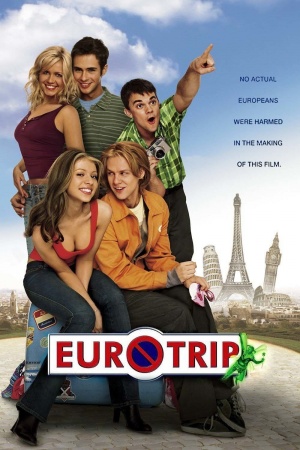
EuroTrip (2004) Poster
EUROTRIP (2004) B+
dir. Jeff Schaffer
Sex comedies tend to be either overcooked or underseasoned, but EuroTrip gets the recipe right. It refuses to hesitate—every joke is delivered with absolute conviction, no matter how ridiculous, and by the time the punchlines hit, the sheer commitment makes them twice as funny. A mime gets heckled. The setup seems like a throwaway, then it escalates, then it escalates more. Suddenly, it’s the funniest thing in the room. And that’s just an aside. Scott (Scott Mechlowicz), a recent high school graduate, assumes his German pen pal, Meike (Jessica Boehrs), is a guy named Mike. One poorly translated insult later, she cuts off contact. Rather than let it go, Scott recruits his best friend Cooper (Jacob Pitts), a walking impulse; his sharp-tongued friend Jenny (Michelle Trachtenberg); and her twin brother Jamie (Travis Wester), a sightseeing obsessive who treats every detour like a dissertation. Their destination: Germany. They don’t exactly take the scenic route. In London, they fall in with a gang of rowdy Manchester United hooligans (led by a magnificently unhinged Vinnie Jones), who drive them across the English Channel with the subtlety of a battering ram. In France, they hit a nude beach expecting sun-draped models but find only a sea of other clueless tourists (all naked) who had the same idea. In Eastern Europe, they discover their entire trip budget is worth a small fortune, leading to a champagne-soaked detour. And somehow, against all reason, they end up in Vatican City, where one of them is accidentally elected Pope. The movie doesn’t just work—it barrels forward. The jokes stack, the pacing never falters, and even the broadest gags are delivered with an unexpected sharpness. A deliriously fun, surprisingly well-timed comedy about Americans abroad, way out of their depth but fully committed to the plunge.
Starring: Scott Mechlowicz, Jacob Pitts, Kristin Kreuk, Cathy Meils, Nial Iskhakov, Michelle Trachtenberg, Travis Wester, Matt Damon, J. Adams, Christopher Baird, Nicolas J.M. Cloutman.
Rated R. DreamWorks Pictures. USA. 92 mins.
Eurovision Song Contest: The Story of Fire Saga (2020) Poster
EUROVISION SONG CONTEST: THE STORY OF FIRE SAGA
(2020) C
dir. David Dobkin
An Icelandic child watches ABBA take Eurovision by storm in 1974 and decides his destiny is sealed: he will win the contest. Decades later, that child has become Lars (Will Ferrell), still convinced of his future glory, still rehearsing elaborate performances in his father’s basement. His best friend, Sigrit (Rachel McAdams), supports the dream—or at least doesn’t object to being swept along. Through a string of misfortunes and sheer dumb luck, they find themselves representing Iceland at the actual Eurovision Song Contest. For a while, the film embraces the madness. The opening act fires off jokes with confidence: bombastic Euro-pop anthems, Ferrell at full throttle, McAdams throwing herself into every ridiculous moment. Eurovision’s excess is lovingly skewered, with a parade of preening, self-serious superstars and songs so exaggerated they loop back around to catchy. But then something shifts. The film loses its bite. Suddenly, it wants to be earnest. An underdog story emerges, sentimental moments pile up, and a half-formed romantic subplot drifts into focus, as if someone in the writer’s room worried the film needed more heart. A ghost appears, says a few words, then vanishes—less a joke than an abandoned punchline. Ferrell does his Ferrell thing, McAdams proves that she can elevate anything, and the song performances at least keep the energy from flatlining. But for a film centered on one of the most over-the-top spectacles in existence, it pulls back just when it should be going completely off the rails.
Starring: Will Ferrell, Rachel McAdams, Melissanthi Mahut, Mikael Persbrandt, Ólafur Darri Ólafsson, Graham Norton, Demi Lovato, Pierce Brosnan, Elín Petersdóttir.
Rated PG-13. Netflix. USA. 123 mins.
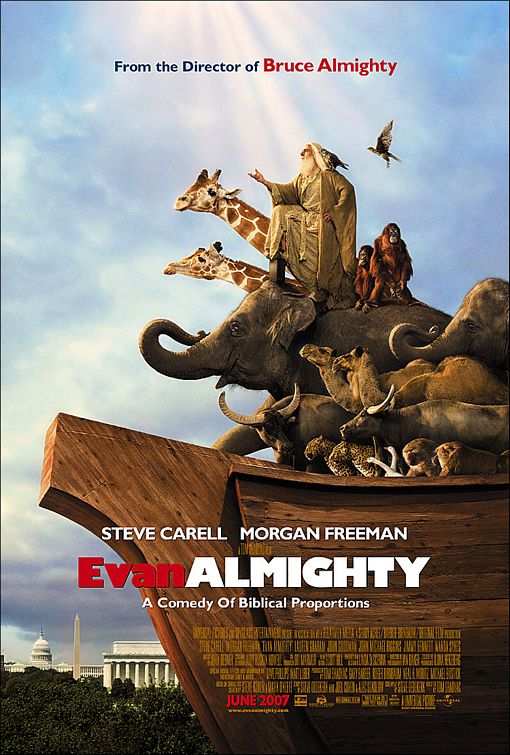
Evan Almighty (2007) Poster
EVAN ALMIGHTY (2007) C–
dir. Tom Shadyac
A sequel in name, a spinoff in spirit. Evan Almighty follows Bruce Almighty (2003), where Steve Carell—then a supporting character playing a pompous news anchor—stole his scenes with such precision they gave him his own movie. It’s a promotion he earns. The movie, unfortunately, doesn’t return the favor. Now a newly elected congressman, Evan Baxter (Carell) has relocated to a pristine Virginia suburb, where he prays for the chance to “change the world.” The answer arrives in Old Testament form: build an ark. Animals begin shadowing him in pairs, his beard grows back the second he shaves it, and his wardrobe gradually swaps out suits for robes. (The film never explains why Noah cosplay is necessary—other than it lets the writers swipe gags from The Santa Clause.) Evan doesn’t so much receive a calling as get backed into one by a series of divine stunts. The film aims for a comedy of faith, in the Oh, God! tradition—ordinary man, extraordinary message, internal crisis, external disbelief—but skips the hard part. Evan isn’t asked to believe; he’s cornered. He’s not tested so much as nudged, repeatedly, by special effects. It’s one thing to build an ark because you believe God told you to. It’s another when animals line up two-by-two on your lawn. At that point, the world hasn’t gone mad—it’s just following instructions. The story turns into a high-budget children’s book. The only version of this that might have worked is one where Evan has to act without proof—trust without guarantees—and risk humiliation based on nothing but conviction. But instead, the movie lunges for the nearest poop joke like it’s the punchline that’ll save the scene. Carell’s a comedy magician—he threads sincerity through the exasperation just enough to keep Evan from tipping into full cartoon, and his timing is so precise he can pull a laugh out of a line that doesn’t even want to be funny. But even magicians need something to work with, and here all he gets to do is pull rabbits out of a paper bag. What starts as a story about belief gets smothered in broad slapstick and glossy effects, as if the filmmakers panicked at the first sign of ambiguity. For a movie about trusting the unseen, it’s strangely desperate to show you everything—as if the one thing it doesn’t really believe in is the audience.
Starring: Steve Carell, Morgan Freeman, Lauren Graham, John Goodman, Jonah Hill, Wanda Sykes, John Michael Higgins, Jimmy Bennett.
Rated PG. Universal Pictures. USA. 96 mins.
Everest (2015) Poster
EVEREST (2015) B
dir. Baltasar Kormákur
Everest isn’t great cinema, but it operates as a brisk, high-altitude docudrama—concerned less with character arcs than with cold, hard logistics. It follows a group of climbers aiming to summit the world’s tallest peak, only to find themselves trapped in a brutal, fast-moving storm. Their motivations are stated plainly—“because it’s there,” and so forth—but not deeply explored. This is not a film that peers into its characters so much as lists them. There’s effort, at least, to suggest lives off the mountain: wives back home (including Keira Knightley and Robin Wright) wringing hands and waiting by satellite phone. But the people onscreen are mostly sketches, lightly shaded and quickly set into motion. What the film does capture—quietly, methodically, and with almost scientific interest—is the mechanics of the climb itself. Oxygen tanks. Ladder crossings. Sherpas risking their lives to haul down stranded tourists. The medical tent at base camp. The small, punishing details are often more gripping than the people enduring them. The mountain doesn’t just tower—it haunts. Its ridges are etched like bone, its clouds stretched thin like breath on glass. The people remain vague impressions, but the mission is stark and exacting. I didn’t need depth to stay engaged; just watching them climb was enough to make my lungs tighten. The margin for error isn’t just slim—it’s spiteful.
Starring: Jason Clarke, Josh Brolin, John Hawkes, Jake Gyllenhaal, Keira Knightley, Emily Watson, Robin Wright, Sam Worthington, Michael Kelly.
Rated PG-13. Universal Pictures. USA-UK-Iceland. 121 mins.
Every Day’s a Holiday (1937) Poster
EVERY DAY’S A HOLIDAY (1937) B
dir. A. Edward Sutherland
Mae West sells the Brooklyn Bridge, gets caught, and does what any self-respecting con artist would do—reinvents herself as a French chanteuse named Fifi. That’s the setup, but the setup hardly matters. The plot is there to keep things moving, but what matters is West, tossing off one-liners with the ease of someone who’s never lost a game of verbal fencing. She struts through 1890s New York with the self-assurance of a woman who knows the town is only as corrupt as its men and that all of them are pushovers in the right hands. The breezy pace keeps things light, the jokes land where they need to, and West plays to her strengths, batting her eyes while fleecing every chump in sight. It’s a pleasure to watch her charm and swindle in equal measure, proving once again that the best version of a Mae West movie is the one where she’s completely in control. Edmund Lowe plays a police chief with an eye on both crime and West, though he’s only marginally more successful at one than the other. Charles Butterworth and Walter Catlett pop in for comic relief, as if the film needed more. Then there’s Louis Armstrong, who doesn’t just appear—he owns his moment. Blasting through a New Orleans-style jazz parade, trumpet blazing, he injects the film with a jolt of rhythm and energy. It’s a number that doesn’t need justification, only appreciation. Not one of West’s most famous vehicles, but surely among her finer ones. The wit is sharp, the cons are clever, and the film understands what every good Mae West movie does: the best seat in the house is wherever she’s standing.
Starring: Mae West, Edmund Lowe, Charles Butterworth, Charles Winninger, Walter Catlett, Lloyd Nolan, Louis Armstrong, George Rector.
Not Rated. Paramount Pictures. USA. 80 mins.
Everything Everywhere All at Once (2022) Poster
EVERYTHING EVERYWHERE ALL AT ONCE (2022) A-
dir. Daniel Kwan, Daniel Scheinert
A sci-fi spectacle, an action comedy, a metaphysical head trip, a family drama—sometimes all at once, sometimes one at a time, sometimes folded together like a cosmic accordion and played at full blast. Everything Everywhere All at Once doesn’t just juggle genres; it arranges them into their own strange, internal logic and follows through with total conviction. Michelle Yeoh, exasperated and magnificent, plays Evelyn Wang, a laundromat owner whose day-to-day grind takes a sharp turn when her husband (Ke Huy Quan, all soft edges until he isn’t) informs her, via an alternate version of himself, that she alone must save the multiverse. That’s the assignment. Reality obliges by splintering into an explosion of worlds, each following its own set of rules. A husband who fights like a Hong Kong action star. A daughter (Stephanie Hsu) who bends existence to her will. A universe where fingers droop like rubber sausages. Another where everyone is a rock. It should feel like nonsense, but the film builds its own absurd logic and sticks to it. Power is unlocked through improbable acts—one character slices paper between his fingers like a monk sharpening his mind, another achieves peak ability through an act of inspiration that should not be spoiled for the uninitiated. It all makes sense, at least if you let yourself go along for the ride. The movie never stumbles over its own ambition. The editing—whip-fast, kaleidoscopic—tosses out martial arts, heartfelt reconciliations, and philosophical musings with the precision of a card shark, dealing each one exactly where it needs to go. Jamie Lee Curtis, brilliant in a way no one was prepared for, plays an IRS agent built like a filing cabinet that fights back. She stomps, sneers, and throws herself into physical comedy with such enthusiasm that it feels like a second career was hiding inside her all along. Ridiculous and unexpectedly moving, Everything Everywhere All at Once bends genres, emotions, and reality itself into a controlled explosion of creativity. That a movie featuring googly-eyed rocks and fanny-pack kung fu won Best Picture is either a sign of the times or a small cinematic miracle.
Starring: Michelle Yeoh, Stephanie Hsu, Ke Huy Quan, James Hong, Jamie Lee Curtis, Jenny Slate, Harry Shum Jr., Tallie Medel.
Rated R. A24. USA. 139 mins.
Everything Is Illuminated (2005) Poster
EVERYTHING IS ILLUMINATED (2005) B+
dir. Liev Schreiber
Jonathan Safran Foer (Elijah Wood) collects the past like other people collect postcards, except his souvenirs come vacuum-sealed in Ziploc bags. A handful of soil, a pair of old spectacles, someone’s dentures—each relic stuffed into his pockets as if memory itself might slip through the cracks. He lands in Ukraine, stiff-backed and owl-eyed, on a mission to find the shtetl where his grandfather lived before history intervened. His guides: Alex (Eugene Hutz), a self-proclaimed ladies’ man with a thick accent and an even thicker layer of misplaced confidence, and his grandfather (Boris Leskin), a tight-lipped curmudgeon who insists he’s blind, though he still manages to drive the car. They rattle across the countryside in a Trabant, the trip at first little more than a series of cultural misfires—Alex translating in a linguistic gymnastics routine that would make an English professor faint, his grandfather grumbling through cigarette smoke, Jonathan blinking behind oversized lenses. Then the landscape shifts. The laughter thins. The village they seek isn’t there, but its absence speaks louder than any discovery. History isn’t a relic in a plastic bag; it’s something still breathing under the surface, waiting to be acknowledged. Schreiber directs with a light touch, letting humor and tragedy collide without forcing either. The jokes hit early, Alex’s fractured English practically an art form, but the film deepens without losing its rhythm. Hutz, a punk rocker moonlighting as an actor, gives Alex a restless, unpredictable energy, but it’s Leskin who leaves the deepest mark, his silence more revealing than any monologue. And Wood, awkwardly dignified, watches it all unfold like a man realizing, too late, that the past isn’t something you find—it finds you.
Starring: Elijah Wood, Eugene Hutz, Boris Leskin, Laryssa Lauret.
Rated PG-13. Warner Independent Pictures. USA. 104 mins.
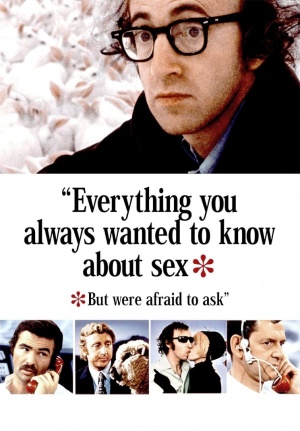
Everything You Always Wanted to Know About Sex* (*But Were Afraid to Ask) (1973) Poster
EVERYTHING YOU ALWAYS WANTED TO KNOW ABOUT SEX* (*BUT WERE AFRAID TO ASK)
(1973) B
dir. Woody Allen
Woody Allen in grab-bag mode, tossing jokes, gags, and fully committed performances at the screen like he’s running a demented variety show. Seven sketches, some beautifully ridiculous, some just ridiculous, all built around outdated sex-ed questions that he turns into comic hypotheticals. Science, history, horror, monster movies, and Italian art-house all get thrown into the mix, and at its best, it plays like a mad scientist stitching together classic comedy with whatever stray wires were lying around. What Happens During Ejaculation? is the knockout—Tony Randall and Burt Reynolds command a high-tech control center inside a man’s brain, monitoring vitals as he moves in for a seduction. Somewhere in the lower decks, a squadron of nervous sperm, led by Allen himself, prepares for launch with all the enthusiasm of first-time skydivers who just discovered their parachutes might not work. It’s hysterically intricate, the kind of idea that seems too simple until you realize how much thought went into making it play like clockwork. Gene Wilder plays a doctor who falls hopelessly in love with a sheep, a slow descent into madness delivered with such sincerity that the entire thing somehow becomes even funnier. And then there’s Are the Findings of Doctors and Clinics Who Do Sexual Research and Experiments Accurate?, where a rampaging, car-sized breast terrorizes the countryside like something out of Attack of the 50-Foot Woman. Not all the sketches click, and some float by like rejected Monty Python skits, but when they work, they feel like classic Allen: brilliantly constructed and shamelessly juvenile. It’s a mixed bag, but at its best, it plays like a late-night comedy show beamed in from another planet.
Starring: Woody Allen, John Carradine, Lou Jacobi, Louise Lasser, Anthony Quayle, Tony Randall, Lynn Redgrave, Burt Reynolds, Gene Wilder, Jack Barry, Elaine Giftos.
Rated R. United Artists. USA. 88 mins.
Evolution (2001) Poster
EVOLUTION (2001) D+
dir. Ivan Reitman
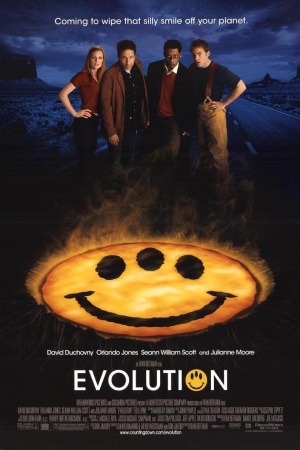
A meteor crashes in the Arizona desert, and within weeks, the impact site becomes a breeding ground for single-celled extraterrestrial life evolving at a pace that would make Darwin‘s head spin. The organisms, multiplying and mutating at an exponential rate, present a clear existential threat to humanity. But never fear: two community college professors (David Duchovny and Orlando Jones) are on the case, somehow convinced that their authority over this discovery trumps national security. Julianne Moore joins the mix as a CDC scientist whose clumsiness is apparently meant to be a defining personality trait, and Seann William Scott plays a wannabe firefighter whose main qualification is his enthusiasm. The U.S. military inevitably steps in, though their approach is more testosterone than tactical. The script flails in every direction, desperately grasping for humor but mostly coming up empty. Duchovny and Jones share an easy rapport, but their quippy back-and-forth often leans on dated racial humor that lands with all the grace of a pratfall on concrete. The film tries to build tension as the creatures grow increasingly complex—fanged slugs, reptilian brutes, airborne monstrosities—but then it undercuts itself with cartoonish gags, as if it’s afraid of committing to even the most basic sci-fi stakes. The climax is a last-minute revelation that selenium, conveniently found in mass-market dandruff shampoo, is lethal to the alien biology. A truly ridiculous solution, though the film at least tries to justify it with convincingly described pseudo-science. Evolution wants to be an offbeat mix of sci-fi spectacle and screwball irreverence, but it keeps tripping over its own instincts. The special effects do their job, the cast is game, but the execution never rises beyond half-hearted.
Starring: David Duchovny, Julianne Moore, Orlando Jones, Seann William Scott, Ted Levine, Ethan Suplee, Michael Ray Bower, Pat Kilbane, Ty Burrell, Dan Aykroyd, Katherine Towne, Gregory Itzin.
Rated PG-13. DreamWorks Pictures, Columbia Pictures. USA. 102 mins.
Excalibur (1981) Poster
EXCALIBUR (1981) A-
dir. John Boorman
A medieval fever breaking into visions, all drenched in mist, mud, and the eerie glow of steel catching the light. Excalibur doesn’t just recount the Arthurian legend; it erupts with it, moving like a procession of holy relics through battlefields and enchanted forests. John Boorman doesn’t do restraint. He crafts a world where knights shine like celestial warriors, swords are not just weapons but divine instruments, and destiny isn’t whispered—it is screamed by a sorcerer wrapped in silver. The forests pulse with magic, the battles—mud-slicked, bloody, visceral—feel closer to some long-lost nightmare than a Hollywood epic. Nicol Williamson’s Merlin, draped in silver, isn’t just a sorcerer but a trickster, a prophet, a man who sees everything and still laughs at the folly of kings. Helen Mirren’s Morgana slinks through the film, a creature of calculated menace, all seduction and quiet wrath. The film doesn’t just revel in the legend; it sinks into it, drenched in the grandeur and the grotesque. It isn’t flawless. Some sequences stretch longer than needed, and the themes—honor, betrayal, the burden of kingship—aren’t much deeper than any high school curriculum. But few films have ever conjured Arthurian legend with this level of raw, mythic force. The sweeping operatic score (Wagner, Orff) crashes down like the gods themselves are conducting, and the sheer visual spectacle is so immersive that even its flaws feel like part of the legend. Excalibur isn’t just one of the best King Arthur films—it’s one of the only ones that truly believes in its own magic.
Starring: Nigel Terry, Nicol Williamson, Nicholas Clay, Helen Mirren, Cherie Lunghi, Paul Geoffrey, Robert Addie, Gabriel Byrne, Liam Neeson, Corin Redgrave, Keith Buckley.
Rated R. Warner Bros. USA. 141 mins.
Exorcist: The Beginning (2004) Poster
EXORCIST: THE BEGINNING (2004) C-
dir. Renny Harlin
A film with an idea—an ancient Christian church buried beneath African sands, impossibly predating the religion itself—but no conviction. Exorcist: The Beginning sets out to explore the origins of Father Merrin’s battle with evil, casting Stellan Skarsgård as a younger, less world-weary version of the priest who once faced down Pazuzu. He’s called to the site to investigate, but the real question isn’t archaeological—it’s whether this film can summon anything resembling fear. It cannot. Merrin moves through the film like he’s solving an equation that keeps changing variables—pragmatic, burdened, but never quite unnerved. Skarsgård commits, but the script gives him little beyond recycled exorcism lore, stitched together with loud noises and dimly lit corridors. Some images linger—a cavernous church rising out of the desert like a misplaced monument, a village where violence simmers just beneath the surface—but atmosphere never develops, tension never builds. The film is too busy throwing gore at the screen, mistaking volume for impact, excess for terror. A horror film about an unearthed evil should be suffocating, should weigh on you, should pull tighter with every passing scene. Exorcist: The Beginning does none of this. It cues up the scares, slathers on the effects, and yet, somehow, the only thing truly buried here is suspense.
Starring: Stellan Skarsgård, Izabella Scorupco, James D'Arcy, Ralph Brown, Julian Wadham, Andrew French, Ben Cross.
Rated R. Warner Bros. Pictures. USA. 114 mins.
The ExTerminators (2009) Poster
THE EXTERMINATORS (2009) C
dir. John Inwood
Heather Graham plays Alex, an IRS agent whose day begins with a layoff and ends with her boyfriend tangled up with someone else on the couch. After punching a stranger in a store—a man who fully deserved it—she’s diverted to anger management therapy. There she meets Stella (Jennifer Coolidge), who runs a pest control business and seems just as qualified to fumigate men, and Nikki (Amber Heard), a quietly homicidal dental tech with the affect of a cult leader’s receptionist. They bond. One of their classmates’ abusive husbands is nudged off the road and bursts into flames. Alex is rattled. The others are inspired. Before long, Stella and Nikki are freelancing: removing problem boyfriends for a small circle of grateful clients. Alex wavers, gets involved, and starts dating a police officer (Matthew Settle), who is, of course, investigating the murders. The film sets this all up and then dithers. Scenes loop, punchlines sag, and the premise starts to feel like something the movie’s afraid of. Coolidge has presence but feels stuck in second gear. Heard floats above it all, occasionally remembering to look dangerous. Graham plays Alex as someone who hasn’t quite agreed to be in the film she’s starring in. The momentum peters out halfway through, and the back half is spent tying things off rather than escalating them. The kills go quiet. The pacing goes flatter. By the end, the movie has talked itself down from rage to mild regret. For a film about women taking justice into their own hands, The ExTerminators spends an awful lot of time tiptoeing around it. What should have been a Deathwish for jilted women instead gets a polite offboarding.
Starring: Heather Graham, Jennifer Coolidge, Amber Heard, Matthew Settle, Joey Lauren Adams, Sam Lloyd.
Rated R. Cinedigm. USA. 90 mins.
Extremely Wicked, Shockingly Evil, and Vile (2019) Poster
EXTREMELY WICKED, SHOCKINGLY EVIL, AND VILE
(2019) B
dir. Joe Berlinger
A man so arrogant he thought he could outtalk his way out of murder, and for a while, he almost did. Extremely Wicked, Shockingly Evil and Vile doesn’t reconstruct Ted Bundy’s crimes—it reconstructs his illusion. Zac Efron, unnervingly well-cast, plays him not as a monster lurking in shadows but as the bright, charming, crowd-working showman he really was. The film unfolds through the eyes of his long-term girlfriend Liz Kendall (Lily Collins), who believed his innocence even as the world, piece by piece, exposed the truth. For most of its runtime, the film operates inside that delusion, keeping the viewer locked in her perspective, waiting for the mask to slip. Berlinger directs with a slick confidence, capturing the media frenzy that allowed Bundy to thrive in the public imagination. The film doesn’t revel in violence—there are no dramatized killings, no horror-movie recreations of his crimes—but the weight of them hangs in the air. Efron plays Bundy as a man so intoxicated with his own intelligence that he can’t resist grandstanding. He represents himself at trial, baits the press, and escapes jail twice, but the same confidence that let him manipulate everyone is exactly what leads to his downfall. The film hints at this contradiction more than it truly digs into it, and by the time we see flashes of the real Bundy, we already know the ending. John Malkovich, dry and unamused as the judge presiding over the trial, delivers the film’s title line like a man handing down a verdict to someone who still thinks he can talk his way out of it. It’s a compelling, well-executed take on Bundy’s story, though not a particularly deep one. The psychology of his crimes is left largely unexplored, and his victims, while acknowledged, remain at the edges. The film captures how Bundy wanted to be seen, and Efron sells it completely—but what still lingers is everything it leaves unspoken.
Starring: Zac Efron, Lily Collins, John Malkovich, Kaya Scodelario, Jeffrey Donovan, Angela Sarafyan, Jim Parsons, Dylan Baker, James Hetfield, Haley Joel Osment.
Rated R. Netflix. USA. 108 mins.
Eye of the Needle (1981) Poster
EYE OF THE NEEDLE (1981) B+
dir. Richard Marquand
A war thriller with ice in its veins, moving with the cold efficiency of its protagonist. Donald Sutherland plays Faber, a German intelligence agent who operates with a stillness that’s almost hypnotic, a man who leaves no loose ends and no witnesses. He moves through England unnoticed, collecting intelligence, eliminating obstacles with a precise flick of his stiletto dagger, his quiet ruthlessness a skill honed to perfection. Then he stumbles upon something that could change the war—proof that the Allies’ D-Day deception is exactly that. The message must reach Germany. The problem is he’s stranded on a remote Scottish island with no way off. The island is a bleak and windswept prison and home to Lucy (Kate Nelligan), a woman whose life stalled when her husband (Christopher Cazenove) was paralyzed in an accident. She exists in a kind of exile—dutiful, unfulfilled, desperate for something she can’t define. Faber, ever the shape-shifter, plays the role required of him. She sees escape; he sees opportunity. The seduction is slow, deliberate, and when Lucy learns what he really is, it turns violent. The romance dissolves into a brutal survival game, and suddenly, the war is no longer across the channel—it’s inside her home. Sutherland’s Faber isn’t a villain who rants or schemes—his presence alone is a threat, his intelligence and self-control more terrifying than any act of violence. Nelligan, in a role that could have been passive, makes Lucy’s awakening raw and urgent, her shift from lonely wife to fighter more gripping than any military maneuver. The film doesn’t rush. The tension coils tighter with every scene, and by the time the last act hits, it’s operating at a slow, merciless burn. No gimmicks. No indulgences. Just a thriller with a knife-sharp edge, honed to do exactly what it needs to do.
Starring: Donald Sutherland, Kate Nelligan, Ian Bannen, Christopher Cazenove, Stephen MacKenna, Philip Martin Brown, George Belbin, Faith Brook, Barbara Graley, Arthur Lovegrove.
Rated R. United Artists. UK. 112 mins.
Eyes Behind the Stars (1978) Poster
EYES BEHIND THE STARS (1978) C–
dir. Mario Gariazzo
Italian UFO yarn that confuses hushed chatter about flying saucers for actual science fiction. If you’re expecting revelations from the stars, lower your sights—it’s mostly stiff dialogue and blank stares, broken up by the occasional fish-eye lens drifting through a half-lit room while a synthesizer bubbles like an aquarium pump on the fritz. Now and then, you get a peek at an alien in a shiny jumpsuit and black helmet—oddly static, never quite eerie, just there because the movie promised one. The film starts with a photographer and a model snapping pictures in the woods. They accidentally catch something hovering where nothing should hover. Before they can hustle the proof to the tabloids, they’re stalked, relieved of their film, and snatched by a chrome visitor. After that, a reporter (Robert Hoffmann) tries to piece it together, but a shadowy bunch called The Silencers do their best to keep him—and us—confused and in the dark. On paper, this all should be pulp fun. In reality, it’s mostly people ambling through offices, muttering lines about cover-ups, with cheap synth noise sprinkled in to remind you this is supposed to be science fiction. A few moments hit that sweet spot of accidental weirdness—enough to tickle the part of my brain that hoards Z-grade oddities—but not nearly enough to justify the slog. If you collect bottom-shelf UFO curiosities, file this next to the lint at the back of your VHS cabinet. Everyone else can skip it without a second thought.
Starring: Robert Hoffmann, Nathalie Delon, Martin Balsam, Sherry Buchanan, Victor Valente, Sergio Rossi, Mario Novelli, Carlo Hintermann, Franco Garofalo.
Not Rated. Variety Film. Italy. 90 mins.
Load Next Page