Film Buff Musings

by Michael Lawrence

List of "F" Movies


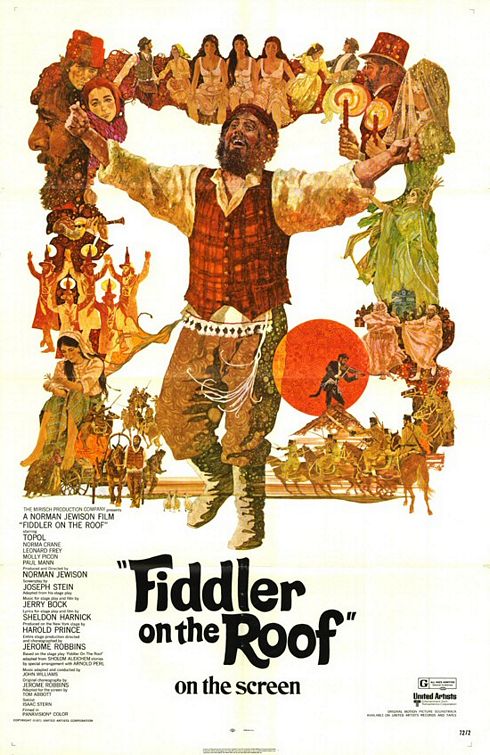
Fiddler on the Roof (1971) Poster
FIDDLER ON THE ROOF (1971) A
dir. Norman Jewison
If this isn’t a perfect musical, then the category may need to be redefined. It has scale, humor, heartbreak, and songs that arrive not with pomp but with the inevitability of folk wisdom. Topol, in the role of Tevye, is a revelation—not just because he sings and dances with effortless verve, but because he filters every comic beat through a weathered kind of warmth. There’s a slight squint in his gaze, a shrug in his voice (the expressive kind, not the banned metaphorical one), and the sense that fantasy is the only insulation he’s got left against a world that keeps rewriting the rules. It would have been a treat to see Zero Mostel reprise the role he originated, but Topol more than earns his place here. He grounds the performance in something weary and sly, and the humor becomes less about punchlines than survival instincts. His scenes with his daughters are the beating heart of the film—especially with Tzeitel (Rosalind Harris), whose insistence on marrying for love nudges the entire narrative into motion. Tevye’s reaction, both proud and bewildered, is summed up in one of the film’s best lines: “They’re so happy, they don’t know how miserable they are.” The songs are astonishing—richly melodic, seamlessly integrated, and remarkably resistant to age. There isn’t a weak one in the bunch, and several (If I Were a Rich Man, Matchmaker, Do You Love Me?) have reached that rarified status where they feel like they’ve always existed. The first half of the film hums with energy and warmth, but it gradually darkens as the story catches up with history. The second act makes you earn your joy back in installments. One musical number arrives with such emotional precision it practically wrings the tears out of you on cue. Norman Jewison directs with a steady hand, balancing stage origins and cinematic scale. The camera occasionally cranes, occasionally lingers, but mostly it gets out of the way and lets the material sing. There’s no effort to gloss over the hardship or erase the politics—the film understands that Tevye’s humor exists precisely because it has to. What begins in song ends in exile, but what stays with you isn’t the displacement—it’s the rituals, the dances, the stubborn insistence on dignity.
Starring: Topol, Norma Crane, Leonard Frey, Molly Picon, Rosalind Harris, Michele Marsh, Neva Small, Paul Michael Glaser, Raymond Lovelock.
Rated G. United Artists. USA. 181 mins.
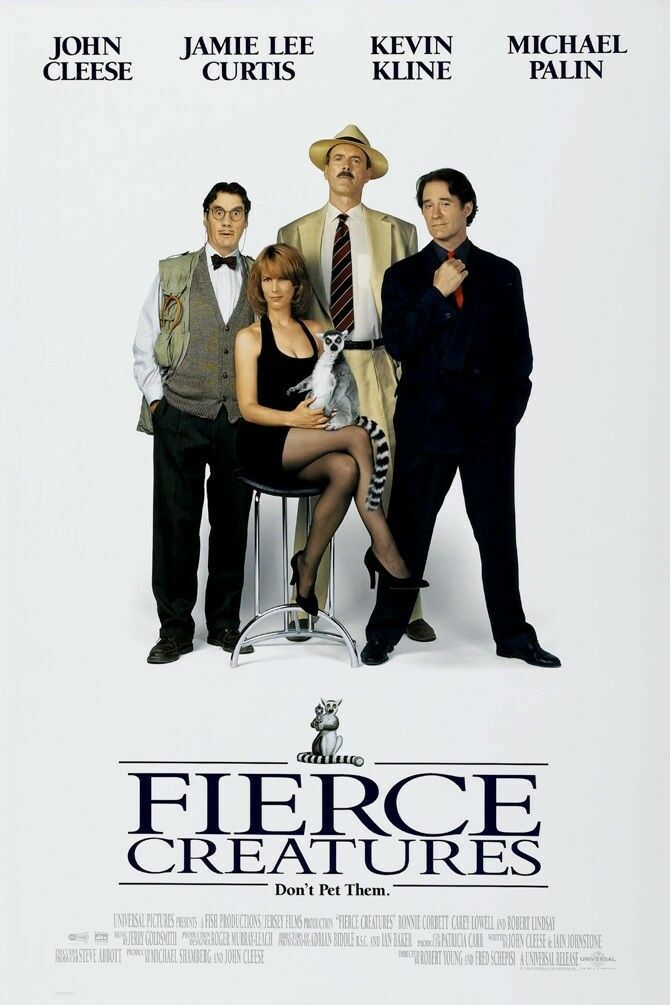
Fierce Creatures (1997) Poster
FIERCE CREATURES (1997) C+
dir. Fred Schepisi, Robert Young
The cast is back. The rapier wit isn’t. Fierce Creatures brings the Fish Called Wanda quartet into a new setting, hands them a zoo, and hopes the chemistry will take care of the rest. It doesn’t. The tone never quite locks in, the jokes loop the same punchlines, and the script confuses speed for wit. The setup: a fading British zoo gets absorbed by a global media empire, and the new mandate is simple—profit or perish. John Cleese arrives as an ex-Hong Kong cop with a surplus of rules and a deficit of charisma. Kevin Kline plays both the oblivious billionaire and his sweaty, oversexed son. Jamie Lee Curtis, saddled with the role of “sensible woman amid clowns,” mostly deflects ogling while trying to keep the plot from toppling over. There’s satire here—branding, image control, the monetization of nature—but it gets softened at every turn, like someone’s afraid of actually saying anything. A few stray laughs survive. There’s a decent jab at billionaire greed. A sly sheep shagger joke sneaks in. And there are flickers of the old chemistry. But it’s a lopsided film. Kline, usually reliable as a loudmouth menace, gives two performances that amount to background noise. In Wanda, he was cruel and ridiculous. Here, he’s just exhausting. The farce mechanics creak—closet gags, mistaken identities, people yelling through walls. You can feel the strain. This movie knows how to bare its teeth and pause for applause, but then it immediately forgets what it was doing. It keeps getting distracted.
Starring: John Cleese, Jamie Lee Curtis, Kevin Kline, Michael Palin, Robert Lindsay, Ronnie Corbett, Carey Lowell, Bille Brown.
Rated PG-13. Universal Pictures. UK–USA. 93 mins.
The 5TH Wave (2016) Poster
THE 5TH WAVE (2016) C
dir. J Blakeson
The end of the world arrives in waves. First, the power goes out. Then the floods hit. Then the plagues. By the time the aliens start slipping into human bodies, the survivors are too broken down to fight back. The 5th Wave moves through this destruction with mechanical efficiency, following the steps without hesitation, never stopping to make anything feel urgent. Chloë Grace Moretz plays Cassie, a high schooler turned reluctant survivor after extraterrestrials, known as The Others, wipe out most of humanity. The first attacks are brute force—natural disasters, engineered viruses, mass slaughter—but the final move is deception. The Others start wearing human faces, infiltrating what’s left of civilization. The military, already compromised, recruits children, arms them, and convinces them they’re saving the world. Cassie isn’t part of the program, but her little brother is, so she does what protagonists do—treks through a war zone, dodges snipers, and picks up an obligatory love interest along the way. The setup works on paper, but the execution is as lifeless as a factory-printed paperback. The action scenes go through their motions, the dialogue sounds engineered for promotional posters, and Moretz, usually magnetic, is given nothing to work with. Cassie is brave but never desperate, self-sufficient but never hardened, a protagonist shaped to fit a formula rather than a person reacting to the end of everything. Other sci-fi thrillers have failed in more interesting ways, but The 5th Wave is just forgettable. It moves efficiently from one plot point to the next, never building tension, never giving its characters room to feel like real people. The story plays out exactly as expected, and by the time it’s over, there’s nothing left to think about.
Starring: Chloë Grace Moretz, Nick Robinson, Ron Livingston, Maggie Siff, Alex Roe, Maria Bello, Maika Monroe, Liev Schreiber.
Rated PG-13. Sony Pictures Releasing. USA. 112 mins.
50 First Dates (2004) Poster
50 FIRST DATES (2004) C
dir. Peter Segal
A lopsided mash of rom-com blueprint and Adam Sandler’s frat-house reflexes. What stings is that the playbook was right there. Sandler had already tried this pairing in *The Wedding Singer*—no masterpiece, but breezy, likable, and funny often enough. Barrymore was his co-star there, too. The difference is that this one can’t commit to sincerity long enough to pass as romance, and it can’t stay funny long enough to coast on laughs. Unless, of course, your definition of comedy includes a walrus vomiting on an androgynous German tourist. Every time a scene starts to warm up, the thermostat gets yanked—usually by some loud, juvenile gag that plays like an interruption, not a punchline. The lone exception: Sean Astin, playing a lisping, wannabe-tough bodybuilder whose every line is a deadpan gem. He’s in and out too quickly to save the thing, but while he’s there, the movie wakes up. Barrymore should be a natural fit—her role calls for cheer, openness, a sunny streak—but here she turns the dial so high it grates. The premise, at least, is novel enough to keep you from switching it off: she’s a young woman with no short-term memory, stuck waking up each morning believing it’s the day of her accident. Sandler plays a commitment-phobe who initially treats that like the perfect loophole—no strings, no baggage—until the inevitable happens and he starts caring. There’s a better movie buried in there, one that leans into its premise instead of breaking it up with walrus bile. But that’s not the one we got.
Starring: Adam Sandler, Drew Barrymore, Rob Schneider, Sean Astin, Blake Clark, Dan Aykroyd, Amy Hill, Lusia Strus, Pomaika’i Brown, Maya Rudolph.
Rated PG-13. Columbia Pictures. USA. 99 mins.
The Final Countdown (1980) Poster
THE FINAL COUNTDOWN (1980) C-
dir. Don Taylor
I have a soft spot for aircraft carriers—those floating steel cities always feel like catnip for daydreamers who like their technology loud and their corridors claustrophobic. The Final Countdown knows this and spends a fair chunk of its runtime letting you wander the narrow passageways, catch glimpses of officers barking orders over the drone of turbines, and watch fighter jets slice through Pacific skies like over-caffeinated hawks. It’s all quite enjoyable—if your tastes run to military hardware polished to a dull naval gray. But the film squanders its premise almost as soon as it clicks into place. The USS Nimitz gets sucked into a cosmic storm—a swirling light show with no real rules and less explanation—and lands smack dab in the Pacific, 1941, just days before the attack on Pearl Harbor. Will they stop the Japanese fleet? Should they? This ought to be the sort of tantalizing setup that keeps you gnawing at moral tangles for days—history, war, and the delicious anxiety of playing god. Instead, it shrivels into stiff little meetings in airless briefing rooms, a handful of handsome flybys to remind you jets exist, and endless shots of men squinting at radar screens as if gravitas might save the script. The cast isn’t the problem—Kirk Douglas, Martin Sheen, and Charles Durning bring just enough authority to their uniforms to sell the tension when the script remembers there’s tension to sell. Some of the supporting players feel suspiciously like real Navy men drafted to stand around looking convincingly practical. But the dialogue they’re given is dry as gunpowder and half as explosive. The time travel, meanwhile, never musters a real sense of paradox or poetic dread; it’s mostly an excuse for a few dogfights that look great in widescreen and a final twist so limp it almost apologizes for existing. By the time the storm reappears to tidy up the mess, you might find yourself admiring the jets and the ship’s tight corners more than the movie wrapped around them. There’s a version of this story that plays like Dr. Strangelove on a flight deck—moral panic, cold sweat, philosophical dead-ends. The Final Countdown isn’t it. It’s a polished curiosity: fun to glance at, easy to forget once you step back on dry land.
Starring: Kirk Douglas, Martin Sheen, Katharine Ross, James Farentino, Ron O’Neal, Charles Durning.
Rated PG. United Artists. USA. 103 mins.
Final Exam (1981) Poster
FINAL EXAM (1981) B
dir. Jimmy Hudson
Finals week. The dorms empty, the noise dies down, and the campus settles into an eerie stillness—the perfect time for a slasher to wander in and start thinning the student body. Final Exam doesn’t shake up the formula, but it plays by the rules well enough to make them work. The cast is a grab bag of horror archetypes—cocky jocks, bookish nerds, disposable co-eds—but the film lets them stretch a little before lining them up for the kill. Radish (Joel S. Rice), the obligatory horror obsessive, actually has a personality, and the others are a step above mannequins waiting for the axe. The killer is simple. No mask, no supernatural angle, no elaborate backstory. Just a guy. And somehow, that makes it worse. The film takes its time, almost too much, but the slow build makes the campus feel strangely isolated, like the whole world has emptied out. The kills are staged well, the atmosphere works, and the occasional bursts of unintentional comedy remind you that early ’80s slashers were rarely concerned with perfection. The pacing stumbles, and some of the scares come pre-diluted, but Final Exam gets the basics right: a good setting, a few solid shocks, and a killer who doesn’t need mythology to make an impression. For slasher fans, this is the kind of movie that fits like a well-worn VHS tape. Not essential, but an enjoyable relic from an era when all you needed was a sharp knife and a quiet campus.
Starring: Cecile Bagdadi, Joel S. Rice, Ralph Brown, DeAnna Robbins, Sherry Willis-Burch, John Fallon, Terry W. Farren.
Rated R. Motion Picture Marketing. USA. 89 mins.
Final Fantasy: The Spirits Within (2001) Poster
FINAL FANTASY: THE SPIRITS WITHIN (2001) C
dir. Hironobu Sakaguchi
For anyone who has ever wanted to sit through a video game cutscene expanded to feature length, Final Fantasy: The Spirits Within would be right up your alley. It looks and moves like one of those pre-rendered cinematics you want to skip but can’t—except here, there’s no game to get back to. No buttons to mash, no spells to cast, just digital actors talking in solemn tones about things that never feel quite real. The setup is grand, the execution less so. Earth has been invaded by translucent alien specters called Phantoms—cosmic refugees from a destroyed planet. They aren’t here to conquer so much as exist in the wrong place at the wrong time, unintentionally wiping out humanity. The only solution is to collect eight Spirits, mysterious energy sources capable of neutralizing the Phantom threat through their connection to Gaia, the planet’s life force. This film plays like a quest objective waiting for you to pick up a controller, but instead, all we can do is sit and watch. The animation, groundbreaking for 2001, aimed for realism and mostly got as far as impressive waxworks. The characters are well rendered, but their eyes rarely suggest independent thought. Ming-Na Wen voices Aki Ross, the film’s protagonist, who is more concept than character: a scientist, a visionary, and—per the film’s marketing push—a would-be digital movie star. Donald Sutherland voices Dr. Sid, a weary scientist who actually seems to care about what’s happening. Alec Baldwin, Steve Buscemi, and Ving Rhames round out the cast, each doing their best to inject personality into a script that resists it. The film’s ambition is remarkable. Sakaguchi didn’t just want a Final Fantasy movie—he wanted to rewrite the rules of cinematic storytelling, merging gaming aesthetics with traditional filmmaking. But what’s missing is something essential: engagement. It’s all grand ideas and pristine digital craftsmanship, but watching The Spirits Within is like pressing your face to the glass of an aquarium—admiring the details while feeling entirely separate from what’s inside.
Voices of: Ming-Na Wen, Alec Baldwin, Ving Rhames, Steve Buscemi, Peri Gilpin, Donald Sutherland, James Woods, Keith David, Jean Simmons, Matt McKenzie.
Rated PG-13. Sony Pictures Releasing. USA-Japan. 106 mins.
Finding Forrester (2000) Poster
FINDING FORRESTER (2000) B-
dir. Gus Van Sant
Finding Forrester stars Sean Connery as William Forrester, a literary legend turned shut-in—J.D. Salinger with a rent-controlled apartment and fewer illusions about the world. Decades removed from his one great novel, he now spends his time holed up in a cluttered Manhattan walk-up, speaking to no one and writing only for himself. His isolation gets interrupted by Jamal Wallace, a 16-year-old from the Bronx whose talent is obvious to everyone except the people meant to recognize it. Jamal, played by Rob Brown, is quiet and careful, which is what happens when you’re smart enough to know what not to say. His test scores are exceptional, his grades less so, and the prep school that offers him a scholarship seems more interested in his jump shot than his writing. He accepts the offer, but it’s clear they want an athlete who can pass an English class—not a writer who happens to dunk. He meets Forrester after sneaking into his apartment on a dare. It should’ve been a one-off—an old man yelling, a kid running. Instead, it turns into an exchange. Jamal leaves behind a notebook. Forrester reads it. Slowly, something resembling mentorship takes shape—not dramatic, not declared, just a quiet rhythm of notes, revisions, and guarded trust. F. Murray Abraham plays the professor—measured, skeptical, and clearly not used to being challenged. He’s positioned as the gatekeeper, the one who decides what genius is supposed to look like. It works well enough for the story, but he feels more like a fixed idea than a fully developed character. The film needs an obstacle, and he fills the space a little too neatly. The story stays familiar. But Connery gives Forrester some welcome rough edges, and Brown plays Jamal with control—sharp, unbothered, never in a hurry to explain himself. Their scenes have weight, even when the film starts to repeat itself. Finding Forrester doesn’t break the formula, but it carries it with purpose.
Starring: Sean Connery, Rob Brown, F. Murray Abraham, Anna Paquin, Busta Rhymes, Michael Pitt, April Grace.
Rated PG-13. Columbia Pictures. USA. 136 mins.
Finian’s Rainbow (1968) Poster
FINIAN’S RAINBOW (1968) A-
dir. Francis Ford Coppola
Fred Astaire, months from 70 but still lighter than air, plays an Irishman who steals a leprechaun’s pot of gold and heads to America with a peculiar belief: bury it in the soil, and it’ll grow. He and his daughter (Petula Clark, luminous in voice and presence) arrive in Rainbow Valley, Missitucky, where a blustering, racist senator (Keenan Wynn) is scheming to take the land for himself. Meanwhile, a frantic leprechaun (Tommy Steele, committing so fully you half-expect him to turn green) is rapidly shedding his magic and scrambling to reclaim it. Don Francks, playing Clark’s romantic prospect, is technically present, though he makes for an unusually weak leading man. Unlike the stiff, airbrushed musicals of its time, Finian’s Rainbow breathes. Filmed in sunlit fields rather than the controlled sterility of a soundstage, it moves with a rare looseness, letting songs like “Look to the Rainbow,” “Old Devil Moon,” and “How Are Things in Glocca Morra?” flow naturally into the scenery rather than grandly announcing themselves. The choreography is exquisite—not just a series of steps but a seamless extension of the film’s joy—with Astaire, in particular, moving as if age never caught up to him. Its racial satire remains strikingly effective, including the much-debated blackface sequence in which the senator, through magical intervention, is forced to experience the discrimination he so gleefully enforces. If there were ever a case for blackface with a purpose, this is it—a sharp, well-executed transformation that sees Wynn not only reckoning with his new identity but embracing it. For all the film’s whimsy, this is one of its boldest strokes. And then there’s Astaire, still gliding, still impossibly light. Clark, whose voice alone feels like a warm breeze. Steele, bouncing around like a storybook illustration come to life. The film is long, odd, overflowing with ideas—but always, irresistibly, joyful.
Starring: Fred Astaire, Petula Clark, Tommy Steele, Don Francks, Keenan Wynn, Barbara Hancock, Al Freeman Jr., Ronald Colby, Dolph Sweet, Wright King, Louil Silas.
Rated G. Warner Bros.-Seven Arts. USA. 145 mins.
Firewalker (1986) Poster
FIREWALKER (1986) D+
dir. J. Lee Thompson
Two treasure hunters, Max (Chuck Norris) and Leo (Lou Gossett Jr.), find themselves tied up in the desert of Durango, left to die by a scar-faced villain with a theatrical sense of cruelty. A bottle of Perrier sits just out of reach—close enough to taunt, too far to save them. (Why Perrier? Maybe because nothing mocks a macho American like Norris worse than fancy French sparkling water.) Max, unwilling to let the joke land at his expense, stretches, contorts, and finally kicks the bottle closer with his boot. He smashes it, grabs a shard, and saws himself free. They escape with their lives but not their dignity—just another treasure hunt ending in failure. Back in Arizona, broke and banged up, they cross paths with Patricia (Melody Anderson), a woman with a treasure map and a proposition. The first stop is a local Indian reservation, of all places. But instead of gold, they find hostile Native guardians, dry bones, and a mystical dagger that looks like it was borrowed from a community theater prop room. But the dagger is more than a trinket—it holds the key to an even bigger treasure, one buried somewhere deeper in Mexico. While this ought to be a grand, old-school adventure comedy, the action limps, and the comedy fumbles. Norris, whatever his talents may be, was not built for banter. Gossett Jr. tries to carry the weight of their dynamic but keeps getting dragged down by a script that refuses to help. The jokes, mostly of the dad variety, land with the grace of a falling cinder block. J. Lee Thompson, a director with The Guns of Navarone and Cape Fear under his belt, does know how to stage adventure, but Firewalker gives him nothing to work with. The film just plods from one scene to the next, hinting at excitement but never finding it. By the end, the only real accomplishment isn’t by the characters but by me, for sitting through it. My advice: Leave Firewalker in the desert, and this time, don’t give it a Perrier.
Starring: Chuck Norris, Louis Gossett Jr., Melody Anderson, Will Sampson, Sonny Landham, John Rhys-Davies, Ian Abercrombie.
Rated PG. The Cannon Group. USA. 104 mins.
FIRST KID (1996) Poster
FIRST KID (1996) C–
dir. David M. Evans
The White House has a problem: the president’s son is a brat. So they call in Sinbad. And as you might expect, he somehow makes things better and worse at the same time. Sinbad plays Sam Simms, a Secret Service agent quietly reassigned after an incident involving a senator’s wife. His new post is Luke (Brock Pierce), a preteen with a knack for disappearing, provoking, and testing the limits of whatever adult is tasked with keeping him in check. Simms is supposed to keep him in line, but mostly ends up trailing behind, trying not to lose his job. The arc is familiar: mutual dislike, softening over time, a climactic school dance. In between, there’s a boxing montage, a mild cyberstalker subplot, and a glimpse of early Internet culture. In one chatroom exchange, a user types “lol” and immediately adds “(laughing out loud),” because—adorably, in 1996—not everyone knew what it meant. The comedy leans on pratfalls, cafeteria gags, and Sinbad’s natural volume, along with that trademark grin he uses to get through every situation. He doesn’t have much to work with—the script is mostly pep talks and mildly exasperated one-liners. Pierce cycles through expressions like someone auditioning to be grounded. First Kid isn’t aggressively bad. It’s just idle. A film built on casting and premise, then left to autopilot. The most memorable moments are two brief cameos—Sonny Bono walking through a hallway, and Bill Clinton flickering on a small screen. That’s about as exciting as it sounds. The film doesn’t offend so much as drift, coasting from setup to release without anyone ever stopping to check whether it works.
Starring: Sinbad, Brock Pierce, Timothy Busfield, Art LaFleur, Blake Boyd, Fawn Reed, Robert Guillaume, Lisa Eichhorn.
Rated PG. Walt Disney Pictures. USA. 101 mins.
The First Time (1969) Poster
THE FIRST TIME (1969) D
dir. James Neilson
Here’s an obscurity that ought to stay that way. The First Time is one of those cultural curios that piqued my interest for about five minutes—just long enough to regret watching it. The premise sounds vaguely anthropologically promising: three just-graduated high school boys head to Canada, hoping to shed their virginity. The brothel they’re looking for has been shut down, so they’re left wandering around Niagara Falls like confused cub scouts until they bump into Jacqueline Bisset, who, for reasons left entirely unexamined, decides to humor them. You can tell the movie thinks it’s going for a Graduate-style dynamic—older woman, young men, self-discovery—but it’s never clear what these boys actually want, what Bisset wants, or why we’re supposed to care. She’s barely in her twenties herself, and the film can’t decide if she’s supposed to be worldly or just bored. Mostly she’s just there. The tone is strange—more gee-whiz than risqué. The dialogue sounds like it was written by someone who once overheard teenagers talking about sex but didn’t quite catch the details. Everyone speaks in that stilted, over-enunciated way old movies thought young people did. The first half plays like a travelogue to Niagara Falls, which is exactly as exciting as it sounds. You half expect someone to pull out a carousel of slides. It’s not that the movie is offensive, or even exactly bad in a lurid way—it’s just limp. No tension, no insight, and not nearly enough weirdness to warrant rediscovery. I went in expecting something along the lines of American Pie filtered through late-’60s self-seriousness. Instead, I got a glum detour with no destination. Keep it shelved.
Starring: Wes Stern, Rick Kelman, Wink Roberts, Jacqueline Bisset, Gerard Parkes.
Rated R. Columbia Pictures. Canada-USA. 90 mins.
A Fish Called Wanda (1988) Poster
A FISH CALLED WANDA (1988) B+
dir. Charles Crichton
I usually have a sturdy appetite for mean-spirited British comedy. This one, clever and frequently hilarious, piles on so much gleeful cruelty I found myself wincing as often as I laughed. It’s a caper that runs on humiliation, betrayal, and the occasional fish murder, and it’s hard not to admire the precision even while wanting to take a shower. The plot’s a tangle worth keeping tangled. Two Americans, Wanda (Jamie Lee Curtis) and Otto (Kevin Kline), pose as siblings but are actually lovers—partners in a robbery that leaves their associate George (Tom Georgeson) in jail and the loot hidden. Wanda sidles up to Archie Leach (John Cleese), George’s barrister, hoping to pry out the location. George’s real ally is Ken (Michael Palin), an animal-loving hitman with a stutter and a fish tank—his favorite, an angelfish named Wanda, fated to become collateral damage. The cast is airtight, but Kline pushes his Otto so far into oblivious, swaggering cruelty that you start rooting for bad things to happen to him. The movie obliges. Other gags wobble—Wanda’s fetish for men speaking foreign languages feels like a single-joke premise in search of somewhere to go—but it does set up one perfect farce scene, with Cleese naked and stranded in a situation you couldn’t explain to your own solicitor. It’s fast, nasty, and sharply built, the kind of comedy where every plot turn is another chance to watch someone you like get embarrassed. I enjoy it. I admire it. And I keep it at a polite arm’s length—close enough to laugh, far enough not to feel like I’m in the gang.
Starring: John Cleese, Jamie Lee Curtis, Kevin Kline, Michael Palin, Tom Georgeson, Maria Aitken.
Rated R. MGM. UK/USA. 108 mins.
FIST OF LEGEND (1994) Poster
FIST OF LEGEND (1994) B+
dir. Gordon Chan
Jet Li plays it like a locked door—expression unreadable, movements whittled down to purpose. He’s never been a demonstrative actor, but here that economy works in his favor. As Chen Zhen, returning to 1937 Shanghai after the suspicious death of his master, he enters quietly and watches everything. Stillness becomes strategy. The city is fraying. Japanese soldiers patrol the streets. Tensions hang thick in the air. Chen—trained in Japan, fluent in its language—walks into a country that doesn’t quite know what to do with him. He doesn’t cause a stir. He just exists in the wrong context. The story presses into politics, cultural conflict, and national allegiance—serious themes, handled more dutifully than urgently. I didn’t tune out, but I didn’t feel drawn in either. What does register is the texture. The setting doesn’t announce itself—it just sits there, fully formed. The wool uniforms, the somber architecture, the heavy light filtering through paper windows—it all feels placed, not staged. No visual noise. Just a sense of time and place, grounded without calling attention to itself. And when the fighting begins, the film drops the pretense and gets to what it’s actually interested in. Yuen Woo-ping’s choreography is lean, direct, and uninterested in flash. The punches land, the camera stays wide, and the editing doesn’t duck. There’s a bluntness to it—a kind of structural honesty. Gordon Chan shoots like he knows the audience has eyes. This was early Yuen, before The Matrix, before Crouching Tiger, and the core of his style is already here. The rhythm. The control. The sense that these fights are less about victory than about precision under pressure. Fist of Legend doesn’t build toward spectacle. It holds its ground, delivers clean contact, and moves on. No style for its own sake. Just form, intention, and follow-through.
Starring: Jet Li, Chin Siu-ho, Nakayama Shinobu, Billy Chow, Paul Chun, Yasuaki Kurata.
Not Rated. Golden Harvest. Hong Kong. 103 mins.
Fit to Kill (1993) Poster
FIT TO KILL (1993) D
dir. Andy Sidaris
By the eighth entry in Andy Sidaris’ budget-conscious bullet-and-bikini saga, you’d think the formula would at least be self-cleaning. Fit to Kill once again sends Donna Spier and Roberta Vasquez—two of the series’ most durable gun-toting centerfolds—after a priceless diamond, though the real jewel here is how thoroughly the film squanders its own premise. The usual corny double entendres and mid-shootout puns have been dialed down in favor of something resembling plot coherence, which sounds like progress until you realize how little fun survives the upgrade. The action sequences shuffle past with the urgency of a rehearsal, and the film’s other selling point—softcore detours lit like shampoo commercials—reaches a kind of reverse artistry. These are, without exaggeration, some of the most clumsily staged erotic scenes ever captured on film: indifferent lighting, camera angles that seem allergic to anatomy, and a mood that suggests everyone involved is doing this as a favor. Whatever Sidaris was chasing here—narrative credibility, a touch of polish—it comes at the cost of the very trashy vitality that made the earlier entries almost watchable.
Starring: Dona Speir, Roberta Vasquez, Julie Strain, Geoff Mark, Bruce Penhall, Ava Cadell.
Not Rated. Malibu Bay Films. USA. 97 min.
Fits & Starts (2017) Poster
FITS & STARTS (2017) B–
dir. Laura Terruso
A wry little comedy about creative ego, relationship rot, and literary events where sincerity gets performed like wardrobe. David (Wyatt Cenac) was once supposed to break out. Now his wife Jennifer (Greta Lee) has the career, the agent, the panels—while he gets introduced as her plus-one and mistaken for her intern. They’re en route to a writerly salon in Connecticut. Wine is expected. David forgets. The stores are closed. Jennifer goes off to fix it, and he’s left to orbit a room full of publishing types who treat him like a networking opportunity with posture issues. An overzealous agent (Maria Dizzia) tries to seduce his manuscript—and then him—if he’ll just lose the beard. He complies, barely, and ends up looking like he’s lost a bet. The night spirals: two indifferent cops, a string of smug party acts, and a creeping realization that Jennifer may have outpaced him completely. Cenac plays it with a kind of passive irritation—too annoyed to smile, too self-aware to lash out. There’s not much plot, just a steady accretion of small humiliations. But the tone is dry, the pacing brisk, and the social satire just sharp enough to register. Even the familiar parts—writer’s block, fading romance, rooms full of self-importance—don’t feel tired, just gently overexposed. The film isn’t aiming for depth. It just lets the awkwardness pile up until it starts to itch.
Starring: Wyatt Cenac, Greta Lee, Maria Dizzia, Alex Karpovsky.
Not Rated. The Film Arcade. USA. 77 mins.
Fitzcarraldo (1982) Poster
FITZCARRALDO (1982) A-
dir. Werner Herzog
A phenomenal film about one man’s unchecked madness—Brian Sweeney Fitzgerald (Klaus Kinski), a colonial interloper and unhinged opera devotee who dreams of building a grand opera house in Iquitos, Peru, and bringing Caruso himself to the jungle. His taste is lavish, but his purse is empty, and his grand schemes to bankroll this fantasy—like a failed attempt to build a rail link from the jungle to the coast—have all crumbled before they began. But his latest gamble might be the most deranged of them all: tapping a remote grove of virgin rubber trees on the Ucayali River, blocked by rapids no steamboat can survive. His plan? Drag a full-sized steamship over a hill connecting two river systems, then float it back down to market riches. And yes—Herzog really did this. No trick shots, no models: the film’s insane production mirrors Fitzcarraldo’s lunacy inch for inch. Kinski’s performance is almost radioactive in its single-minded intensity—he rants, wheedles, and hypnotizes entire river communities into dragging that rusted behemoth over the jungle ridge. Claudia Cardinale appears briefly but memorably as Molly, Fitzcarraldo’s steadfast lover and the brothel owner who bankrolls his half-cooked dream. Herzog shoots the Amazon as equal parts cathedral and fever swamp; the sweat, rot, and clanging machinery feel so present you half expect the screen to drip humidity. By the time the ship crests the hill, the film has become not just a madman’s folly but a testament to the feral thrill of watching impossible things get done the hard way. An astonishing piece of work—mad, mythic, and completely its own.
Starring: Klaus Kinski, Claudia Cardinale, José Lewgoy, Miguel Ángel Fuentes, Paul Hittscher, Huerequeque Enrique Bohórquez.
Rated PG. New World Pictures. West Germany-Peru. 158 mins.
Five Easy Pieces (1970) Poster
FIVE EASY PIECES (1970) A
dir. Bob Rafelson
Bobby Dupea has talent he doesn’t want, a girlfriend he can’t manage, and a family he’d rather avoid. What he does have is an oil-rigger’s paycheck, a decent pool game, and a knack for turning even a diner breakfast into a small act of rebellion. Jack Nicholson plays him as a man allergic to roots—restless, sharp-tongued, and ready to bolt the second something starts to feel like home. Once a piano prodigy, Bobby has buried that life so deep he barely admits to it. Then news comes that his father has suffered two strokes, and he’s pulled back to the coastal Washington home he abandoned. He plans to leave Rayette (Karen Black) behind—she’d fit with his family like oil and water—but she guilts her way into the trip with tearful bedroom pleas and a Tammy Wynette soundtrack. The road there feels like a cross-section of the country: bowling alleys, traffic jams, roadside diners, a hitchhiker (Helena Kallianiotes) delivering a monologue on the filth of the world. At home, the old life waits—his gifted sister (Lois Smith), his intellectual brother-in-law, a father trapped in silence. Bobby drifts through it all, still playing the part of the outsider, hiding Rayette at a nearby motel and taking up with another woman (Susan Anspach) as if it’s a foregone conclusion. The tension between who he was and who he’s become never resolves; it just deepens. Rafelson shoots it without fuss, letting Nicholson flare in bursts: the diner standoff where Bobby, boxed in by arbitrary rules, needles the waitress until the whole place is watching; the truck-bed piano solo tossed into the wind on a long stretch of road; the late, wordless vigil beside his father’s chair, the silence heavier than any confession. It’s not sentimental, but it isn’t cold—just unsparing about those who can’t stay put, even when walking away takes more than it gives back. Bobby’s last ride north, disappearing into the snow, feels less like an ending than a reminder: for some, leaving is the only thing that lasts.
Starring: Jack Nicholson, Karen Black, Susan Anspach, Lois Smith, Ralph Waite, Billy “Green” Bush, Helena Kallianiotes, William Challee.
Rated R. Columbia Pictures. USA. 98 mins.
The 5,000 Fingers of Dr. T (1953) Poster
THE 5,000 FINGERS OF DR. T (1953) B+
dir. Roy Rowland
A children’s movie, technically. A musical, supposedly. But mostly, The 5,000 Fingers of Dr. T is what happens when Dr. Seuss—who not only conceived the story but co-wrote the screenplay—is handed a Hollywood budget and left unsupervised. The sets twist and stretch like a funhouse collapsing in on itself, every surface a swirl of garish color and impossible geometry. The villain—Hans Conreid in full cackling glory—isn’t just an eccentric piano teacher; he’s a full-fledged dictator, ruling over a fortress where music lessons have been turned into a form of enslavement. Bart (Tommy Rettig) is a kid suffering through piano lessons under the tyrannical Dr. Terwilliker, a man who believes no other instrument deserves to exist. While drumming out yet another lesson, Bart slumps forward and falls into a dream, waking up inside his worst nightmare: the Terwilliker Institute, a prison devoted entirely to piano. At its center lies Dr. T’s crowning achievement—a monstrous keyboard stretching hundreds of feet, designed to be played by 500 captive children, their combined digits giving the film its title. His vision is painfully specific: a world where scales and arpeggios reign supreme, where non-piano instruments are contraband, and where any dissent is punishable by banishment to the dungeon. Bart, now a prisoner, must sabotage the whole operation and rescue his mother, who has fallen under Dr. T’s hypnotic spell. The world-building is something to behold. Staircases twist back on themselves, doors lead nowhere, and a pair of roller-skating guards—twins conjoined by their beards—glide through the halls in eerie, synchronized unison. Below the institute, a dungeon houses musicians whose only crime was choosing the wrong instrument. Every corner of the frame twitches with odd details, making the whole thing feel less like a movie and more like a hallucination someone accidentally filmed. For all its extravagant design, the story itself moves in a surprisingly direct line: a boy, a villain, a parent to be saved. It’s a familiar skeleton draped in delirious spectacle. Even the musical numbers, which range from sinister villain monologues to eerie prisoner laments, aren’t so much traditional showstoppers as surreal set pieces designed to unsettle as much as entertain. And yet, for all its wild invention, there’s a sense that the film is holding back just a little—never quite hurling itself into total madness, always keeping one foot on the ground when it should be soaring off into oblivion. Too strange for mass appeal, too deliberately constructed to be dismissed. If Seuss had made more movies, Hollywood might have had to reevaluate what was possible. As it stands, The 5,000 Fingers of Dr. T remains a singular misfit—a lavish, wildly specific experiment in giving a cartoonist full control of reality.
Starring: Peter Lind Hayes, Mary Healy, Hans Conreid, Tommy Rettig, John Heasley, Robert Heasley, Noel Cravat.
Not Rated. Columbia Pictures. USA. 92 mins.
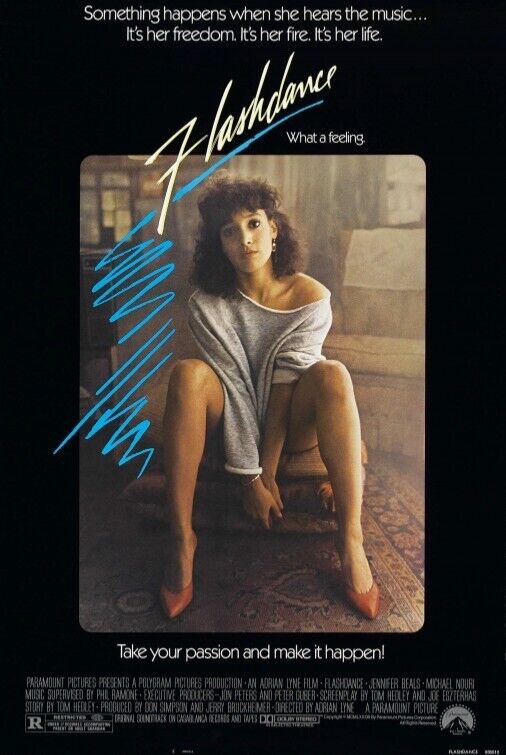
Flashdance (1983) Poster
FLASHDANCE (1983) B
dir. Adrian Lyne
One of the first things you see in Flashdance is a welder’s mask glowing blue in the dark. That’ll eventually give way to a slow pan up a pair of leg warmers. That’s the film in miniature—grit and gloss, staged like they’re speaking the same language, all pulsing to a drum machine. There’s a story, technically, but it’s just there to string the sequences together. Characters aren’t developed so much as thrown into motion—none more so than Alex Owens (Jennifer Beals), 18, who welds steel by day and flings herself into high-voltage nightclub routines by night. Not that either gig really holds up. At 18, you’d barely qualify as a welding apprentice, and ballet is the sort of thing you usually start before you can spell it. But Flashdance isn’t concerned with realism—it’s about striking poses and pushing forward. Alex dreams of auditioning for a top ballet academy, despite having no formal training and no real plan. She teaches herself in an empty warehouse, surrounded by mirrors and sweat, dancing like someone trying to outpace hesitation. Her boyfriend—who also owns the steel mill—tries to help by arranging an audition. She turns it down. It wouldn’t count if she didn’t fight for it herself. She also turns down an offer to dance at a strip club, which would pay more and ask less. The film treats it not as a dilemma but a line in the sand—what kind of dancer, what kind of woman, what kind of story is this going to be? Flashdance isn’t interested in ambiguity. It’s a film of declarations: bright, loud, choreographed to hit on the beat. The closest comparison is Saturday Night Fever, if someone gave it a blow-dry and a dance double. That film was sweat and gloom; this one is synth and spotlight. The performances are shot like music videos—stylized, accelerated, allergic to realism. Beals didn’t do most of the dancing; the film used stand-ins. You wouldn’t guess it. The editing is sharp enough to sell the illusion, and Beals brings enough presence to carry the rest. And then comes the final audition. Street dance collides with ballet, a flash of defiance wrapped in a leotard and set to “Maniac.” It’s wildly implausible. It works anyway. The film’s been building toward this moment—not through plot, but through accumulation. Sweat, speed, resistance. Flashdance isn’t asking to be believed. It’s asking to be felt.
Starring: Jennifer Beals, Michael Nouri, Lilia Skala, Sunny Johnson, Kyle T. Heffner, Lee Ving, Ron Karabatsos, Belinda Bauer, Malcolm Danare, Phil Bruns.
Rated R. Paramount Pictures. USA. 97 mins.
Flatliners (2017) Poster
FLATLINERS (2017) D+
dir. Niels Arden Oplev
The trouble starts early. Elliot Page, medical student, harbors a curiosity about what waits on the other side of death and, with the enthusiasm of someone who’s just had their first espresso, enlists a group of friends to stop her heart and bring her back. No ghosts yet, but a rush of euphoria, a boost in mental sharpness, and suddenly she’s playing piano like a prodigy whose talent was merely misplaced in the attic of her brain. It doesn’t take much for the rest to follow—science be damned, they want in. And so they go, one by one, into the void, emerging reborn, renewed, suddenly excellent at everything except recognizing a bad idea when it stares them in the face. If the film had any bite, the next turn—when their high wears off and the afterlife starts sending back unwanted souvenirs—might have amounted to something thrilling. Instead, they get trapped in a tangle of dialogue about past regrets, as though the horror of the unknown needs a motivational speech before it can do its job. The visuals, polished to an impersonal gleam, resemble an early-2000s TV procedural—mood lighting for the disinterested, eerie music that apologizes for itself. The atmosphere, if one could be located, suggests a supernatural horror that enrolled in med school and forgot why it came. Kiefer Sutherland, briefly on hand as a professor, wears the expression of a man thinking about his next meal. The premise, once alive with the possibilities of existential dread, has been reduced to a networking event for the clinically angsty. Flatliners isn’t a horror film so much as a dreary group therapy session with a pulse monitor attached.
Starring: Elliot Page, Diego Luna, Nina Dobrev, James Norton, Kiersey Clemons, Kiefer Sutherland, Beau Mirchoff, Madison Brydges, Miguel Anthony.
Rated R. Sony Pictures Releasing. USA. 97 mins.
Flightplan (2005) Poster
FLIGHTPLAN (2005) C+
dir. Robert Schwentke
An action thriller starring Jodie Foster can’t be bad—but it doesn’t have to be good either, and Flightplan hovers in that unfortunate middle. The premise is a clever lift from Hitchcock’s The Lady Vanishes, except here the missing person is a child, and the train’s been swapped for a gleaming double-decker airplane with enough crawlspace to make Bruce Willis jealous. Foster plays Kyle Pratt, an engineer flying from Berlin to the U.S. with her husband’s coffin in the cargo hold and her young daughter (Marlene Lawson) by her side—until she isn’t. One moment the girl’s napping. The next, she’s gone. The bathroom’s empty. The lounge is a dead end. And the flight crew, rather than springing into action, seem weirdly skeptical from the jump—as if a mother frantically searching for her missing daughter is more nuisance than emergency. Even when they start to help, it’s with the begrudging tone of people offering you a lost luggage form after you’ve said your child has vanished. There’s an air marshal onboard (Peter Sarsgaard), but his involvement only complicates things—both for Kyle, and for the plot. The film gestures at psychological suspense, asking whether the daughter ever existed at all—but it never sells the doubt. Foster’s too composed, too lucid, too anchored in reason. In The Lady Vanishes, the heroine second-guesses herself, and so do we. Here, the script all but shouts, “She’s telling the truth,” and then spends the rest of the runtime pretending that ambiguity still exists. When the twists arrive, they don’t land—they unfold. Predictably. As a popcorn thriller, Flightplan mostly functions. It’s paced well enough, shot slickly, and Foster sells every second of maternal desperation. But it’s a hollow ride. The logic buckles under scrutiny, the character behavior borders on absurd, and the depiction of flight attendants—cold, dismissive, implausibly hostile—feels less like drama and more like wish fulfillment for people who yell at customer service. Watchable, sure. But too ridiculous to believe, and too polite to surprise.
Starring: Jodie Foster, Peter Sarsgaard, Erika Christensen, Sean Bean.
Rated PG-13. Touchstone Pictures. USA. 98 mins.
The Flintstones in Viva Rock Vegas (2000) Poster
THE FLINTSTONES IN VIVA ROCK VEGAS (2000) D+
dir. Brian Levant
Viva Rock Vegas isn’t so much a prequel as a regression. Recast, reheated, and resoundingly less fun, it takes everything that worked in the original and dials it down to something louder and dumber. It’s a downgrade in every department. Set before the suburban comforts of Dino-disposals and baby mammoth showers, the story rewinds to the courtship days—Fred and Barney meeting Wilma and Betty back when sparks flew fast and nobody asked too many questions. Mark Addy and Stephen Baldwin lumber in as the bedrock bros, with Kristen Johnston and Jane Krakowski more than happy to play along. The chemistry clicks well enough, the performances are loose and affable, and the tone stays breezy—even as the humor keeps scraping the prehistoric bottom. The plot centers on Wilma hiding her wealth to avoid scaring off Fred, while her status-obsessed family tries nudging her back toward Chip Rockefeller, a smug socialite with a pocketful of schemes. He’s the designated villain, though his dirty tricks amount to petty sabotage and light trespassing. Most of the disruption comes courtesy of Alan Cumming, pulling double duty as the smarmy Chip and as The Great Gazoo—a lime-green alien who hovers, quips, and radiates discomfort. He’s supposed to be comic relief. He mostly just makes things weirder. Visually, it’s a step backward. Gone are the chunky, practical effects of the original—replaced by bargain-bin CGI, recycled sets, and creatures that barely register as animated. Dinosaurs blink, but don’t emote; stone-age contraptions move, but without much charm. There’s a brief Vegas-style revue featuring dancing girls and a brontosaurus, but even that feels more like theme park filler than actual spectacle. The original film wasn’t exactly high art, but charm, scale, and the sense that someone, somewhere, was trying. Viva Rock Vegas feels like the part they shot after the fun ran out.
Starring: Mark Addy, Stephen Baldwin, Kristen Johnston, Jane Krakowski, Alan Cumming.
Rated PG. Universal Pictures. USA. 90 mins.
Flushed Away (2006) Poster
FLUSHED AWAY (2006) B
dir. Sam Fell, David Bowers
Aardman, famed for their lovingly thumb-pressed claymation, takes a detour through the glossy corridors of computer animation, and while the fingerprints are gone, the mischief remains. The excuse for the switch? Water. Too tricky to coax out of clay, they say, so here we are, watching an expensive simulation of what used to be achieved with a good splash in a miniature tub. The result is smoother, faster, more aerodynamic, but something about it feels like a well-rehearsed comedy act performed one too many times—still funny, but the edges sanded down. Roddy St. James (Hugh Jackman) is a luxury-penthouse rodent, the kind of house pet who lounges in a doll-sized tuxedo and dines on gourmet crumbs. His routine implodes when Sid (Shane Richie), a sewer rat with the table manners of a traffic accident, tumbles in and makes himself at home. Roddy’s attempt to eject the intruder backfires, and down the pipes he goes, into Ratropolis, a subterranean metropolis built from discarded bric-a-brac and the dreams of the unwashed. Enter Rita (Kate Winslet), a scavenger with an eye for survival and a personal vendetta against the villainous Toad (Ian McKellen), whose evil plan unfolds with the grandeur of a Bond villain who never quite graduated to the big leagues. The film moves like it’s got somewhere to be, stuffing itself with visual gags, slapstick, and a chorus of musical slugs that function as a sort of vaudeville Greek chorus, appearing exactly when you least expect them and precisely when they’re needed. It’s all impossibly breezy, a proper sprint through a world built on half-chewed wads of Aardman wit. The whole thing goes down easy, even if you can’t shake the feeling that it was engineered to be exactly that way.
Voices of: Hugh Jackman, Kate Winslet, Ian McKellen, Jean Reno, Andy Serkis, Bill Nighy, Shane Richie.
Rated PG. Paramount Pictures. USA-UK. 85 mins.
The Fly II (1989) Poster
THE FLY II (1989) C+
dir. Chris Walas
The Brundle curse lives on, albeit with less poetry and a lot more ooze. If The Fly was a high-wire act of horror and tragedy, its sequel is the full-body splat—viscera everywhere, grace nowhere. Gone is the aching love story, the slow, terrible disintegration of self. What’s left is a meatier, sloppier beast, interested not in dread but in spectacle—the kind that erupts when you hand an effects team a blank check and an open wound. It never reaches the tragic brilliance of the first, but as a monument to ooze and anatomy gone rogue, it earns its place in the hall. Eric Stoltz plays Martin Brundle, son of Jeff Goldblum’s doomed scientist—though “son” hardly covers the birthing scene: a heaving, gelatinous mess that spits him into the world, courtesy of a corporate-funded lab eager to see what a half-human, half-fly hybrid might accomplish if given the right motivation (and enough test tubes). He ages at five times the normal rate, a biological time bomb with genius intellect and a knack for teleportation pod tinkering. The company, sensing a cash cow, gives him full lab access—because nothing bad ever happens when science is left unsupervised in a sequel. The transformation doesn’t creep—it explodes. It hits all at once, a delayed eruption finally breaking through skin and bone. A romance sneaks in, courtesy of Daphne Zuniga. Her role mostly exists to remind us that Martin Brundle is still, technically, a man—even as his internal wiring starts to get buggy. Meanwhile, the scientists loom, the corporate interests sneer, and in one moment of pure, cruel gut-punch, a golden retriever suffers a fate worse than death. A lesser film, but a fully committed one. It’s messy, single-minded, and soaked in practical effects. Subtlety dies early, but the spectacle stays loud, wet, and weird to the end.
Starring: Eric Stoltz, Harley Cross, Daphne Zuniga, Lee Richardson, Garry Chalk.
Rated R. 20th Century Fox. USA. 105 mins.
The Fly II (1989) Poster
THE FLY II (1989) C+
dir. Chris Walas
The Brundle curse lives on, albeit with less poetry and a lot more ooze. If The Fly was a high-wire act of horror and tragedy, its sequel is the full-body splat—viscera everywhere, grace nowhere. Gone is the aching love story, the slow, terrible disintegration of self. What’s left is a meatier, sloppier beast, interested not in dread but in spectacle—the kind that erupts when you hand an effects team a blank check and an open wound. It never reaches the tragic brilliance of the first, but as a monument to ooze and anatomy gone rogue, it earns its place in the hall. Eric Stoltz plays Martin Brundle, son of Jeff Goldblum’s doomed scientist—though “son” hardly covers the birthing scene: a heaving, gelatinous mess that spits him into the world, courtesy of a corporate-funded lab eager to see what a half-human, half-fly hybrid might accomplish if given the right motivation (and enough test tubes). He ages at five times the normal rate, a biological time bomb with genius intellect and a knack for teleportation pod tinkering. The company, sensing a cash cow, gives him full lab access—because nothing bad ever happens when science is left unsupervised in a sequel. The transformation doesn’t creep—it explodes. It hits all at once, a delayed eruption finally breaking through skin and bone. A romance sneaks in, courtesy of Daphne Zuniga. Her role mostly exists to remind us that Martin Brundle is still, technically, a man—even as his internal wiring starts to get buggy. Meanwhile, the scientists loom, the corporate interests sneer, and in one moment of pure, cruel gut-punch, a golden retriever suffers a fate worse than death. A lesser film, but a fully committed one. It’s messy, single-minded, and soaked in practical effects. Subtlety dies early, but the spectacle stays loud, wet, and weird to the end.
Starring: Eric Stoltz, Harley Cross, Daphne Zuniga, Lee Richardson, Garry Chalk.
Rated R. 20th Century Fox. USA. 105 mins.
Load Next Page