Film Buff Musings

by Michael Lawrence

List of "L" Movies


Legend of the Guardians: The Owls of Ga’Hoole (2010) Poster
LEGEND OF THE GUARDIANS: THE OWLS OF GA’HOOLE
(2010) B
dir. Zack Snyder
Legend of the Guardians is a dark, myth-heavy fantasy about owls that might sound like the setup to a parody, but Legend of the Guardians plays it straight—and pulls it off more often than not. The story begins with two young brothers, Soren and Kludd, knocked from their nest and captured by the Pure Ones, an authoritarian sect recruiting young owlets into its ranks. New recruits are sorted into soldiers or pickers. Soldiers train for conquest. Pickers spend their nights digging through owl pellets—regurgitated clumps of fur and bone—in search of mysterious magnetic fragments called flecks. Kludd leans in. Soren resists. His defiance lands him in menial labor until he’s quietly recruited by the Guardians of Ga’Hoole, a legendary resistance group that lives out in the mist and wears honor like armor. The mythology is a lot: names, titles, backstories, and lore arrive fast and thick. But the film sells it with visual confidence and a steady tone. The animation is strong—well-rendered, atmospheric, and unafraid of shadow. The flying sequences have a real sense of motion and weight, and the film isn’t shy about letting things get intense. The problems are familiar. The humor is broad, the dialogue stumbles, and the owls, by nature, aren’t built for emotional range. Still, the tone holds, and the film never panders. It’s better than it needs to be. Not quite great, but weirdly memorable—an owl epic with fascist overtones, slow-motion flight duels, and pellet-sifting labor camps. You’ve never seen anything quite like it, and probably won’t again.
Voices of: Jim Sturgess, Ryan Kwanten, Helen Mirren, Geoffrey Rush, Sam Neill, Hugo Weaving, Emily Barclay, Anthony LaPaglia, David Wenham, Miriam Margolyes, Abbie Cornish, Joel Edgerton, Adrienne DeFaria, Deborra-Lee Furness, Richard Roxburgh.
Rated PG. Warner Bros. Pictures. USA. 97 mins.
Lemony Snicket’s A Series of Unfortunate Events (2004) Poster
LEMONY SNICKET’S A SERIES OF UNFORTUNATE EVENTS
(2004) B
dir. Brad Silberling
A film with impeccable tailoring and slightly too much starch, Lemony Snicket’s A Series of Unfortunate Events is a gothic diorama of eccentric dread, ornamented with so much macabre flair you can almost feel the mildew. The plot isn’t the draw—it’s functional—but the atmosphere, and Jim Carrey in hyperelastic form, are what keep it ticking. Carrey plays Count Olaf, a theatrically malevolent leech of a man determined to get his hands on the Baudelaire fortune by any means involving wigs and forged documents. He doesn’t just chew scenery—he fillets it, flambés it, and serves it back with a maniacal flourish. Later in the film, he returns in various guises, fooling every adult in sight while the three orphaned Baudelaire children (Emily Browning, Liam Aiken, and Kara/Shelby Hoffman) look on with mounting exasperation. These kids, conveniently equipped with talents bordering on Marvel origin stories—tinkering, memorization, and industrial-strength teething—cycle through guardians and narrow escapes in a world that seems perpetually waterlogged and faintly poisoned. The supporting cast is stacked: Meryl Streep pops in with trembling nerves, Billy Connolly brings melancholy whimsy, and a parade of familiar faces (Timothy Spall, Catherine O’Hara, Luis Guzmán, Craig Ferguson) flit through like curious visitors to an exhibit on stylish despair. What it lacks, perhaps, is a sense of genuine wonder. The grimness is thorough, the humor sharp, but the heart stays partially submerged. Still, for a story that warns you upfront not to enjoy yourself, there’s a surprising amount to enjoy: the production design is a morbid treat, Carrey’s cartoonish menace is well-calibrated, and the Baudelaire children are never anything less than watchable. It’s not enchanting, but it is clever, darkly polished, and never dull.
Starring: Jim Carrey, Emily Browning, Liam Aiken, Kara Hoffman, Shelby Hoffman, Jude Law, Timothy Spall, Billy Connolly, Meryl Streep, Jamie Harris, Catherine O’Hara, Cedric the Entertainer, Luis Guzmán, Craig Ferguson, Jennifer Coolidge.
Rated PG. Paramount Pictures. USA. 103 mins.
Lenny (1974) Poster
LENNY (1974) B+
dir. Bob Fosse
Bob Fosse’s Lenny isn’t staged so much as peeled—slowly, uncomfortably, one layer at a time. Shot in chilly black-and-white, the film comes at you like a backroom confession, full of smoke, sweat, and raw nerves. This is not the triumph-of-the-tortured-genius narrative. It’s more like watching someone try to stay upright on a crumbling soapbox. Dustin Hoffman’s Lenny Bruce is all edge—edgy thoughts, edgy rhythms, edgy facial muscles. There’s a twitch to every sentence, as if each word might spontaneously combust mid-delivery. The routines he recreates—furious, funny, exhausting—don’t feel like they’re performed for the audience’s benefit so much as expelled out of necessity. Whether or not they’re accurate to Bruce’s actual sets becomes irrelevant; they have the stench of truth, which is the point. Fosse doesn’t cushion the spiral. The courtrooms and club basements blur together, legal briefs stacking up as fast as the neuroses. The narrative swings back and forth in time, refusing to settle down or offer clean resolution. Valerie Perrine, as Honey, gives a performance that’s equal parts naked (sometimes literally) and guarded. Her scenes with Hoffman pulse with the kind of messy intimacy that can’t be faked—love curdled into co-dependence, then dissolved in litigation and needlepoint paranoia. There’s no mistaking this for a feel-good movie, but it never wallows. The structure is restless, like Lenny himself, as if standing still might kill the momentum. What results is a portrait not of a comedian’s rise and fall, but of a man worn down by his own compulsive need to provoke. Ugly, electric, and never less than alive.
Starring: Dustin Hoffman, Valerie Perrine, Jan Milner, Stanley Beck, Rashel Novikoff, Gary Morton, Guy Rennie, Aldo Demeo.
Rated R. United Artists. USA. 111 mins.
Leprechaun (1993) Poster
LEPRECHAUN (1993) B-
dir. Mark Jones
Some movies arrive pre-soaked in stupidity and wear it like a glittered sash. Leprechaun is one of them—a dingy, gleefully inane slasher comedy about a murderous shoemaking goblin who’d rather rhyme than reason. Warwick Davis, makeup-caked and spry, plays the title terror with a wrinkled sneer and the gait of a vaudeville imp, delivering his lines in riddles and cackles but—curiously—without an Irish accent. He stabs, bites, gouges, pogo-sticks victims to death, and occasionally pauses to shine a shoe or polish his pot of gold. The plot, such as it is, involves a cursed stash of gold, a paint-chipped house in North Dakota, and a group of dopey bystanders—including a pre-Friends Jennifer Aniston—who slowly begin to realize they’re trapped with a rhyming gremlin and no roadmap out. Continuity is treated more as a polite suggestion: the leprechaun can teleport across state lines to retrieve a missing coin but struggles to locate it when it’s under a seat cushion. Sometimes he’s a hunter, sometimes a prankster, and sometimes he just stands there, blinking like he forgot his own script. And yet—I had a ball. The gore is cartoonish, the dialogue an open invitation to mockery, and the logic exists on a rotating axis. But it’s never boring. This is the kind of trash that knows it’s trash and throws in some glitter for good measure. Whether the camp is accidental or engineered doesn’t matter much. It lurches, it limps, it grins through its broken teeth. You’ll know within ten minutes if you’re in the right mood.
Starring: Warwick Davis, Jennifer Aniston, Ken Olandt, Mark Holton, Robert Hy Gorman, David Permenter, William Newman.
Rated R. Trimark Pictures. USA. 92 mins.
Leprechaun 2 (1994) Poster
LEPRECHAUN 2 (1994) C
dir. Rodman Flender
If nothing else, this sequel should make you appreciate Jennifer Aniston’s thespian restraint in the original. The new cast is so tinny and ill-equipped that you start scanning the screen for acting coaches holding cue cards just out of frame. But for a Leprechaun movie, that’s hardly a fatal blow. What matters here, as before, is Warwick Davis—our snarling sprite in platform boots—once again stomping through the scenery and garbling his murderous intentions in rhymes that sound forged in a cursed nursery. This time, he’s not after his gold but his bride—a centuries-old vendetta sparked by a wedding gone wrong. The setup involves a sneeze-based loophole (don’t say “God bless you” three times and the Leprechaun gets the girl), which sounds like something hatched in a brainstorming session over expired Guinness. The would-be bride’s ancestor foils the plot, so the Leprechaun retreats into a tree for a thousand years, only to re-emerge in modern-day Los Angeles—through a portal located, for no explained reason, on the grounds of Houdini’s former estate. The result is more or less the same gristle as the first film, with death-by-nose-hair-plucking and other gag kills designed to make even the weakest stomachs giggle. It lacks the scrappy novelty of part one and drags in places, but the gruesome gags arrive on cue, and Davis still seems to be having the time of his life. Whether that’s contagious or not depends on your tolerance for low-budget horror that treats logic as optional and pacing as negotiable.
Starring: Warwick Davis, Charlie Heath, Shevonne Durkin, Sandy Baron, Lames Lancaster, Adam Biesk, Kimmy Robertson, Clint Howard.
Rated R. Trimark Pictures. USA. 85 mins.
Leprechaun 3 (1995) Poster
LEPRECHAUN 3 (1995) C+
dir. Brian Trenchard-Smith
By the third installment, the Leprechaun franchise has settled into its own warped rhythm—goopy, ridiculous, and weirdly proud of itself. This time the little green menace has relocated to Las Vegas, a city whose general aesthetic is already only a few rhinestones away from horror. He arrives at a pawn shop as a statue with a cursed medallion around his neck. Naturally, the proprietor removes it, and the Leprechaun thaws like a vengeful TV dinner. Warwick Davis returns, still speaking in groan-worthy rhymes and killing with the relish of a goblin who’s just discovered cable TV. The plot, if we’re using that term generously, revolves around a college-bound kid named Scott McCoy (John Gatins) who loses his tuition money at the casino, only to find a wish-granting coin that allows him to win it back. Of course, this being Leprechaun, there’s a catch: the coin belongs to the little monster, and he’d very much like it returned—preferably over your dead body. The usual array of grotesque kills follows, some of them bloodier than they need to be, none of them even pretending to take place in a world with rules. There’s a strange moment where the Leprechaun pauses mid-murder spree to hang out with an Elvis impersonator, which tells you everything you need to know about the franchise’s priorities. It’s not smart, but it is gleeful. The acting is spotty, the logic evaporates under even a light breeze, but as far as schlock horror sequels go, this one hits its marks with something close to conviction. Or at least commitment.
Starring: Warwick Davis, John Gatins, Lee Armstrong, Caroline Williams, John DeMita, Michael Callan, Tom Dugan.
Rated R. Vidmark Entertainment. USA. 94 mins.
Leprechaun 4: In Space (1997) Poster
LEPRECHAUN 4: IN SPACE (1997) D-
dir. Brian Trenchard-Smith
Of all the places the Leprechaun might terrorize—Vegas, suburbia, a quaint Irish hamlet—the fourth entry in the series blasts him into low-rent orbit, where laser guns replace shotguns and the laws of physics (and storytelling) go entirely unacknowledged. Set in the year 2096, a time when space travel is treated with the casualness of weekend errands, the film opens with the titular imp somehow already aboard a distant planet, trying to woo an intergalactic princess into marriage. Why? Because monarchy, apparently, still trumps gold. You’d think the fun would be baked in: a Leprechaun loose on a spaceship full of trigger-happy mercenaries. But the film commits the genre’s cardinal sin—neglecting its monster. Warwick Davis, the only consistent joy across this increasingly crumbling franchise, is relegated to scattered scenes while the camera lingers instead on the charisma-vacuum marines, who bicker endlessly with their villainous employer via a monitor that looks ripped from a RadioShack liquidation sale. They talk, plan, and pace around sets that suggest someone raided a Doctor Who storage closet. The Leprechaun does eventually reappear, now wielding space-age murder gadgets and indulging in a brief detour involving genetic mutation and one of the clunkiest “giant monster” effects ever committed to VHS. But even these moments feel like contractual obligations, ticked boxes in a movie that knows it’s out of juice but keeps going anyway. There’s a version of this that could have been glorious schlock—a green-suited maniac loose in a zero-gravity slaughterhouse. Instead, we get bargain-bin sci-fi with a little person in face paint briefly interrupting the drudgery. If you’re watching for Davis, and most sane people are, you’ll spend most of the runtime wondering if he took a nap halfway through production.
Starring: Warwick Davis, Rebekah Carlton, Brent Jasmer, Jessica Collins, Guy Siner, Gary Grossman.
Rated R. Vidmark Entertainment. USA. 95 mins.
Leprechaun in the Hood (2000) Poster
LEPRECHAUN IN THE HOOD (2000) D
dir. Rob Spera
By the fifth round, the Leprechaun franchise had already hitched rides to Vegas and outer space, so why not drop him into South Central with a magical flute and a vendetta? Leprechaun in the Hood imagines itself as part supernatural slasher, part DIY rags-to-riches rap fable, and fumbles both with the finesse of a greased bowling pin. This time, Warwick Davis’s ever-rhyming goblin is after a stolen flute that apparently bestows hypnotic charisma—or maybe just really solid stage presence. A trio of aspiring rappers (Anthony Montgomery, Rashaan Nall, and Red Grant) fall into possession of it, and the Leprechaun, in his platform shoes and emerald pimpwear, wants it back. Ice-T shows up in the prologue as a gun-toting hustler who originally lifted the flute, and hangs around long enough to collect a paycheck and make one wish too many. It’s an upgrade over Leprechaun 4 in the same way a paper cut is preferable to a sprained ankle: slightly less painful but still not something to brag about. The film spends more time on its aspiring rappers than on the titular menace, which might’ve worked if their dialogue weren’t stitched from first-draft sitcoms and their performances so wooden you’d think the flute had cursed them too. There’s some unintentional goofball energy—the sight of grown men solemnly wielding a golden flute like it’s Excalibur for SoundCloud—but it’s undercut by tonal whiplash and a smattering of transphobic gags that age like yogurt on a radiator. Still, Davis commits with his usual deranged gusto, gluing rhymes to corpses and reciting limericks with the relish of a man who knows he’s the only reason you’re still watching. And he’s right.
Starring: Warwick Davis, Ice-T, Anthony Montgomery, Rashaan Nall, Red Grant, Dan Martin, Lobo Sebastian, Ivory Ocean, Coolio.
Rated R. Trimark Pictures. USA. 90 mins.
Leprechaun: Back 2 tha Hood (2003) Poster
LEPRECHAUN: BACK 2 THA HOOD (2003) D+
dir. Steven Ayromlooi
The sixth Leprechaun film opens with a prologue that plays like a stoned game of Dungeons & Dragons narrated by someone who’s only half-committed to the bit, before dropping us into modern-day South Central L.A., where a group of young locals unearth a trove of gold hidden beneath a crack in the ground. Wishes are made, bling is flaunted, and the moral of the story—don’t mess with supernatural currency—comes stamped in shamrock green and arterial red. Warwick Davis once again slips into the buckled shoes, but doesn’t show up until nearly halfway in, when he rips a woman’s gold tooth out by the root—or at least allegedly does. The camera spares us the gore and instead cuts to the aftermath, with the Leprechaun waddling away and tossing a fake jaw over his shoulder like yesterday’s party favor. That’s about the high-water mark for the mayhem this time around. Most of the action feels uninspired, the kills neutered by budget constraints, and the script hangs slack like a stretched-out elastic band. Davis, ever game, mugs through scenes with his usual crypt-keeper cadence, but even he seems to know he’s been demoted to a supporting act in what’s become a cut-rate morality play about greed and comeuppance. Page Kennedy shows up as comic relief, swapping racial slurs for PG-friendly substitutes and nearly stealing the movie just by knowing how ridiculous the whole thing is. There’s a funny riff about why he’s avoiding the N-word, and it’s one of the few moments the film lets itself laugh without trying too hard. Compared to the last trip to the hood, this one’s barely worth the bus fare. But for the completist, it’s another glittery pothole on the road to wherever this series thinks it’s headed.
Starring: Warwick Davis, Tangi Miller, Laz Alonso, Page Kennedy, Sherrie Jackson, Donzaleigh Abernathy, Sheik Mahmud-Bey, Sticky Fingaz.
Rated R. Lionsgate Home Entertainment. USA. 90 mins.
Leprechaun: Origins (2014) Poster
LEPRECHAUN: ORIGINS (2014) F
dir. Zach Lipovsky
Leprechaun: Origins bears no meaningful connection to the franchise it allegedly belongs to, unless you count the use of the word “leprechaun” in the marketing materials. It doesn’t explain an origin, has no interest in myth, and treats the long-running series’ mix of gore and giggles with an air of embarrassed denial. This is the kind of reboot that would rather forget it’s rebooting anything. Gone are the rhymes, the camp, the winks (thankfully), and Warwick Davis, whose absence is felt like a sucked-out soul. In his place is Dylan “Hornswoggle” Postl, buried under a suit of prosthetics and grunts, playing a feral creature with the narrative depth of a claw machine prize. He doesn’t speak, he doesn’t glint, and he certainly doesn’t resemble anything Irish, aside from the fact that the film is set in Ireland—which is mostly a few forests in British Columbia pretending to be ancient countryside. The plot involves four American tourists lured into a trap by a local who promises them archaeological wonders. Instead, they get a monster who treats their bodies like beef jerky. There’s a blood sacrifice angle, some hand-waving about local curses, but it’s all rote and muddled, as if fed through a woodchipper and reassembled with tourist maps and bad ADR. Whatever this film was trying to be—gritty horror, franchise reimagining, low-budget creature feature—it misses the mark by a wide, misty moor. It’s murky, it’s loud, and it’s relentlessly humorless. The original Leprechaun movies were often dumb, but they knew how to juggle tone like circus clowns on a bender. Origins drops the balls and sulks in the corner.
Starring: Stephanie Bennett, Andrew Dunbar, Melissa Roxburgh, Brendan Fletcher, Dylan "Hornswoggle" Postl, Garry Chalk, Teach Grant.
Rated R. Lionsgate. USA. 90 mins.
Let It Ride (1989) Poster
LET IT RIDE (1989) C
dir. Joe Pytka
Let It Ride is a strange, lopsided comedy about a cabbie and compulsive gambler, Jay Trotter (Richard Dreyfuss), who finds himself, for once, on the winning side of a horse track tip—and proceeds to gamble his way through what may be the most surreal day of his life. The premise, which promises modest laughs and a satirical jab at the illusion of hot streaks, is instead played at several registers simultaneously: irony-laced fable, sweaty domestic drama, cartoon farce. Dreyfuss, all nerves and nasal wheezing, leans hard into his archetype—man on the verge—pulling off his usual brand of clenched comic combustion. The film lets him cook, even if the kitchen seems unsure of the menu. One minute he’s groveling before his long-suffering wife (Teri Garr), the next he’s barreling through a wall with the commitment of an animated bull. There’s something vaguely supernatural about the way everything falls into place for him, and the movie toys with that notion—but never enough to develop it or make it interesting. Instead, it teeters between a morality tale and a feverish gambler’s fantasy, before giving up and letting the bits play out one by one, tonal whiplash be damned. Still, Dreyfuss is magnetic enough to keep things from collapsing completely. The supporting cast is eccentric in that loose-limbed, late-’80s comedy way, with appearances from Jennifer Tilly, Robbie Coltrane, and a blink-and-you’ll-miss-it Cynthia Nixon. The film has its moments—a few deadpan zingers, a well-timed pratfall—but for a story about a man who can’t stop winning, Let It Ride feels like it’s never quite sure what to do with a hot hand.
Starring: Richard Dreyfuss, David Johansen, Teri Garr, Jennifer Tilly, Allen Garfield, Ed Walsh, Robbie Coltrane, Michelle Phillips, Mary Woronov, Richard Edson, Cynthia Nixon.
Rated PG. Paramount Pictures. USA. 87 mins.
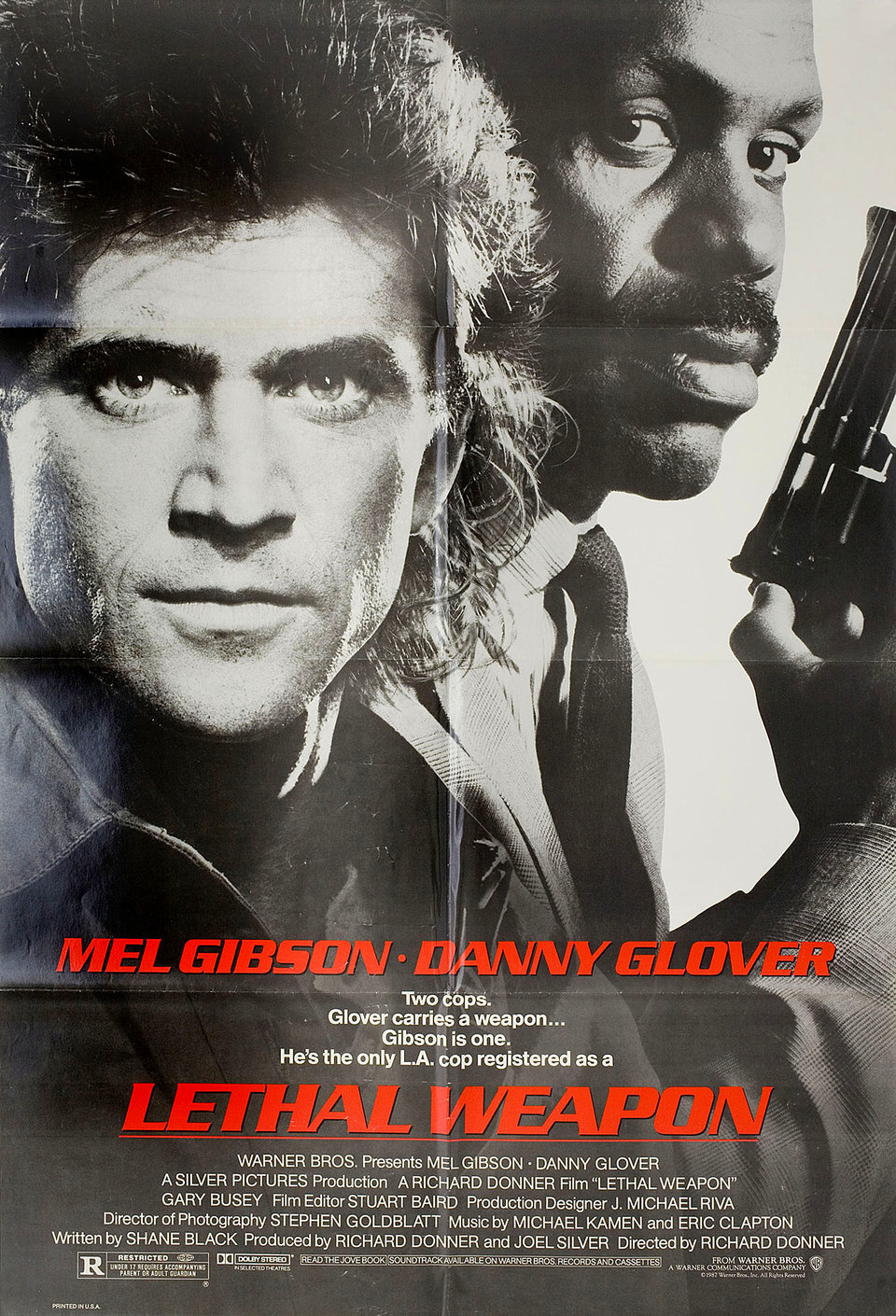
Lethal Weapon (1987) Poster
LETHAL WEAPON (1987) A-
dir. Richard Donner
Lethal Weapon masquerades as a routine action movie, but its central relationship is built on psychological debris. Danny Glover is Roger Murtaugh, a steady LAPD sergeant who’s just turned 50. He’s got a mortgage, a family, and no appetite for surprises. Mel Gibson is Martin Riggs, a narcotics officer in freefall after the death of his wife. He lives in a trailer, drinks with the television on, and is introduced with a loaded pistol in his mouth. He doesn’t pull the trigger. That’s considered progress. The plot—heroin smuggling tied to an ex-military outfit called Shadow Company—starts with a poisoned sex worker and ends in a nighttime shootout involving helicopters and a fire hydrant. It’s efficient, occasionally inventive, but mostly beside the point. What gives the film its grip is the pairing at the center. Murtaugh is methodical, visibly tired, already thinking about retirement. Riggs walks into rooms like he’s hoping someone gives him a reason not to leave. At one point, he pulls a gun on himself in front of a suspect—less tactic than reflex. The risk isn’t staged. It’s baked in. And yet, for a film built on trauma, the tone stays remarkably light on its feet. One scene slides into the next without fuss. Riggs and Murtaugh clash, joke, retreat, and recalibrate in rhythms that feel offhanded but land precisely. Their rapport is brilliant—arguably the finest in the genre. It’s not just chemistry, it’s a pattern of behavior: Riggs tests boundaries to see who’ll stop him; Murtaugh complains but stays in the car. The dynamic doesn’t evolve so much as harden into familiarity. They’re not healing. They’re adjusting. There’s no catharsis, no big emotional release. Just two men who start to operate like a unit, even if they can’t explain why. The shootouts are clean, the pacing steady, but the film’s staying power is in how casually it builds something real out of two people trying not to fall apart on the job.
Starring: Mel Gibson, Danny Glover, Gary Busey, Mitchell Ryan, Tom Atkins, Darlene Love, Traci Wolfe.
Rated R. Warner Bros. USA. 110 mins.
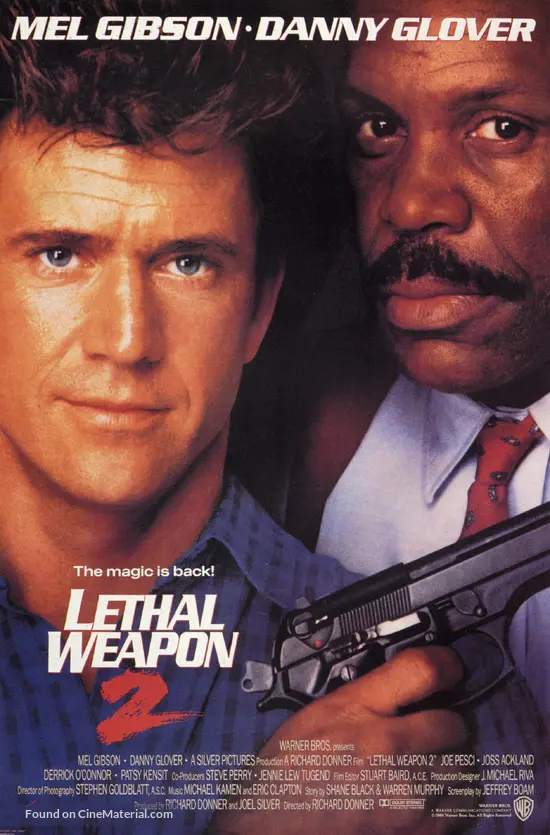
LETHAL WEAPON 2 (1989) Poster
LETHAL WEAPON 2 (1989) B+
dir. Richard Donner
By now Riggs and Murtaugh are practically domestic. The bickering has settled into banter, the shootouts feel more conversational than dangerous, and the partnership has become more sitcom than standoff. Mel Gibson and Danny Glover return with chemistry to burn, chasing what they think is a standard drug ring until it unspools into something gaudier: Krugerrands, apartheid-era diplomacy, and a villain who flashes his immunity papers like a hall pass from Satan. That villain is Arjen Rudd (Joss Ackland), an Afrikaner official so smug he could qualify as a toxic element. Every time they try to book him, he reminds them he can’t be touched—diplomatic immunity. It’s not a boast so much as a loophole with a passport. His henchman (Derrick O’Connor) does most of the dirty work, but Ackland does the sneering. Enter Joe Pesci as Leo Getz, a fast-talking accountant who launders money and won’t stop narrating his own sentences. He should be deadweight—an add-on, a distraction—but he’s funny, nimble, and never unwelcome. The dynamic bends to accommodate him, but never breaks—and the film finds a new groove in the trio’s dysfunction. The action has polish, the jokes hit hard, and the movie’s most bizarre set piece—Murtaugh trapped on a bomb-rigged toilet while Riggs plays nursemaid—somehow pulls off tenderness and slapstick at the same time. There’s also a recurring gag involving Murtaugh’s daughter appearing in a condom ad, which makes every male character in the film visibly malfunction. If the first film nailed the buddy cop blueprint, this one colors in the margins: flashier, sillier, but still sharp. It doesn’t deepen the genre so much as decorate it—and it’s a damn good decoration.
Starring: Mel Gibson, Danny Glover, Joe Pesci, Joss Ackland, Derrick O’Connor, Patsy Kensit, Darlene Love, Traci Wolfe.
Rated R. Warner Bros. USA. 114 mins.
Liar Liar (1997) Poster
LIAR LIAR (1997) B
dir. Tom Shadyac
Jim Carrey, king of rubber-faced mania, pulls things just barely into the realm of the relatable as Fletcher Reede, a smooth-talking Los Angeles lawyer whose greatest skill—lying—vanishes overnight. After breaking one promise too many, his young son Max (Justin Cooper) wishes that, for just one day, his father can’t lie. The universe obliges. What follows is a daylong meltdown in business attire. Fletcher blurts out every inconvenient truth, from elevator confessions to courtroom disasters. And disaster it is—he’s stuck defending a client (Jennifer Tilly) who is transparently, enthusiastically guilty of gold-digging and perjury. With honesty involuntarily switched on, Fletcher can’t spin a thing. He insults witnesses, botches his strategy, and becomes a barely contained wreck of frantic energy and legal self-sabotage. The script itself is flimsy, mostly a playground for Carrey to run, flail, and shred his dignity for laughs. But that energy carries the movie, and there’s a surprising tenderness beneath the contortions. Carrey’s chemistry with Cooper gives the film its emotional hook—you want this man, ridiculous though he is, to become the father his son believes he can be. Supporting cast members drift through in amusing beats—Cary Elwes as the too-nice stepdad, Swoosie Kurtz as a no-nonsense judge—but the spotlight never really leaves Carrey, who weaponizes his physicality with impressive discipline. The jokes hit, not because they’re clever, but because he commits like he’s got something to prove. The ending lands with sentiment, but it’s earned. Liar Liar might be built on a sitcom premise, but with Carrey pushing it to its slapstick limits—and grounding it with real feeling—it becomes something better: a screwball redemption story with a soft heart and a busted filter.
Starring: Jim Carrey, Maura Tierney, Jennifer Tilly, Swoosie Kurtz, Amanda Donohoe, Jason Bernard, Mitchell Ryan, Anne Haney, Justin Cooper, Cary Elwes, Chip Mayer, Eric Pierpoint.
Rated R. Buena Vista Pictures Distribution. USA. 118 mins.
Libeled Lady (1936) Poster
LIBELED LADY (1936) A
dir. Jack Conway
If Libeled Lady isn’t already enshrined as one of the great screwball comedies, it ought to be—and if it is, then we ought to dust off the shrine more often. The plot is the kind of ridiculous you only wish modern comedies could pull off: a major New York newspaper publishes a false story accusing a high-society heiress (Myrna Loy) of chasing a married man, and she responds with a libel suit to the tune of $5 million—enough to bankrupt the paper and probably every ink-stained finger that touches it. Enter Spencer Tracy as the frantic managing editor, who concocts a scheme so convoluted it practically needs blueprints. He ropes in his long-suffering girlfriend (Jean Harlow) to marry his favorite frenemy (William Powell), a debonair fixer with a pocket full of fake backstories, who will then proceed to woo the heiress under this fraudulent identity, seduce her if necessary, and thus retroactively justify the original lie. What could go wrong? Nothing, except for everything. This is a film that runs on banter and bad ideas, and it does both with breathtaking finesse. The dialogue snaps like champagne corks. Loy is all graceful indignation and sly intelligence; Powell glides through the frame like he’s on rollerskates made of charm. Harlow turns what could’ve been a thankless “girlfriend” role into a full-on comedic firework display, and Tracy, in a rare second banana spot, plays frustration like a man whose ulcer has filed for its own ulcer. The movie is decades older than I am, and yet the laughs feel freshly squeezed. I genuinely lost it more than once—sharp lines, perfect timing, chaos delivered with silk gloves. There’s something exhilarating about comedy that moves this fast and lands this clean.
Starring: Jean Harlow, William Powell, Myrna Loy, Spencer Tracy, Walter Connolly, Charley Grapewin, Cora Witherspoon, E. E. Clive.
Not Rated. Loew’s Inc. USA. 98 mins.
The Life Aquatic with Steve Zissou (2004) Poster
THE LIFE AQUATIC WITH STEVE ZISSOU (2004) B
dir. Wes Anderson
This is a film I want to love with my whole chest. The colors alone deserve an ovation—turquoises that could swaddle the Mediterranean, reds that pop like flare guns, yellows that wink like old postcards. The cast reads like a dream assembled by cinephile committee. The concept is sublime. Bill Murray plays Steve Zissou, a washed-up Jacques Cousteau type with a documentary crew, a grudge against a jaguar shark, and the kind of professional résumé that comes with a midlife crisis in every frame. And yet, it never quite swims. It floats, it drifts, it bobs. But something about it feels too effortful, like Anderson tried to fold melancholy into whimsy and the batter never took. The ironies are crisp, the production design is full of handmade charm—sets sliced open like dollhouses, props that belong in a curated nautical museum-slash-toy chest—but the movie itself moves with the emotional weight of papier-mâché. Murray gives a performance so dry it practically peels, channeling grief, ego, and existential rot into a man who can’t connect with anyone, least of all himself. Owen Wilson wanders in as a maybe-son with a polite drawl and daddy issues, while Cate Blanchett plays a pregnant journalist who seems equally unsure why she’s here. The ensemble—a who’s who of delightful oddballs—mostly seem stranded at sea, treading quirk in lieu of direction. And then there’s Seu Jorge, stationed on the ship like a spectral troubadour, playing acoustic David Bowie covers in Portuguese. It’s lovely. It’s perfect. It almost tricks you into thinking the rest of the film is too. The Life Aquatic is a beautiful idea, elaborately staged, and gently adrift. I love everything about it—except the experience of actually watching it.
Starring: Bill Murray, Owen Wilson, Cate Blanchett, Anjelica Huston, Willem Dafoe, Jeff Goldblum, Michael Gambon, Bud Cort, Noah Taylor, Seu Jorge, Robyn Cohen, Seymour Cassel.
Rated R. Buena Vista Pictures Distribution. USA. 118 mins.
Life as We Know It (2010) Poster
LIFE AS WE KNOW IT (2010) C–
dir. Greg Berlanti
It’s easy to watch, hard to respect. Katherine Heigl plays Holly, owner of a boutique bakery. Josh Duhamel is Eric, a sports broadcast director with a bachelor’s fridge. Their mutual friends think they’re perfect for each other and set them up on a blind date. But it goes immediately, horribly wrong. Then those friends die in a car crash and leave behind a one-year-old daughter—plus a will that names both Holly and Eric as joint guardians. If you’re a reasonable human, you might wonder if assigning two barely acquainted people as co-parents was the best move. But the ink’s dry, the couple’s dead, and Holly and Eric inherit the baby, the house, and each other. They move in and do their best. A sneeze sets off a panic call to the pediatrician. Changing diapers becomes an Olympic event. No babysitter means hauling the baby to work, where she proceeds to interfere. Feeding her something or other is always wrong to somebody—purees are too processed, finger foods are choking hazards, formula’s practically poison. But presumably letting her starve would be worse. Unlike the usual Baby Boom setup, this one features a mother and father figure cohabiting, co-parenting, and dating other people. That might’ve been a clever premise for a farce—if only the script weren’t built from distilled sitcom clichés. They bond. They bicker. They can’t open their apparently NASA-designed toilet when the baby’s about to go. The kid takes her first steps while Holly’s mid-bath, surrounded by candles like she’s summoning spirits, so she has to frantically get out. And you already know how this movie ends—it’s never really trying to surprise you. The couple gain a growing respect, there’s the not-quite-jealousy at the other people they’re dating, the late-stage blowup, and the reconciliation. More reliable clockwork than an actual clock. But the movie isn’t painful. It just pickles the brain in soft-focus for a while. A domestic fantasy draped in spit-up.
Starring: Katherine Heigl, Josh Duhamel, Josh Lucas, Christina Hendricks, Hayes MacArthur, Sarah Burns.
Rated PG-13. Warner Bros. USA. 114 mins.
Life of the Party (2018) Poster
LIFE OF THE PARTY (2018) C+
dir. Ben Falcone
Perfectly watchable, occasionally funny, and mostly held together by Melissa McCarthy doing what she does best: turning thin material into something you won’t mind finishing. It’s also exactly what it looks like—a one-note idea stretched to feature length and padded with more filler than invention. The premise is older than the dorm furniture: Deanna (McCarthy), a chirpy suburban mom blindsided by divorce, decides to finish the college degree she abandoned decades ago. The twist—she enrolls at the same university her daughter attends, immediately upending the girl’s social standing. Rodney Dangerfield did it sharper in Back to School, which worked because his insult comedy was built into every line. Here, McCarthy does the heavy lifting alone, and while she’s reliably quick, the script hands her more obvious gags than clever ones. The early stretch hits every expected beat: mom shows up at frat parties, overshares in class, blurts out personal details her daughter would rather burn. It’s broad and harmless, but the routine feels worn out before the halfway point. Strangely, the film doesn’t collapse entirely. As it ambles along, the side plots wake up: Deanna drifts into a fling with a sweet but clueless frat boy, which sets up a genuinely awkward family lunch when the new romance surfaces at the worst possible moment. Her petty skirmishes with her ex-husband (Matt Walsh) and his polished new fiancée (Julie Bowen) get more unhinged in small, satisfying ways. None of it’s vital. If you’ve seen McCarthy steer this sort of suburban mess before, you know exactly where it lands: mild embarrassment, a handful of decent laughs, plenty of filler. But if you have a taste for her brand of good-natured nonsense, she keeps this one afloat just enough to justify the runtime. Not a standout, not a train wreck—just a passable campus detour with a few sparks buried in the clutter.
Starring: Melissa McCarthy, Molly Gordon, Gillian Jacobs, Maya Rudolph, Julie Bowen, Debby Ryan, Stephen Root, Matt Walsh, Chris Parnell.
Rated PG-13. Warner Bros. USA. 105 mins.
Life Stinks (1991) Poster
LIFE STINKS (1991) B-
dir. Mel Brooks
A minor Mel Brooks outing by any metric—but I’d be lying if I said I didn’t enjoy it. It’s not a spoof, which might throw his usual devotees off, but a romantic comedy—one with soot under its fingernails and a surprisingly warm pulse underneath the scruff. Brooks, directing and starring, plays Goddard Bolt, a billionaire real estate developer who accepts a bet from a smug associate (Jeffrey Tambor) that he couldn’t last thirty days living on the street. Hubris obliges, and he’s promptly dropped into the urban underbrush with nothing but his name and a tailor-made suit to ruin. The premise is built for satire but only skims the surface. What gives the film its staying power isn’t its critique of wealth or urban decay—it’s the unexpected tenderness that begins to peek through the cracks. Bolt doesn’t just stumble around in slapstick squalor; he changes, awkwardly and incrementally, thanks to the rough camaraderie of a ragtag street community and the jittery affections of a woman named Molly (Lesley Ann Warren), a delusional firebrand with a heart that runs deeper than her monologues suggest. There are plenty of reasons to dismiss Life Stinks: the setup is wobbly, the screenplay leans on easy beats, and Warren’s performance occasionally slips into high-volume theater. But there’s real feeling here, too—Brooks tones himself down in places, letting his character actually feel something rather than just react. Even the most eccentric supporting players aren’t just gag delivery systems—they form a makeshift world where decency stubbornly survives. This isn’t top-tier Brooks, and it’s hardly essential. But for a director known for skewering the absurd, it’s oddly touching to watch him reach for something earnest—and not entirely miss.
Starring: Mel Brooks, Lesley Ann Warren, Jeffrey Tambor, Stuart Pankin, Howard Morris.
Rated PG-13. Metro-Goldwyn-Mayer. USA. 92 mins.
A Life Too Short: The Isabella Nardoni Case (2023) Poster
A LIFE TOO SHORT: THE ISABELLA NARDONI CASE
(2023) C+
dir. Micael Langer & Claudio Manoel
Isabella Nardoni was five. She fell—or was thrown—from a sixth-floor window in São Paulo, and Brazil didn’t so much react as combust. The media turned the case into a nightly ritual, with news anchors howling theories before the forensics team had even zipped the bag. The father and stepmother were charged, then convicted, and the public nodded along like they’d solved it themselves in real time, from the couch. The documentary walks through the case like it’s afraid to scuff its shoes. Everything is neatly arranged: trial footage, taped interviews, a solemn narrator parsing contradictions like they’re museum pieces. The parents’ statements don’t match. The evidence doesn’t quite cohere. And somewhere in the middle of this curated mess, a suggestion: maybe this wasn’t as airtight as everyone decided it was. The film raises the flag and then immediately folds it back up—neatly, politely. Visually, it’s slick—lots of drone shots, tasteful re-creations, the usual forensic-glow editing that true crime adopted once it realized it wanted awards. But there’s no pulse behind the packaging. The outrage has been decanted, the horror flattened. We’re left with a case that once gripped a nation, now delivered in a tone that could narrate museum tours or onboard safety videos. Is it competent? Yes. Is it compelling? Less so. It re-tells a tragedy with the calm of someone reading from a laminated card. There’s a story here that rattles. The documentary, unfortunately, doesn’t.
TV-MA. Netflix. Brazil. 88 minutes.
Life with Father (1947) Poster
LIFE WITH FATHER (1947) A-
dir. Michael Curtiz
A household in constant motion, one might say—and all of it orbiting a single red-headed planet named Clarence Day Sr., played to perfection by William Powell. He is a man of firm convictions, stricter routines, and an unshakable belief that if the universe would just follow his example, everything would fall neatly into place. Instead, his wife, four sons, a revolving door of frazzled servants, and the world in general seem determined to unravel him. Powell is in top form here—commanding, exasperated, and hilariously precise. Clarence doesn’t yell so much as erupt in fully formed editorials, punctuated by incredulity and a desire for one blessed hour of order. The irony, of course, is that his own fussy declarations often cause the very chaos he aims to quell. The Day household is a model of bustling disorder, made all the more entertaining by subplots that bubble up with the regularity of tea kettles: the ongoing hunt for a maid that won’t flee in terror, the eldest son’s tentative romance with a visiting Elizabeth Taylor (already a luminous screen presence), and the late-breaking scandal that Clarence, upstanding Presbyterian though he is, was never baptized. Directed with buoyancy by Michael Curtiz, Life with Father is that rare studio-era comedy that still feels sprightly. The dialogue crackles—funny, literate, and shockingly modern in its rhythm. Irene Dunne matches Powell beat for beat as his genteel but quietly scheming wife, and the ensemble fills out the frame with eccentric warmth. It’s a comedy of manners that never loses its sense of play. What could’ve been a sentimental wallow is instead a sharply observed portrait of domestic life, where love is expressed not in grand gestures, but in bickering, bustling, and the refusal to sit still.
Starring: William Powell, Irene Dunne, Elizabeth Taylor, Edmund Gwenn, Zasu Pitts, Jimmy Lydon, Emma Dunn, Moroni Olsen, Elisabeth Risdon.
Not Rated. Warner Bros. USA. 118 mins.
Load Next Page