Film Buff Musings

by Michael Lawrence

List of "D" Movies


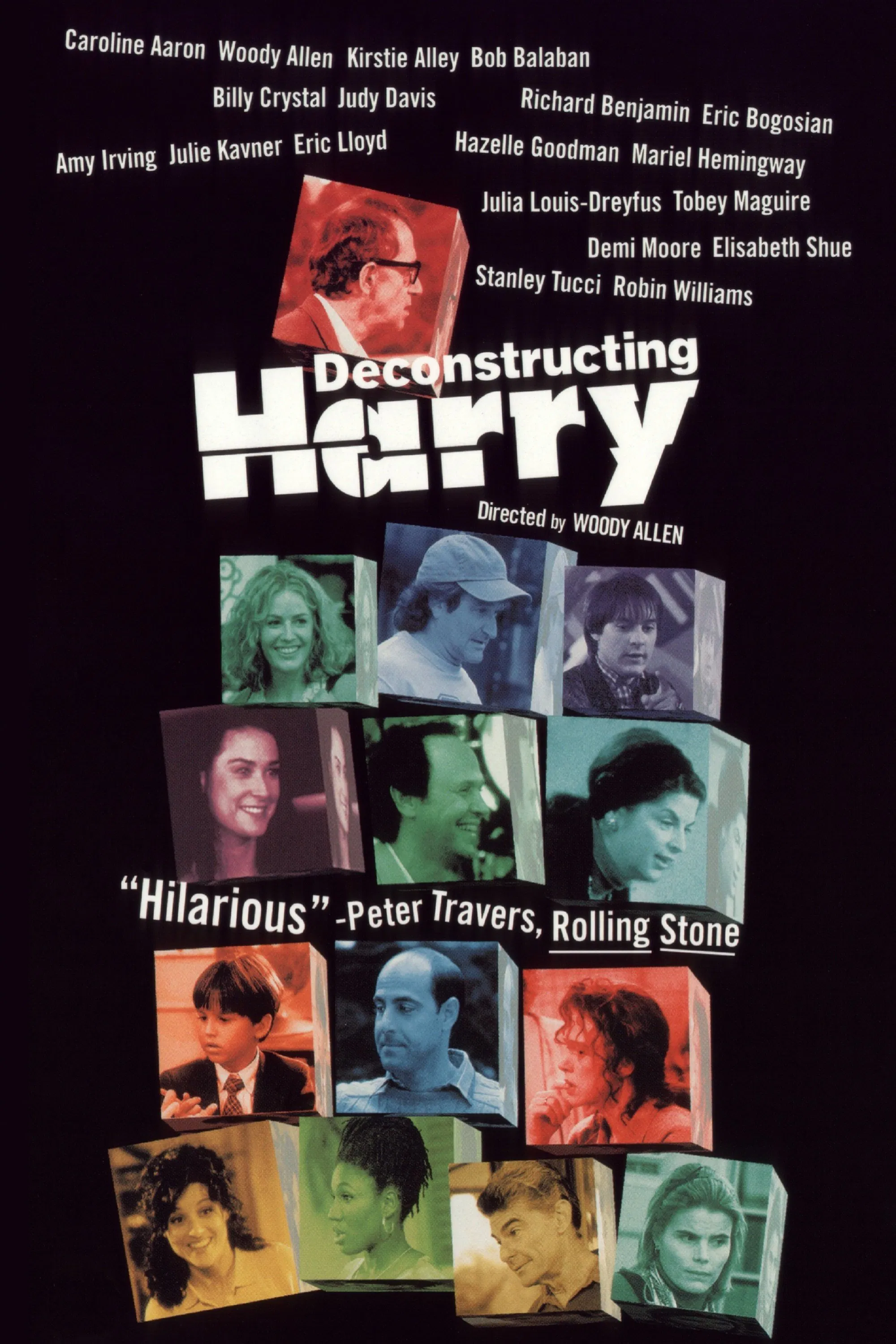
Deconstructing Harry (1997) Poster
DECONSTRUCTING HARRY (1997) B+
dir. Woody Allen
One of Woody Allen’s sharper late-career efforts, Deconstructing Harry is less a narrative than a neurotic fever chart—spiked with guilt, sex, and metafictional cross-talk. Allen plays Harry Block, a thinly veiled stand-in for himself, a writer who’s spent a career raiding his personal life for material. Ex-wives, sisters, old flames—they’ve all made appearances in his work, and none of them are thrilled about it. The film bounces between reality, fiction, and the bits in between. Characters walk out of stories and into arguments. Flashbacks are refracted through short stories, sometimes with stand-ins for the stand-ins. At one point, Harry lies on his therapist’s couch, only for the scene to flash into one of his stories, where a fictionalized Harry (Tobey Maguire) is doing the exact same thing. Elsewhere, Robin Williams plays an actor who’s gone “out of focus”—a clever sight gag that doubles as a comment on identity, alienation, or possibly just bad lighting. The structure is deliberately cluttered, as if the film is being assembled from mismatched fragments Harry himself can’t quite control. There are hallucinations, dream sequences, and imagined confrontations, all colliding in a blur of creative panic and personal fallout. That might sound exhausting—and it sometimes is—but Allen’s timing remains sharp, and his sour little aphorisms still hit their targets. It’s a film best appreciated by viewers already tuned to Allen’s frequency. For everyone else, it may come off as disjointed or self-indulgent. But for fans, it’s a kind of artistic exorcism—a confessional dressed up as farce, honest enough to sting and absurd enough to deflect the blow.
Starring: Woody Allen, Judy Davis, Elisabeth Shue, Billy Crystal, Kirstie Alley, Demi Moore, Tobey Maguire, Robin Williams, Richard Benjamin, Bob Balaban, Stanley Tucci, Julia Louis-Dreyfus, Mariel Hemingway, Eric Bogosian.
Rated R. Fine Line Features. USA. 96 mins.
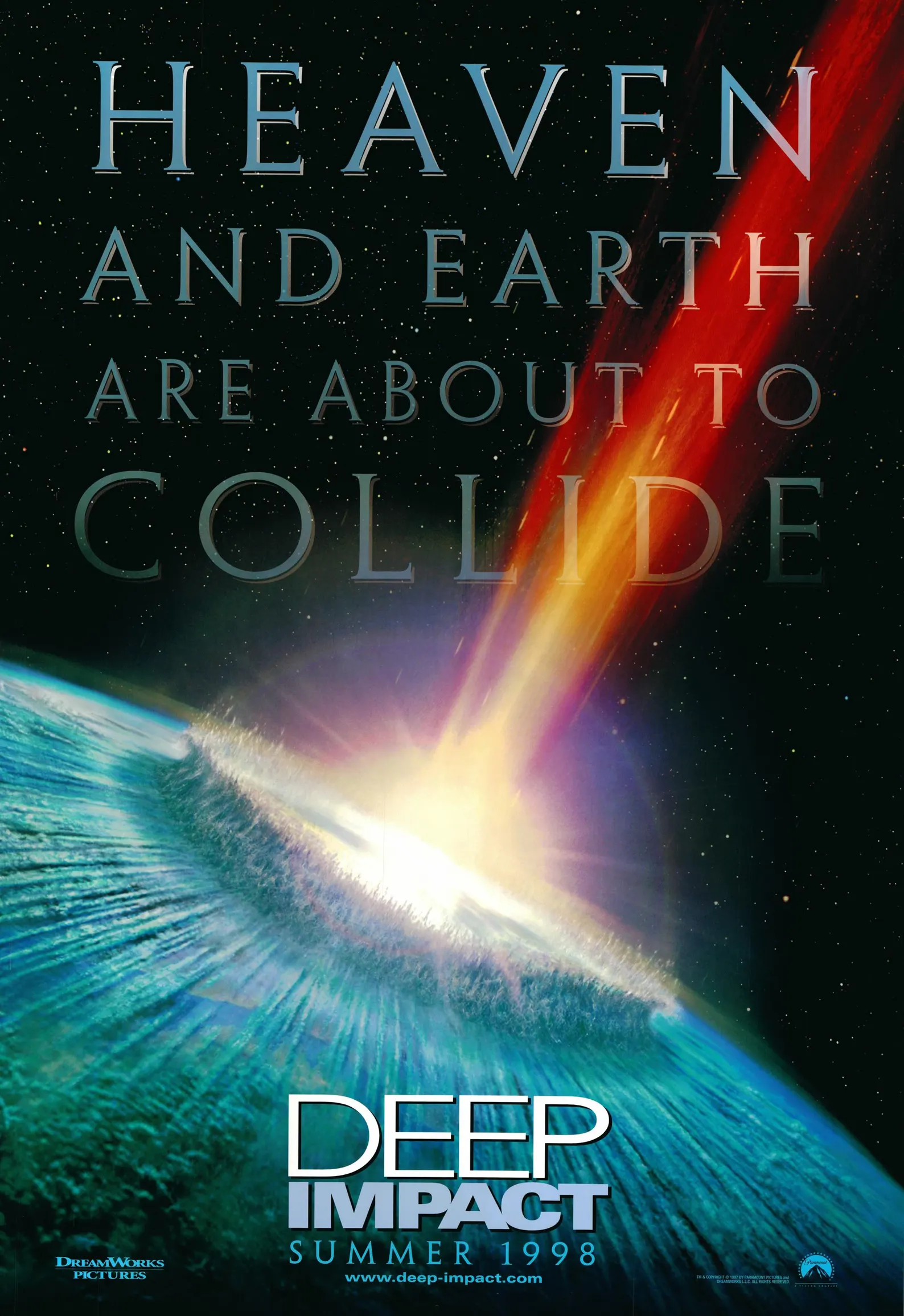
Deep Impact (1998) Poster
DEEP IMPACT (1998) B-
dir. Mimi Leder
Disaster films are rarely known for restraint, but Deep Impact at least tries to feign some. The premise is the usual: a celestial object is headed for Earth, the world is ending, and we have about two hours to get sentimental. Only this time, the mood is less screaming mobs and more quiet dread. Less Armageddon, more soft-focus apocalypse. It kicks off when an astronomy club teen (Elijah Wood) stumbles onto what he thinks is a new star. Turns out it’s a comet the size of Mount Everest, locked on a direct path toward Earth. There’s a brief chain of scientists looking alarmed, and then we’re informed it’s an “Extinction Level Event”—capitalized and everything. From there, we check in with a cross-section of representatives: Wood and his vaguely defined love interest (Leelee Sobieski), a TV reporter (Téa Leoni) who becomes the reluctant face of the story, her strangely composed mother (Vanessa Redgrave), a crew of astronauts led by Robert Duvall, and Morgan Freeman as a President with the bedside manner of a hospice nurse. The film occasionally flirts with silliness—Wood and Sobieski reuniting dramatically moments before impact plays like the world’s least convincing Nicholas Sparks epilogue—but overall, it holds together. It’s a disaster movie that, for once, doesn’t feel the need to flatten every landmark on the map to make a point. There are better films in this genre, and certainly louder ones. But Deep Impact earns some credit for keeping its voice down. The planet might be doomed, but at least no one’s trying to punch the comet.
Starring: Téa Leoni, Morgan Freeman, Elijah Wood, Robert Duvall, Leelee Sobieski, Vanessa Redgrave, Maximilian Schell, James Cromwell, Jon Favreau, Mary McCormack.
Rated PG-13. Paramount Pictures. USA. 120 mins.
Deep in the Valley (2009) Poster
DEEP IN THE VALLEY (2009) C-
dir. Christian Forte
A raunchy comedy with a premise that suggests Pleasantville by way of late-night cable, Deep in the Valley imagines a world built on the logic of vintage adult films—where plumbers don’t fix pipes, secretaries lose their blouses before lunch, and plot is something to fast-forward through. It’s a setup with real potential: a send-up of porn’s stilted universe and the way its tropes bleed into mainstream fantasy. But the film never makes the leap. It just reenacts the clichés, grinning at them like that counts as a joke. Chris Pratt, years before Guardians of the Galaxy but already locked into his lovable-loser rhythm, plays Carl—a beer-guzzling slacker who, along with his straight-laced best friend Lester (Brendan Hines), stumbles into this alternate universe via a magical “vintage pornography video machine.” What follows is a fish-out-of-water story dressed in bad wigs, cheap puns, and sitcom-level smirking. Pratt coasts on charm. Hines plays the straight man with functional dullness. Neither has much to work with. The film toys with satire but won’t commit. It’s not bold enough to be wild, not smart enough to be subversive, and not funny enough to get away with either. You can see the version of this movie that might have worked—a ridiculous, self-aware takedown of porn logic and the fantasies it feeds. This one just reenacts the scenes with better lighting and slightly more irony. It doesn’t crash so much as idle in place.
Starring: Chris Pratt, Brendan Hines, Scott Caan, Rachel Specter, Kate Albrecht, Denise Richards, Christopher McDonald, Blanca Soto, Tracy Morgan.
Rated R. Persistent Entertainment. USA. 96 mins.
Deep Red (1975) Poster
DEEP RED (1975) B+
dir. Dario Argento
Dario Argento’s Deep Red is a horror film soaked in style and laced with enough menace to keep your eyes glued to the screen—even when you’re not entirely sure what’s holding the plot together. As with much of Argento’s work, narrative coherence is less of a priority than pure sensation. And what a sensation it is. David Hemmings plays Marcus Daly, an English jazz pianist living in Turin who, while walking home one night, witnesses a murder through the window of a neighboring apartment. A woman is attacked with horrifying precision, and Marcus—drawn to the scene by instinct, bad luck, or both—becomes fixated on the idea that something was off. A painting he thinks was there now isn’t. He can’t place what he saw, but it gnaws at him. The police are useless, the media paint him as a witness, and before long he’s hearing a creepy children’s lullaby playing outside his door—usually followed by a whisper that feels far too specific to be a hallucination. The camera doesn’t just observe—it glides, tilts, and pans like it’s stalking something. Even ordinary scenes get warped into something strange, thanks to Argento’s off-kilter framing and blasts of saturated color. You begin to second-guess furniture. The plot may be a little slippery in places, but it’s never dull. Argento fills the frame with striking images—a murdered psychic, a jagged mural, and, in one unforgettable moment, a demonic mechanical puppet that lurches out of nowhere with a grin that should have come with a warning label. This is, undeniably, style over substance—but the style is electrifying, and the substance is sturdy enough to carry it. Aesthetically fearless and rhythmically strange, Deep Red isn’t just a slasher—it’s a gallery of violence and dream logic that sticks with you long after the blood dries.
Starring: David Hemmings, Daria Nicolodi, Gabriele Lavia, Macha Méril, Clara Calamai, Eros Pagni, Giuliana Calandra.
Not Rated. Rizzoli Film. Italy. 127 mins.
The Deer Hunter (1978) Poster
THE DEER HUNTER (1978) A
dir. Michael Cimino
A haunting, slow-burn epic about friendship, trauma, and the brutal reshaping of identity under war. The Deer Hunter is less about Vietnam than about what it does to the people who go—what it carves out of them, what it leaves behind. The film is divided cleanly into thirds: before, during, and after. But the emotional through-line is anything but orderly. The first hour, set in a working-class Pennsylvania steel town, feels almost leisurely. There’s a wedding, a hunting trip, rounds of bar chatter, even a little piano playing—just men passing time before being sent off to fight a war they barely understand. The night before deployment hangs heavy with stillness, like a slow goodbye. No one quite knows how to say what they’re afraid of. When the war arrives, it does so with hallucinatory violence—abrupt, surreal, and unforgiving. The infamous Russian roulette sequences are the centerpiece, but also a kind of thesis: these men aren’t fighting battles so much as enduring existential torment, spun on a chamber. It’s not about military strategy or battlefield heroism. It’s about how the human psyche splinters under random, intimate cruelty. Some of them come home. Some never really do. What’s remarkable is how precisely the film captures that disorientation—how familiar faces return as altered versions of themselves, too haunted to fully re-enter the lives they left. Michael (Robert De Niro), Nick (Christopher Walken), and Steven (John Savage) are never reduced to types. Each is drawn with specificity, depth, and quiet heartbreak. Walken, in particular, looks like someone whose soul is still orbiting somewhere above Saigon. Despite its three-hour runtime, the film never drags. It lingers, yes—but in that deliberate, contemplative way that allows you to sit with these characters, feel their ache, and experience time as they do: fractured, loaded, disjointed. The Deer Hunter is an unshakable work—elegiac, brutal, and intimate. A film that begins with a wedding and ends in a stunned rendition of “God Bless America,” unsure whether it’s mourning or pleading. A masterpiece, absolutely.
Starring: Robert De Niro, Christopher Walken, John Savage, Meryl Streep, John Cazale, George Dzundza, Chuck Aspegren, Shirley Stoler, Rutanya Alda.
Rated R. Universal Pictures. USA. 183 mins.
Déjà Vu (2006) Poster
DÉJÀ VU (2006) C+
dir. Tony Scott
Some action movies take a familiar formula and inject a clever sci-fi twist. Déjà Vu drowns itself in one—introducing a wildly complex premise, then stretching, reshuffling, and re-explaining its own rules every 20 minutes. By the time the film has expanded, refined, and twisted itself into knots, keeping track feels like chasing a shadow. Not that it matters much. Tony Scott, a director who never met an edit he couldn’t quicken, is after momentum, not coherence, and the result is an action movie that keeps moving just fast enough to keep you from asking too many questions. It begins with an explosion. A ferry in New Orleans, hundreds dead, an act of terrorism that leaves behind only wreckage and questions. Enter Douglas Carlin (Denzel Washington), an ATF investigator with an instinct for patterns and a habit of being the smartest man in the room. His latest puzzle: Claire Kuchever (Paula Patton), whose body washes ashore hours before the explosion—her injuries suggesting she was both a victim and a prelude. The mystery deepens when Carlin is brought to a top-secret government lab, where a team of scientists unveils their mind-bending surveillance system—a device that lets them observe any location, from any angle, exactly four days in the past. The catch: Once they pick a vantage point, it’s locked. No rewinds, no fast-forwards—until, of course, the film decides otherwise. From there, Déjà Vu barrels ahead, throwing logic to the wind in favor of spectacle. The technology bends whenever the plot needs it to, shifting from a surveillance thriller into a full-blown time-travel rescue mission. The action is slick, the dialogue snaps, and Washington, as always, makes every scene feel smarter than it actually is. But ultimately, the film doesn’t quite work. It is too intricate and too careless—a thriller so tangled in its own mechanics that it forgets to let them matter. At its best, it’s entertaining in fits and bursts. At its worst, it’s exhausting. Déjà Vu doesn’t need you to believe it—it just hopes you’re too dazzled to notice it doesn’t add up.
Starring: Denzel Washington, Paula Patton, Val Kilmer, Jim Caviezel, Adam Goldberg, Elden Henson, Erika Alexander, Bruce Greenwood, Matt Craven, Elle Fanning, Enrique Castillo.
Rated PG-13. Buena Vista Pictures Distribution. USA. 126 mins.
Deliverance (1972) Poster
DELIVERANCE (1972) A-
dir. John Boorman
An adventure, at least in theory. Four suburban men with paddles and misplaced confidence set off on a weekend canoe trip through the backwoods of Georgia, determined to conquer a river that will soon be swallowed by a reservoir. A chance to leave behind their city lives, test their endurance, reconnect with something primal. But just outside Atlanta, they might as well have driven into another century. The locals don’t just look at them—they size them up, the way a predator evaluates something that’s wandered into the wrong terrain. There’s a warning in their silence, but the men, brimming with the false assurance of outsiders who mistake their surroundings for a playground, are too preoccupied to hear it. Burt Reynolds’ Lewis is the ringleader, the self-styled survivalist, the one who insists they’re ready. Jon Voight’s Ed plays the cautious observer, willing to follow but unable to shake the feeling that they may be in over their heads. Ned Beatty’s Bobby is the loudest and least prepared, his flippant attitude setting him up for the film’s most infamous reckoning. Ronny Cox’s Drew, more thoughtful than the rest, takes the first tentative step toward understanding their surroundings—his wordless “Dueling Banjos” exchange with a young, eerily silent local standing out as an omen in plain sight. The scene plays like a riddle they don’t yet realize they’re failing to solve. The river is wild, the landscape magnificent, and for a brief moment, their adventure is exactly what they wanted it to be. Then, in an instant, it isn’t. The film’s turning point—the brutal, shattering rape of Bobby—arrives without prelude, its stark realism eclipsing the impact of most horror films. No music, no stylization, no way to look away. What follows is a slow, agonizing descent into survivalism of the most unforgiving kind. Kill or be killed. Bury the evidence and move on. The thrill of their adventure curdles into something they will never escape, not in the woods, not in their homes, not in the quiet moments when their minds wander back. The first half of Deliverance is taut, thrumming with dread, every interaction weighted with something unspoken. The second half, while still gripping, settles into a more straightforward survival narrative, its energy never quite matching the unbearable tension of what came before. But maybe that’s the point. The horror doesn’t lie in the struggle to escape. It lies in what they take with them. This is a film that doesn’t just stay with you—it embeds itself and resurfaces in flashes like something half-remembered from a nightmare.
Starring: Jon Voight, Burt Reynolds, Ned Beatty, Ronny Cox, Bill McKinney, Herbert “Cowboy” Coward, James Dickey, Billy Redden.
Rated R. Warner Bros. Pictures. USA. 109 mins.
The Delta Force (1986) Poster
THE DELTA FORCE (1986) B-
dir. Menahem Golan
A brisk, no-nonsense action film that puts Chuck Norris in his natural habitat—gunning down terrorists and saving the day with a stoic expression and a roundhouse kick. This time, he’s up against Lebanese hijackers who seize control of a Boeing 707, holding its passengers hostage in a situation loosely inspired by real-life airline hijackings of the era. The movie can’t quite decide if it wants to be a nerve-wracking political thriller or a gleefully excessive shoot-’em-up, so it spends its first half wringing suspense from the hijacking—lingering on sweaty brows, trembling hands, and overwrought moral dilemmas—before tossing all that aside in favor of a slam-bang spectacle where Chuck Norris and his elite commandos mow down terrorists with the effortless efficiency of a Saturday morning cartoon. The script flirts with psychological depth—hostages whispering about survival, hijackers justifying their brutality, a plane full of fear and tension—but this is all foreplay to the inevitable moment when Delta Force comes roaring in. The film wants the audience to feel the weight of its Jewish passengers being separated from the rest, but the moment lands with the kind of exaggerated solemnity that can only exist in a film counting the minutes until its lead character storms in on a tricked-out motorcycle. The reality of terrorism, the trauma of captivity—these are merely things to be avenged, swept aside in favor of clean-cut heroics. Lee Marvin, in his final film role, brings his usual flinty authority, but he’s only here to introduce the main act. Norris, expressionless and indestructible, stomps through the film like an action figure come to life, moving from set piece to set piece, dealing out justice with the detached efficiency of someone who knows he’ll never lose a fight. He doesn’t act so much as exist, a living embodiment of 1980s American invincibility. The dialogue barely matters, the performances register only in the broadest strokes, but none of that gets in the way of the film’s true priorities: one-liners, slow-motion shots of terrorists flying through the air, and an unwavering belief in the catharsis of a well-timed explosion. It’s all ridiculous, and it’s not trying to be anything else. The Delta Force plays like a child’s idea of geopolitical conflict—black-and-white morality, unstoppable heroes, and villains just competent enough to justify wiping them off the map. It doesn’t build tension so much as it bides time, waiting for the moment when it can unleash its star on the problem. And when it does, it’s fast, loud, and every bit as blunt as you’d expect.
Starring: Chuck Norris, Lee Marvin, Martin Balsam, Joey Bishop, Robert Forster, Lainie Kazan, George Kennedy, Hanna Schygulla, Susan Strasberg, Bo Svenson, Robert Vaughn, Shelly Winters.
Rated R. The Cannon Group. Israel-USA. 129 mins.
Delta Force 2: The Colombian Connection (1990) Poster
DELTA FORCE 2: THE COLOMBIAN CONNECTION
(1990) C
dir. Aaron Norris
Chuck Norris, dead-eyed and indestructible, fights the drug war with his fists, his boots, and his unwavering belief in American justice. The first Delta Force had a loose tether to real-world events; this one operates entirely in action-movie fantasy, where narcoterrorists run entire countries, cocaine flows like a biblical plague, and only one man can stop it. There’s no tension, no suspense—just a waiting game until Norris storms in and starts dealing out justice in quantities too large for the human body to absorb. His opponent: Billy Drago, looking like a wax statue that might come to life if you touched it wrong, turning in the kind of slow-burning villainy that elevates bad material into something almost hypnotic. He’s gaunt, reptilian, soaking every scene in menace while Norris, barely shifting his expression, waits for the go-ahead to dismantle his empire. Dialogue is a formality, character development a distraction, and moral complexity an obstacle best ignored. The action moves efficiently, at least. Helicopters, jungle fortresses, slow-motion gunfire, a villain’s downfall orchestrated with the precision of a checklist. The film believes its message—drugs are bad, Chuck Norris is good—and delivers it with the subtlety of a public service announcement wrapped in an explosion. Not particularly good, not exactly bad, just another exercise in brute-force filmmaking where every problem can be solved by applying enough firepower to the right part of the map.
Starring: Chuck Norris, Billy Drago, John P. Ryan, Richard Jaeckel, Begona Plaza, Paul Perri, Hector Mercado, Mark Margolis.
Rated R. Metro-Goldwyn-Mayer. USA. 111 mins.
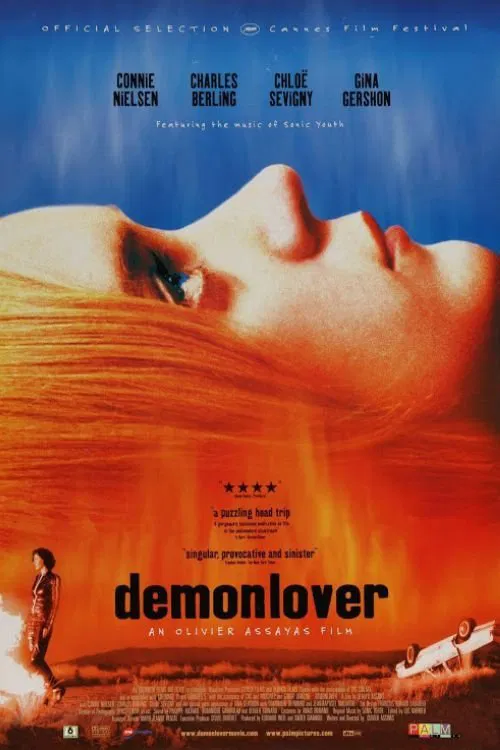
Demonlover (2002) Poster
DEMONLOVER (2002) B
dir. Olivier Assayas
Demonlover wears the look of a polished corporate thriller but runs on something colder: a quiet reminder of how easily espionage, adult content, and casual cruelty pass for business as usual when everyone agrees not to look too closely. At the center is Diane (Connie Nielsen), an executive at a French media company angling to lock down the Western rights to a Japanese studio pushing 3D hentai just far enough into the mainstream to look like legitimate entertainment. The plan is simple enough until rival companies, secret payouts, and an off-the-books site called the Hellfire Club start peeling back any illusion of respectability. That club, incidentally, doesn’t traffic in fantasy — it live-streams real torture to paying subscribers who prefer to think of it as “extreme content.” The film stays more unsettling than graphic. Nielsen holds it steady: her Diane is ruthless when needed, but too sure she’s the smartest person in the room to see who’s playing her. Charles Berling circles as Hervé, a colleague whose loyalty shifts whenever convenient. Chloë Sevigny, as the assistant Elise, watches, waits, and turns the tables at exactly the worst moment—without a flicker of regret. Assayas handles the nastier threads with a straight face. The ugliest moments flicker by on monitors or echo through off-screen whispers—corporate glass boxes where people in tasteful suits haggle over streamed misery and congratulate themselves for calling it product instead of filth. Demonlover belongs to that sharp little pocket of early-2000s thrillers that didn’t quite know how prescient they were—too cool at the time, almost too on-the-nose now. What’s left is a cold, steady look at how people shrug off the worst human appetites so long as there’s profit and a password shielding them from the fallout. Not for everyone, but if you like your thrillers mean, sleek, and just a shade too believable, it’s worth the discomfort.
Starring: Connie Nielsen, Charles Berling, Chloë Sevigny, Dominique Reymond, Jean-Baptiste Malartre, Julie Brochen, Alicia Hava.
Rated R. Palm Pictures. France. 122 mins.
The Departed (2006) Poster
THE DEPARTED (2006) A–
dir. Martin Scorsese
Martin Scorsese’s The Departed reimagines the 2002 film Infernal Affairs (dir. Andrew Lau & Alan Mak)—a sleek Hong Kong noir—by dragging it into South Boston, tossing it a brick, and telling it to go make trouble. The plot is a double helix of deception: two men on either side of the law, twisting closer with every step. Leonardo DiCaprio plays Billy Costigan, undercover and unraveling—nerves like exposed wire, hands that don’t stop twitching. Matt Damon, as Colin Sullivan, moves like he’s been in costume since childhood. His suits fit too well. His smile lasts a beat too long. Jack Nicholson, as Frank Costello, leaks into the film like toxic gas—grinning, grandiose, swinging a severed hand like a prop he brought from home. He doesn’t act so much as detour through scenes, waving guns and theories like party favors. He’s not so much a man, but a bad mood with a face. The movie jumps—fast cuts, blunt force dialogue, surveillance screens and confessionals stitched into a rhythm that’s more manic than methodical. Mark Wahlberg shows up like someone took the lid off a pressure cooker. Vera Farmiga, somehow both overqualified and outnumbered, threads grace into a film built like a pipe bomb. Martin Sheen tries to keep things steady, but even he knows what’s coming. Scorsese tightens the whole thing until it squeals. Fates flip mid-line. Secrets burst out like engine parts. The violence doesn’t climb—it detonates. And when it ends, it doesn’t tie off. It collapses. The last shot doesn’t settle anything—it just lets you know the game’s over, and the house always collects. The Departed doesn’t mimic Infernal Affairs—it swings harder, bleeds more, and slaps the chessboard off the table before the checkmate even clicks into place.
Starring: Leonardo DiCaprio, Matt Damon, Jack Nicholson, Vera Farmiga, Mark Wahlberg, Martin Sheen, Ray Winstone.
Rated R. Warner Bros. USA. 151 mins.
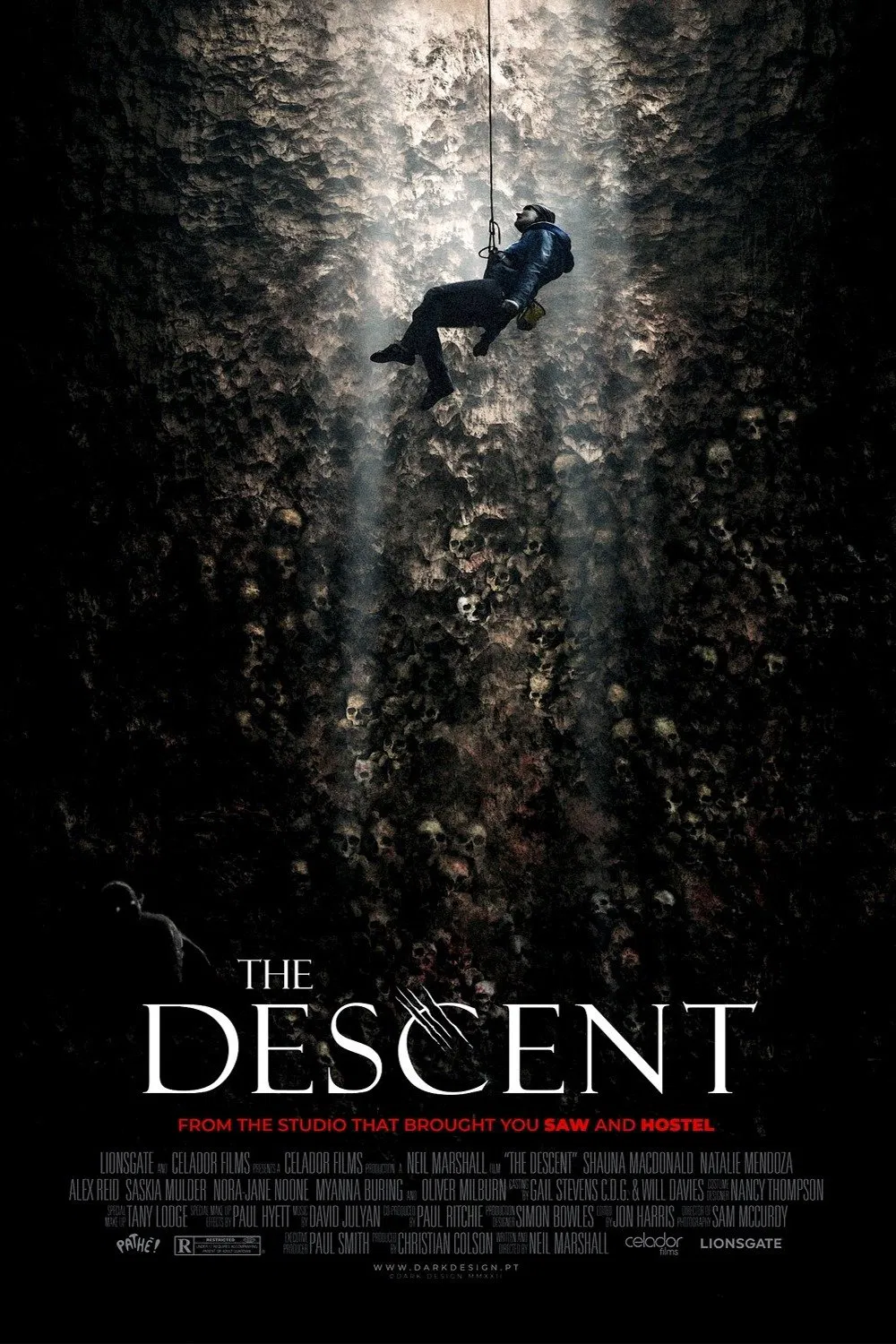
The Descent (2005) Poster
THE DESCENT (2005) A-
dir. Neil Marshall
A claustrophobic shriek-fest that doubles as a lesson in what not to do with your weekend. The Descent begins as six thrill-seeking women go spelunking in the Appalachian backwoods and promptly stumble into a cave system that—surprise—isn’t on any official map. At first, the danger is purely geological: tight spaces, bad directions, the mounting dread that the next crawlspace might be a dead end. But then come the noises. The movement. The realization that the cave is already occupied. Director Neil Marshall builds this one like a pressure chamber—airtight, dimly lit, and designed to squeeze until something snaps. What starts as a survival thriller quietly molts into full-on creature horror, complete with humanoid cave-dwellers that lurch from the shadows like Gollum’s inbred, far less sociable cousins. The film’s pleasures are brutal and visceral: gory standoffs lit by headlamps, a blood pit you’d rather not think too hard about, and fight scenes that feel more like blind scrambles for air than anything choreographed. It never blinks, and you’re not given the luxury either. The all-female ensemble isn’t spotlighted so much as matter-of-factly present—which, in its own way, is refreshing. The film doesn’t pause to pat itself on the back for novelty. It’s too busy grinding down your nerves like a cracked molar. If there’s a flaw, it’s that the characters don’t register much beyond their stress responses. We know just enough to tell them apart, not quite enough to mourn them properly. But maybe that’s the point. In this cave, everyone’s meat.
Starring: Shauna Macdonald, Natalie Mendoza, Alex Reid, Saskia Mulder, Nora-Jane Noone, MyAnna Buring.
Rated R. Lionsgate. UK. 99 min.
The Descent Part 2 (2009) Poster
THE DESCENT PART 2 (2009) B
dir. Jon Harris
It begins exactly where the first film left off, which is another way of saying we’re back in the same miserable cave with the same hungry mutants and the same bad ideas. The lone survivor, still caked in blood and breathing like a trampled animal, has forgotten everything—an amnesia subplot no one asks too many questions about, probably because it gets her back underground without further fuss. A search party is assembled, lanterns are lit, and down they all go, single file, into the hole. The crawlers—those pallid, shrieking, evolutionary dead-ends—remain right where we left them, still blind, still peckish, and still very good at dismantling a human torso in under ten seconds. The atmosphere is once again thick with damp rock, panic sweat, and flashlight beams that always seem to fail at the wrong moment. The original was a pressure cooker. This is more of a reheat—warmer than expected, but you can tell it’s been microwaved. Still, the movie gets the job done. The close quarters feel appropriately miserable, the pacing doesn’t dawdle, and the kills have a utilitarian splatter to them. Nobody here is safe, and the film, to its minor credit, doesn’t pretend otherwise. You’ve seen this furniture before, yes—but it’s been moved just enough to stub a toe on.
Starring: Shauna Macdonald, Natalie Mendoza, Krysten Cummings, Gavan O’Herlihy, Joshua Dallas.
Rated R. Lionsgate. UK. 94 min.
Desperados (2020) Poster
DESPERADOS (2020) D
dir. LP
A rom-com with all the charm of a headache. It begins predictably enough—Wesley (Nasim Pedrad), a romantically unlucky guidance counselor, meets Jared (Robbie Amell), a handsome, seemingly perfect guy. They hit it off, spend the night together, and then, radio silence. Ghosted, or so she thinks. A few drinks and a deranged email later, she discovers the truth: Jared wasn’t ignoring her. He was in a coma in Mexico. So naturally, she and her two best friends (Anna Camp and Sarah Burns) hop on a plane to break into his hotel and delete the evidence before he regains consciousness. This should be a harmless, mildly amusing rom-com detour. Instead, it pitches itself off the rails and into some bizarre netherworld where comedy is mistaken for a series of random, escalating humiliations. A dolphin attack that turns vaguely pornographic. A recurring gag where Wesley keeps making inappropriate advances toward an underage boy. The film lurches between set pieces, each one grasping wildly for shock value, as though terrified of running out of momentum. It’s slapstick without rhythm, raunch without payoff, all strung together with a script that seems to be challenging itself to see how far it can push bad taste before anyone notices. Pedrad, the one bright spot, commits fully to the lunacy, throwing herself into every pratfall, but even she can’t outrun the script’s desperation. The movie barrels toward a rom-com resolution, but by the time it gets there, the mechanics have rusted over, and all that’s left is the hollow clunk of a genre film running on fumes. A miscalculation from start to finish, Desperados mistakes movement for comedy, noise for humor, and humiliation for fun.
Starring: Nasim Pedrad, Anna Camp, Lamorne Morris, Sarah Burns, Jessica Chaffin, Toby Grey, Mo Gaffney, Izzy Diaz, Heather Graham.
Rated TV-MA. Netflix. USA. 105 mins.
Deuce Bigalow: Male Gigolo (1999) Poster
DEUCE BIGALOW: MALE GIGOLO (1999) C-
dir. Mike Mitchell
The premise is idiotic, the title is a threat, and for a while, the movie delivers exactly what you’d expect: a series of tone-deaf sketches stitched together by Rob Schneider’s baffling confidence that he can carry a film. He plays a fish tank cleaner who becomes a male escort out of financial desperation—not that the movie ever bothers to sell that as anything but a setup for a parade of “defective” clients. Too tall, too obese, too clumsy, too narcoleptic—it’s a freakshow posing as a self-esteem campaign. At one point, the film tries to make a case for kindness: Schneider’s Deuce gives a speech about how women hate their bodies and just want to be told they’re sexy. Moments later, a towering woman takes the witness stand in court (only shown from the neck down, because subtlety is for other movies), and the peanut gallery lets loose: “Freak!” “That’s a huge bitch!” Like a punchline served with a brick. And yet—and this is the frustrating part—it doesn’t stay awful. Around the halfway mark, a romantic subplot creeps in, and for a few scenes, the movie seems to stop elbowing you in the ribs. Arija Bareikis brings something like warmth to her role, and Schneider, against the odds, almost manages to play a human being. There’s a brief stretch where the film feels like it’s trying to earn your goodwill instead of hijack it. But then he cooks dinner in snorkel gear or wallops someone with a prosthetic leg, and you remember exactly what kind of movie this is. There’s a front, but no lift. Schneider mugs his way through the role like a backup dancer trying to freestyle a solo. He’s no Jim Carrey. He’s not even Adam Sandler. Deuce Bigalow isn’t quite unwatchable. It’s just the kind of bad that thinks it’s pulling something off. It doesn’t. But by the end, you’re almost grateful it stopped trying.
Starring: Rob Schneider, Arija Bareikis, Eddie Griffin, Oded Fehr, Gail O’Grady, Richard Riehle.
Rated R. Touchstone Pictures. USA. 88 minutes.
The Devils (1971) Poster
THE DEVILS (1971) B
dir. Ken Russell
Ken Russell doesn’t direct so much as set fire to the screen and let it burn. The Devils is history reimagined as an unholy circus—nuns thrashing in hysteria, priests wielding power like a cudgel, a Catholic monarchy indulging itself in grotesque pageantry. The premise comes straight from the history books: a hunchbacked, sexually tormented nun (Vanessa Redgrave) fixates on a rebellious priest (Oliver Reed), jealousy warping into accusation, accusation into mass hysteria. The result is a public spectacle of witch hunts and torture, dressed in gold and drowning in filth. Russell doesn’t hold back. His version of 17th-century France pulses with theatrical depravity—demonic possessions that play like drug-fueled raves, inquisitors gleefully engineering suffering, sacred spaces twisted into playgrounds for power and lust. It revels in shock, but the beauty of it is how deliberately crafted the shocks are. Derek Jarman’s production design turns the city of Loudun into a surrealist prison—white brick fortresses, yawning archways, spaces too clean for a world this corrupt. The contrast only makes the ugliness inside them fester. Reed, smirking and sensual, plays Grandier with enough swagger to explain why half the convent is in heat. Redgrave, all twisted limbs and whispered torment, turns Sister Jeanne into a study in self-loathing, her desire bleeding into religious mania. Their performances are operatic, and the film matches them at every turn. Graham Armitage’s Louis XIII struts through like a degenerate court jester, parading in drag and treating executions as after-dinner entertainment. Nothing about The Devils is restrained, least of all the script, which treats history as a launching pad for something bigger, stranger, too blasphemous to be ignored. As horror, it shocks more than it unsettles. But as spectacle, it mesmerizes. A film that barrels forward in a delirium of sex, power, and religious hypocrisy, refusing to pause for breath. The Catholic Church may have condemned it, but Russell films as though he’s already excommunicated, with nothing left to lose.
Starring: Oliver Reed, Vanessa Redgrave, Dudley Sutton, Max Adrian, Gemma Jones, Murray Melvin, Michael Gothard, Georgina Hale, Brian Murphy, John Woodvine, Christopher Logue, Kenneth Colley.
Rated R. Warner Bros. USA. 111 mins.
Diary of a Madman (1963) Poster
DIARY OF A MADMAN (1963) B-
dir. Reginald Le Borg
A must for Vincent Price completists, if not quite a horror standout. The premise has teeth, the sets have polish, and Price—as always—commits. But for a story about demonic possession and unraveling sanity, the film plays it oddly safe. Price stars as Simon Cordier, a respected French magistrate whose diary—read posthumously—reveals a mind not broken but hijacked. He wasn’t mad, he insists. He was haunted. By the Horla: an invisible, parasitic force that whispers, tempts, and eventually takes over. It first appears after Cordier kills a prisoner he believes is possessed, then moves on to him, like evil with a forwarding address. What follows is a slow, methodical slide into paranoia. Cordier hears voices, loses time, and begins to question which thoughts are truly his. It’s a strong setup, and Price carries it with his usual blend of grandiosity and inward panic. But the film can’t quite sustain the dread. The Horla’s disembodied voice—more breathy soap villain than cosmic menace—deflates the tension, and the script never sharpens the stakes. Still, there’s atmosphere to spare. The production design leans gothic without going full baroque, and the mood stays agreeably creaky throughout. Adapted (loosely) from Maupassant, it’s more literary in tone than lurid, which both helps and hurts: the themes linger, but the pacing sags. Price, though, finds the sweet spot—pitching Cordier somewhere between rational terror and theatrical doom. The film doesn’t quite earn the madness in its title, but it wears its unease well. You just wish the Horla had more bite.
Starring: Vincent Price, Nancy Kovack, Chris Warfield, Elaine Devry, Ian Wolfe.
Not Rated. United Artists. USA. 96 mins.
Die Another Day (2002) Poster
DIE ANOTHER DAY (2002) B–
dir. Lee Tamahori
Bond begins this one waterlogged, bruised, and politically inconvenient. Captured in North Korea mid-mission and left to rot for fourteen months, he comes back thinner, quieter—and not entirely trusted. M (Judi Dench) has him debriefed, detained, and politely accused of leaking intel. He disagrees. And walks out. From there, the film dusts off the franchise polish. There’s a shady biotech mogul named Gustav Graves (Toby Stephens), a genetically altered North Korean colonel, a satellite with a solar death ray, and a nightclub made entirely out of ice. Halle Berry shows up as Jinx, an NSA agent with a slow-motion entrance à la Ursula Andress—emerging from the sea in an orange bikini, tossing one-liners, and leaving behind enough debris to count as plot. The villain, meanwhile, has diamonds embedded in his face—a souvenir from an earlier explosion, and maybe the film’s most committed visual gag. He fences, not well, but compensates with access to space weapons and the kind of charisma that suggests he’s auditioning to be an action figure. It’s silly, sleek, and occasionally stupid, but never quite dull. Brosnan coasts through with the professionalism of a man who knows his tux still fits, and the action sequences—while increasingly physics-optional—are nothing if not energetic. By the time we get to the invisible car, it’s clear the film has gone full cartoon. But for a series that’s always done its best work flirting with the ridiculous, Die Another Day does manage to keep the flirting fun.
Starring: Pierce Brosnan, Halle Berry, Toby Stephens, Rosamund Pike, Rick Yune, Judi Dench.
Rated PG-13. MGM/United Artists. UK-USA. 133 mins.
Dinosaur (2000) Poster
DINOSAUR (2000) C
dir. Ralph Zondag, Eric Leighton
At the time, a marvel. CGI dinosaurs moving through real-world landscapes, the kind of technological sorcery that made audiences sit up in their seats, wondering how animation had come this far. But technology marches on, and what once dazzled now merely exists—no longer seamless, no longer magic. The live-action backdrops, once an inspired touch, now expose the separation between reality and digital artifice, a trick that no longer holds under high-definition scrutiny. But even if the animation still impresses, the storytelling never rose to meet it. A visual spectacle saddled with a plot that feels borrowed—plucked straight from The Land Before Time, stripped of its poignancy, and repackaged with a Disney sheen. Aladar, an iguanodon raised by lemurs (voiced by D.B. Sweeney), embarks on a migration tale we’ve seen before, leading a ragtag herd across a scorched landscape in search of safe, green pastures. They battle hunger, exhaustion, and the obligatory carnivorous threats, but the danger never quite grips, the emotional stakes never fully take root. For a film so grand in scale, the characters feel strangely small—archetypes more than personalities, designed more for function than connection. The wise elder, the cowardly follower, the brutish antagonist—none leave much of an imprint. The film wants to inspire awe, to immerse us in a prehistoric odyssey, but too often, it feels like a carefully animated nature documentary awkwardly paired with the most generic version of a hero’s journey. Still, Dinosaur remains a testament to Disney’s ambition, even if it never becomes the landmark it was intended to be. A technical marvel for its moment, a curiosity in retrospect. The bones are there, but the soul never quite made it through the extinction event.
Voices of: D. B. Sweeney, Alfre Woodard, Ossie Davis, Max Casella, Hayden Panettiere, Samuel E. Wright, Julianna Margulies, Peter Siragusa, Joan Plowright, Della Reese.
Rated PG. Walt Disney Pictures. USA. 82 mins.
Dirty Dancing (1987) Poster
DIRTY DANCING (1987) A-
dir. Emile Ardolino
The story isn’t new—privileged girl meets working-class boy, love crosses social lines, the world tries to keep them apart—but Dirty Dancing understands that execution matters more than originality. What keeps people coming back isn’t the plot, but the sheer energy, the chemistry, the way it makes falling in love feel like stepping into a perfect rhythm. Jennifer Grey’s Baby is the idealistic daughter of an upper-middle-class family, spending the summer at a staid Catskills resort where every activity is carefully curated to ensure that nothing unexpected happens. But then she drifts into the orbit of the resort’s working-class staff and sees something unfiltered—sweat, movement, bodies colliding to the beat of something that feels dangerous and thrilling. And at the center of it, Johnny (Patrick Swayze), the dance instructor who moves like every step is second nature, confident in his body in a way Baby has never known. When Johnny’s dance partner Penny (Cynthia Rhodes) finds herself pregnant and in need of an abortion—illegal at the time—Baby steps in, first with money, then with her own two feet. She volunteers to take Penny’s place in a critical performance, even though she has never danced like this in her life. What follows isn’t just a love story but a transformation, a girl shedding the person she thought she was, learning how to trust herself and, more importantly, her own movement. The story works well enough to pull you in, but Dirty Dancing isn’t a film of plot points—it’s a film of moments. The lake scene, Baby’s trust wavering as Johnny lifts her into the air, water splashing around them. Jerry Orbach’s quiet devastation as he realizes Johnny isn’t the villain he assumed. And, of course, that final dance—Baby’s leap into the unknown, Johnny’s triumphant return, the entire room swelling with I’ve Had the Time of My Life, carrying the sheer euphoria of two people finding perfect sync. To dismiss it as lightweight is to miss the point. Dirty Dancing is about the electricity of transformation, the pulse of first love, the intoxicating rush of breaking the rules and getting it exactly right. Not just a romance. Not just a dance movie. Dirty Dancing understands that transformation should feel electric, that romance should make your pulse race, that the right song at the right moment can turn an ordinary night into something mythic.
Starring: Jennifer Grey, Patrick Swayze, Jerry Orbach, Cynthia Rhodes, Jack Weston, Jane Brucker, Kelly Bishop.
Rated PG-13. Vestron Pictures. USA. 100 mins.
Disclosure (1994) Poster
DISCLOSURE (1994) C+
dir. Barry Levinson
A tech-thriller with a harassment twist and a CD-ROM subplot, Disclosure wants to feel provocative but mostly circles around in a corporate holding pattern. Michael Douglas plays Tom Sanders, a Seattle executive expecting a promotion and instead getting a new boss—Meredith Johnson (Demi Moore), a former flame in tailored suits and litigation-ready heels. She calls him into her office, pours the wine, makes a move—and by the end of the meeting, he’s defending himself against a misconduct claim. It was branded “bold” in 1994: a man suing a woman for sexual harassment. But the film treats the reversal like a thesis, not a story. The mediation scenes are sleek—cool, clipped, and faintly claustrophobic. Everything else plays like a glorified tech demo with sexual politics wedged between user prompts. Tom’s wife (Caroline Goodall) exists mostly to be skeptical, then supportive. Moore gives Meredith a predator’s polish, but there’s no mystery to her—just motive, drawn in permanent marker. There’s also a corporate merger, a crooked executive (Donald Sutherland), and an extended sequence in a virtual reality archive that’s meant to thrill but mostly looks like someone trying to escape a haunted Windows 95 screensaver. Disclosure wants heat, suspense, relevance—but what it really delivers is workflow. Staged, procedural, faintly shiny. Whatever shock it thought it had has long since evaporated.
Starring: Michael Douglas, Demi Moore, Donald Sutherland, Caroline Goodall, Roma Maffia, Dylan Baker.
Rated R. Warner Bros. USA. 128 mins.
The Discreet Charm of the Bourgeoisie (1972) Poster
THE DISCREET CHARM OF THE BOURGEOISIE (1972) A-
dir. Luis Buñuel
A dinner party that never quite happens. Invitations extended, outfits pressed, appetites sharpened, but every attempt to sit down and eat unravels—an absent host, a misplaced date, a sudden act of violence, a restaurant that runs out of everything but drinks. The guests remain gracious, undeterred, their frustration buried under decorum, because losing one’s temper would be far worse than missing a meal. Buñuel toys with reality the way a magician palms a coin. Some dreams are labeled, others slip in unnoticed, until even the most ordinary conversations feel slightly off-kilter. And then, suddenly, the whole illusion rips wide open. The group finally sits down to eat, but they don’t slice—the meal gleaming on their plates is made of plastic. The curtain behind them lifts, and there they are, actors in a play they didn’t know they were performing. The audience jeers. They freeze. Their nightmare isn’t just hunger. It’s being seen for what they are. The satire lands lightly, never forced. The dialogue is crisp, the pacing effortless, the humor elegant. The interruptions pile up with such casual certainty that by the time a bishop moonlights as a gardener and dinner guests are sentenced to death between sips of wine, it feels like the only logical progression. This is a movie that, in its own slippery way, is both playful and razor-sharp. The Discreet Charm of the Bourgeoisie never stops shifting, never quite resolves itself, but like its characters, you follow along anyway—because what else is there to do?
Starring: Fernando Rey, Paul Frankeur, Delphine Seyrig, Bulle Ogier, Stéphane Audran, Jean-Pierre Cassel, Julien Bertheau, Milena Vukotic, Claude Piéplu.
Rated PG. 20th Century Fox. France-Italy-Spain. 101 mins.
Disenchanted (2022) Poster
DISENCHANTED (2022) C
dir. Adam Shankman
There’s a specific trap sequels fall into when they try to deepen characters who were never built for depth in the first place. Disenchanted doesn’t just step into it—it swan-dives. Ten years after the first film, Giselle (Amy Adams) is still radiating uncut cheer, undeterred by time, circumstance, or the fact that no one around her seems to share her blood-sugar levels. Her husband (Patrick Dempsey) doesn’t mind. Her teenage stepdaughter Morgan (Gabriella Baldacchino) minds very much. She’s reached the age where the word “stepmother” gets spat like a slur, and Giselle—fairy-tale optimism intact—can’t quite see what’s wrong. There’s a new baby. There’s a move to the suburbs. And there’s a castle-shaped house so garish it could be sued for impersonating a theme park. Giselle feels something’s missing—namely, the magic. So she wishes for more of it. The town snaps into fairy-tale mode: talking animals, pantomime villains, and enough ballgowns to clog a dry cleaner. Trouble is, Giselle doesn’t become the heroine. She becomes the evil stepmother. Which might be interesting if the film did anything with it. But Adams, gifted as she is, seems a little stranded—too nice to be nasty, too broad to be scary. The original charm came from watching a fairy-tale creature flail through the real world. Here, we’re stuck watching a slightly meaner fairy-tale creature flail through a fake one. The premise flips itself inside out and finds nothing new in the lining. To be fair, a few jokes land, and those who adored the first film may enjoy the reunion. The energy’s cheerful. The songs exist. But there’s nothing to uncover—familiar themes shuffled like flashcards, costumes that look borrowed, and a fantasy world that plays like a demo reel. Giselle’s descent into villainy registers mostly as wardrobe changes and louder line readings. I laughed. Occasionally. But mostly I watched with the faint disappointment of someone who wanted a little mischief and got a plastic tiara instead.
Starring: Amy Adams, Patrick Dempsey, Gabriella Baldacchino, James Marsden, Idina Menzel, Maya Rudolph, Yvette Nicole Brown, Jayma Mays.
Rated PG. Walt Disney Studios Motion Pictures. USA. 121 mins.
Do or Die (1991) Poster
DO OR DIE (1991) D
dir. Andy Sidaris
Do or Die is another round in Andy Sidaris’ long-running “guns and swimsuits” cycle, setting up a pulp thriller and then nodding off behind the wheel. Pat Morita plays a crime lord who, for reasons never clarified, decides to hunt two federal agents—Dona Speir and Roberta Vasquez—not with a bullet, but with a formal challenge: a head start, then waves of killers. It should feel like a countdown. Instead, it feels like stalling. The assassins show up in pairs. The ambushes blend together—half-speed shootouts, recycled setups, soft lighting. Morita phones it in from a recliner, watching his goons fail like he’s half-tuned into a bad TV marathon. There’s a remote-controlled car bomb—an inspired idea, perhaps—but it’s only a small flourish in a film that is otherwise smothered with rote repetition: setup, slow-motion gunplay, quick escape, repeat. The cast looks camera-ready and surgically enhanced but otherwise disengaged. The action is lifeless, the dialogue just enough to fill the gaps. Sidaris has made junkier movies, and he’s made more fun ones. Do or Die manages neither. It’s pulp without pop—shiny, shapeless, and out of gas.
Starring: Pat Morita, Erik Estrada, Dona Speir, Roberta Vasquez, Bruce Penhall, Cynthia Brimhall, William Butler.
Rated R. Malibu Bay Films. USA. 97 mins.
Do You Know the Muffin Man? (1989) Poster
DO YOU KNOW THE MUFFIN MAN? (1989) D
dir. Gilbert Cates
Anyone watching this to find out who the Muffin Man is will leave empty-handed. The title’s a misdirection—there’s no nursery rhyme, no reference, not even a nickname. What you get instead is a TV melodrama about child abuse, moral panic, and cross-examination—with the kind of title that suggests a playground mystery but delivers a courtroom dirge. The film dropped right into the heart of the late-’80s day care sex-abuse hysteria, and while I won’t accuse it outright of exploiting the panic… it knew the market. Pam Dawber, still best known as Mindy from Mork & Mindy, plays Kendra, a suburban mother who grows convinced that her young son Teddy (Brian Bonsall) was abused at his day care. The child, notably, says very little. But that doesn’t stop her from prying—mostly during bedtime, when she seems determined to extract a confession while the kid’s trying to fall asleep. If he wasn’t traumatized going in, he might be now. The film clearly means to shock and inform, but it mostly hectors. Courtroom scenes go operatic—lots of impassioned monologues, plenty of finger-pointing, no room left for doubt or restraint. I laughed a few times, not because it was funny, but because the volume gets so high that the script starts to short-circuit. It’s handsomely shot, and Dawber does what she can with a role that mostly involves alternating between worry and indignation. But the writing is slanted, the tone is punishing, and the message—whatever it was aiming for—gets buried under hysteria. There’s nothing wrong with confronting a difficult subject. But this isn’t confrontation. This is hyper-dramatized panic, and by the end, I didn’t feel moved—I just wanted it to be over.
Starring: Pam Dawber, John Shea, Brian Bonsall, Stephen Dorff.
Not Rated. CBS. USA. 100 mins.
Doc Hollywood (1991) Poster
DOC HOLLYWOOD (1991) C+
dir. Michael Caton-Jones
Michael J. Fox, grinning like he’s got an inside joke with the universe, plays Dr. Ben Stone, a freshly minted surgeon with one foot out of residency and the other flooring the gas pedal of a 1956 Porsche Speedster. The plan: Hollywood, where a career in plastic surgery promises money, status, and the kind of clients who treat their faces like ongoing construction projects. But destiny—disguised as a picket fence and a small-town judge (Roberts Blossom) who dispenses justice with the enthusiasm of a man who rarely gets this kind of entertainment—has other plans. One wrecked car and 32 hours of community service later, Stone is stuck in Grady, South Carolina, patching up locals who haven’t seen a new doctor since the invention of penicillin. The setup is a Capra rerun with a fresh coat of ‘90s gloss. The big-city doctor grumbles, the town extends a reluctant welcome, and the script gets busy proving that true wealth comes in the form of simple pleasures, small acts of kindness, and a picturesque Main Street where even the pig has a social life. The residents of Grady are the usual suspects—bickering old men keeping score like their lives depend on it, a mayor (David Ogden Stiers) who governs like an undefeated chess player, and a love interest (Julie Warner) who walks out of a lake like she’s auditioning for a Greek mythology reboot. She’s unimpressed by credentials, unimpressed by charm, unimpressed by anything except people who aren’t full of themselves, which puts Stone at a significant disadvantage. The film moves at the pace of a Sunday afternoon, drifting from one genial moment to the next. The jokes are soft, the stakes barely glance at tension, and when the pivotal choice arrives—Stone, gazing at Grady with something dangerously close to sentiment—it carries the weight of a man deciding between cherry pie and peach cobbler. There’s no real conflict, just a series of pleasant encounters that nudge him in a direction we all saw coming the moment his car hit that fence. Fox keeps it all watchable, running on sheer affability. He sells his exasperation, sells his reluctant amusement, sells the transition from condescending outsider to honorary townsperson with such ease that you might not notice the movie coasting on his performance. It never strains, never pushes, never aims for more than exactly what it is—a pleasant, undemanding ride through a town where the biggest emergency is a newcomer mistaking his own restlessness for ambition.
Starring: Michael J. Fox, Julie Warner, Barnard Hughes, Woody Harrelson, David Ogden Stiers, Frances Sternhagen, George Hamilton, Bridget Fonda, Mel Winkler, Helen Martin, Roberts Blossom.
Rated PG-13. Warner Bros. USA. 103 mins.
Doctor Dolittle (1967) Poster
DOCTOR DOLITTLE (1967) C-
dir. Richard Fleischer
A musical fantasy I keep wanting to love far more than I ever actually do—yet every time I circle back to it, I end up shaking my head at how it stumbles over its own grand ideas. Right at the top of the missteps: Rex Harrison. He’s polished, naturally, and pours on his usual sly charm, but I’ve never quite bought the idea that this spotless English gentleman would let an entire zoo lounge around his drawing room. You can’t convince me he wouldn’t be scolding a monkey for soiling the good carpet five minutes in. Then there’s the music. Everyone knows “Talk to the Animals,” though mostly because every singer with a tux has given it a spin over the decades. The rest? Blink and you’ll forget every note by the time the credits roll. And for a film that wants to feel breezy and full of mischief, the pacing is downright lead-footed. By the time the giant sea snail drifts into view—like a pleasure boat on sedatives—you’re torn between appreciating the novelty and wondering why it took half a lifetime to arrive. Not that it’s all bad news. The widescreen Technicolor still looks lush enough to brighten a rainy afternoon, and if you’re a fan of cute animals mugging for the camera, there’s an endless parade—though I could do without the two-headed llama, which looks like a prop that escaped from a horror set. You can see what they were aiming for: a big, cheerful musical stuffed with talking beasts, gentle adventure, and songs you’d hum on the ride home. But somewhere between the glossy budget and the leaden pacing, most of that charm slips away. You can’t say it’s ugly or cheap—only that you keep wishing someone had tightened the reins and given the actual animals more room to upstage the humans.
Starring: Rex Harrison, Samantha Eggar, Anthony Newley, Richard Attenborough, Peter Bull.
Rated G. 20th Century Fox. USA. 152 mins.
Dr. No (1962) Poster
DR. NO (1962) B
dir. Terence Young
Sean Connery materializes at the baccarat table, all cigarette smoke and unconcerned elegance, and in three words—“Bond. James Bond.”—the character steps fully formed into cinematic permanence. He doesn’t find his footing, doesn’t ease into the role. He simply exists, exactly as he should, moving through the film with the confidence of a man who’s never had to ask permission for anything. The plot can catch up when it’s ready. M (Bernard Lee, exasperation personified) assigns Bond to investigate the murder of a British agent in Jamaica, a man who got too close to some radio signals interfering with American rocket launches. Bond touches down, assesses the situation, and proceeds to eliminate threats with a kind of cold, practiced efficiency that makes his later gadget-laden exploits feel almost excessive. There’s an assassination attempt before he’s even unpacked, a few betrayals to sort out, and the uneasy realization that someone is watching his every move. The trail leads to Crab Key, a restricted island with guards who shoot first and ask questions never. The villain, Dr. No (Joseph Wiseman, delivering menace in clipped, deliberate tones), has been orchestrating all this from his underground lair, an architectural marvel with an alarming number of large, blinking control panels. This is Bond before the ejector seats and wristwatch lasers, before MI6 stocked his suitcase with tricks. The fights are brutal and unpolished—Connery doesn’t toy with opponents; he takes them down with quick, decisive blows. He isn’t invincible yet, but the film doesn’t let him bleed too much either. He calculates, adapts, moves forward. The action has weight, and when Bond kills, it isn’t a moment for quips—it’s a loose end being handled. And then, Honey Ryder. Ursula Andress stepping out of the surf in a white bikini, shell knife strapped to her hip, instantly guarantees her place in cinema history. She’s the Bond girl, the first template, the original. The film treats her entrance with reverence, pausing just long enough to let the moment register before Bond greets her like she’s simply another piece of the mystery unfolding around him. Dr. No himself, with his half-smirk and measured politeness, sizes Bond up with mild curiosity before deciding to remove him permanently. The film doesn’t waste time with cat-and-mouse games—No invites Bond to dinner, gives him the standard villain pitch, and, upon rejection, moves straight to imprisonment and torture. There’s no elaborate monologue, no self-sabotaging arrogance, just a controlled, methodical removal of obstacles. Bond, naturally, declines to be removed. Compared to the later films, Dr. No feels almost stripped down. The budget is modest, the spectacle restrained, the villain’s plot more clinical than theatrical. But Connery carries it, proving that Bond doesn’t need an Aston Martin or an exploding pen to be magnetic. He just needs presence. The film watches him, watches how he moves, and decides that’s quite enough.
Starring: Sean Connery, Jack Lord, Joseph Wiseman, Ursula Andress, Zena Marshall, Eunice Gayson, Lois Maxwell, Margaret LeWars, John Kitzmiller, Bernard Lee, Anthony Dawson.
Not Rated. United Artists. UK-USA. 109 mins.
Doctor Strange in the Multiverse of Madness (2022) Poster
DOCTOR STRANGE IN THE MULTIVERSE OF MADNESS
(2022) B-
dir. Sam Raimi
The Marvel Cinematic Universe wasn’t vast enough, so now it multiplies, stacking realities like a shuffled deck. Doctor Strange (Benedict Cumberbatch), still toggling between arrogance and exasperation, finds himself crashing through them thanks to America Chavez (Xochitl Gomez), a teenager whose portal-punching abilities make her a walking target. Wanda Maximoff (Elizabeth Olsen), no longer mourning the children she lost in WandaVision so much as rejecting the very idea of loss, sees America as the key to a reality where her boys are real—and nothing, least of all reason, will stop her. Olsen plays Wanda with an unnerving calm, grief curdled into a singular purpose. The Darkhold has whispered its way into her psyche, convincing her that morality is an obstacle, not a boundary. She moves through the film like an apparition, unrelenting, immune to pleas. Cumberbatch, assured as ever, gets to test-drive variations of himself across dimensions, clashing with versions that have either succumbed to corruption or obliterated their own universes. Gomez, given little more than “kid-on-the-run” duty, makes an impression, though her arc is thin. The multiverse gives Raimi room to play. A city where traffic flows in opposite directions, a surreal montage of shifting realities, a necromantic third act that lets him fully indulge his horror instincts—this is the most stylistic freedom Marvel has allowed in years. The camera tilts, zooms, hurtles forward. A fight scored entirely with floating musical notes lands somewhere between genius and mischief. But for every inspired sequence, there’s a scene bogged down by explanation. The film keeps stopping to clarify itself when it should be sprinting ahead. It introduces fascinating realities—a utopian world ruled by the Illuminati, a desolate one where Strange has already lost—but doesn’t linger long enough to explore their full potential. It’s Marvel’s weirdest film in years, but a wilder, sharper version feels trapped inside, clawing to get out. Even when Multiverse of Madness stumbles, Raimi’s imprint is unmistakable. That’s more than most of these films can say.
Starring: Benedict Cumberbatch, Elizabeth Olsen, Chiwetel Ejiofor, Benedict Wong, Xochitl Gomez, Michael Stuhlbarg, Rachel McAdams.
Rated PG-13. Walt Disney Studios Motion Pictures. USA. 126 mins.
Dr. Strangelove or: How I Learned to Stop Worrying and Love the Bomb (1964) Poster
DR. STRANGELOVE OR: HOW I LEARNED TO STOP WORRYING AND LOVE THE BOMB
(1964) A
dir. Stanley Kubrick
A satire so incisive it hasn’t lost an ounce of bite, Dr. Strangelove skewers Cold War paranoia and nuclear brinkmanship with a precision that still stings. The story begins when an unhinged Air Force general, Jack D. Ripper (Sterling Hayden), orders his bomber fleet to attack Russian targets, convinced the Communists are polluting America’s “precious bodily fluids.” In Washington, politicians and military brass scramble to stop a war that’s already slipping from their grasp—except for one bomber still en route, oblivious to the catastrophe it’s about to trigger. Kubrick’s direction, paired with a script stacked with some of the most darkly hilarious lines in cinema history, makes the absurdity feel unnervingly plausible. Peter Sellers vanishes into three completely distinct roles—stiff-upper-lipped Group Captain Lionel Mandrake, hapless U.S. President Merkin Muffley, and the eponymous Dr. Strangelove, a former Nazi scientist whose mechanical arm still hasn’t quite let go of its allegiances. Sellers is brilliant in all three, shifting between restraint, bewilderment, and barely contained mania. George C. Scott barrels through the film as General “Buck” Turgidson, a gum-smacking Cold Warrior who salivates at the thought of full-scale nuclear engagement. Slim Pickens, playing it completely straight, turns B-52 pilot Major Kong into a rodeo cowboy of doom, riding a bomb to oblivion in one of the most iconic shots ever filmed. The black-and-white cinematography heightens the film’s surreal tension, with the War Room’s cavernous design and its infamous “Big Board” adding to the sense that rationality is just a performance. The humor is so precise, the performances so wildly on-point, that by the time Vera Lynn’s “We’ll Meet Again” plays over a montage of mushroom clouds, the film achieves something remarkable—it makes total annihilation feel not just inevitable, but eerily polite.
Starring: Peter Sellers, George C. Scott, Sterling Hayden, Keenan Wynn, Slim Pickens, Peter Bull, Tracy Reed, James Earl Jones, Jack Creley, Frank Barry.
Not Rated. Columbia Pictures. UK-USA. 94 mins.
Doctor Zhivago (1965) Poster
DOCTOR ZHIVAGO (1965) B
dir. David Lean
Doctor Zhivago sprawls—geographically, romantically, politically—across early 20th-century Russia like a silk banner dragged through the mud. It’s technically about a man torn between two women during the Russian Revolution, but what it’s really about is David Lean and cinematographer Freddie Young finding every excuse to linger on snowy birch forests, half-frozen cottages, and meadows so lush they almost make you forgive the soap opera at the center. Omar Sharif plays Yuri Zhivago: a gifted physician who scribbles poetry when he ought to be tending to the slow-motion wreckage of his personal life and a crumbling country. He’s dutifully married to Tonya (Geraldine Chaplin), loyal, practical, and all but saintly—so naturally his heart drifts toward Lara (Julie Christie), whose sudden reappearances always seem to align with revolutions, exiles, or an inconvenient husband or two. The affair isn’t scandalous so much as faintly exhausting: Yuri drifts between his stoic wife and his incandescent mistress like a leaf caught in a breeze he can’t quite name. Sharif is quietly affecting—his soft eyes and tragic calm do half the work—but the man himself stays frustratingly opaque. His politics feel just as blurred: he’s forever swept along by history, yet you can’t help wishing he’d pick a side, or at least seem to care when armed men barge in to rearrange his living room. Still, the film is never less than ravishing. Lean shoots winter so mercilessly you feel the frostbite in your bones, then turns around and drenches the screen in sunlight and wildflowers until your eyes ache. If the emotional stakes are a bit hazy, the visual ones never are. At heart, Doctor Zhivago is a plush melodrama draped in a revolution’s rags—gorgeous, a little hollow, and so meticulously crafted you almost stop minding how long it stretches on. For three sweeping hours, at least, the cold never looked so lovely.
Starring: Omar Sharif, Julie Christie, Geraldine Chaplin, Alec Guinness, Rod Steiger, Tom Courtenay.
Rated PG-13. MGM. UK/USA. 197 mins.
Load Next Page