Film Buff Musings

by Michael Lawrence

List of "D" Movies


Dog Day Afternoon (1975) Poster
DOG DAY AFTERNOON (1975) A
dir. Sidney Lumet
The robbery is doomed from the moment it begins. Sonny Wortzik (Al Pacino), gripping a rifle like a man who never planned past the front door, barges into a Brooklyn bank expecting a quick in-and-out. Within minutes, the plan crumbles. The vault holds less than expected, a hostage situation unfolds, and the police descend like vultures. But Dog Day Afternoon isn’t about the mechanics of a botched heist—it’s about the people trapped inside it, the shifting power dynamics, the way desperation warps into something unrecognizable under the glare of cameras and the weight of public attention. Pacino delivers one of his most charged performances, burning through emotions at a speed that barely allows him to keep up. Sonny is no hardened criminal. He’s volatile, impulsive, recklessly affectionate toward the hostages, and constantly recalibrating his next move based on instinct rather than strategy. When the growing crowd outside begins chanting Attica!, he throws his fists in the air, feeding off the energy like a man who doesn’t quite realize the spectacle is swallowing him whole. But behind the bravado, there’s something deeper—his crime isn’t for himself but for someone he loves, someone society refuses to recognize. The film operates on two levels: the immediate tension of the siege and the slow unraveling of what brought Sonny to this point. It’s a thriller with no villains, a crime film where the most brutal weapon is circumstance. The hostages develop personalities beyond their predicament—some terrified, some bemused, some almost rooting for Sonny. His partner Sal (John Cazale, devastatingly quiet) says little but radiates the kind of fragility that suggests he was never meant to be in this situation. Even the police negotiator (Charles Durning) seems half-aware he’s just another player in an absurd, unwinnable standoff.
Starring: Al Pacino, John Cazale, Charles Durning, Sully Boyar, Chris Sarandon, Penny Allen, James Broderick, Susan Peretz, Judith Malina, Estelle Omens, Carmine Foresta, John Marriott, Dick Anthony Williams.
Rated R. Warner Bros. USA. 125 mins.
THE DOG WHO SAVED SUMMER (2015) Poster
THE DOG WHO SAVED SUMMER (2015) D+
dir. Sean Olson
A dog-training Karate Kid homage nobody asked for—and anyone who watched it on that premise probably wished they hadn’t. The Dog Who Saved Summer marks the final gasp in the inexplicably persistent Dog Who Saved series, this time dragging a handful of ’80s holdovers into its leash-yanking slapstick. Martin Kove, best remembered for barking orders in The Karate Kid, does roughly the same here—just with more leashes. William Zabka—who played Johnny Lawrence, the blond bully from The Karate Kid—shows up as a local cop, but not as one of Kove’s trainees, which feels like a wasted setup. The movie hints at meta territory, then immediately loses its nerve. The rest plays out as expected: low-effort plotting, lazy gags, and characters who seem to have wandered in from a sitcom nobody renewed. Gary Valentine returns as the chronically confused dad, moving through each scene like he’s not entirely sure what just happened. Things kick off with a smug terrier knocking a birthday cake off the table, which somehow leads to an entire stack of presents landing in the pool. The logic is loose, but the tone is clear: broad setups, canned reaction shots, and a dog getting blamed for everything. Zeus—the returning hero dog, voiced by Mario Lopez—is blamed and sent to obedience camp. He’s introduced as a former police dog, though most of his time is spent getting heckled by poodles and panicking near baked goods. Camp, naturally, is a grab bag of easy stereotypes and weak setups. Zeus gets needled by the other dogs—“What kind of cop were you, anyway, meter maid?”—which is supposed to be a dig, but mostly just raises logistical questions. I’d actually watch a short film about a dog writing parking tickets. There’s no animation, just lightly panting dogs and voiceover actors doing what they can. The comedy is tired, the pacing stumbles, and the ending arrives not with resolution, but because all other options have been exhausted.
Starring: Gary Valentine, Elisa Donovan, Dean Cain, Patrick Muldoon, Martin Kove, William Zabka. Voices of: Mario Lopez, Joey Diaz, Martin Klebba.
Rated PG. Anchor Bay. USA. 89 mins.
Domestic Disturbance (2001) Poster
DOMESTIC DISTURBANCE (2001) B
dir. Harold Becker
Mindless entertainment, but well-crafted, well-polished, and effective in the moment. Domestic Disturbance never reaches beyond the template, but it delivers the kind of solid, workmanlike thrills that made mid-budget studio thrillers a dependable fixture in the early 2000s. John Travolta plays Frank Morrison, a small-town boat builder trying to keep a steady course after divorce. His ex-wife Susan (Teri Polo) is moving on, remarrying Rick Barnes (Vince Vaughn), a wealthy businessman whose charisma is as slick as his backstory is vague. Frank isn’t the jealous type, and Rick plays the devoted stepfather well enough—until Danny (Matt O’Leary), Frank’s son and a habitual troublemaker, sees him commit murder. Danny tells. Nobody believes him. Nobody except Frank, who recognizes the fear in his son’s voice and starts paying closer attention. The script moves in well-worn grooves, relying on twists that any seasoned moviegoer could set their watch to, but it executes them with precision. The characters are drawn just deep enough to hold interest without overcomplicating the ride. Vaughn, stepping away from his usual motor-mouthed roles, dials it down to a quiet menace, playing Rick as a man who can smile his way through any accusation. Travolta, meanwhile, underplays Frank in a way that works—no explosive outbursts, just a slow, steady unraveling of disbelief into determination. By the time the final confrontation arrives, the film has built its tension efficiently, if predictably. The action shifts from psychological to physical, the stakes resolving in the kind of brutal, no-frills climax that a movie like this requires. Uncomplicated, familiar, and satisfying in a way that doesn’t demand much thought—just a quick pulse check. It knows its job, does it well, and doesn’t pretend to be anything more.
Starring: John Travolta, Vince Vaughn, Teri Polo, Matt O’Leary, Steve Buscemi, Susan Floyd.
Rated PG-13. Paramount Pictures. USA. 89 mins.
Donkey Skin (1970) Poster
DONKEY SKIN (1970) A-
dir. Jacques Demy
A fairy tale lacquered in meringue and moonlight—where logic skips, costumes shimmer, and every enchanted object looks like it came from a vintage boutique that also sells spells. Donkey Skin takes Charles Perrault’s 1695 story and filters it through a prism of 1970s French whimsy. The result isn’t quite a children’s film, or a satire, or a tragedy—but it tastes like all three. The king (Jean Marais), grief-drunk and dazed, swears to marry only someone as beautiful as his dead queen. Unfortunately, the only candidate is his daughter. Catherine Deneuve floats through the madness with a gaze like frosted glass. Her solution: go into hiding, cloaked in the enchanted skin of a donkey that once defecated gold and gems. (Not a metaphor.) Around her, courtiers croon like it’s Eurovision, flour drifts in slow motion, and animals pose like cursed garden statuary. The castles look borrowed from tarot cards and pipe dreams—green swirled tiles, lavender drapery, and a forest set where time seems to be napping. Everything feels half-staged and half-spelled. Demy doesn’t aim for realism—he aims for texture, and lets it bleed through the seams. The songs are stitched from harpsichord and soft-focus ’70s pop—lilting one moment, eerie the next, like lullabies sung under glass. Legrand’s score doesn’t underscore scenes so much as mist through them. And Demy, drifting in from Cherbourg and Rochefort, seems less concerned with storytelling than with summoning atmosphere by the yard—frosted, fragrant, a little poisonous. The tone drifts, wilts, flares up again. Fairy tale, farce, valentine, warning. There’s barely a plot. The film floats more than it moves, occasionally remembering it has a prince to introduce or a wedding to arrange. What holds it together is tone—a candlelit weirdness that never burns out. It’s a fable lacquered in nostalgia, filtered through a pop-art lens. I’m a sucker for fairy tale adaptations—especially the ones that go full strange. I waited too long to see this. Now I’ve seen it. And it’s still floating somewhere behind my eyes.
Starring: Catherine Deneuve, Jean Marais, Jacques Perrin, Micheline Presle, Delphine Seyrig.
Not Rated. Janus Films. France. 90 mins.
Donnie Darko (2001) Poster
DONNIE DARKO (2001) A–
dir. Richard Kelly
A psychological horror film, a suburban time loop, a teenage meltdown, a doomsday fable—Donnie Darko is all of these things, or possibly none of them, and something else entirely. The ending will either astonish or infuriate, depending on your tolerance for stories that unravel their own logic and disappear into abstraction. Whatever it is, I’ve rarely had this much fun staring into the void. Jake Gyllenhaal stars as Donnie, a haunted, volatile teenager who begins communicating with a humanoid rabbit named Frank—a towering figure in a warped metal mask, with twisted ears and the voice of a ghost trapped in the walls. Frank doesn’t offer comfort. He offers instructions: flood the school, burn down the house of a smug local guru (Patrick Swayze), prepare for the end. The world, Frank says, will end in 28 days, 6 hours, 42 minutes, and 12 seconds. The story begins with a literal crash: a jet engine falls from the sky and lands in Donnie’s bedroom. He survives only because Frank lured him outside, where he wakes up hours later on a golf course. From there, reality begins to split. The dialogue is razor-sharp, especially in Donnie’s scenes with adults, where every line lands like a provocation. The hallucinations are terrifying and hypnotic—images that linger even as meaning slips away. The ending, which I won’t spoil, might feel like a narrative betrayal or a transcendent reframing. I’m still not sure which. What matters is the aftertaste—it’s a film that refuses to sort itself out, and that’s part of the draw. Gyllenhaal is extraordinary: wounded, intelligent, combustible. The supporting cast—Jena Malone, Drew Barrymore, Mary McDonnell, Beth Grant, and especially Swayze—is perfectly attuned to the film’s strange wavelength, which oscillates between teen drama, sci-fi thriller, and cosmic joke. Donnie Darko was a cult artifact almost the moment it arrived, and it remains one of the few films that feels genuinely unclassifiable. Maybe it’s about time travel. Maybe it’s about mental illness. Maybe it’s about letting go. Or maybe, like the rabbit says, we’re just counting down.
Starring: Jake Gyllenhaal, Jena Malone, Mary McDonnell, Holmes Osborne, Maggie Gyllenhaal, James Duval, Patrick Swayze, Beth Grant, Drew Barrymore, Noah Wyle, Katharine Ross.
Rated R. Pandora Cinema/Newmarket Films. USA. 113 mins.
Donovan’s Brain (1953) Poster
DONOVAN’S BRAIN (1953) B
dir. Felix E. Feist
A B-grade sci-fi film that begins as so many do: with a scientist on the verge of a groundbreaking discovery. Dr. Patrick Cory (Lew Ayres), aided by his assistant and wife Janice (Nancy Davis), has managed to extract the brain of a monkey and keep it alive in a fish tank filled with an electrically charged milky liquid. The potential to study a functioning brain outside its skull could lead to revolutionary breakthroughs—perhaps even solving humanity’s most vexing afflictions, including alcoholism, which plagues Cory’s best friend and colleague, Dr. Schratt (Gene Evans). Then fate intervenes. A small plane crashes near the lab, leaving one passenger, millionaire businessman Warren Donovan, clinging to life. Despite their efforts, Donovan succumbs to his injuries. But his brain? That’s another matter. Eager to push his experiments further, Dr. Cory preserves Donovan’s consciousness, convinced he’s on the verge of a scientific leap. What follows is a slow, unnerving descent into psychological horror as the brain exerts a will of its own—one that has no intention of being just an experiment. The premise is tantalizing, and the film follows through with enough conviction to make the outlandish premise work. Ayres and Davis ground the story with no-nonsense performances, lending just enough credibility to keep the audience invested. The atmosphere builds a creeping tension, transforming what could have been camp into something genuinely compelling. The effects—simple but effective—add to the eerie quality, and while the film occasionally veers into the ridiculous, it never fully loses control. Dated, certainly. Ridiculous, at times. But Donovan’s Brain thrives on its pulpy ingenuity, balancing suspense, paranoia, and just enough mid-century weirdness to make it a minor gem in the sci-fi canon.
Starring: Lew Ayres, Gene Evans, Nancy Davis, Steve Brodie, Tom Powers, Lisa Howard.
Not Rated. United Artists. USA. 83 mins.
Don't Bother to Knock (1952) Poster
DON’T BOTHER TO KNOCK (1952) B+
dir. Roy Ward Baker
A curious little thriller, Don’t Bother to Knock feels both compact and slightly askew—flawed, but in a way that keeps you watching. Marilyn Monroe plays a mentally fragile young woman brought in to babysit a child at a New York hotel. Anne Bancroft, in her film debut, sings smoky numbers in the downstairs lounge. It’s a casting switch that now reads as slightly surreal; today’s audience might expect those roles reversed, but the film moves forward without comment. The script is serviceable—just unusual enough to hold your attention. Richard Widmark plays a jaded airline pilot who stumbles into the situation mid-breakdown, and the plot takes shape around missed signals, accidental encounters, and Monroe’s increasingly erratic behavior. There are suspenseful moments, well staged in their own modest way, but nothing that quite tips into the spine-tingling category. What’s striking now is Monroe’s performance: not especially subtle, but surprisingly raw, and far removed from the bombshell persona she would soon perfect. The film treats her instability with the vague unease of its era—avoiding cruelty, but not exactly probing. The resolution is tidy, if a little convenient, and the whole thing wraps like a well-poured drink at a middling hotel bar—neat, slightly bitter, and gone before you’ve decided how you feel about it. Not a lost classic, but worth a look, especially to see Monroe before the myth calcified.
Starring: Marilyn Monroe, Richard Widmark, Anne Bancroft, Jeanne Cagney, Elisha Cook Jr., Jim Backus, Lurene Tuttle.
Not Rated. 20th Century Fox. USA. 76 mins.
Don't Worry Darling (2022) Poster
DON’T WORRY DARLING (2022) C+
dir. Olivia Wilde
A big shiny idea with barely a blade on it. Don’t Worry Darling wants to be a glossy middle finger to old-school misogyny dressed up as new-school cult nonsense, but it never sharpens enough to cut. It’s the 1950s—or close enough for the costume department—and every wife twirls in a circle skirt while the husbands vanish behind picket fences to do something mysterious and manly. Florence Pugh is Alice, the only one sharp enough to see the cracks: a plane falls out of the sky, a creepy building looms on the horizon, her husband (Harry Styles) flashes that soft, condescending grin every time she asks a question he doesn’t feel like answering. The movie has a big twist, but it drags its feet—pretending it’s cleverer than it is. Chris Pine plays Frank, the local messiah in a silk robe, who’s meant to radiate menace but mostly just likes the sound of his own voice. He’s a stand-in for every online philosopher convinced women need putting back in line—except here, he’s too bland to mean anything. The script circles him, circles Alice, circles its own idea, and never quite lands a hit. But it’s pretty. Director Olivia Wilde makes this Stepford nightmare gleam just enough that you almost forgive how hollow it is. Perfect kitchens, perfect makeup, a dance sequence that feels like someone shook paranoia into a martini. And Pugh holds it together—every suspicious glance, every rising scream, every second she realizes she’s the only adult in a world made for toddlers with pocket squares. All in all, a movie begging to burn itself down but ultimately too careful to light the match.
Starring: Florence Pugh, Harry Styles, Olivia Wilde, Gemma Chan, KiKi Layne, Sydney Chandler, Nick Kroll, Chris Pine, Asif Ali, Kate Berlant, Timothy Simons, Douglas Smith.
Rated R. Warner Bros Pictures. USA. 123 mins.
Dora and the Lost City of Gold (2019) Poster
DORA AND THE LOST CITY OF GOLD (2019) C
dir. James Bobin
Isabela Moner doesn’t just play Dora—she is Dora, barreling through the role with an unshakable sincerity that could power a small nation. She sings, she solves, she narrates her own life with supernatural certainty, and for a while, the movie rides purely on that energy. The setup is promising: Dora, raised in the jungle by her explorer parents, is abruptly relocated to a Los Angeles high school, where her survival skills include relentless optimism and a complete inability to recognize social humiliation. It’s a jungle of a different kind, one ripe for fish-out-of-water comedy—but the film barely lingers before whisking Dora back into an actual jungle, where she and a hastily assembled group of reluctant adventurers embark on a treasure hunt filled with ancient ruins, elaborate traps, and a conveniently self-solving map. Visually, it’s bright and bouncy, a Nickelodeon adventure polished just enough to avoid looking like a theme park attraction. But the script never matches Moner’s boundless energy. The humor skims the surface, the adventure moves at a safe, predictable clip, and the film never lets itself get as strange or inventive as its heroine. It’s enjoyable enough for younger viewers—Moner ensures that—but you can’t help but wish the movie had taken the same fearless leap that Dora does.
Starring: Isabela Moner, Eugenio Derbez, Michael Peña, Eva Longoria, Jeff Wahlberg, Nicholas Coombe, Madeleine Madden, Temuera Morrison. Voices of: Danny Trejo, Benicio del Toro, Marc Weiner.
Rated PG. Paramount Pictures. USA. 96 mins.
Dora and the Search for Sol Dorado (2025) Poster
DORA AND THE SEARCH FOR SOL DORADO (2025) C
dir. Alberto Belli
Tiny explorers who grew up on the cartoon—and stuck around for the 2019 film—will probably be content here. This follow-up is a made-for-streaming venture with no illusions of grandeur. The production’s smaller, the jokes thinner, but the disappointment is familiar. Like the first film, it gestures toward a smarter idea—that Dora is an earnest jungle oddball dropped into a world that finds her exhausting—and then shies away the moment things get interesting. What it leans into instead is adventure. Not real danger, of course, but a plastic, kiddie-version approximation of it. Bright colors, simple clues, traps sprung with a thud. It’s Indiana Jones reimagined for field trip audiences. Dora, recast with wide-eyed optimism by Samantha Lorraine, takes a job leading tours at a tropical theme park—only to realize the animals are fake, the thrills even faker. Eventually, she’s dropped into a mystery—though it barely seems to notice. The riddles solve themselves. The tunnels open on cue. And at the end of it all: an artifact glowing like it’s been lit for television, not legend. The pieces are all in place, but they don’t click. You’re never quite bored, just underwhelmed—watching a story that moves without really going anywhere. It isn’t bad. It just settles. A harmless, passable rerun for the under-10 crowd. It’s humorous. The Indiana Jones stuff isn’t bad. But for the rest of us, the real mystery is why this franchise keeps pulling its punches.
Starring: Samantha Lorraine, Jacob Rodriguez, Mariana Garzón Toro, Acston Luca Porto, Daniella Pineda, María Cecilia Botero, J. Santiago Suarez. Voice of: Gabriel Iglesias.
Rated PG. Paramount+. USA. 96 mins.
Double Jeopardy (1999) Poster
DOUBLE JEOPARDY (1999) B
dir. Bruce Beresford
If you can forgive its enthusiastic mangling of actual law, Double Jeopardy is prime late-’90s thriller bait—slick, shameless, and impossible to stop watching once it hits its groove. Ashley Judd stars as Libby Parsons, a woman who signs up for a sailing trip with her perfect husband (Bruce Greenwood) and ends up framed for his murder when he vanishes overboard and all the evidence politely points back at her. She does her time. She misses her son. And then she catches wind that the dearly departed isn’t quite departed—he’s very much alive, living under a new name, spending her money, and pretending none of this ever happened. Revenge practically writes itself. And because someone on the writing staff read half a paragraph about the Fifth Amendment and promptly called it a day, the film has Libby calmly declare that once you’ve been convicted of murdering your husband, you’re free to actually do it later—no extra trial, no new charge, no pesky legal consequences. Lawyers might wince, but audiences tend not to care. Judd gives Libby a satisfying mix of wounded and fed-up, believable enough to make all the nonsense feel less like nonsense and more like a good excuse to root for some justifiable homicide. Tommy Lee Jones shows up doing his Fugitive thing again—this time as the by-the-book parole officer whose entire personality is built around tracking Libby down before she gets the closure (and the corpse) she’s owed. Nobody’s reinventing anything here, but the premise hums along, the cat-and-mouse tension never really drops, and the scenery—Washington, Louisiana, whatever other moss-draped coastlines they could find—does its part. Legal scholars should keep quiet. Popcorn crowds get exactly what they came for: betrayal, payback, and Ashley Judd finally squaring up with the man who made her a widow in theory only.
Starring: Ashley Judd, Tommy Lee Jones, Bruce Greenwood, Annabeth Gish, Jay Brazeau, Roma Maffia.
Rated R. Paramount Pictures. USA. 105 mins.
Down Periscope (1996) Poster
DOWN PERISCOPE (1996) C-
dir. David S. Ward
A comedy about submarines, but mostly about flatulence, sexism, and Rob Schneider yelling. Kelsey Grammer plays Lt. Cmdr. Tom Dodge, a naval officer with an unorthodox streak who’s finally given his own command—an ancient, barely-seaworthy diesel sub that looks like it was dredged from a museum exhibit. The catch: the whole thing is a setup. His higher-ups, particularly Bruce Dern’s sneering admiral, want to watch him fail during a war game exercise, so they saddle him with a rust bucket and a crew that seems to have been selected through a sweepstakes. What follows is a mix of slapstick, shouting, and tactical decisions made by people who should not be operating heavy machinery. The cook—an unwashed cliché with a name, probably—rips a fart so aggressive it registers on enemy sonar. That’s the gag. And somehow, not the worst one. Lauren Holly plays the sole female officer aboard, part of an experimental Navy program, though in practice she serves mostly as a punchline delivery system for an unbroken string of dated, groan-worthy jokes. The film thinks it’s progressive for putting her on the sub; it’s less enthused about giving her anything to do. Then there’s Rob Schneider, practically vibrating with self-importance, playing a shouty little bureaucrat whose primary function is to be unbearable. He succeeds. Loudly. The script eventually throws him overboard—not metaphorically—and the movie is briefly better for it. There’s a loose charm in Grammer’s performance, a few decent line deliveries, and one or two visual gags that don’t feel like rejected MADtv sketches. But the movie never rises above its own noise. It’s a frat house comedy in a Navy uniform, and like the sub itself, barely holds together under pressure.
Starring: Kelsey Grammer, Lauren Holly, Rob Schneider, Harry Dean Stanton, Bruce Dern, William H. Macy, Rip Torn, Duane Martin, Toby Huss, Bradford Tatum, Harland Williams.
Rated PG-13. 20th Century Fox. USA. 92 mins.
Down to Earth (2001) Poster
DOWN TO EARTH (2001) C-
dir. Chris Weitz, Paul Weitz
Chris Rock wisecracking his way through the afterlife ought to be a gift. The setup is Heaven Can Wait with a racial twist—a reincarnation comedy that should be sharper than ever. But Down to Earth takes a premise built for collision—race, class, identity—and cushions every blow. It’s so afraid of offending anyone that it forgets the comedy was supposed to do the opposite. Rock plays Lance Barton, a struggling comic who bombs at the Apollo and gets hit by a bus on his way to redemption. He dies. A nervous angel (Eugene Levy, dressed like a man late for a tax audit) informs him it was a clerical error—he wasn’t supposed to go yet. But his body’s already gone. The fix: he’s sent back in the body of Charles Wellington III, a joyless, recently murdered white billionaire whose face looks like it’s never seen a punchline. Everyone else sees Wellington. Lance hears—and sees—himself. So when he returns to the Apollo and launches into material about growing up Black in the projects, it should be hysterical. That’s the joke. A buttoned-up white man channeling Chris Rock should detonate the room. But the movie backs away, as if the premise alone might cause a scene. This should be biting. It should be uncomfortable. Instead, it changes the subject. There’s a romance subplot with Regina King, but she’s barely given anything to play. She stars as Sontee, a housing activist protesting the very corporation Wellington used to run. Lance, still wearing Wellington’s face, falls for her. The setup has tension built in, but the film smooths it over, turning something potentially fraught into a harmless flirtation. Rock tries. He delivers the lines, finds a few laughs, and looks like a man who knows exactly what kind of movie this could’ve been. Down to Earth takes a premise built for trouble and files off the corners—a comedy that refuses to commit. Watchable, but afraid of its own potential.
Starring: Chris Rock, Regina King, Eugene Levy, Chazz Palminteri, Frankie Faison, Mark Addy, Greg Germann, Jennifer Coolidge, Wanda Sykes, John Cho, James Gandolfini.
Rated PG-13. Paramount Pictures. USA. 87 mins.
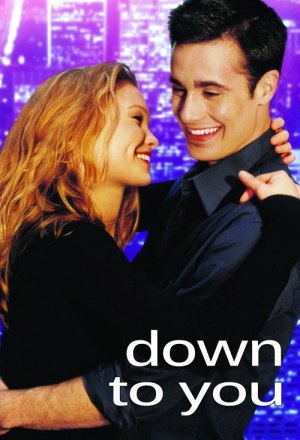
Down to You (2000) Poster
DOWN TO YOU (2000) D
dir. Kris Isacsson
A romance without chemistry, a comedy without timing. Down to You pairs Freddie Prinze Jr. and Julia Stiles—two actors who look like they belong in a love story—and forgets to give them one. He plays Al, a college nice guy with no discernible personality. She’s Imogen, a free spirit in the way movies keep imagining them: all quirks, no interior. They meet. They date. They break up. They stare at each other from across the city. The story follows the usual trajectory—meet-cute, montage, fallout, reconciliation—but nothing in it lands because nothing ever feels like it matters. Whether they end up together or don’t, the emotional result is the same: nothing. The supporting cast is meant to inject energy but plays like sitcom overflow. Selma Blair smirks through every line, Rosario Dawson projects detached cool, and Ashton Kutcher wanders in and out of scenes like he’s on break. And then there’s an inexplicable stab at surrealism—a talking shampoo bottle—introduced without setup, abandoned without consequence. It’s the kind of flourish that mistakes randomness for charm. The film coasts on its leads’ looks and a vaguely romantic tone, but there’s no tension, no momentum, and no reason to care. Down to You isn’t just slight—it’s empty. A movie so afraid to make its characters complicated that it forgets to make them human.
Starring: Freddie Prinze Jr., Julia Stiles, Selma Blair, Shawn Hatosy, Zak Orth, Ashton Kutcher, Rosario Dawson, Lucie Arnaz, Henry Winkler.
Rated PG-13. Miramax Films. USA. 92 mins.
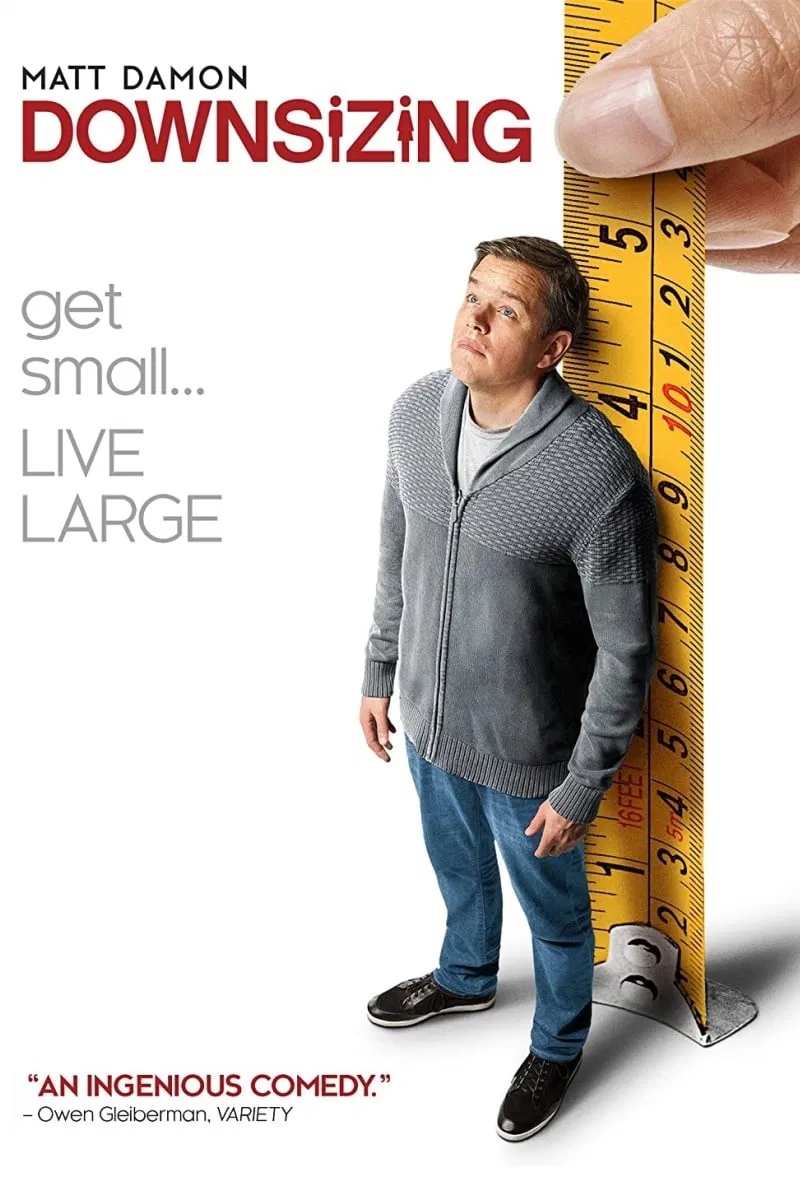
Downsizing (2017) Poster
DOWNSIZING (2017) B+
dir. Alexander Payne
Downsizing takes a sci-fi premise—shrinking people to five inches tall to conserve resources—and uses it to underline a basic truth: even the most forward-thinking solution will be routed through the same old systems. The rich save money. The poor clean the floor. What’s pitched as a global breakthrough plays out like a rebranded wealth grab, just with smaller furniture. Luxury compounds. Branded comfort. And on the outskirts, a slum full of invisible labor. Even utopia needs a service entrance. Few mainstream films bother to be openly political anymore, and fewer still manage to say anything worth hearing. This one tries both—and mostly gets there. It isn’t subtle, and it isn’t trying to be. Matt Damon plays Paul, a cheerful cipher who signs up to be downsized because the brochure looks convincing. The procedure is irreversible, but the future looks safe, sustainable, and filled with high-end amenities at a fraction of the cost. Then, just after he goes through with it, his wife (Kristen Wiig) backs out—leaving him five inches tall, newly single, and without the shared nest egg he thought would support them both. His optimism deflates, but not immediately. It takes him a while to realize how badly he’s been cornered. The film’s most vital character doesn’t show up until the midpoint. Ngoc Lan Tran (Hong Chau), a Vietnamese dissident downsized by her government and smuggled into the U.S. in a television box, now scrubs toilets in a luxury development built on the illusion of equality. She’s missing part of a leg and walks with a limp. Chau plays her with no interest in politeness or preamble; she cuts through conversation without a filter, and she might just be the best thing about this movie. There’s no softening, no pretense—just clipped precision and the quiet confidence of someone who’s already survived worse. The story starts to wander after that as it reaches for bigger questions—environmental collapse, existential meaning, the fate of humanity—but mostly circles familiar ground with slightly more urgency. Still, the ideas hold. Downsizing isn’t about the future. It’s about who gets to disappear into comfort—and who’s left wiping the counters on their way out.
Starring: Matt Damon, Christoph Waltz, Hong Chau, Kristen Wiig, Udo Kier, Jason Sudeikis, Rolf Lassgård, Ingjerd Egeberg, Niecy Nash, James Van Der Beek.
Rated R. Paramount Pictures. USA. 135 mins.
Downton Abbey: A New Era (2022) Poster
DOWNTON ABBEY: A NEW ERA (2022) B
dir. Simon Curtis
The aristocrats and their ever-industrious downstairs staff return in this breezy cinematic installment—the second such film carry-over from the phenomenal television series—and just like its cinematic predecessor, it carries the same genteel charm. This time, the grandeur of Downton Abbey faces a decidedly modern invasion: a Hollywood film crew, led by a big-shot director (Hugh Dancy), descends upon the estate to shoot a motion picture. Naturally, the family bristles at the vulgarity of it all—cinema, money, strangers! However, they need the cash to fix their leaky roof. It also happens to be the dawn of the talkies, and their glamorous leading lady (Laura Haddock) has a Cockney twang that doesn’t match with the refined aristocrat she’s meant to embody on screen. (You half-expect Gene Kelly to materialize with a soggy lamppost at any moment.) The humor stays dry, the emotions refined, the stakes mild but pressing. Everyone is perfectly aware they are playing characters whose deepest conflicts involve real estate, propriety, and whether or not it’s unseemly to enjoy working for a living. The film floats along on impeccable craftsmanship, starched collars, and the pleasure of seeing familiar faces arranged just so. A few moments reach for something deeper—an earned lump in the throat, a quiet goodbye—but mostly, it is what it has always been: a well-appointed drawing room where nothing truly bad happens, and that’s precisely the point.
Starring: Hugh Bonneville, Elizabeth McGovern, Michelle Dockery, Jim Carter, Joanne Froggatt, Maggie Smith, Phyllis Logan, Laura Carmichael, Imelda Staunton, Raquel Cassidy, Brendan Coyle, Kevin Doyle, Michael Fox, Harry Hadden-Patton, Rob James-Collier, Allen Leech, Sophie McShera, Tuppence Middleton, Lesley Nicol, Douglas Reith, Laura Haddock, Hugh Dancy, Dominic West, Penelope Wilton, Jonathan Zaccai.
Rated PG. Focus Features. UK. 125 mins.
Dragonheart (1996) Poster
DRAGONHEART (1996) C+
dir. Rob Cohen
The dragon talks—voiced by Sean Connery, with the tired authority of something that’s made too many bad deals and remembers every one. He lectures, bargains, sighs smoke between half-meant threats. Somewhere underneath is a story about betrayal, uneasy debts, and a shared heart keeping the wrong man alive—but Dragonheart keeps drifting, more interested in admiring itself than telling the story it started with. Dennis Quaid wears the armor: a knight named Bowen, once the proud mentor to a prince who grows up to be David Thewlis with a haircut that screams inherited power and very little else. The prince takes an arrow to the chest and survives, thanks to a metaphysical heart transplant from a dragon. Years pass. Thewlis becomes a tyrant. Bowen, disillusioned, goes freelance. When he crosses paths with the dragon who saved the boy-king, they strike a deal and go village to village running a protection scam. Somewhere between the bartering and fire-breathing, they try to recover their principles. It wants to be mythic but keeps mistaking clutter for depth. It keeps circling a clean premise—kill the king, kill the dragon—but never really acts on it. The idea surfaces, recedes, pops up again like someone behind the scenes is still deciding whether to use it. In the meantime, the movie drifts through new subplots like it’s trying to distract from the one it forgot to finish. By the time it starts building momentum, you’re half-convinced it’s already talked itself out of the ending. Quaid snarls and swats like he’s stuck in a Renaissance Faire that’s lost its liquor license. Thewlis slithers through his scenes as if trying to beat the makeup to the finish line. Connery, meanwhile, sounds like he’s enjoying himself, which helps, since he’s playing the only character with a pulse. The digital dragon still holds together better than the script—he moves like he’s been carved from lead and then taught to glide, and his face has the tragic intelligence of someone who made one bad deal and has had centuries to think about it. It’s not without novelty: there’s a scene where the dragon pretends to eat Quaid, then argues with him through his own clenched teeth. That’s probably as close as the film gets to inspiration. The rest is spectacle-by-committee—vague stabs at grandeur padded with mismatched tones and over-articulated worldbuilding. You can feel the screenplay circling something sharper, but it never quite grips the hilt.
Voice of: Sean Connery. Starring: Dennis Quaid, David Thewlis, Dina Meyer, Pete Postlethwaite, Jason Isaacs, Brian Thompson, Wolf Christian, Lee Oakes.
Rated PG-13. Universal Pictures. USA. 103 mins.
Driving Miss Daisy (1989) Poster
DRIVING MISS DAISY (1989) B+
dir. Bruce Beresford
A car, a chauffeur, a woman who wants neither. Daisy Werthan (Jessica Tandy), an imperious Atlanta widow, dents her Packard and finds herself saddled with a driver. The man assigned to ferry her through the indignities of old age is Hoke Colburn (Morgan Freeman), unflappable, watchful, carrying his patience like a shield. Daisy meets his presence with bristling condescension, cutting him off mid-sentence, accusing him of theft, refusing to acknowledge that the world exists outside her routine. Hoke doesn’t argue, doesn’t correct, doesn’t press—he just waits. A decades-long stalemate begins, one that erodes, slowly, into something resembling friendship. For all its genteel pleasantries, Driving Miss Daisy is sharper than it lets on. A moment: Daisy attends a Martin Luther King Jr. speech, allowing Hoke to drive her but not to join her inside. He listens from the car, hearing King decry the “polite racism” of well-meaning white moderates, while Daisy sits inside, convinced of her own goodness. She doesn’t flinch, doesn’t melt into reform, but something flickers—an awareness, dim and uncomfortable. The film rarely underlines its points, and that makes them land harder. The film runs on the force of two performances. Tandy’s Daisy is brittle, proud, and unknowingly lonely, her clipped precision giving way, bit by bit, to something warmer. Freeman plays Hoke with a grace that doesn’t need to announce itself. His patience isn’t saintly, nor is it submissive—it’s the long-practiced restraint of a man who has been underestimated for a lifetime. Their rhythm together is the movie’s pulse, their shifting dynamic more compelling than any major event. Dan Aykroyd, playing Daisy’s businessman son, balances exasperation with just enough affection to suggest the weight of a lifetime under his mother’s expectations. Soft? Maybe. Sentimental? Absolutely. But it’s also precise, knowing exactly when to pull back, exactly how much to show. Not a grand reckoning, not a searing confrontation—just two people, moving through time, wearing down each other’s edges, finding a way forward.
Starring: Jessica Tandy, Morgan Freeman, Dan Aykroyd, Patti LuPone, Esther Rolle, Joann Havrilla, William Hall Jr., Alvin M. Sugarman, Clarice F. Geigerman.
Rated PG. Warner Bros. USA. 99 mins.
DROP (2025) Poster
DROP (2025) B–
dir. Christopher Landon
The setup’s familiar: a woman out on a date, a threat bubbling in the background, and a stranger behind the curtain pulling the strings. Drop doesn’t break new ground—but it keeps the pressure on. Not brilliantly, but steadily. Violet (Meghann Fahy) is a widowed single mom trying to rejoin the species. Henry (Brandon Sklenar) is her first attempt—a polite, slow-talking photographer who looks like he’s been coached not to blink too fast. Things are going fine, in that early-date “maybe this won’t be awful” way. Then her phone buzzes. Then again. The texts start off goofy—low-effort memes. Then they start aiming lower: threats, commands, proof that someone’s watching her—and knows where her son is. The game is simple: follow instructions, don’t alert the target, and maybe your child stays alive. The camera holds close to Violet’s reactions—tight, twitchy, composed enough to pass for calm. She scans the room, tries to spot who’s watching. A server? A patron? The couple on their second bottle of wine? The film lays its cards slow—but not cleverly. You’ll figure out the puppetmaster long before the big reveal. It’s not that kind of mystery. But the tension holds. Violet doesn’t fight back so much as calculate, and Fahy plays it with just enough restraint to keep things plausible. Sklenar is fine, if a little blank. The rest of the ensemble fades into the background. The logic gets fuzzy. The resolution is weak. But for a one-sitting thriller with a narrow scope and modest ambition, Drop does just enough to pass the time—no more, no less.
Starring: Meghann Fahy, Brandon Sklenar, Violett Beane, Jeffery Self, Reed Diamond.
Rated PG-13. Universal Pictures. USA. 95 mins.
Drop Dead Fred (1991) Poster
DROP DEAD FRED (1991) D
dir. Ate de Jong
Elizabeth Cronin (Phoebe Cates) is having a collapse. Her husband leaves her, her job disappears, her car vanishes—all before dinner. With nowhere else to go, she moves back in with her overbearing mother (Marsha Mason), and that’s when Fred (Rik Mayall) shows up. Long-banished and not remotely missed, her childhood imaginary friend returns like a sugar-addled gremlin with a vendetta against adulthood. As a kid, Fred was chaos incarnate—tormenting her mother with food fights, pranks, and property damage. Now, he’s back to do the same to Elizabeth, whether she wants him or not. The film plays this as a kind of wacky therapy, but watching Fred derail her already crumbling life feels less like healing and more like harassment. He doesn’t help her work through trauma—he just flails around inside it. The tone is a wreck: too manic for pathos, too shrill for charm. Fred isn’t a lifeline—he’s a liability, and the film seems proud of how exhausting he is. Cates does what she can with a character written mostly in reactions, while Mayall commits like he’s doing vaudeville in a vacuum. His energy is constant. Whether it belongs here is another question. What’s meant to be liberating ends up punishing. Instead of catharsis, Drop Dead Fred offers 100 minutes of being stuck in a room with someone who won’t stop screaming.
Starring: Phoebe Cates, Rik Mayall, Marsha Mason, Tim Matheson, Carrie Fisher, Keith Charles, Ashley Peldon, Daniel Gerroll, Ron Eldard.
Rated PG-13. New Line Cinema. UK-USA. 101 mins.
DROP DEAD GORGEOUS (1999) Poster
DROP DEAD GORGEOUS (1999) C
dir. Michael Patrick Jann
A mockumentary in the Waiting for Guffman tradition, Drop Dead Gorgeous sets its sights on the world of small-town beauty pageants—specifically one in Minnesota, where the accents are bright, the ambition is blunt, and the hairspray could stop a bullet. It’s a satire with a mean streak and a taste for the grotesque, stitched together with pageant tape and petty sabotage. Kirsten Dunst plays Amber Atkins, an aspiring news anchor and part-time mortuary cosmetologist who idolizes Diane Sawyer and sees the Sarah Rose American Teen Princess Pageant as her ticket out. Her biggest obstacle is Becky Leeman (Denise Richards), the daughter of a wealthy former winner (Kirstie Alley) who also happens to be running the show. That conflict of interest becomes increasingly conspicuous as the competition thins out. One contestant dies in a suspicious tractor explosion. Another ends up in the hospital after a stage light crashes down mid-rehearsal. Amber’s mother, not to be outdone, is nearly incinerated when their trailer explodes—but still manages to show up for the pageant, beer can melted to her hand like a medal of resilience. The tone aims for deadpan precision, but the rhythm is inconsistent. Some bits sound sharper than they play—like the previous year’s winner being so anorexic she’s wheeled out with an IV bag. It’s framed as darkly absurd, but it lands more as glib provocation. That’s the tradeoff with this kind of satire: when the aim is off, it stops being clever and just feels lazy. Still, a few moments have a kind of crude specificity. Denise Richards slow-dancing with a crucified Jesus to “Can’t Take My Eyes Off of You” isn’t especially funny, but it’s committed. If you’re going to skewer small-town pageantry, a little mild blasphemy doesn’t hurt. The film doesn’t always know where it’s going, but it seems satisfied just getting a rise. I didn’t laugh much. But there’s something about its nerve that’s hard to ignore. Drop Dead Gorgeous is uneven, often tone-deaf, and better on premise than execution—but it’s not cautious, and that counts for something.
Starring: Kirsten Dunst, Denise Richards, Kirstie Alley, Ellen Barkin, Allison Janney, Brittany Murphy, Amy Adams, Sam McMurray, Mindy Sterling, Nora Dunn, Will Sasso.
Rated PG-13. New Line Cinema. USA. 97 mins.
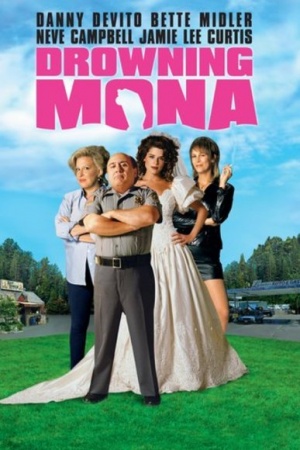
Drowning Mona (2000) Poster
DROWNING MONA (2000) C
dir. Nick Gomez
Mona Dearly (Bette Midler) drives her car off a cliff in the opening scene, and nobody misses her. Not her husband, not her son, not the town. The question isn’t who wanted her dead—it’s who got there first. Drowning Mona sets itself up as a small-town murder mystery wrapped in acid humor, but it never quite decides how mean it wants to be. The film takes place in Verplanck, New York, a town where everyone drives a Yugo—part of a bizarre promotional stunt that’s never explained beyond a passing line and treated like a running gag. It’s the kind of detail that should give the world texture, but instead just hangs there, waiting to be funny. Sheriff Wyatt Rash (Danny DeVito) is tasked with figuring out who killed Mona, but half the town has a motive and most of them don’t care she’s gone. The cast is stacked but stuck. Jamie Lee Curtis and Neve Campbell are handed roles with no angle. Casey Affleck plays it straight and fades into the background. Midler, seen mostly in flashbacks, sneers her way through every scene—maybe entertaining, but all on one frequency. Only DeVito strikes the right tone: dry, flat, and quietly exasperated. It’s pitched as a black comedy and carries the right mean streak, but the rhythm never clicks. Scenes land flat, punchlines get buried, and the central joke wears thin long before the mystery resolves. Drowning Mona isn’t without potential, but it keeps tripping over its own setup.
Starring: Danny DeVito, Bette Midler, Neve Campbell, Jamie Lee Curtis, Casey Affleck, William Fichtner, Marcus Thomas, Peter Dobson, Kathleen Wilhoite, Will Ferrell, Melissa McCarthy, Brian Doyle-Murray.
Rated PG-13. Destination Films. USA. 96 mins.
DUDES (1987) Poster
DUDES (1987) B–
dir. Penelope Spheeris
Too strange to ignore, too uneven to fully embrace. Dudes is one of those films that feels like it got made because no one bothered to stop it—gleefully anarchic, occasionally inspired, and clumsy in exactly the way a punk western probably ought to be. The plot is simple and nuts: three New York punks—Grant (Jon Cryer), Biscuit (Daniel Roebuck), and Milo (Flea)—decide to skip Queens and start fresh in Los Angeles. But somewhere in the Mojave, they cross paths with a gang of white supremacist desert rats, and Milo ends up dead. The rest of the film is a revenge odyssey, punctuated by horseback pursuits, shootouts, and detours that feel half-baked and half-hallucinatory. There’s something irresistible about its setting—a roach motel Americana full of greasy diners, hitchhikers, and Confederate-flagged tow trucks. The aesthetic is punk meets outlaw western, with Spheeris throwing it all at the wall and letting the weirdness ride. She’s not trying to smooth it over or make it elegant. That’s the point. Character growth barely registers, unless you count costume changes and a few cosmic interruptions. Biscuit sees ghost cowboys. Grant gets better at aiming. Emotions show up, but never really settle in. And the tonal shifts feel like trying to parkour the Grand Canyon. But even when it stumbles, Dudes has an energy that’s hard to fake. It’s scrappy, loud, and kind of lovable in its bad-trip sincerity. You don’t watch it for arc. You watch it for the vibe.
Starring: Jon Cryer, Daniel Roebuck, Flea, Lee Ving, Catherine Mary Stewart, Billy Drago.
Rated R. Universal Pictures. USA. 90 mins.
Duel (1971) Poster
DUEL (1971) B+
dir. Steven Spielberg
A man passes a truck. The truck responds like it’s been personally insulted. Duel turns that one petty act into a full-throttle standoff—a relentless game of predator and prey played out across dusty California highways. Dennis Weaver plays David Mann, a soft-spoken salesman whose tomato-red Plymouth Valiant becomes the only thing standing between him and a smoke-belching big rig with a grudge. No honks, no curses—just a long, tightening stretch of tension that builds without explanation or reprieve. The truck is never identified, never explained. It haunts like a curse in the rearview mirror, slipping in and out of view, haunting the edge of David’s vision. Spielberg, directing with the control of someone decades beyond his age, frames it like a horror monster—implacable, unknowable, and always too close. One of the film’s most gripping scenes unfolds in a roadside diner. The truck is parked outside. Inside, David scans the other customers, trying to guess who’s behind the wheel. The tension is nearly unbearable—no violence, just suspicion, second-guessing, and a desperate attempt to restore logic to a situation that no longer has any. He locks onto a man, seemingly at random, and picks a fight. He’s looking for resolution—or at least a target—but he’s not going to find one. What makes Duel work isn’t scale—it’s restraint. No subplot. No backstory. No breathing room. Just a car, a truck, and the psychological spiral that turns open road into a trap. Spielberg leans into repetition and momentum, building pressure without pause. It’s a survival thriller without mythology—just motion and menace. The truck doesn’t chase. It bears down. And by the end, the road feels like it’s shrinking beneath the wheels.
Starring: Dennis Weaver.
Rated PG. Universal Television. USA. 90 mins.
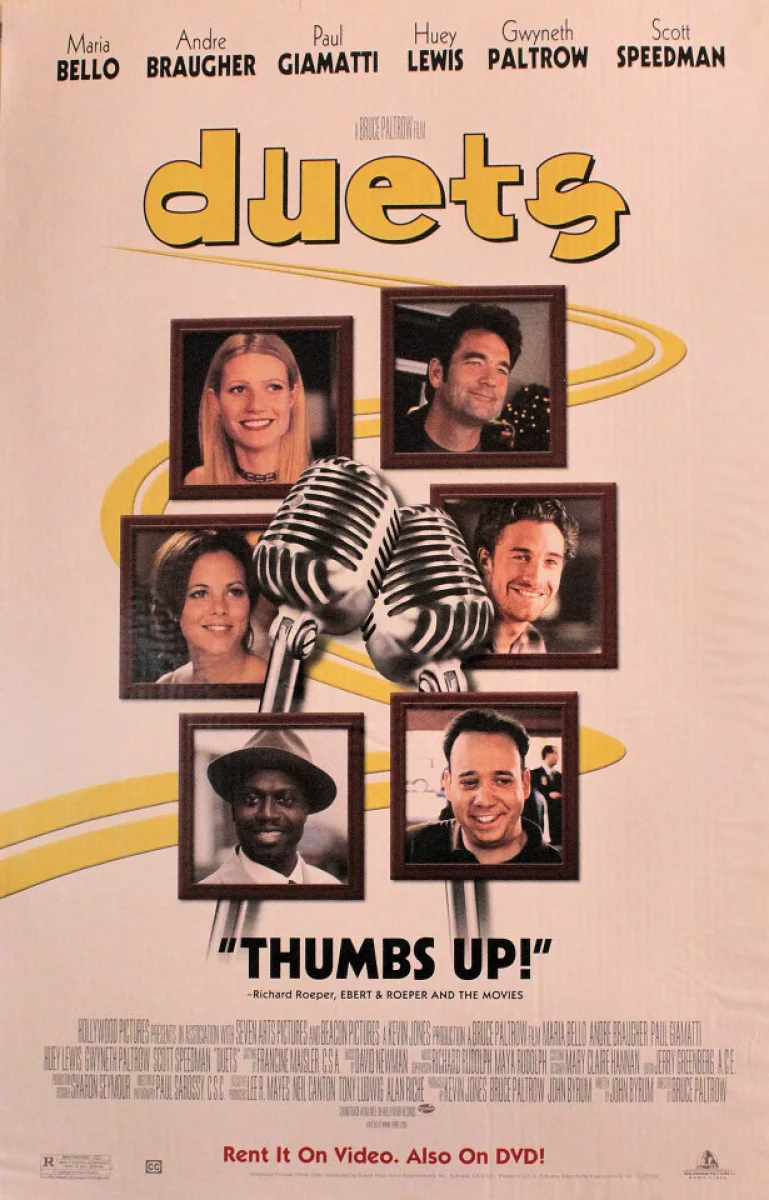
Duets (2000) Poster
DUETS (2000) D
dir. Bruce Paltrow
The only real laugh Duets gets comes early—and entirely by accident—when Paul Giamatti, dead serious, asks, “What is karaoke?” It’s the sort of line that might make sense coming from someone just thawed out of a glacier, but here it’s delivered straight and never brought up again. Minutes later, he’s chasing karaoke like a fix—clutching the mic, eyes blazing, howling into the microphone. At some point he picks up a hitchhiker (Andre Braugher) who just happens to sing like he’s been borrowed from a Motown tour bus. The film doesn’t connect these dots so much as scatter them and keep moving. Meanwhile, Huey Lewis—playing a karaoke hustler whose grift involves scamming amateur singers out of bar cash—travels from lounge to lounge with the ease of someone who thinks charisma is hereditary. His real-life daughter (Gwyneth Paltrow, directed here by her actual father) plays his estranged kid, which the film treats as both emotional spine and subplot. She looks vaguely embarrassed; he looks stranded. The dialogue doesn’t help—written with a tin ear, it leaves even the professionals looking lost, and Lewis sounding like someone trying to read sarcasm off a cue card. But just when you think the film couldn’t get more baffling, Giamatti pulls a gun on a hotel concierge over frequent flyer points and proceeds to unload rounds into the lobby. The movie plays it for laughs—big, cathartic, crowd-pleasing laughs, apparently—but it mostly plays like the most tonally confused plot point in recent memory. Duets clearly wants to be a crisscrossing emotional tapestry: small lives, big songs, unexpected connections. But what it ends up with is a karaoke night that won’t end—tuneless, endless, and weirdly proud of itself. Everyone gets a solo. Not one of them earns it.
Starring: Paul Giamatti, Huey Lewis, Gwyneth Paltrow, Maria Bello, Andre Braugher, Scott Speedman.
Rated R. Buena Vista Pictures. USA. 112 mins.
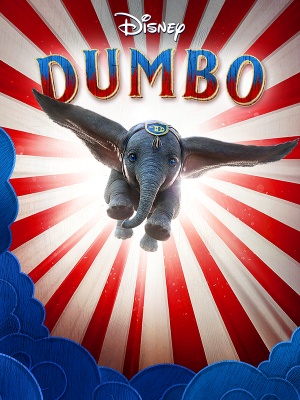
Dumbo (2019) Poster
DUMBO (2019) D+
dir. Tim Burton
Tim Burton stretches Disney’s 64-minute animated fable into a two-hour studio tentpole and manages to flatten everything in the process. The pathos, the magic, the elegance of the original are replaced with noise, plot mechanics, and human characters nobody asked for. Colin Farrell plays Holt Farrier, a one-armed war veteran returning to the circus without his wife, without much of a role, and without any real purpose beyond delivering exposition and standing near CGI. His children, who are supposed to anchor the emotional core, come off as oddly passive—just along for the ride. And then there’s Dumbo, a wide-eyed digital elephant with ears like parachutes and barely a personality. He flies. People clap. That’s the arc. The plot lurches forward when V.A. Vandevere (Michael Keaton), a theme park tycoon with a thin smile and an even thinner motive, shows up to turn Dumbo into the star attraction at his shiny corporate deathtrap. Eva Green floats in as an aerialist with a heart of gold, because every Burton film needs one. Danny DeVito tries to inject some life as the circus ringleader, but even he seems unsure what kind of film he’s in. The movie gestures at darker themes—exploitation, grief, corporate greed—but it doesn’t engage with any of them. It keeps cutting to another set piece, another act break, another chance for Dumbo to flap his ears and take flight. The original Dumbo found emotion in stillness. This one never slows down long enough to feel anything. Burton was a smart choice in theory—he’s always had a soft spot for the outcasts, the misunderstood oddities—but here, his vision feels diluted. The circus isn’t strange. The world isn’t enchanted. Everything is polished, flattened, and narratively overworked. Dumbo was never subtle, but this version doesn’t even know what it’s reaching for.
Starring: Colin Farrell, Michael Keaton, Danny DeVito, Eva Green, Alan Arkin, Nico Parker, Finley Hobbins, Roshan Seth, DeObia Oparei, Joseph Gatt, Douglas Reith, Sharon Rooney.
Rated PG. Walt Disney Studios Motion Pictures. USA. 112 mins.
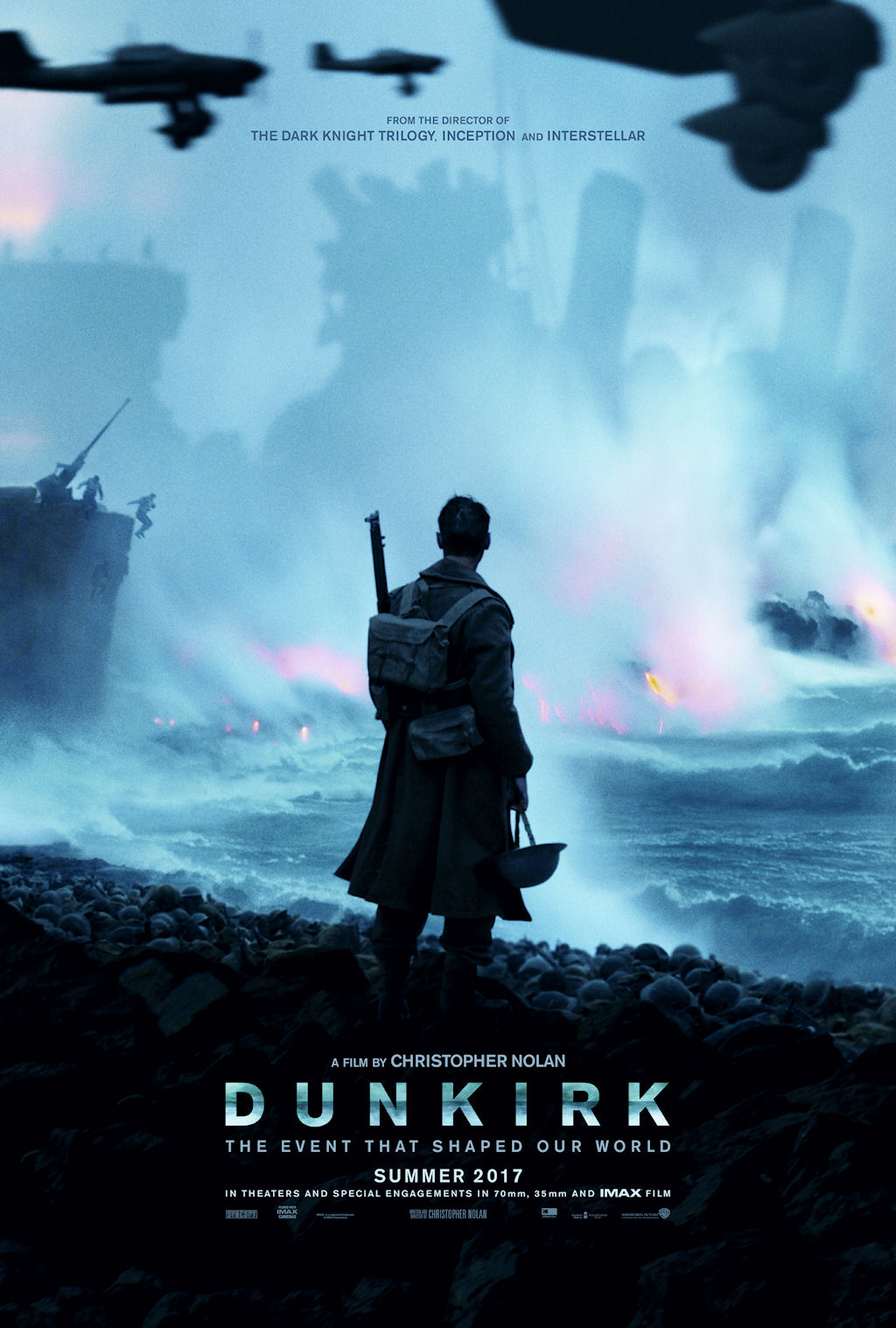
Dunkirk (2017) Poster
DUNKIRK (2017) A
dir. Christopher Nolan
Less a war film than a plunge into dread, Dunkirk strips away exposition and sentiment, immersing you in the brutal geometry of survival: 338,000 Allied soldiers marooned on a French beach, eyes fixed on the horizon, waiting for rescue as the enemy circles above. And when the boats come, they’re not warships but fishing trawlers, pleasure cruisers, and civilian skiffs—hauling in sons, strangers, and the staggering weight of hope. There’s no real plot to summarize, which feels like a small miracle in itself. Nolan lets the event speak for itself—and he’s right to. Told across three overlapping timelines—land over a week, sea over a day, air over an hour—the film unfolds like a puzzle solving itself under fire. It assumes you can keep up. That’s not confidence you usually get from a studio film. It’s something closer to nerve. Anthony Dod Mantle’s cinematography captures the physical grandeur and terror of the setting: destroyers sinking like stones, flames slicking the ocean, skyward glances timed to the mounting growl of a dive bomber. Soldiers cheer when a Messerschmitt goes down—but only for a second. The next one’s already on its way. The tension is relentless. There’s no relief, only reprieve. At one point I realized I hadn’t breathed properly in several minutes, like my lungs were rationing air in solidarity. Hans Zimmer’s score doesn’t underscore the film—it stalks it. All ticking clocks and stretched notes, like the movie is wired to detonate if you look away too long. And then, somehow, a moment of grace: a Spitfire glides silently across the sky, out of fuel, the pilot scanning the sand below. It’s so quiet it feels sacramental. He lands. He sets the plane on fire. And he waits. Dunkirk might be the most poetic film ever made about logistical nightmare. It doesn’t try to extract meaning from suffering or wring tears from tragedy. It’s too respectful for that. It simply recreates what happened—and that’s somehow more moving. No big speeches, no moral calculus. Just survival, scraped together minute by minute, with no guarantee of rescue. It’s one of the best war films ever made. Not because it says something new, but because it knows when to say nothing at all.
Starring: Fionn Whitehead, Tom Hardy, Mark Rylance, Kenneth Branagh, Cillian Murphy, Harry Styles, Jack Lowden, Barry Keoghan, James D’Arcy, Aneurin Barnard.
Rated PG-13. Warner Bros. UK-USA. 106 mins.
Dunston Checks In (1996) Poster
DUNSTON CHECKS IN (1996) C+
dir. Ken Kwapis
A monkey movie—and a slightly better-than-average one, which is faint praise considering the field. This time the primate in question is an orangutan named Dunston, sidekick to the rat-faced jewel thief Lord Rutledge (Rupert Everett), who treats his partner like luggage until Dunston finally breaks ranks and sets off on his own across the halls of a luxury hotel. Eric Lloyd plays Kyle, the precocious son of uptight hotel manager Robert Grant (Jason Alexander), who’s already dealing with a rumored inspector and a high-stakes visit from the hotel’s cartoonishly demanding owner, Elena Dubrow (Faye Dunaway), when Kyle starts reporting strange encounters with a monkey. Naturally, no one believes him—until Dunston starts leaving a trail of disrupted room service and ruffled egos. It’s not a bad setup for a farce, and the movie makes more out of its orangutan than you'd expect. Everett goes delightfully overboard as the sneering aristocrat-villain, and his scenes with Dunston—particularly when he’s scoffing at the ape’s less-than-genteel manners—give the movie a little bounce. Lloyd’s rapport with the orangutan is weirdly sincere. But beyond that, it’s a grab bag of hijinks and slapstick, much of it on the soggy end of the spectrum. The film goes out of its way to humiliate Dunaway—at one point shoving her, elegantly costumed and stone-faced, into a giant cake—and seems to think that alone constitutes comedy. It doesn’t. That scene, like most of the movie, feels a little too proud of itself for aiming low and hitting the target.
Starring: Jason Alexander, Eric Lloyd, Faye Dunaway, Rupert Everett, Paul Reubens.
Rated PG. 20th Century Fox. USA. 88 mins.
The Dunwich Horror (1970) Poster
THE DUNWICH HORROR (1970) C-
dir. Daniel Haller
Sandra Dee, freshly scrubbed from her teen idol years, stars in this adaptation of Lovecraft’s The Dunwich Horror, playing a college student named Nancy who makes the mistake of handing over the Necronomicon—a mythical book of forbidden knowledge—to a stranger who looks like he hasn’t seen sunlight—or basic human warmth—in years. That would be Wilbur Whateley (Dean Stockwell), a soft-spoken occultist with unsettling hair and a stare that doesn’t blink nearly enough. What follows is an occult thriller where very little actually happens. Nancy falls under Wilbur’s influence and ends up at his family’s decaying mansion, where every room looks like it’s waiting for a séance to start. His grandfather mumbles warnings. The score spirals. Stockwell chants. Somewhere offscreen, an unspeakable evil is apparently preparing its entrance, though the film mostly settles for telling us it’s there rather than showing anything. The film gestures toward horror but never builds momentum. Its attempts at atmosphere slip away as quickly as they’re introduced, and the rituals, meant to summon dread, feel staged and inconsequential. Dee drifts through the film like she’s not entirely sure how she got there. Stockwell, to his credit, goes all in, but the movie gives him nowhere to take it. Every now and then, something more surreal threatens to push through, but the film keeps smoothing its edges, sanding Lovecraft’s cosmic dread down into stagey theatrics.
Starring: Dean Stockwell, Sandra Dee, Ed Begley, Talia Shire, Sam Jaffe, Donna Baccala, Lloyd Bochner, Barboura Morris.
Rated R. American International Pictures. USA. 90 mins.
Dutch (1991) Poster
DUTCH (1991) D+
dir. Peter Faiman
The downfall of John Hughes wasn’t gradual—it hit like a thud, and Dutch is the dull echo. Conceived, maybe, as a family-friendly riff on Planes, Trains and Automobiles, it strands Ed O’Neill as Dutch Dooley, a well-meaning lug with a pinky ring and a trunk full of firecrackers, tasked with escorting his girlfriend’s impossibly smug son Doyle (Ethan Embry) home for Thanksgiving. The kid wears cufflinks to a school assembly and reads Nietzsche for fun. Dutch, meanwhile, shows up with a short fuse and a bad sense of timing—more brawler than babysitter. Their early interactions are pitched somewhere between farce and felony. In their first encounter, Doyle assaults Dutch with a golf club and a karate kick, and Dutch just sort of walks it off. It isn’t played for tension or growth—just dropped in like a leftover from a sketch no one bothered to finish. That offhandedness becomes the film’s default setting: violence with no fallout, sentiment with no pulse. What follows isn’t a story so much as a shuffle through mismatched set pieces—truck stops, motel rooms, even a brothel—with each new backdrop promising character development it never delivers. Hughes’s script gestures at lessons about class, empathy, and broken families, but they drift by like props with nowhere to land. By the time Dutch and Doyle inevitably warm up to each other, the thaw feels perfunctory. Dutch wants heart and hijinks in equal measure, but fumbles both—loudly, gracelessly, and with a face full of pie.
Starring: Ed O’Neill, Ethan Embry, JoBeth Williams, Christopher McDonald, Ari Meyers.
Rated PG-13. 20th Century Fox. USA. 107 min.
Load Next Page