Film Buff Musings

by Michael Lawrence

List of "S" Movies


Shampoo (1975) Poster
SHAMPOO (1975) B
dir. Hal Ashby
Warren Beatty plays George Roundy, a Los Angeles hairstylist whose real talent isn’t cutting hair—it’s slipping in and out of women’s lives without ever fully arriving in his own. He’s in his mid-30s, popular with clients, charming to a fault, and completely adrift. His job grants him unrestricted access to wealthy, restless women, and George takes full advantage. But something is fraying underneath the tan and the tousled locks. He wants to open his own salon, but no bank will touch him. He’s got no credit, no clout, and not nearly enough self-awareness. So he does what he knows: he tries to seduce his way to the top. He cozies up to Lester Karpf (Jack Warden), a conservative businessman with a wandering eye, who also happens to be married to one of George’s many lovers. That would be Felicia (Lee Grant). Complicating matters further, George is also sleeping with Lester’s mistress (Julie Christie), and—why not—Lester’s daughter, too (a teenage Carrie Fisher, in her screen debut). Back home, he’s supposedly committed to Jill (Goldie Hawn), a sweet, clueless girlfriend who genuinely thinks he’s hers. It’s not a love triangle. It’s a carousel, and George is too caught up in his own spin to know when to get off. The film is set on the eve of Richard Nixon’s 1968 election victory, and that backdrop is no accident. Hal Ashby’s direction (with Beatty co-writing and producing) plays the farce against the crumbling illusions of the era—free love, personal freedom, sexual autonomy. George is a product of all three, and also a warning. That said, the satire doesn’t always land. The political undertones feel like static playing behind a very different movie. And while the film is often described as a comedy, the laughs are dry to the point of evaporating. What does land is Beatty’s performance—an unusually vulnerable portrayal of a man who sleeps around constantly and somehow never comes across as predatory or smug. George doesn’t conquer women so much as chase their approval like a boy who never learned how to be still. Shampoo isn’t airtight. Its social commentary drifts, and its tone shifts in ways that feel more dated than daring. But at the center of it all is a character who’s messier, needier, and far more human than the rake archetype usually allows. For that alone, it’s worth the watch.
Starring: Warren Beatty, Julie Christie, Goldie Hawn, Lee Grant, Jack Warden, Tony Bill, Jay Robinson, George Furth, Carrie Fisher.
Rated R. Columbia Pictures. USA. 110 mins.
Shanghai Noon (2000) Poster
SHANGHAI NOON (2000) B
dir. Tom Dey
Jackie Chan arrives with fists; Owen Wilson arrives with excuses. The Wild West takes it from there. Chan plays Chon Wang, an imperial guard dispatched from the Forbidden City to retrieve Princess Pei-Pei (Lucy Liu), who’s fled to America on a half-baked rescue mission of her own. Along the way, Chon crosses paths with Roy O’Bannon (Wilson), a self-mythologizing outlaw whose gang just demoted him in the rudest way possible—by attempting to kill him. Their first encounter ends with Roy buried to the neck in sand, granted a pair of chopsticks and no clear sense of what happens next. From there, a partnership takes shape. Roy sees gold. Chon sees duty. Both are too stubborn to walk away. The plot mostly exists to shuttle them between bathhouses, saloons, and passing trains—each one arranged so Chan can vault, spin, flip, and outmaneuver a half-dozen opponents using little more than timing and leverage. The fights are lighter on intricacy than in his finest work, but the invention is there. He treats space like something to be solved. Wilson, meanwhile, lounges through the film with his usual half-smile and sandpaper wit. Roy isn’t brave, skilled, or particularly useful, but Wilson gives him just enough rhythm to stay in the scene. The comedy comes in streaks, but when it works, it works cleanly—especially when the two start trading reactions like mismatched vaudevillians. Shanghai Noon doesn’t worry about structure. It moves on personality, on chemistry, on the appeal of two very different performers trading momentum across dusty towns and cattle-strewn landscapes. It has its rough spots, but it also has energy, confidence, and a steady supply of charm that doesn’t dry up before the last scene.
Starring: Jackie Chan, Owen Wilson, Lucy Liu, Brandon Merrill, Roger Yuan, Xander Berkeley, Walton Goggins.
Rated PG-13. Touchstone Pictures. USA. 110 mins.
The Shape of Water (2017) Poster
THE SHAPE OF WATER (2017) A-
dir. Guillermo del Toro
Octavia Spencer and Sally Hawkins are such a winning pair of odd-couple co-workers that you wish you could see what their breakroom conversations sound like on a normal Tuesday. But The Shape of Water doesn’t deal in normal. From the first moments, it drops us into a heightened world—part Cold War thriller, part adult fairytale—where even the mop-wielding custodians at a top-secret lab stumble upon monsters and miracles. Hawkins plays Elisa, a mute janitor whose daily routine is marked by silence, routine, and a kind of aching vacancy. That changes when she discovers the facility’s latest classified specimen: a man-amphibian hybrid kept submerged in a tank and brutalized by the staff. Her immediate reaction isn’t fear—it’s recognition. In him, she sees another being cut off from language, misunderstood, left to endure in isolation. She brings him hard-boiled eggs, teaches him sign language, and finds, almost before she realizes it, that she’s no longer alone. What starts as kindness turns into something deeper, and remarkably, it works. The romance—between a mute woman and a gilled creature that looks like it wandered in from a black-and-white creature feature—is not just convincing, it’s touching. Del Toro plays it straight, with just enough restraint to avoid sentimentality and just enough conviction to make you believe it. This is a film soaked in atmosphere—foggy windows, green light, vintage wallpaper, humming pipes. It’s a love letter to the lonely, the strange, the discarded. The violence is graphic, the sex explicit, and the fantasy elements fully embraced—this isn’t a bedtime story, but a dream shaped by adult longings and adult horrors. Michael Shannon’s villain, a government agent with a short fuse and a rigid worldview, is terrifying not just for his brutality but for his belief that anything nonhuman is inherently lesser. His disgust isn’t just bureaucratic—it’s theological. He sees the creature not only as an abomination but as an offense to the order of things. It’s a performance that burns with contempt. The Shape of Water is unabashedly romantic, elegantly grotesque, and gently political in ways that sneak up on you. It doesn’t just reimagine the monster movie—it reclaims it, turning the creature into the prince and the silent girl into the one who finally speaks the loudest.
Starring: Sally Hawkins, Michael Shannon, Richard Jenkins, Doug Jones, Michael Stuhlbarg, Octavia Spencer, Nick Searcy, David Hewlett, Nigel Bennett.
Rated R. Fox Searchlight Pictures. USA-Mexico. 123 mins.
Shark Tale (2004) Poster
SHARK TALE (2004) C
dir. Vicky Jenson, Bibo Bergeron, Rob Letterman
Shark Tale looks fantastic. The animation is slick, vibrant, borderline excessive—every bubble polished, every fish given the face of its celebrity voice actor, whether or not it should’ve been. But beneath the surface, it’s a mess: loud, smug, and oddly lifeless. DreamWorks tries to repeat the Shrek formula here—splashy visuals, name-brand voice cast, nonstop gags—but forgets to include anything resembling heart. What’s left is a jittery tangle of seafood puns and dated references, strung together by Will Smith as Oscar, a fast-talking wrasse who scrubs scum off bigger fish and dreams of making it big. He gets his shot after falsely taking credit for killing a shark, and the plot paddles through a vaguely moral arc about honesty, image, and self-respect—none of which land with much force. There’s a love triangle of sorts: Oscar is torn between a gold-digging angelfish (voiced by Angelina Jolie, all lipstick and calculation) and a kindhearted coworker (Renée Zellweger, buried in earnestness). Neither dynamic sparks. Meanwhile, Robert De Niro grumbles his way through a fishified mafia boss, and Martin Scorsese pops up as a pufferfish accountant—a cameo that raises more questions than laughs. It’s the kind of movie where the jokes are aimed at parents, but only remind them of better movies. Technically, the film’s impressive. The underwater cityscape is glimmering with detail, resembling Times Square if it were rebuilt by an ad agency with gills. But it’s all window dressing. The energy is manic, the tone inconsistent, and the story too thin to support the noise. Shark Tale wants to be clever, kinetic, and cool, but it ends up exhausted.
Voices of: Will Smith, Renée Zellweger, Angelina Jolie, Robert De Niro, Jack Black, Martin Scorsese.
Rated PG. DreamWorks Animation. USA. 90 mins.
The Shawshank Redemption (1994) Poster
THE SHAWSHANK REDEMPTION (1994) A-
dir. Frank Darabont
What keeps pulling me back to The Shawshank Redemption isn’t the clever sleight-of-hand or the tidy satisfaction of watching Andy Dufresne (Tim Robbins) slip through the cracks in the system—though those pleasures are real. It’s the way his friendship with Red (Morgan Freeman) blooms like something planted by accident, tended without fuss, and left to thrive in a yard full of concrete. That, somehow, is the part that registers—not the escape, but the companionship that makes surviving worth the trouble. They aren’t alike, but they complete something in each other. Andy is the thinker, the dreamer, and the man who plays the long game. Red is the realist. He knows how to make things happen in the here and now. If Andy needs a rock hammer, a poster, a chess set carved from stone, Red finds a way. There’s real pleasure in watching that dynamic evolve. But more than that, there’s something quietly moving about the loyalty they build, the mutual respect that grows not out of necessity, but from shared decency. It helps that neither of them really belongs behind bars—at least not in the moral sense. Andy, convicted of murdering his wife and her lover, is clearly innocent, the victim of cruelly persuasive circumstantial evidence. Red, on the other hand, admits to his crime but wears it with the weight of someone who no longer recognizes the person who committed it. Time has aged him, softened him, sharpened him. There’s more to this story than the plot summary usually allows for—corruption, cruelty, quiet acts of rebellion, and the bittersweet melancholy of wasted years. It’s a long film, but it breathes so naturally that you hardly notice. It’s not a prison break movie, though it ends with one. It’s a film about hope, worn down to the bone and still somehow intact. And if that sounds hackneyed, the movie has a way of making you believe in it anyway. That’s the magic of it.
Starring: Tim Robbins, Morgan Freeman, Bob Gunton, William Sadler, Clancy Brown, James Whitmore.
Rated R. Columbia Pictures. USA. 142 mins.
Shazam! (2019) Poster
SHAZAM! (2019) B
dir. David F. Sandberg
Shazam! is a rare thing: a superhero movie that doesn’t mistake solemnity for significance. It’s silly, self-aware, and pitched at the emotional level of a teenager who just found out he can shoot lightning from his hands. Which is exactly what happens. Billy Batson (Asher Angel), a 14-year-old foster kid with abandonment issues and a built-in distrust of authority, is chosen by an ancient wizard (Djimon Hounsou, looking slightly embarrassed) to inherit godlike powers. One magic word later, Billy morphs into Shazam (Zachary Levi), a bulked-up superhero who behaves like a kid on a vending machine high. Levi is the best part of the film. He plays Shazam with the perfect blend of big-kid bravado and wide-eyed idiocy, the kind of hero who tests his superpowers by zapping soda machines and charging people’s phones at the mall. His performance feels improvised in the best way. The central flaw is that Billy and his superhero alter ego don’t feel like versions of the same person. Asher Angel plays Billy as quiet, guarded, and skeptical. Zachary Levi’s Shazam is a human confetti cannon—loud, giddy, and constantly performing. The film never really bridges the gap between the two, and the disconnect weakens what should be a single character arc. Mark Strong, meanwhile, is stuck playing a stock villain in a movie that keeps outgrowing him. His character, Dr. Sivana, summons CGI gargoyles called the Seven Deadly Sins and scowls his way through long monologues. But even so, Shazam! holds together on energy and charm alone. It knows the fantasy is the fun of it—that superheroes, at their most basic, are just kids in adult bodies pretending to save the world. And sometimes, pretending is more fun than pretending not to.
Starring: Zachary Levi, Asher Angel, Mark Strong, Jack Dylan Grazer, Djimon Hounsou, Faithe Herman, Grace Fulton, Ian Chen, Jovan Armand, Marta Milans, Cooper Andrews.
Rated PG-13. Warner Bros. Pictures. USA. 132 mins.
Shazam! Fury of the Gods (2023) Poster
SHAZAM! FURY OF THE GODS (2023) C
dir. David F. Sandberg
The original Shazam! was a pleasant surprise—a superhero comedy that managed to feel breezy and inventive without dissolving into parody. This sequel, Fury of the Gods, seems to have taken the wrong lesson from that success. It’s still jokey, still light on its feet, but the spark’s gone. What remains is a cluttered, shouty effects reel stitched together with catchphrases and awkward punchlines. Zachary Levi, once the film’s live-wire center, now plays Shazam like he’s slightly bored by his own origin story. The disconnect between Billy (Asher Angel) and his superhero alter ego existed in the first film too—Billy was moody, Shazam was manic—but here it feels more pronounced. Billy is barely in the movie, and when he is, he’s thoughtful, reserved, and relatively serious. Shazam, meanwhile, bounces around like a party entertainer with a head injury. There’s no sense these two are the same person, and the film never bothers to bridge the gap. The plot revolves around a broken magical staff from the first film, now reassembled by the villainous daughters of Atlas—Hespera (Helen Mirren, at least having fun) and Kalypso (Lucy Liu, playing it straight). They want to reclaim their ancestral powers and plant a massive world-ending tree right in the middle of Philadelphia. Why the tree? Something about ancient magic. Why Philly? Unclear. Buried in the noise are some stray delights, including a young girl who bonds telepathically with unicorns—feral, glowing beasts the film describes as the most dangerous creatures in mythology. She tames them with Skittles. It’s ridiculous, but also the only moment that seems to remember kids might actually be watching this. There’s also a shoehorned Wonder Woman cameo (Gal Gadot), built around the idea that the teenage hero has a crush on her—though the joke doesn’t land, and the scene plays like a contractual obligation rather than a payoff.
Starring: Zachary Levi, Asher Angel, Jack Dylan Grazer, Rachel Zegler, Adam Brody, Ross Butler, D.J. Cotrona, Grace Caroline Currey, Meagan Good, Lucy Liu, Djimon Hounsou, Helen Mirren.
Rated PG-13. Warner Bros. Pictures. USA. 130 mins.
She (1984) Poster
SHE (1984) C+
dir. Avi Nesher
This one’s hard to classify—somewhere between post-apocalyptic pulp and a community theater fever dream, She is the kind of movie that throws darts at genres and hits several things it wasn’t aiming for. It belongs to the low-budget sword-and-sorcery tradition of the early 1980s, except it’s not content to play by even those rules. The setting is a future-Earth wasteland, one rebuilt from the wreckage of pop culture itself. Characters dress like medieval mercenaries, but the sets are scattered with the remains of collapsed malls and video arcade husks. Sandahl Bergman stars as She, a vaguely defined immortal goddess and resident warrior queen, who stalks through the rubble with absolute confidence, despite the fact that no one—not her, not the audience—seems entirely sure what’s going on. She and her muscle-bound companions who look like they wandered in from a nearby heavy metal video shoot embark on what technically qualifies as a quest—though the particulars of that quest dissolve almost immediately into a string of surreal set pieces. You get a tutu-wearing strongman. A bridge troll with multipliable limbs who talks like a carnival barker. Cannibal academics in togas who moonlight as werewolves. This is a film that feels like it was written scene by scene, each by a different person and none of whom read the previous pages. Is it good? Not by any conventional metric. But it’s never boring, and the laughs—whether earned or accidental—arrive regularly. She may be a mess, but it’s a mess with conviction.
Starring: Sandahl Bergman, David Goss, Quin Kessler, Harrison Muller, Elena Wiedermann, Gordon Mitchell.
Not Rated. American National Enterprises. Italy. 106 mins.
She-Devil (1989) Poster
SHE-DEVIL (1989) B-
dir. Susan Seidelman
She-Devil promises mayhem and delivers mischief—an R-rated revenge comedy that seldom draws blood but occasionally nicks the vanity of its targets. The premise is pulp gold: Ruth (Roseanne Barr), a dumped and duly humiliated housewife, decides to ruin the lives of the people who wronged her. Chief among them is Mary Fisher (Meryl Streep), a romance novelist who writes with a feather pen and lives in a bubblegum-pink mansion perched somewhere between Barbie Dreamhouse and erotic retreat. She’s rich, vapid, overperfumed—and Ruth’s husband has just moved in. What follows isn’t quite the vengeful rampage the title suggests. Ruth’s payback leans bureaucratic. She doesn’t poison, stalk, or seduce. She reorganizes. She manipulates social systems with the mild detachment of someone managing a spreadsheet titled “Ruin Lives.” Her triumphs are less about fire and fury than about strategic delegitimization—an IRS audit here, a sabotage of social standing there. The edge is dulled, the satire soft. For a film that calls itself She-Devil, it could use a touch more brimstone. And yet, it works in strange ways. Streep, in particular, seems to be having the time of her life. Playing Mary Fisher—part narcissist, part perfume ad—she floats through the film with a kind of deranged elegance, enunciating every vowel like it’s covered in frosting. This was the first time audiences had seen her step so gleefully outside the Serious Actress mold, and the shock of it still lands. She’s the reason to watch. Every line she delivers feels dipped in self-regard and served with a side of satire. The film never fully leans into its potential for wickedness, and Barr, though serviceable, plays Ruth with a kind of grim inertia that flattens scenes that should sing. But the movie has its moments—odd little pockets of absurdity, social commentary, and bad behavior in pastel. As a revenge comedy, it underachieves. As a vehicle for Streep’s barbed reinvention, it has its own perverse appeal.
Starring: Meryl Streep, Roseanne Barr, Ed Begley Jr., Linda Hunt, Sylvia Miles, Rosanna Carter, Mary Louise Wilson, Elizabeth Moss.
Rated R. Orion Pictures. USA. 103 mins.
She Done Him Wrong (1933) Poster
SHE DONE HIM WRONG (1933) B
dir. Lowell Sherman
Mae West strolls through She Done Him Wrong like she owns the screen—and maybe she does. Based on her own play (Diamond Lil), the film is a slim 66-minute showcase for West’s signature mix of slow-burn seduction and quick-draw quips. It’s often considered her best, and while it’s certainly tight and stylish, I don’t find the one-liners here quite as wickedly sharpened as the ones she delivers in I’m No Angel. Still, there’s plenty to enjoy. West plays Lady Lou, a saloon singer draped in diamonds and double entendres, whose bedroom eyes and withering wit seem to hypnotize every man in the tri-state area. Her bar is the kind of establishment where business is conducted in whispers and side glances—counterfeit cash, shady deals, and more than one knife fight in formalwear. Cary Grant, impossibly young and already magnetic, plays a Salvation Army officer who turns out to be an undercover cop. West famously invites him to “come up sometime and see me,” and his reaction—somewhere between amused and flustered—says more than any scripted comeback. Their scenes together are barely coded at all, filled with playful tension and a few lines that must have given the Hays Office indigestion. The film moves quickly, wrapping crime, romance, and innuendo into a compact package that feels both slightly rushed and entirely sufficient. It’s not West’s sharpest, but it’s plenty sharp. And when she’s on screen, even the plot knows to wait its turn.
Starring: Mae West, Cary Grant, Owen Moore, Gilbert Roland, Noah Beery Sr.
Not Rated. Paramount Pictures. USA. 66 mins.
She Said (2021) Poster
SHE SAID (2021) B+
dir. Maria Schrader
Harvey Weinstein’s power wasn’t just in the films he made—it was in the silence he bought. Decades of harassment and assault, buried under payouts, NDAs, and an industry happy to keep the machine running. It didn’t crack open on its own. The first real breach came when two New York Times reporters, Megan Twohey (Carey Mulligan) and Jodi Kantor (Zoe Kazan), started pulling at the threads—and the system pulled back hard. The barricade was built from legal concrete and professional threat—sign here, keep quiet, or find out how fast your career disappears. Even the off-the-record talks felt radioactive. But siege work is patient. Twohey and Kantor keep showing up: knocking on doors, sitting at kitchen tables, letting the pauses stretch until someone fills them. Survivors start stepping forward—names, dates, stories intact. A few of Weinstein’s own people cross the line too, finally deciding they’ve had enough of carrying his mess. As newsroom drama, it’s deliberate—less interested in the monster himself than in the slow choreography of getting him on the record. This is All the President’s Men without the cigarette haze, Spotlight with a sharper chill. Mulligan’s Twohey slices through small talk like it’s clutter. Kazan’s Kantor works in soft landings, but never lets go. Together, they give the film its pulse—reminding you that breaking a story isn’t one cinematic “gotcha,” it’s the grind. The story builds in inches, then feet, then miles. And when it finally breaks, it’s not a single shattering moment—it’s the sound of every locked door opening at once.
Starring: Carey Mulligan, Zoe Kazan, Patricia Clarkson, Andre Braugher, Jennifer Ehle, Samantha Morton.
Rated R. Universal Pictures. USA. 129 mins.
She’s All That (1999) Poster
SHE’S ALL THAT (1999) C+
dir. Robert Iscove
Pygmalion by way of teen lip gloss and pop-punk needle drops. The premise is less updated than copy-pasted: Zack (Freddie Prinze Jr.), a high school golden boy with the emotional depth of a bumper sticker, makes a bet with his equally shallow friend (Paul Walker) that he can turn any girl into prom queen material. The target: Laney Boggs (Rachael Leigh Cook), a misunderstood art geek and the only girl in school apparently hiding behind a pair of glasses. Bernard Shaw tackled class, language, and identity. Here, those concerns are trimmed down to hallway popularity and whether Laney can paint and be pretty. The film gestures toward self-discovery, but mostly sticks to surface-level aesthetics—eyebrow plucking, hair straightening, a slow-motion staircase descent scored to Sixpence None the Richer. Still, for what it is, it’s watchable. The dialogue rarely inspires but mercifully avoids full-on embarrassment. And the cast, while mostly playing types, doesn’t overreach. Cook gives Laney a sliver of inner life, enough to momentarily distract from how absurd the makeover premise actually is. Prinze Jr. is…present, in that late-’90s way that relies more on jawline than range. There’s an inevitable dance-off. There’s a prom. There’s a final kiss. And then there’s the sudden realization that the whole thing evaporates as soon as the credits hit. But for viewers nostalgic for frosted lip gloss, hacky sack, and the illusion that high school could be wrapped up in 97 minutes, it offers a faint echo of a very particular cultural moment.
Starring: Freddie Prinze Jr., Rachael Leigh Cook, Matthew Lillard, Paul Walker, Jodi Lyn O’Keefe, Kevin Pollak, Kieran Culkin, Elden Henson, Usher Raymond, Kimberly “Lil’ Kim” Jones, Anna Paquin.
Rated PG-13. Paramount Pictures. USA. 97 mins.
She’s the Man (2006) Poster
SHE’S THE MAN (2006) D-
dir. Andy Fickman
Nominally based on Shakespeare’s Twelfth Night, but so broad, tin-eared, and aggressively unfunny that one imagines the Bard clawing his way out of the grave just to drink poison. Amanda Bynes stars as Viola Hastings, a soccer-obsessed teen whose high school team gets the boot. When the boys’ team refuses to let her try out, she does the next most logical thing in the logic of teen comedies: impersonate her twin brother, who conveniently disappears to London for the duration of the plot. She slaps on a wig, some sideburns, and enough eyeliner to suggest nobody on set knew what boys actually look like, then enrolls at his elite boarding school to prove she can play just as well as the guys. While in drag, Viola inevitably develops a crush on her new roommate (Channing Tatum, sleepwalking through the part with the confused intensity of someone doing long division). Cue a parade of mistaken identities, locker room close calls, and a metric ton of dialogue that toggles between vapid and vaguely offensive. The film aims for screwball satire, but mostly recycles teen sex comedy clichés with a thin gloss of Shakespearean branding. Bynes, for her part, does what she can. Every so often, she throws out a dudebro one-liner with just enough side-eye to suggest she’s in on the joke—if not exactly enjoying it. But even her comic timing can’t rescue a premise so lazily handled that the disguise barely lasts past the second row of the audience. Close-ups reveal full makeup, a distinctly un-masculine wardrobe, and facial expressions that scream “I am definitely not a 17-year-old boy.” The film isn’t just implausible—it’s inert. Any gesture toward social commentary is trampled under the weight of tone-deaf gags and a script that seems to think gender identity is a party trick. What little goodwill it musters is mostly thanks to Bynes herself, who at least appears to be trying to make sense of the nonsense around her. A painful watch, and not just for Shakespeare fans.
Starring: Amanda Bynes, Channing Tatum, Laura Ramsey, Vinnie Jones, David Cross, Julie Hagerty, James Kirk.
Rated PG-13. DreamWorks Pictures. USA. 105 mins.
The Shining (1980) Poster
THE SHINING (1980) A
dir. Stanley Kubrick
Stanley Kubrick didn’t just make a horror film—he designed a psychological trapdoor. The Shining isn’t about what’s hiding around the corner. It’s about the slow corrosion of a man’s mind and the blurring of what he sees, hears, believes. This is the template for dread-driven horror: not just isolation and madness, but the feeling that reality itself is quietly warping under your feet. The ending isn’t a resolution—it’s an invitation to obsess. I’ve turned it over in my head for years, waiting for the pieces to lock into place. They never quite do. Jack Nicholson is Jack Torrance, a once-promising writer and recovering alcoholic who takes a job overseeing a remote hotel high in the Rockies, closed for the winter and cut off from everything. With him are his wife Wendy (Shelley Duvall), still uneasy in her forgiveness, and their son Danny (Danny Lloyd), who speaks through an imaginary friend named Tony and has a way of sensing things no one else can. The Overlook isn’t just haunted—it’s hungry. And when the snowstorm arrives and the phones go dead, the place begins to feed. Jack is already on edge when they arrive. The hotel pushes him further, room by room, hallucination by hallucination, until his anger calcifies into something primal. Nicholson’s descent is magnetic and unhinged—his performance skirts the line between brilliance and mania in every frame. Duvall, often unfairly dismissed, gives one of the great slow-burn performances of screen terror. And Lloyd, with his whispery voice and thousand-yard stare, plays less like a child than a tiny oracle. The scares here aren’t sudden—they’re embedded. In the wallpaper. In the carpet. In the repetition. The Shining doesn’t reach for cheap thrills. It watches you unravel, alongside the characters, and never confirms whether what you saw was real—or just something the hotel needed you to believe.
Starring: Jack Nicholson, Shelley Duvall, Danny Lloyd, Scatman Crothers, Barry Nelson, Philip Stone, Joe Turkel.
Rated R. Warner Bros. USA-UK. 146 mins.
Sick (2022) Poster
SICK (2022) B–
dir. John Hyams
A slasher for the COVID age—pared down, masked up, and ready to pounce. It’s April 2020, and Parker (Gideon Adlon) and Miri (Beth Million) have fled to a remote family lake house to quarantine in peace. The plan: isolation, snacks, maybe a little self-pity. The reality: an uninvited love interest shows up, and while everyone’s sleeping, their phones vanish into someone else’s pocket. That’s the starter pistol. It’s a lean, low-budget affair, short on elaborate set pieces and allergic to the winking camp that’s crept into so many post-Scream slashers. The kills are cleanly staged, the chases tight, and the camera doesn’t waste time on clever gimmicks it can’t afford. The acting is serviceable, the suspense competent—neither likely to lodge in your memory. What does stick is the setting, with its early-pandemic paranoia and the eerie emptiness of a house that was supposed to be safe. Then the finale arrives, tossing subtlety aside. The explanation is ridiculous—one of those reveals that makes you glance around to see if anyone else caught it. But by then, the film’s moving too fast to care. It keeps moving, keeps swinging, and doesn’t stop to apologize. You could do worse for a night in—especially if you like your horror with a pulse and a straight face, right up until it starts laughing at itself.
Starring: Gideon Adlon, Bethlehem Million, Dylan Sprayberry, Marc Menchaca, Jane Adams.
Rated R. Peacock. USA. 83 mins.
The Shop Around the Corner (1940) Poster
THE SHOP AROUND THE CORNER (1940) A
dir. Ernst Lubitsch
Few romantic comedies manage to feel both featherlight and psychologically grounded, but The Shop Around the Corner walks that tightrope like it’s taking a stroll. It’s easy to forget just how clever this film is because Lubitsch makes everything look so effortless. The laughs are low-key but frequent, the tone gentle without being soft-headed, and the romance actually earns its payoff. James Stewart is Alfred Kralik, an intelligent, principled salesman who’s given years of loyalty to a small Budapest leather goods store—run, for better and increasingly worse, by the perpetually agitated Mr. Matuschek (Frank Morgan, in one of his best slow-burn unravelings). For reasons Kralik can’t figure out, their once-sturdy rapport is beginning to fray. Meanwhile, a new hire, Klara (Margaret Sullavan), has arrived with smarts, nerve, and no patience for Kralik’s particular brand of superiority. They needle each other with increasing precision, not realizing they’ve been anonymously corresponding through letters—each believing the other is a kindred soul with impeccable taste. That they’re already falling in love on paper while sparring in person might sound contrived, and maybe it is, but the script threads it so gracefully you don’t think twice. There’s real substance under the romantic scaffolding: resentment, pride, economic anxiety, all tucked beneath the surface. The supporting cast—particularly Felix Bressart as the soft-spoken Pirovitch—adds dimension and charm, never reduced to comic relief. Even the store itself begins to feel like a character: cramped, bustling, somehow intimate. The writing is sharp without ever reaching for cleverness, and the emotional turns arrive not with orchestral swell, but with quiet precision. The final scene doesn’t need fireworks—it just needs Stewart’s voice softening and Sullavan’s eyes flickering with recognition. That’s all it takes.
Starring: Margaret Sullavan, James Stewart, Frank Morgan, Joseph Schildkraut, Sara Haden, Felix Bressart, William Tracy, Inez Courtney, Charles Halton, Charles Smith, Sarah Edwards, Edwin Maxwell, Charles Arnt, Mabel Colcord.
Not Rated. Metro-Goldwyn-Mayer. USA. 99 mins.
Shopgirl (2005) Poster
SHOPGIRL (2005) B-
dir. Anand Tucker
Shopgirl has good ideas, but they arrive in a slightly over-lacquered frame. Adapted by Steve Martin from his own novella, the film traces a romance—or something like one—between Mirabelle (Claire Danes), a soft-spoken sales clerk at Saks, and Ray Porter (Martin), a wealthy, emotionally opaque man several decades her senior. He’s interested, polite, vaguely melancholy, and possessed of the kind of resources that make awkward silences disappear behind gift wrapping. The age gap is the film’s primary tension, though it’s treated less as scandal than as ambient discomfort. Mirabelle doesn’t exactly fall for Ray so much as she accepts his attention—at first cautiously, then almost by default. Whether she’s drawn in by his charm or by the safety of his lifestyle is a question the film leaves gently unresolved. Meanwhile, her other option—Jeremy (Jason Schwartzman), a well-meaning but emotionally stunted slacker—floats through the narrative like a human counterpoint. He doesn’t have money, or insight, or even proper hygiene, but he’s her age, and at least he doesn’t talk in aphorisms. The performances are measured. Martin trades his usual comic velocity for something quieter and more restrained—watchful, even. Danes carries the film’s weight without showboating; there’s a certain stillness to her that works well here. Schwartzman provides contrast, playing Jeremy as a collection of fumbled sentences and aspirational posturing, and manages to land most of the film’s laughs without feeling tacked on. Tonally, though, Shopgirl is heavy. The pacing drifts, and the score, paired with the film’s self-serious atmosphere, can feel overly insistent. The emotional material is real enough, but the delivery feels pressed and a little too arranged—more composed than felt. Still, it’s a thoughtful film. The writing is sharp, the characters drawn with care, and there’s a quiet confidence in how little it feels the need to explain. But for all its polish, Shopgirl holds you at a distance. It gestures at feeling more than it actually evokes. You admire the construction—you just don’t feel much in the space it leaves behind.
Starring: Claire Danes, Steve Martin, Jason Schwartzman, Bridgette Wilson-Sampras, Sam Bottoms.
Rated R. Touchstone Pictures. USA. 104 mins.
Shortcut to Happiness (2007) Poster
SHORTCUT TO HAPPINESS (2007) D+
dir. Harry Kirkpatrick (Alec Baldwin)
Based—very loosely, very sluggishly—on Stephen Vincent Benét’s “The Devil and Daniel Webster,” this morality tale was shot in 2001, then buried under legal and production dust until 2007—by which point it had stiffened into something more preserved than performed. It looks dated, moves like molasses, and plays like a sermon left too long in the drawer. Alec Baldwin directs, though you wouldn’t know it from the credits. He hides behind the alias Harry Kirkpatrick, which tells you everything about the confidence level on display. He also stars as Jabez Stone, a struggling New York writer whose career stalls so dramatically he tosses his typewriter out the window and kills a pedestrian. It’s presented as the grand symbolic rupture. It mostly means splat. Enter Jennifer Love Hewitt in heels and horns, playing the Devil as a glossy temptress with corporate polish and zero menace. She offers Jabez a deal: literary stardom in exchange for his soul. Suddenly he’s writing bestsellers, fielding agents, bathing in applause—but the critics keep calling him hollow, and he’s starting to take it personally. Turns out, you can’t write the great American novel when Hell’s got editorial control. Anthony Hopkins shows up as Daniel Webster, now a book publisher who seems to moonlight as an exorcist of contract law. He delivers every line with the weary gravity of a man trying to sell gravitas to a teleprompter. The courtroom finale—complete with spectral witnesses and shouted objections—drags on, the film mistaking length for drama. By then, the pacing has already dissolved, the dialogue flattens on arrival, and the whole thing sits like a sermon sealed in Tupperware. A morality play with no bite, and nothing left to say but vapor.
Starring: Alec Baldwin, Jennifer Love Hewitt, Anthony Hopkins, Dan Aykroyd, Kim Cattrall, Amy Poehler, Bobby Cannavale, Darrell Hammond.
Rated PG-13. Yari Film Group. USA. 106 mins.
A Shot in the Dark (1964) Poster
A SHOT IN THE DARK (1964) A
dir. Blake Edwards
Blake Edwards’ A Shot in the Dark is one of those rare genre hybrids that pulls off the impossible: a pitch-perfect whodunit propelled almost entirely by the ineptitude of its detective. The setup—multiple murders, a shrinking pool of suspects, airtight alibis—is pure Agatha Christie. But the investigation is led by Inspector Jacques Clouseau (Peter Sellers), a disaster in a trench coat who mistakes doors for walls and derives conclusions from whatever happens to be underfoot. Clouseau has been inexplicably promoted and is now assigned to a murder at the opulent country estate of millionaire Benjamin Ballon (George Sanders). The facts are damning: the maid, Maria Gambrelli (Elke Sommer), was found holding the murder weapon. But Clouseau, either smitten or simply delusional—it’s hard to say—immediately declares her innocent. After all, how could someone so soft-spoken, so wide-eyed, so routinely caught red-handed, possibly be a killer? What follows is a parade of escalating absurdity: more corpses, more implausible explanations, and more opportunities for Clouseau to embarrass himself with conviction. Sellers doesn’t just perform the pratfalls—he constructs them. The pacing, the posture, the misplaced certainty—it’s all exquisitely tuned. The film is packed with comic gems: Clouseau clumsily tangling with a pool cue, tumbling down a staircase while attempting a dramatic entrance, knocking over a suit of armor and then trying to steady it with misplaced authority. And of course, his ongoing war with manservant Kato (Burt Kwouk), whom he has instructed to launch surprise attacks in the name of self-defense training, results in some of the most elaborate and gleeful physical comedy ever filmed. Sellers never oversells the moment. The joke is always that Clouseau truly believes he’s in control. Through it all, George Sanders maintains dignified disbelief, while Herbert Lom—playing Clouseau’s supervisor Dreyfus—begins the slow unraveling that will become a series-long descent into madness. The case is incidental. The comedy is the point. And on that front, it’s just about perfect.
Starring: Peter Sellers, Elke Sommer, Herbert Lom, George Sanders, Graham Stark, André Maranne, Martin Benson, Burt Kwok, Tracy Reed, Moira Redmond, Vanda Godsell.
Not Rated. United Artists. UK-USA. 102 mins.
Shotgun Wedding (2022) Poster
SHOTGUN WEDDING (2022) C–
dir. Jason Moore
A destination wedding in the Philippines. A lavish island resort. Jennifer Lopez in full bridal glam, about to marry Josh Duhamel beneath gauzy canopies and tropical skies. It should be a dream. But the cracks are already showing—Darcy (Lopez) and Tom (Duhamel) are sniping through final preparations, nursing doubts even as the guests arrive. Cold feet, meet warm bullets: pirates crash the ceremony, take the wedding party hostage, and demand millions from Darcy’s wealthy father. The setup suggests a fizzy genre cocktail—Romancing the Stone with bridal favors—but the ingredients barely mix. The action is bloodless, the romance is tepid, and the comedy comes in flickers. A few scenes almost break through—like when the pirates herd the guests into a swimming pool for safekeeping, a moment that’s just absurd enough to work. Jennifer Coolidge, playing the mother of the groom, wrings some actual laughs out of the mess with her spaced-out delivery and innate sense of timing. She’s doing more with the material than the movie seems to expect. But the film doesn’t have much to say beyond its premise. It coasts on timing and tropical views, hoping the leads’ charisma will do the heavy lifting. It doesn’t. The explosions don’t thrill, the romance doesn’t spark, and the tone hovers somewhere between lazy spoof and second-tier Hallmark. There’s a decent idea buried in here, but like a lot of wedding plans, it looks better on paper.
Starring: Jennifer Lopez, Josh Duhamel, Jennifer Coolidge, Sônia Braga, Lenny Kravitz.
Rated R. Amazon Studios. USA. 100 mins.
Showing Up (2023) Poster
SHOWING UP (2023) B+
dir. Kelly Reichardt
Artists are supposed to suffer, but Lizzy (Michelle Williams) doesn’t even get to suffer glamorously. She’s got a day job at an arts college where her mother—cheerfully indifferent and administratively passive-aggressive—signs her paychecks. Her landlord Jo (Hong Chau) is a sculptor too, but the sort who always seems to be on her way to something prestigious and forgets that hot water isn’t a conceptual luxury. Lizzy, by contrast, is trying to finish some vaguely lumpy figures for a show no one seems excited about—not even her. She takes a day off work to focus—an actual sacrifice, considering how little of her life is allowed to feel like her own. Instead, she’s roped into caring for a pigeon that her landlord rescued (after Lizzy’s cat mauled it and she tossed it out the window). The bird becomes an unwanted mascot—half pet, half metaphor—ferried between their homes like a damp responsibility neither of them wants to admit they’ve grown attached to. Meanwhile, her brother (John Magaro), possibly a genius, probably not, has gone off-grid in his own backyard, digging monumental holes and calling it art. The narrative keeps to small irritations: lukewarm family dynamics, politely competitive friendships, and the tedious logistics of making things no one may care about. Reichardt doesn’t inflate it. She just observes—how Lizzy chips at her sculptures, how she drags her feet through days that feel lightly booby-trapped, how the world insists on interrupting even the most modest ambition. Michelle Williams gives a performance so economically tuned it nearly disappears into the wallpaper—an artist whose quiet persistence is less about drive than attrition. And while the pigeon eventually flies again, the film isn’t so obvious as to draw a line. Lizzy finishes her figures. She goes to her opening. She exists, slightly more intact than before. Sometimes that’s all the plot you get.
Starring: Michelle Williams, Hong Chau, John Magaro, André Benjamin, Maryann Plunkett, Judd Hirsch, Amanda Plummer.
Rated R. A24. USA. 108 mins.
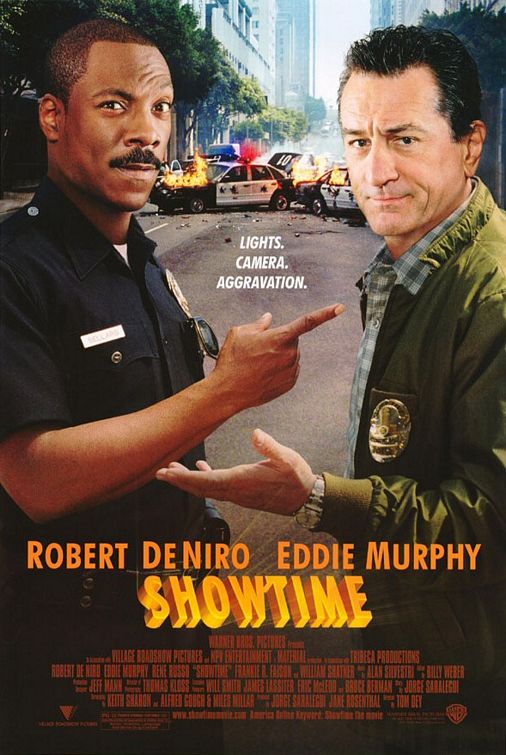
Showtime (2002) Poster
SHOWTIME (2002) D+
dir. Tom Dey
Showtime has everything it needs except a reason to exist. Robert De Niro is the grumpy cop. Eddie Murphy is the fame-hungry hotshot. Throw in a reality TV gimmick, some buddy-cop clichés, and the setup practically writes itself. But instead of sending up the genre, the movie just follows the formula—and follows it badly. The result isn’t satire; it’s a knockoff of the very movies it’s trying to parody. De Niro plays Mitch, a no-nonsense detective forced onto a reality show after shooting a news camera. Murphy is Trey, a patrolman with acting dreams and a desperate need to be famous. They’re mismatched, of course, and the film milks that setup for the usual: grudging partnership, forced hijinks, and a script that barely remembers to be funny. The movie keeps insisting this pairing is comic gold, but hands them scenes so limp they might as well be reciting cue cards through drywall. Shatner shows up as Shatner, which should be the joke—but the film forgets to tell it. He gives De Niro lessons in screen-ready swagger: where to stand, when to squint, how to make a badge feel like a choice. It almost clicks. Then it collapses. Rene Russo drifts through like she’s scanning for exits. She plays the TV producer supposedly in charge, but the film can’t decide if she’s the brains, the conscience, or just another placeholder in a headset. The action scenes arrive like mandatory overtime—noisy, shapeless, and cut together like someone’s racing the clock. Even the climax feels pre-shrunk, hitting the motions without a single jolt of momentum. What starts as a comedy flattens into a commercial break with gunfire. Showtime doesn’t crash—it limps to the curb, cueing the credits before anyone can ask for their money back.
Starring: Robert De Niro, Eddie Murphy, Rene Russo, William Shatner, Frankie R. Faison.
Rated PG-13. Warner Bros. / Village Roadshow Pictures. USA. 95 mins.
Shrek (2001) Poster
SHREK (2001) B
dir. Andrew Adamson, Vicky Jenson
Shrek is one of those animated comedies that wants it both ways: a postmodern fairy tale full of ironic elbow jabs and a sincere fable about self-acceptance. It mostly gets there, though not without fraying the fabric a bit along the way. The film works so hard to spoof its source material that it sometimes forgets to be genuinely funny. The satire is constant, the pace relentless, and the pop culture references fly fast enough to make a medieval peasant dizzy. But when it slows down—and it does, occasionally—it reveals a heart that’s surprisingly genuine. Shrek (voiced by Mike Myers, with a brogue pitched somewhere between Aberdeen and Looney Tune) is a misanthropic ogre with a fondness for solitude and mud baths. His peaceful swamp is abruptly overrun by fairy tale creatures—exiles from a kingdom-wide purge ordered by the tyrannically preening Prince Farquaad (John Lithgow, slicing every line into satin). To reclaim his home, Shrek sets off on a reluctant quest to confront the prince, saddled with a talking donkey named Donkey (Eddie Murphy), whose manic cheer and verbal overdrive nearly steal the film. Along the way, they rescue Princess Fiona (Cameron Diaz), a sharp-witted royal hiding a secret curse that makes her just as much a misfit as her would-be rescuer. The setup flirts with convention, but the film’s real aim is subversion: ogres get the girl, princes are petty, and true love doesn’t need a makeover. The relationship between Shrek and Donkey plays like a begrudging buddy comedy on the edge of a therapy session, while Fiona’s arc—half-romantic, half-existential—grounds the movie with unexpected warmth. Visually, it’s serviceable if unspectacular, though the animators clearly prioritized expressive character work over polished textures, which was a good move. The storytelling is lean, the pacing snappy, and even if the world it builds feels more like a remix than a myth, the ride is entertaining enough. Shrek is charming in a lopsided way—an ogre in a jester’s outfit, offering both a laugh and a hug.
Voices of: Mike Myers, Eddie Murphy, Cameron Diaz, John Lithgow, Vincent Cassel, Conrad Vernon, Chris Miller, Cody Cameron, Simon J. Smith, Christopher Knights.
Rated PG. DreamWorks Pictures. USA. 90 mins.
Shrek 2 (2004) Poster
SHREK 2 (2004) B+
dir. Andrew Adamson, Conrad Vernon, Kelly Asbury, Rachel Falk
It’s a rare sequel that improves upon the original, but Shrek 2 pulls it off—if only by upping the joke quotient and bringing in a ringer. That would be Puss in Boots, an orange tabby voiced by Antonio Banderas, who arrives on screen with the swagger of Errol Flynn and the disarming fluffiness of a pillow that purrs. He’s supposed to be a threat—an assassin hired by Prince Charming (Rupert Everett) to eliminate Shrek—but one pouty look and a few swipes of the rapier later, he’s a full-fledged sidekick. By the end of the film, he doesn’t just steal scenes; he practically adopts them. But maybe I’m biased. I’m an easy mark for any cat that wanders through a movie frame, whether it’s there for a second or takes center stage. Still, even by feline standards, this one’s a marvel—suave, ridiculous, and hilariously aware of his own cuteness. He joins the returning cast—Shrek (Mike Myers), Donkey (Eddie Murphy), and Fiona (Cameron Diaz)—as they journey to the kingdom of Far Far Away to meet Fiona’s parents, voiced with perfect uptight pomp by John Cleese and Julie Andrews. The royal welcome is chilly. King Harold is furious his daughter married an ogre, and the kingdom’s Fairy Godmother (Jennifer Saunders, in full diva mode) has other plans involving Charming and a potion-fueled makeover. The film delivers the same message as its predecessor—love yourself, scales and all—but it manages to deliver that lesson with fresh energy. The humor is broader, the cultural references even more crammed in, and the animation cleaner. It’s still a jukebox world of pop songs and punchlines, but the timing is sharper, the character dynamics more playful, and the emotional beats hit with just enough sincerity to make it all work. Shrek 2 doesn’t deepen the fairy tale so much as remix it louder and flashier. But the additions—especially a sword-wielding cat with a lethal stare—are worth the noise.
Voices of: Mike Myers, Eddie Murphy, Cameron Diaz, John Lithgow, Julie Andrews, Antonio Banderas, John Cleese, Rupert Everett, Jennifer Saunders, Conrad Vernon, Joan Rivers.
Rated PG. DreamWorks Pictures. USA. 92 mins.
Sick (2022) Poster
SICK (2022) B–
dir. John Hyams
Spring 2020, frozen in amber. The beginning of the COVID pandemic. Empty highways, stripped supermarket shelves, strangers eyed like moving hazards. Parker (Gideon Adlon) and Miri (Bethlehem Million) head for a family lake house—fill the fridge, lock the door, and wait for the world to switch back on. It’s meant to be a bubble, but the air in that bubble is already tense. Parker’s phone is a lifeline she pretends not to check every few minutes, Miri is half host, half moral compass, and then Parker’s not-quite-boyfriend materializes with a grin that suggests both boredom and ulterior motive. That night, every phone in the house disappears. From that point, the movie stays on its feet. Hyams doesn’t go for flourishes or self-congratulation; he maps the space the way a hunter studies a blind. Rooms are entered, crossed, abandoned. Doors are opened on hesitation, windows on reflex. The attacks are quick but not anonymous—you can tell who’s breathing hardest, who’s taking the risk of looking back. The style is stripped to the mechanics of being chased: the sound of footfalls closing in, the short burst of breath when a corner is turned and the hallway’s not empty after all. The early-pandemic setting isn’t a gimmick here; it’s a pressure point. Every character is already half-suspicious of the others, the air feels measured out by the breath, and the idea of a stranger in the room carries a double charge—physical danger and viral threat. Even before the first blade, it’s a movie about proximity. When the explanation finally arrives, it’s the sort of motive you can’t quite believe you’re hearing, and the film seems to know it. Rather than defend it, Hyams treats it like gasoline and lets the last reel burn hot. It’s ridiculous, yes—but also quick, sharp, and unwilling to stop for the kind of apology that would kill the momentum. By the time it’s over, the only thing left is the echo of the chase and the odd recognition that, for a while there, you weren’t thinking about anything else.
Starring: Gideon Adlon, Bethlehem Million, Dylan Sprayberry, Marc Menchaca, Jane Adams.
Rated R. Peacock. USA. 83 mins.
Sidekicks (1993) Poster
SIDEKICKS (1993) C+
dir. Aaron Norris
Sidekicks is a Karate Kid clone that comes pre-packaged with daydream sequences, asthma attacks, and Chuck Norris in full mythological glow. It’s not a great movie—not even really a good one—but it has its heart in the right place and a goofy earnestness that, in the right light, might pass for charm. Jonathan Brandis plays Barry Gabrewski, a wheezy, soft-spoken teen whose real life is a gray loop of bullies, gym class trauma, and mild parental neglect. But in his head, he’s Bruce Lee with better hair—slicing through ninjas and jumping out of helicopters with Chuck Norris. (Norris appears as a fantasy version of himself, playing it stoic and just this side of sleepwalking.) Barry longs to learn martial arts for real, but when he tries to join a local dojo, he’s promptly humiliated by its deranged leader, Kelly Stone (Joe Piscopo). Barry’s fortunes change when Mr. Lee (Mako, dignified even when delivering fortune-cookie wisdom) agrees to train him using a blend of tai chi, tough love, and kitchen utensils. The real world intrudes occasionally—most awkwardly in the form of a shoehorned romance between Barry’s father (Beau Bridges) and his teacher (Julia Nickson), a subplot that adds almost nothing but extra running time. Still, the training montages are passable, the dream sequences outlandish, and the finale—a martial arts tournament, naturally—wraps things up with predictable but satisfying bravado. Kids who enjoy martial arts flicks will find something to latch onto here, especially if they’ve already worn out their Three Ninjas VHS. Adults might chuckle at the film’s oddball tone, or at Piscopo’s performance, which feels like a Saturday morning cartoon character possessed his body. Sidekicks isn’t original or especially coherent, but it’s an inoffensive fantasy of self-improvement, shot through with sincere cornball optimism—and the occasional roundhouse kick.
Starring: Jonathan Brandis, Beau Bridges, Mako, Julia Nickson, Chuck Norris, Joe Piscopo, Danica McKellar.
Rated PG. Triumph Films. USA. 101 mins.
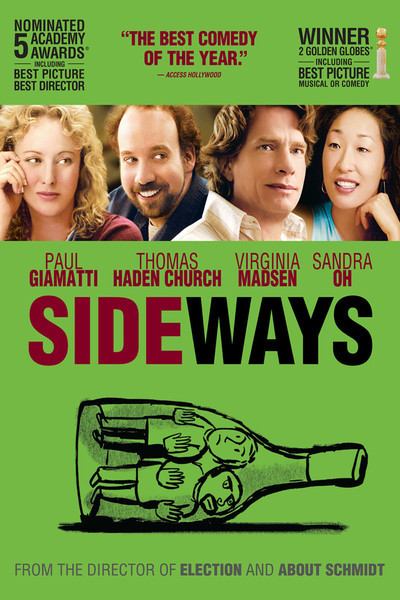
Sideways (2004) Poster
SIDEWAYS (2004) A
dir. Alexander Payne
I’ve always had a soft spot for people who get carried away talking about the things they love, no matter how niche or lopsided their passion might be. In Sideways, it’s wine. And the enthusiast in question is Miles (Paul Giamatti), a schlubby, self-thwarting middle school teacher who treats Pinot Noir like religion and Merlot like personal betrayal. He’ll talk your ear off about tannins and terroir and why Cabernet Francs are all bark, no body—assuming you don’t interrupt his monologue with something as gauche as optimism. To send off his friend Jack (Thomas Haden Church) before the altar claims him, Miles curates a getaway to Santa Barbara wine country: a tight itinerary of vineyard tours, golf, and general male bonding. Jack, naturally, has different ideas. Within hours, he’s plotting a weeklong fling with a winery employee named Stephanie (Sandra Oh) and nudging Miles toward Maya (Virginia Madsen), a waitress with warmth, insight, and infinitely more patience than Miles deserves. He’s into her, sure—but too riddled with doubt and inertia to do anything about it. What unfolds is a sun-dappled comedy of disappointment and desire, where the laughs land with a wince and the tenderness arrives in sneaky little sips. The contrast between Miles and Jack—one perpetually wound, the other terminally unbothered—should strain belief, but it doesn’t. Their friendship is baffling, occasionally toxic, and completely convincing. You get the sense they’ve seen each other at their lowest and agreed to keep showing up anyway. Alexander Payne directs with his usual acerbic grace, peeling back the layers without ever forcing the point. There are moments here that are laugh-out-loud funny, others that are quietly bruising, and more than a few that manage both. Sideways is the kind of film that creeps up on you—talky, melancholic, deeply human. And Giamatti, in one of his best performances, captures the soul of a man who knows exactly how he ended up in the ditch, and still can’t stop himself from climbing back in.
Starring: Paul Giamatti, Thomas Haden Church, Virginia Madsen, Sandra Oh.
Rated R. Fox Searchlight Pictures. USA. 127 mins.
Signs (2002) Poster
SIGNS (2002) B
dir. M. Night Shyamalan
The The Sixth Sense worked because ghosts don’t need logic. The plot holes, the narrative sleights of hand—you forgave them, because ghosts don’t follow rules. Unbreakable was shakier. But Signs—this one’s harder to forgive. The gaps aren’t tucked into the margins; they’re front and center, glaring enough to trip the story. Hard to explain without spoiling it, but when the logic finally appears, it feels less like a reveal and more like someone clearing their throat and hoping you’ll move on. Mel Gibson plays Graham Hess, a former Episcopalian minister whose wife died in an accident that cracked his theology straight through. Now he tends corn instead of congregants, raising two kids with help from his younger brother Merrill (Joaquin Phoenix, part live-wire, part sad-sack golden retriever). The children—Rory Culkin and Abigail Breslin—are unusually good. Shyamalan, once again, draws out performances that feel unforced, emotionally clear, and just stylized enough to keep the mood strange. The setup is War of the Worlds by way of a single farmhouse. Something’s out there—crafty, coordinated, mostly unseen—and this family is stuck with the front-row seats. Crop circles. Baby monitors picking up static that might not be static. News reports that grow more frantic by the hour. The tension comes not from what we see, but what might be crouching just offscreen. It’s a global event staged like a chamber piece, and that tightness makes the fear feel personal. Shyamalan may fumble structure, but he knows how to shape a scare. The setups are clean, the rhythm deliberate, and the payoffs work: a glimpse on tape, a door half-open, footsteps crossing the roof. The suspense holds—until it doesn’t. But by then, the film already has you. Because Signs isn’t really about aliens. It’s about a man circling his lost faith, trying to decide if meaning is something you find or something you invent. The horror is often secondary. It’s the grief that sticks. The kitchen-table theology. He’s stopped praying, but not hoping—drifting toward the idea that someone might still be out there. The film doesn’t quite hold, but it sticks with you—funny, tense, uneven, and unexpectedly affecting.
Starring: Mel Gibson, Joaquin Phoenix, Rory Culkin, Abigail Breslin.
Rated PG-13. Touchstone Pictures. USA. 106 mins.
The Silence (2019) Poster
THE SILENCE (2019) C-
dir. John R. Leonetti
It starts with a cave—cracked open by unwitting explorers who release a swarm of winged predators called “vesps,” blind bat-piranha hybrids with hypersensitive hearing and a taste for flesh. One cough, one ringtone, one misstep, and they descend like airborne piranhas. Civilization unravels quickly, as it tends to in films like this. Enter Ally (Kiernan Shipka), a teenage girl who lost her hearing in an accident and now communicates through lip-reading and sign language. Her family, conveniently fluent, seems better equipped than most to survive in a world that demands silence. They flee to the countryside, betting that quiet and isolation might buy them time. The setup is solid. The follow-through, less so. The Silence toys with suspense but rarely builds any. A pharmacy sequence laced with corpses generates some tension, but most of the film drifts from scene to scene with little urgency. Stanley Tucci, playing Ally’s father, seems underused—his reactions so muted you’d think he misplaced his wallet, not watched his best friend get torn apart. Ally’s deafness, though central to the premise, feels mostly like a narrative convenience. The film leans heavily on it early, only to fall back on whispered conversations and forgettable survival beats. Then, midway through the third act, the vesps take a backseat to a robed cult called The Hushed, who sever their own tongues and communicate through eerie stares and scrawled notes. They want Ally—why isn’t clear—but their presence feels undercooked, as if grafted on from a more interesting movie that never got made. The Silence has the bones of a creature feature, but no voice—and nothing much to say.
Starring: Stanley Tucci, Kiernan Shipka, Miranda Otto, Kate Trotter, John Corbett, Kyle Harrison Breitkopf, Dempsey Bryk, Billy MacLellan.
Rated PG-13. Netflix. Germany-USA. 90 mins.
The Silence of the Lambs (1991) Poster
THE SILENCE OF THE LAMBS (1991) A
dir. Jonathan Demme
A thriller so immaculately tense and queasily unforgettable that decades later, you can still feel its fingerprints on half the crime films that followed. Anthony Hopkins, in what might be cinema’s most unnerving performance delivered mostly from behind glass, plays Dr. Hannibal Lecter—former psychiatrist, part-time gourmet, full-time monster. He’s locked away in a cell so the public can keep an eye on him, though the uneasy truth is it often feels like he’s the one doing the watching. The plot coils tighter with every scene: Clarice Starling (Jodie Foster, never better) is a fledgling FBI trainee thrown into deep water when she’s sent to squeeze insights from Lecter about another active horror show—a serial killer dubbed Buffalo Bill (Ted Levine), who prefers tailoring to taxidermy in the worst possible way. Lecter, being Lecter, won’t simply hand over answers. Instead, he teases apart Clarice’s past like a cat pawing a thread, offering crumbs of truth only when it suits him. Demme draws more dread from eye contact than most thrillers get from a dozen chase scenes. When the violence hits, it’s precise and savage—Lecter’s escape remains one of the great nerve-shredding sequences ever put to film. Hopkins makes every syllable drip—purring, savoring consonants like a tasting flight—yet Foster’s Clarice keeps the film honest. She’s sharp but raw, and tough though visibly afraid. Her scenes opposite Lecter crackle with an unspoken tension that can still prickle your skin. By the time the film reaches that basement finale—night vision goggles, desperate breathing, and the creeping certainty that you’re next—you realize this film had never loosened its hold. This is a movie that knows exactly how fear works, and it doesn’t waste a drop.
Starring: Jodie Foster, Anthony Hopkins, Scott Glenn, Ted Levine, Anthony Heald, Brooke Smith.
Rated R. Orion Pictures. USA. 118 mins.
Silverado (1985) Poster
SILVERADO (1985) B
dir. Lawrence Kasdan
A sturdy Western with a giddy ensemble and a plot that comes pre-dusted in genre shorthand. Four men—Scott Glenn, Kevin Kline, Danny Glover, and a twitchy, scene-stealing Kevin Costner—find each other on the open road and stick, less out of loyalty than momentum. Their pasts are sketchy, their goals mostly improvised, but they drift into the same fight: a showdown with Brian Dennehy’s corrupt sheriff in the boomtown of Silverado. The film is more cartoon than myth, but not in a bad way. Kasdan shoots it wide and golden, like he’s staging the idea of a Western. There are saloons, ambushes, horses that always seem to arrive at just the right moment. The plot checks the usual boxes—revenge, redemption, a final shootout—but the side roads are where the fun is. The real pleasure is in the casting. Glenn plays stoic. Kline stays sly. Glover brings gravity. And Costner, grinning, flipping, always moving, plays like he’s just glad to be out of the house. Rosanna Arquette pops in as a maybe-love-interest and voice of reason, but the script doesn’t know what to do with her. And then there’s John Cleese, of all people, wandering through an early stretch as a by-the-book sheriff who seems to have taken a wrong turn on the way to A Fish Called Wanda. It’s overlong, and the script isn’t built for surprise. But scene by scene, it’s good company—more about momentum than meaning. It rides tall, tips its hat, and keeps going.
Starring: Kevin Kline, Scott Glenn, Kevin Costner, Danny Glover, Brian Dennehy, Rosanna Arquette, John Cleese, Linda Hunt.
Rated PG-13. Columbia Pictures. USA. 133 mins.
Load Next Page