Film Buff Musings

by Michael Lawrence

List of "C" Movies


Celtic Pride (1996) Poster
CELTIC PRIDE (1996) B
dir. Tom DeCerchio
A movie with a premise so absurd it should topple like a house of cards—but Celtic Pride stays standing. Maybe it’s the sheer conviction of Daniel Stern and Dan Aykroyd, playing a pair of rabid Boston Celtics fans whose love for their team bulldozes through any shred of common sense. Maybe it’s the sharp, surprisingly mean-spirited script that knows exactly how far to push its own ridiculousness. Or maybe it’s just the raw, unfiltered “bro energy” radiating from every scene, as if the film itself is running on a mix of beer, nachos, and blind sports devotion. Whatever magic holds it together, it works. Mike (Stern) and Jimmy (Aykroyd) aren’t just Celtics fans—they’re the kind of guys who treat every loss like a personal betrayal, every win like a spiritual awakening. With Boston trailing in the NBA Finals, they take matters into their own hands: get Lewis Scott (Damon Wayans), the Utah Jazz’s star player, blackout drunk the night before Game 7. One thing leads to another, and by morning, Scott isn’t just hungover—he’s tied up in Mike’s apartment. They’ve kidnapped him. Not for ransom, not out of malice, but because, in their deluded minds, this is what true fans do. Stern, all mouth and no impulse control, plays Mike, the kind of guy who thinks he knows the game better than the coach, the players, and probably God himself. Aykroyd’s Jimmy, meanwhile, treats sports like religion—rituals, superstitions, deep-seated beliefs that dictate how he lives, breathes, and bets. Together, they create a comedy duo so perfectly matched that their completely deranged scheme somehow feels like something they’ve been building toward for years. They bicker, they improvise, they come close to ruining their own lives, and it’s all weirdly—almost disturbingly—believable. Wayans, stuck in their fanboy hostage situation, spends most of the film trying to gauge whether these two are truly dangerous or just a pair of overgrown children playing with fire. He settles somewhere between exasperation and amusement, his reactions giving the film just enough grounding to keep it from floating into pure farce. And then there’s Larry Bird—their idol, their god—who shows up just long enough to eviscerate them so thoroughly that kidnapping a human being almost starts to seem like the least terrible decision they’ve ever made. The whole thing is ridiculous, and the film wastes no time pretending otherwise. It’s a celebration of sports obsession gone completely off the rails, and if you’ve ever screamed at a TV over a bad call or refused to wash a lucky jersey, you’re already halfway to understanding these guys. This isn’t a smart movie, but it’s sharp enough to know exactly what it’s doing. And that’s enough.
Starring: Damon Wayans, Daniel Stern, Dan Aykroyd, Gail O’Grady, Christopher McDonald, Paul Guilfoyle, Adam Hendershott, Scott Lawrence, Deion Sanders, Vladimir Cuk, Bill Walton, Darrell Hammond, Larry Bird, Marv Albert, Bob Cousy.
Rated PG-13. Buena Vista Pictures Distribution. USA. 90 mins.
The Center of the World (2001) Poster
THE CENTER OF THE WORLD (2001) B-
dir. Wayne Wang
A movie about sex, though not the kind anyone dreams about. The Center of the World unfolds in hotel rooms and strip clubs, in dimly lit spaces where intimacy is transactional and love is something people pretend not to need. Wayne Wang shoots it like a documentary on the slow erosion of hope—grainy, handheld, voyeuristic, as if the camera itself feels a little ashamed to be watching. The film doesn’t seduce so much as expose, peeling back the thin layer of fantasy that keeps sex work and relationships in separate categories. Peter Sarsgaard, playing a dot-com millionaire who’s rich in everything but human connection, meets Florence (Molly Parker), a stripper who knows exactly what she’s selling and at what price. He proposes a weekend in Vegas. She agrees, but not without terms—four hours per evening, no sex, rules designed to keep things from turning into anything that might sting later. And yet, they spend their days together, too. Talking, eating, sightseeing, playing at something closer to romance, though neither one admits it. Richard, clearly believing that enough money and enough time will turn this into something real, even offers financial help to Florence’s friend (Carla Gugino) under the pretense of generosity. What he’s really selling is himself—look, no strings attached, no expectations, no pressure. Just a good guy with a credit card and a fragile ego. The film hints at something deeper but gets tangled in its own voyeurism, too fascinated with what it’s showing to fully explore why any of it matters. The script is there—buried under the grainy camcorder aesthetic, the quiet pauses that stretch a little too long, the moments that feel real enough to be uncomfortable. But Parker and Sarsgaard commit completely, playing the tension between control and vulnerability with such raw precision that, at times, the film barely needs a script at all. Uncomfortable, frustrating, and weirdly mesmerizing, The Center of the World isn’t erotic so much as clinical, stripping desire down to something mechanical, something both parties understand but refuse to acknowledge. Nobody seduces, nobody wins, nobody gets what they really want. But for two hours, it watches as they try.
Starring: Peter Sarsgaard, Molly Parker, Carla Gugino, Balthazar Getty.
Rated R. Artisan Entertainment. USA. 88 mins.
Chain Reaction (1996) Poster
CHAIN REACTION (1996) C
dir. Andrew Davis
A science thriller with just enough surface polish to pass for competent, and just enough internal emptiness to remind you it isn’t. Keanu Reeves plays Eddie, a Chicago lab tech with the haircut of a session drummer and the brain of a theoretical physicist, who accidentally stumbles into cold fusion. Moments later, his mentor is dead, the lab’s been reduced to dust, and every federal acronym with a helicopter budget is after him. Rachel Weisz, saddled with dual duties as fellow scientist and fleeing companion, spends most of the runtime toggling between baffled and hypothermic. Morgan Freeman, billed like a lead but positioned more like a warning label, drifts in and out with the somber cadence of a man who’s already seen the ending and wasn’t impressed. What follows is a series of chase scenes, CCTV footage, and expository throat-clearing disguised as dialogue. The film moves, technically, but in the way a screen saver moves—predictable, repetitive, and oddly proud of itself. The action doesn’t embarrass, but it doesn’t quicken the pulse either. It’s as if someone phoned in a description of a thriller and the studio greenlit the transcript. There are mentions of global energy reform, corporate conspiracy, and technology that could rewrite civilization, but none of it registers above background noise. Chain Reaction plays safe, stays tidy, and exits without ever kicking up a spark.
Starring: Keanu Reeves, Morgan Freeman, Rachel Weisz, Fred Ward, Brian Cox.
Rated PG-13. 20th Century Fox. USA. 107 mins.
Chaos Walking (2021) Poster
CHAOS WALKING (2021) C
dir. Doug Liman
A sci-fi premise so full of possibility it practically begs for a better movie. Chaos Walking, adapted from a young adult novel, imagines a distant planet where every man’s thoughts are projected into the open air—visible, audible, impossible to conceal. Privacy is an extinct concept and deception requires an iron will. Silence belongs only to women—they’re excluded from this phenomenon for whatever reason. Not that it matters much anyway, since there are no women left. The planet’s original inhabitants, The Spackle, supposedly wiped them all out, leaving behind a town of men slowly drowning in each other’s unfiltered thoughts. Then, a ship crashes. Viola (Daisy Ridley) emerges—the first woman Todd (Tom Holland) has ever seen since his mother was killed years ago. She becomes a mysterious visitor in a world where her very presence is a threat. The town’s leader (Mads Mikkelsen, wrapped in furs like a Scandinavian warlord) takes an immediate interest in her, which, in this kind of movie, means she needs to run. An idea like this should unravel into something terrifying—a slow-burn examination of paranoia and power—a dystopia where thought itself becomes a weapon. Instead, Chaos Walking plods along like a hiking trip nobody wanted to go on, turning its wildly original concept into a limp chase movie. Holland and Ridley, inspired casting choices, try their best with what they’re given. He plays Todd as a wide-eyed puppy still figuring out how his own paws work. She plays Viola with the guarded, measured intelligence of someone who has spent her life around people with more power than her and knows how to navigate them. Their chemistry could have been something—electric, awkward, anything—but the script gives them nothing beyond hurried exchanges and the vague suggestion of romance. The premise deserved sharper writing, a wilder narrative imagination, a willingness to push its own ideas further. Instead, Chaos Walking pulls back, too timid to take real risks, too safe to be truly memorable. It doesn’t collapse, it just trudges forward, head down, getting to the finish line without making much of a scene. Not a disaster, just a wasted shot at something better.
Starring: Tom Holland, Daisy Ridley, Mads Mikkelsen, Demián Bichir, Cynthia Erivo, Bethany Anne Lind, Nick Jonas, David Oyelowo, Kurt Sutter, Ray McKinnon.
Rated PG-13. Lionsgate. USA. 109 mins.
Chaplin (1992) Poster
CHAPLIN (1992) C
dir. Richard Attenborough
Robert Downey Jr. doesn’t just impersonate Chaplin—he channels him. The walk, the flinchy grace, the elastic grin—it’s all there, like he’s been possessed by nitrate stock. It’s a performance so finely tuned you end up laughing at Downey the same way you laugh at Chaplin, which is its own kind of magic. Unfortunately, it’s in service of a biopic that feels like homework with production values. Director Richard Attenborough ticks off the major life events like he’s guiding us through a wax museum: childhood poverty, sudden fame, serial marriages, political scandal, exile, redemption. Everything’s present, nothing’s illuminated. The filmmaking gets a footnote; the women get whole chapters. Even the exile—arguably the defining rupture of Chaplin’s public life—is brushed aside like a canceled vacation. Downey is magnetic, but the film rarely meets him halfway. He’s performing in dimensions the script doesn’t even recognize—expressive, reactive, alive. Everyone else is stuck in historical cosplay. Dan Aykroyd barrels through as Mack Sennett with the urgency of a man trying to beat the reel change. Kevin Kline coasts through as Douglas Fairbanks, all posture and polish. Geraldine Chaplin plays her own grandmother, which ought to add a shiver of something uncanny, but the film doesn’t give her the space to let it settle. There’s no shortage of material, but no sense of discovery. The movie files Chaplin under “important,” glosses him in soft lighting, and moves on. What’s missing is the itch—what drove him, what carved comedy from deprivation, what made a silent man say more than most people with a microphone. Even the mechanics of how he built those films barely get a glance. We get the silhouette. The mind, the mischief, the meaning—that’s left offscreen.
Starring: Robert Downey Jr., Geraldine Chaplin, Paul Rhys, John Thaw, Moira Kelly, Anthony Hopkins, Dan Aykroyd, Marisa Tomei, Penelope Ann Miller, Kevin Kline, Milla Jovovich, Kevin Dunn, Diane Lane, Nancy Travis, James Woods, David Duchovny, Peter Cook.
Rated PG-13. TriStar Pictures. UK-USA. 145 mins.
Charade (1963) Poster
CHARADE (1963) A-
dir. Stanley Donen
It’s a Hitchcock setup on a screwball bender. A twisted mystery wrapped in banter, murder, and Audrey Hepburn in Givenchy. Her husband winds up dead, strangers start circling, and suddenly everyone’s convinced she’s sitting on a stolen fortune she didn’t know existed. Enter Cary Grant, with just enough charm and mystery to keep everyone off balance. This movie plays like three genres in one breath—thriller, comedy, romance—and never feels winded. The bones are classic: a wartime heist, a hidden stash, and three men willing to kill for it. But the tone’s more confection than noir. Stanley Donen keeps the bodies coming and the mood just light enough to glide. The humor’s dry, the danger sharp, and the film moves like it knows exactly how good it looks—and doesn’t mind if you know too. Grant and Hepburn carry the thing. He’s smooth, a little slippery, and clearly having fun. She’s quick, suspicious, and not nearly as naïve as everyone assumes. Their scenes have that kind of flirtation where the subtext keeps changing mid-sentence. She keeps asking who he is. He keeps changing the subject. It works. The heavies are a fun crew: James Coburn, George Kennedy, and Ned Glass, all menace and oddball energy. Walter Matthau ambles in as a CIA guy who mostly looks like he’d rather be somewhere else. But the one who never leaves Reggie’s orbit is Grant—his name shifting, his story never quite settling, but his presence never in doubt. The plot’s a nest of reversals. Every time you think you’ve got the handle, it slips. By the end, it’s less about who’s lying and more about who’s lying best. And somehow, through all the bodies and aliases, it still lands as a romance. It’s a thriller with crisp lines and a mean little grin. The mystery holds, the jokes snap, and Mancini’s score keeps the whole thing gliding. Charade isn’t trying to break the mold. It’s just having a damn good time with it.
Starring: Audrey Hepburn, Cary Grant, Walter Matthau, James Coburn, George Kennedy.
Rated PG. Universal Pictures. USA. 113 mins.
Chariots of Fire (1981) Poster
CHARIOTS OF FIRE (1981) A-
dir. Hugh Hudson
Unexpectedly moving, Chariots of Fire takes a story that could have been stiff with reverence and instead makes it feel immediate, as if history were something you could lace up and run alongside. A film about British Olympic runners in the 1920s shouldn’t, by all logic, be this gripping, let alone this stirring. Yet, slow-paced as it is, it draws you in—not just into the narrative, but into its very atmosphere, its damp air, its rolling fields, its solemn courtyards where history settles like an old book held open to a specific page. Ben Cross plays Harold Abrahams, a Jewish student and gifted runner, forever fighting for his place, driven by something both clear and unknowable. He takes on the fabled “Race Around the Quad,” a mad sprint through Cambridge’s courtyard before the clock strikes twelve, an act of sheer defiance that marks him as both a legend and a man who will never quite be satisfied. But for all his fire, he keeps coming in second to Eric Liddell (Ian Charleson), a devout Scotsman who runs not for victory but for something higher. Liddell refuses to race on Sundays, a decision that makes as much sense to him as breathing but bewilders everyone else. The film is based on real people, but it never stumbles into the usual biopic traps—no forced melodrama, no overworked arcs straining for meaning. Instead, it moves with an almost eerie naturalism, as though it couldn’t have happened any other way. Even Vangelis’ now-iconic electronic score, a sonic anachronism, doesn’t break the spell. It deepens it. The famous slow-motion training sequence on the beach—runners cutting through wet sand, muscles working, breath steady—is less about athleticism than the sheer weight of effort, the pursuit of something intangible. It’s easy to grumble about Chariots of Fire taking Best Picture over Raging Bull, a decision that still stirs debate. But that argument, however valid, doesn’t change what’s on the screen. This is a beautiful film, and more than that, a film that feels—history, struggle, faith, the quiet poetry of a runner pushing forward, chasing something just out of reach.
Starring: Ben Cross, Ian Charleson, Nigel Havers, Nicholas Farrell, Ian Holm, John Gielgud, Lindsay Anderson, Cheryl Campbell, Alice Krige, Struan Rodger, Nigel Davenport.
Rated PG. 20th Century Fox. UK-USA. 124 mins.
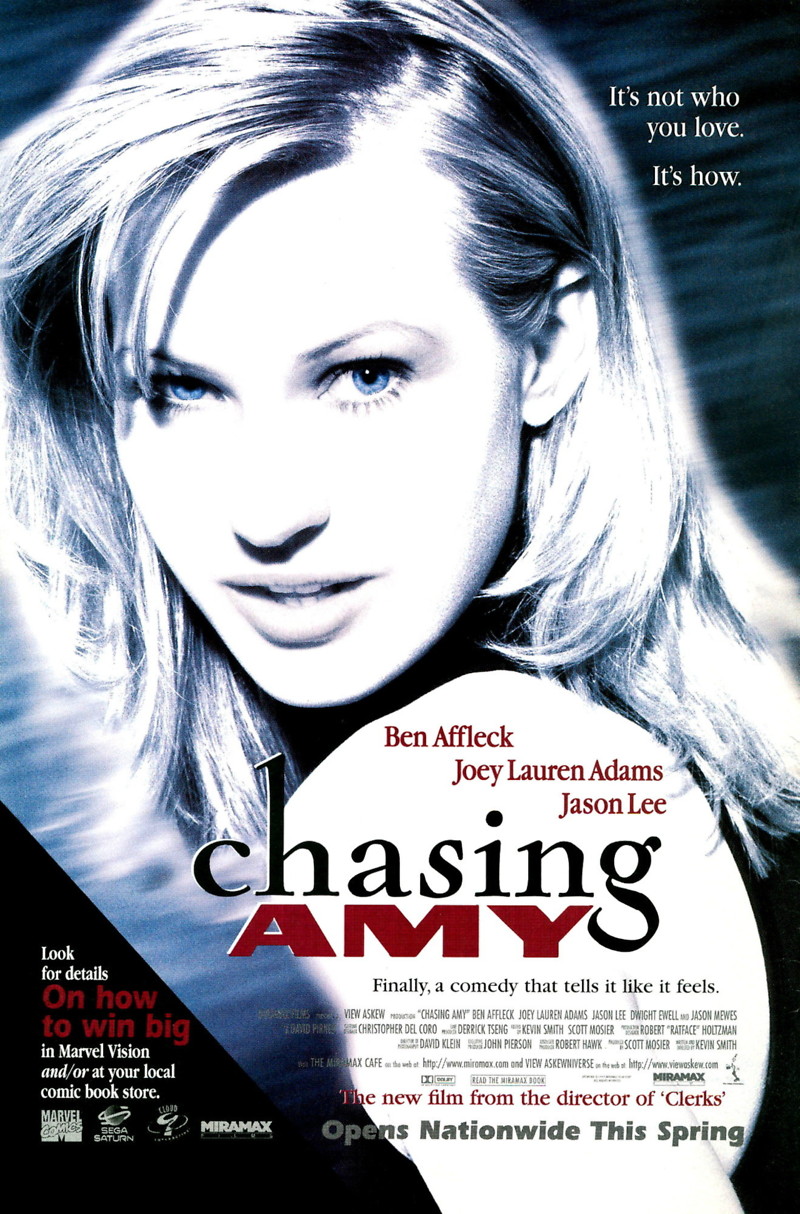
Chasing Amy (1997) Poster
CHASING AMY (1997) B+
dir. Kevin Smith
Chasing Amy starts loud: comic shop rants, dick jokes, Star Wars metaphors. Vintage Kevin Smith, back when pop culture and profanity were a worldview. Then it shifts—slows down, looks inward, gets messy. What begins as a talky Gen X comedy becomes an awkward, compelling meditation on desire, identity, and the limits of straight-guy imagination. It’s not seamless, but it holds. Ben Affleck plays Holden McNeil, a comic book artist with just enough clout to get by and just enough ego to get in his own way. He and his partner Banky (Jason Lee) are milking success off Bluntman and Chronic, a stoner superhero riff based on their weed-slinging acquaintances. Then Holden meets Alyssa (Joey Lauren Adams)—fellow artist, fast-talking, and, as it turns out, not into men. He falls anyway. Banky, whose opinions are about as subtle as a foghorn, warns him off. Holden, naturally, thinks sincerity is a trump card. That if he wants it enough, the rules will change. The movie doesn’t cheer him on—it lets him flail. What follows isn’t a romance so much as a case study in projection, entitlement, and selective listening. Smith isn’t always deft, but the attempt to dig into messy feelings instead of dodging them puts this on a different plane from the rest of his early filmography. The film’s handling of LGBTQ themes isn’t always precise, but it’s not dismissive. It centers Holden more than it should, and Alyssa is sometimes framed more as a lesson than a person. But Adams pushes back—her performance carries a charge the script can’t quite contain. Affleck, playing things quieter than usual, does solid work as a man caught between wanting love and wanting to be right. Lee, as Banky, lets his bitterness build until it hints at something deeper. Chasing Amy occasionally stumbles over its own good intentions, but even with its rough edges, it’s curious in a way that sticks. Smith reaches past his usual comfort zone, and while the film doesn’t always pull it off, there’s something compelling about the effort—messy, overreaching, and maybe the most interesting thing he’s made.
Starring: Ben Affleck, Joey Lauren Adams, Jason Lee, Dwight Ewell, Ben Indra.
Rated R. Miramax Films. USA. 113 mins.
Chestnut: Hero of Central Park (2004) Poster
CHESTNUT: HERO OF CENTRAL PARK (2004) C+
dir. Robert Vince
Two orphaned sisters hide a Great Dane in a Manhattan high-rise and somehow no one notices. That’s the plot. Or most of it. Chestnut: Hero of Central Park is built on improbability and sentiment, but it’s not without its uses—chief among them a pre-Little Miss Sunshine Abigail Breslin, already figuring out how to be endearing on cue. Breslin and Makenzie Vega play the girls, fresh from an orphanage that seems to operate on rules last updated during the Roosevelt administration. They’re adopted by kindly Manhattanites and, within minutes, have smuggled their dog into the building. There’s a plan in place—sort of—but the film seems more interested in the concept than the logistics. What passes for comedy is a collection of pratfalls, overreactions, and adults muttering things that probably read funnier on paper. A man sneezes himself across a room in a rolling chair. Someone else ends up spinning on a ceiling fan. Halfway through, two would-be criminals appear, auditioning for a reboot of the Wet Bandits, only to be thwarted by the dog’s impromptu booby traps. Mercifully, the movie doesn’t dwell on any of this longer than necessary. It’s squarely aimed at young kids—especially those susceptible to puppies and sisterly bonding. But there’s something sincere under the synthetic parts. The girls’ connection to the dog actually feels like a real relationship, even if nothing else does. The ending, curiously, veers more somber than you’d expect from a movie that features a criminal being outsmarted by a dog biscuit. It may not be much, but it knows its audience and plays to them without condescension.
Starring: Abigail Breslin, Makenzie Vega, Christine Tucci, Barry Bostwick, Irene Olga López, Justin Louis, Maurice Godin.
Rated G. Miramax Films. USA. 87 mins.
Chicago (2002) Poster
CHICAGO (2002) A-
dir. Rob Marshall
Chicago doesn’t adapt the musical so much as lacquer it in gloss, set it spinning, and let the camera scramble to keep up. It’s a high-wire razzmatazz of jazz hands and jaundiced morality, where murder becomes a career move and staying relevant means staying ruthless. Rob Marshall directs like he’s orchestrating a publicity stunt—and it mostly works. Every number doubles as a transaction or an alibi. Renée Zellweger plays Roxie Hart as a starry-eyed cipher with a loaded pistol and no discernible talent beyond needing an audience. She shoots a man who lied about his industry connections (he was just looking for sex), and winds up in prison with a sob story and a stage name. Enter Billy Flynn (Richard Gere), a lawyer with tap shoes in his briefcase and a horn section in his closing arguments. He rebrands Roxie as a tragic heroine—self-defense, big eyes, satin gloves. Catherine Zeta-Jones, sharp as a switchblade, is Velma Kelly, the former tabloid sensation who killed her husband and her sister but can’t find a good PR hook anymore. The musical numbers—scrubbed and sequined—stay true to the spirit of Fosse, even as they nod to Hollywood spectacle. The whole thing is a carnival of misdirection, but that’s the point. If virtue is passé and spin is the only currency left, then this is a musical where the razzle is the dazzle. And it’s catchy as hell.
Starring: Renée Zellweger, Catherine Zeta-Jones, Richard Gere, Queen Latifah, John C. Reilly, Christine Baranski.
Rated PG-13. Miramax. USA. 113 mins.
Children of a Lesser God (1986) Poster
CHILDREN OF A LESSER GOD (1986) B
dir. Randa Haines
A thoughtful, well-structured adaptation of the 1979 stage play of the same name by Hesper Anderson and Mark Medoff, and while it flirts with melodrama, it ultimately holds together on the strength of its performances and its refusal to tidy up its central conflict. At heart, it’s a romance—albeit one wrapped in the tangled ethics of communication, identity, and the limits of empathy. William Hurt plays James Leeds, a spirited and unorthodox teacher at a school for the deaf and hard of hearing. He’s charming, insistent, and believes with a missionary’s fervor that helping his students speak phonetically is the key to integrating them into the “real” world. He jokes, he teases, he teaches them to swear—because apparently assimilation includes profanity. These classroom scenes are easily among the most engaging in the film, buoyed by Hurt’s easy charisma and the students’ refusal to be treated as projects. But it’s his relationship with Sarah (Marlee Matlin), a fiercely independent deaf custodian at the school, that pushes the film into more complicated terrain. James finds himself drawn to her, but his methods—so effective in the classroom—collapse when applied to someone who doesn’t want to be “fixed.” Their romance burns hot, then cold, and then somewhere between the two, never quite resolving the imbalance at its center. Matlin, in her film debut, delivers a performance with steel behind the softness. She communicates volumes without speaking a word and won the Best Actress Oscar for it. Hurt matches her beat for beat, even as the script occasionally drifts into overwrought territory. The film doesn’t pretend to solve anything. It simply observes—how two people fall in love, misunderstand each other, and try to make that mean something. That, in itself, is enough.
Starring: William Hurt, Marlee Matlin, Piper Laurie, Philip Bosco, Allison Gompf, John F. Cleary.
Rated R. Paramount Pictures. USA. 119 mins.
Children of Paradise (1945) Poster
CHILDREN OF PARADISE (1945) A
dir. Marcel Carné
Few films earn the label “miraculous” as convincingly as Children of Paradise. Conceived and completed under Nazi occupation—shot in secret, with sets built under false pretenses, and some cast members working under assumed names—it arrives not just as an artistic triumph, but as an act of quiet defiance. The fact that it doesn’t wear that context on its sleeve, but instead delivers one of the grandest love stories ever filmed, makes it all the more astonishing. Leave it to the French—invade the country if you must, but don’t even think about halting production. Set in 1820s Paris and centered around the backstage bustle of the Funambules theater, the film orbits Garance (Arletty), a coolly enigmatic woman whose presence ricochets through the lives of four very different men. The most affecting of them is Baptiste (Jean-Louis Barrault), a gentle, near-silent mime whose love for Garance runs so deep it bypasses language entirely. He doesn’t declare it—he performs it. His pantomimes are confessions, staged in full view of a crowd too dazzled to recognize the heartbreak. Each gesture carries more weight than dialogue ever could. Marcel Carné and screenwriter Jacques Prévert structure the film as a romantic epic, but one stitched together from quieter materials—regret, illusion, vanity, longing. The supporting cast doesn’t orbit the leads; it complicates them. Pierre Brasseur’s vain actor, Marcel Herrand’s serpentine thief, Maria Casares’ wronged aristocrat—they’re all part of the same emotional equation, shading each corner of the central love story with something just slightly sour. Visually, it’s a marvel. The Paris it conjures isn’t pristine—it’s theatrical, crowded, and dimly luminous, like a stage set that’s grown too large to contain. Street performers, aristocrats, and criminals all share the same oxygen. The sets don’t chase realism—they chase mood. Every corner hums with performance, longing, and artifice. For all its length—it runs just over three hours—Children of Paradise never drags. It builds patiently, accumulating power in glances and silences, until the emotional weight lands in full. It’s a film about timing, about people arriving too late or not quite whole, and the performances—especially Arletty and Barrault—carry that ache in every scene. It’s not just one of the great romances. It’s one of cinema’s great feats: lush, unshakable, and entirely alive.
Starring: Arletty, Jean-Louis Barrault, Pierre Brasseur, Marcel Herrand, Pierre Renoir, Maria Casares.
Not Rated. Pathé. France. 190 mins.
The Children's Hour (1961) Poster
THE CHILDREN’S HOUR (1961) B+
dir. William Wyler
The Children’s Hour sets out like a refined drama of manners—two intelligent women, played by Audrey Hepburn and Shirley MacLaine, running a boarding school with competence and grace. The parents approve, the students behave, the finances balance. Everything looks so tidy, right up until one child, played with venomous precision by Karen Balkin, decides to upend it all with a single lie. A whisper, vague enough to be dangerous, ripples outward, shattering reputations and dragging livelihoods down with it. That Karen and Martha are more than just business partners. That their friendship is something darker, something scandalous. The film doesn’t even let us hear Mary say it—just the horrified face of the adult listening is enough. Parents snatch their children from the school, and suddenly, these two women find themselves boxed in by a world that, it turns out, never really wanted them there in the first place. Wyler directs with classic Hollywood control—every shot measured, every line polished—but the material bristles against its own decorum. Hepburn, luminous as ever, plays Karen with an almost excruciating restraint, a woman trying to stay rational as the ground shifts beneath her. MacLaine, raw in ways 1961 barely knew how to process, plays Martha like someone realizing too late that she may have been playing a role her whole life. For all its grace, the film is still of its time—there’s a whiff of caution in how it handles its subject matter, a careful sidestep around certain realities, as if the floor could give way at any moment. But even with that restraint, the emotional wreckage it leaves behind is staggering. A story about gossip shouldn’t feel this harrowing, but The Children’s Hour proves that a lie, told with just the right amount of conviction, can level everything in its path.
Starring: Audrey Hepburn, Shirley MacLaine, James Garner, Miriam Hopkins, Fay Bainter, Karen Balkin, Veronica Cartwright, Mimi Gibson, Debbie Moldow.
Not Rated. United Artists. USA. 107 mins.
Child’s Play (1988) Poster
CHILD’S PLAY (1988) C–
dir. Tom Holland
There’s a baseline novelty to a horror movie about a freckled, two-and-a-half-foot doll that won’t stop killing people—but Child’s Play never quite figures out how to play it. You laugh, occasionally. Just not in the way it hopes. It’s never especially scary, never especially clever, but it did give pop culture a new mascot: a mop-haired menace with two voices—one chirpy and canned, the other snarling and profane. Brad Dourif, in full sprint, opens the film with a shootout in a toy store. Bleeding and cornered, he chants a voodoo incantation and zaps his soul into the nearest plastic vessel: a “Good Guy” doll, all overalls and molded dimples. The next morning, a single mother (Catherine Hicks) gives that very doll to her young son (Alex Vincent) as a birthday gift. It chirps and blinks on command: “Hi, I’m Chucky! I’m your friend to the end!” The boy is thrilled—until the doll starts speaking to him when no one else is around. Not the pre-recorded catchphrases, but darker, stranger things. He tries to tell his mother, but she assumes it’s imagination—kids say things. The film flirts with ambiguity for maybe half a reel before giving up entirely. We’ve already seen the possession, so there’s no real question of what’s happening—just when the adults will catch up. But imagine if the film hadn’t tipped its hand so early. If we, like the mother, weren’t sure whether the boy was imagining things. If the doll stayed silent just long enough to make us wonder. It could’ve built into a slow, sick paranoia. Instead, it skips ahead to the part where the doll starts killing people. The doll, meanwhile, defies physics with every scene—using a hammer gripped in its toddler limbs to strike someone on the head and launch them ten feet backward through a high apartment window. Once it’s clear he’s unbound by physical limits, nothing feels risky. Still, for all its clumsiness, Child’s Play struck a nerve. The filmmaking is flimsy, the scares are forced, and the logic collapsed by a doll that can apparently bench-press a grown man. But the image stuck. Chucky—snarling, wisecracking, grinning through blood—became the thing people remembered. The doll is the brand. Everything else is packaging.
Starring: Catherine Hicks, Chris Sarandon, Alex Vincent, Brad Dourif, Dinah Manoff, Tommy Swerdlow.
Rated R. United Artists. USA. 87 mins.
Chinatown (1974) Poster
CHINATOWN (1974) A
dir. Roman Polanski
A towering neo-noir that stands shoulder-to-shoulder with the classics it shamelessly nods to—and, on the right night, maybe even tops them. It begins exactly as these stories must: a private detective, a seemingly routine case, and a client whose only honest trait is the check she signs. The detective is Jake Gittes (Jack Nicholson, never more gorgeously smug), who runs a profitable sideline snapping photos of cheating husbands for Los Angeles high society. Into his office walks a well-heeled blonde claiming to be Evelyn Mulwray. She suspects her husband, Hollis (Darrell Zwerling), of stepping out on her. Jake takes the job, catches the man in a discreet scandal, and cashes his check. Then the floor drops out: the real Evelyn Mulwray (Faye Dunaway) shows up, lawsuit in hand, and Jake realizes he’s been played to ruin a man whose greatest crime was refusing to sign off on a shady dam project. When Hollis turns up dead—face-down in an aqueduct meant to solve the city’s thirst—Jake does what a good noir detective does: he ignores every polite warning and goes snooping anyway. The deeper he digs, the more poisonous the air gets: stolen water, land grabs, old money, and a switchblade that redefines “keep your nose clean” in the most literal way possible. By the time you reach that baked-dry ending—cruel, pitiless, and carrying the weight of something that’s been rotting for decades—you grasp what makes Chinatown so ruinous and perfect: you could untangle every lie and still lose. Corruption here isn’t a twist, it’s bedrock. Nicholson’s Jake is bravado and bad timing—he’s smart enough to follow the breadcrumbs but too cocky to see the trap. Faye Dunaway, as the real Evelyn, layers fragility over iron; when her secrets crack open, it’s like watching porcelain split with a scream you can’t unhear. The shock, the betrayal, the final gut-punch line—this is noir as it should be: bitter, lingering, and truer than we’d like to admit. Want a moral? Try children’s books. Here, you get the truth—and it stings.
Starring: Jack Nicholson, Faye Dunaway, John Huston, John Hillerman, Perry Lopez, Darrell Zwerling.
Rated R. Paramount Pictures. USA. 130 mins.
Chitty Chitty Bang Bang (1968) Poster
CHITTY CHITTY BANG BANG (1968) C
dir. Ken Hughes
Dick Van Dyke, once again shepherding a pair of wide-eyed children through a world of music and mischief, seems perfectly at home in Chitty Chitty Bang Bang—and why wouldn’t he be? He’s done this before, in a better movie (though with a worse accent). Here, he plays Caractacus Potts, a crackpot inventor whose cottage is an obstacle course of overly complicated gizmos that turn simple tasks into engineering feats. Sharing this whimsical chaos are his two irrepressibly cheerful children, Jeremy and Jemima (Adrian Hall and Heather Ripley), whose primary function is to gaze at their father with pure, undiluted faith. His latest invention, a candy whistle called “Toot Sweets,” nearly bankrupts him, but fate intervenes in the form of a beat-up old race car that he restores into something miraculous: a sentient vehicle that swims, flies, and makes everyone who rides in it instantly more whimsical. Also along for the ride is Truly Scrumptious (Sally Ann Howes), a proper Englishwoman and Caractacus’ alleged love interest. She gamely sings and smiles her way through the proceedings, though the chemistry between her and Van Dyke remains elusive—more like two amiable acquaintances agreeing that they should probably fall in love since they’re both in the same movie. The film begins on solid footing—rolling English countryside, playful Sherman Brothers tunes, and the kind of earnest, storybook fantasy that a flying car practically guarantees. Then Vulgaria happens. A land where children are outlawed should, in theory, be menacing, but instead, it drags the film into a sort of theatrical purgatory, where the rules of engagement are unclear, the villainy is oddly polite, and everything starts to feel like an overlong school play. The Baron (Gert Fröbe) and Baroness (Anna Quayle) are less terrifying dictators than bickering aristocrats who seem mildly annoyed by the existence of other people. The supposedly nightmarish Child Catcher (Robert Helpmann), all sharp features and sugar-coated threats, certainly looks the part, but even he seems to be playing to the balcony rather than inspiring genuine fear. There’s still pleasure to be had—Van Dyke’s irrepressible charm, the lush storybook visuals, the songs that, for better or worse, will lodge themselves in the brain. But for a film about a car that flies, Chitty Chitty Bang Bang spends an awful lot of time stalling on the ground.
Starring: Dick Van Dyke, Sally Ann Howes, Adrian Hall, Heather Ripley, Lionel Jeffries, Gert Frobe, Anna Quayle, Benny Hill, James Robertson Justice, Robert Helpmann, Barbara Windsor, Davy Kaye.
Rated G. United Artists. UK-USA. 145 mins.
Chloe (2009) Poster
CHLOE (2009) B–
dir. Atom Egoyan
Imperfect, but hypnotic in its way, Chloe is the kind of erotic thriller that promises mind games and emotional wreckage, then settles for well-composed tension and filtered lighting. It’s a remake of the French film Nathalie…, which I haven’t seen—so comparisons will have to wait. You can’t have everything. Julianne Moore plays Catherine, a high-end gynecologist convinced her husband David (Liam Neeson), a charming, frequently absent music professor, is cheating on her. Instead of asking, she hires Chloe (Amanda Seyfried), a call girl with poise, practiced softness, and just enough mystery to pass as a controlled experiment. The test: approach David, flirt, maybe more. Report back. But the setup doesn’t hold. Things twist from there—how and how far, I won’t spoil—but the turns land more as curious sidesteps than actual gut punches. The script hints at deeper psychological terrain, but never gets its hands dirty. It gestures toward obsession, manipulation, blurred desire—then backs away. You feel what it could have been: something raw, stylish, and emotionally dangerous. Instead, it glides along the surface, seductive but not fully immersive. Moore and Seyfried are all-in, and Neeson delivers his usual blend of charm and opacity. The atmosphere is slick, the pacing controlled, and the steamy scenes do their job. But it never quite crosses the line into truly gripping. Mild recommendation—if it’s on, and you’re in the mood, let it play. It pulls you in just long enough to forget it by morning.
Starring: Julianne Moore, Amanda Seyfried, Liam Neeson, Max Thieriot, R.H. Thomson.
Rated R. Sony Pictures Classics. Canada-USA-France. 96 mins.
Chocolat (2000) Poster
CHOCOLAT (2000) C+
dir. Lasse Hallström
A whimsical parable laced with melodrama, Chocolat wants to be about the pleasures of indulgence but keeps interrupting itself with gloomier concerns—alienation, intolerance, generational wounds. Set in a sleepy French village in 1959, it’s the story of Vianne (Juliette Binoche), a nomadic chocolatier with a suitcase full of sweets and the faint shimmer of magical realism. She opens shop during Lent, of all times, and proceeds to upend the town’s delicate balance of repression and ritual, one truffle at a time. It should work better as a fable. Vianne drifts into town like Mary Poppins with a temperate moral compass and a box of cocoa beans. Her chocolates don’t just delight—they heal, seduce, embolden. Everyone who enters the shop walks out subtly changed. Except her daughter (Victoire Thivisol), who’s less enchanted by the lifestyle. She’s tired of new towns, new faces, and the vague promise that the wind knows best—she just wants to unpack. The film wavers on how enchanted Vianne actually is. One moment she’s a rootless artisan with excellent timing; the next, she’s conjuring moral awakenings with cocoa powder. The tone doesn’t always keep up. She’s either a drifter, a saint, or a confectionery sorceress—possibly all three, depending on the scene. Johnny Depp wanders in at the halfway point, playing a riverboat gypsy who strums a guitar and lightly flirts, but his presence is less romantic catalyst than ambient background. It’s the supporting characters who register most clearly. Judi Dench brings a dry snap to the role of a cantankerous landlady who thaws by degrees, while Alfred Molina practically vibrates with repression as a town official whose control issues start leaking out like steam from a cracked valve. They bring more texture than the central love story ever manages. The film looks great—sepia-dipped and dusted with sugar—but the narrative feels thin, scattered, as if too many flavors were left to swirl without blending. Chocolat wants to seduce you with sweetness and surprise you with depth, but the charm wears off before the center sets.
Starring: Juliette Binoche, Judi Dench, Alfred Molina, Johnny Depp, Lena Olin, Carrie-Anne Moss, Victoire Thivisol.
Rated PG-13. Miramax. USA-UK. 121 min.
Chopping Mall (1986) Poster
CHOPPING MALL (1986) C-
dir. Jim Wynorski
Chopping Mall has a tagline that belongs in a museum: Where shopping costs you an arm and a leg. So much possibility. So much promise. But the film itself isn’t so much a frenzied splatter-fest than it is a long night shift at a job you don’t particularly like. A group of bright-eyed, dim-witted teenagers decide that the mall—already the ultimate ‘80s playground—is the perfect place for an overnight party. Unfortunately for them, the mall has just introduced high-tech robotic security guards. Unfortunately for the audience, the robots are about as menacing as oversized Roombas. They roll around with dead-eyed efficiency, zapping victims with laser beams that feel less like a terrifying display of unchecked robot violence and more like a malfunctioning light show at a department store grand opening. For something with a title and tagline this good, the film is oddly restrained. Bloodshed is kept to a minimum, save for one moment when a poor soul’s head explodes like a piñata. But instead of giving us more of that, the movie just plods along—robots zapping, teenagers screaming, everyone scrambling for survival in ways that are far more elaborate than simply taking the escalator, because these things have all the mobility of a shopping cart. More jokes might have helped. More gore, definitely. Instead, Chopping Mall seems bored with itself, a film with a premise begging for a midnight-movie spectacle but settling for a light jog through a mall full of missed opportunities.
Starring: Kelli Maroney, Tony O’Dell, Russell Todd, Karrie Emerson, Barbara Crampton, Nick Segal, John Terlesky, Suzee Slater.
Rated R. Concorde Pictures. USA. 76 mins.
The Chosen (1981) Poster
THE CHOSEN (1981) B+
dir. Jeremy Kagan
The Chosen adapts Chaim Potok’s novel with a warmth that feels almost rare—measured, reflective, unwilling to sell its emotions wholesale. No grand pronouncements, no tidal waves of orchestral insistence, just two boys navigating the quiet tremors of understanding and the fault lines of expectation. Danny (Barry Miller) and Reuven (Robby Benson) meet in 1940s Brooklyn, two teenage boys bound by religion but divided by everything else. Danny, Hasidic, is expected to inherit his father’s (Rod Steiger) position as a revered rabbi, but his mind drifts to Freud and forbidden knowledge. Reuven, Orthodox and scientific-minded, finds himself drawn into Danny’s insular world while studying under Danny’s father, a man who speaks in Talmudic riddles and wields silence like a scalpel. Their friendship is careful and deliberate, shaped by curiosity rather than conflict, growing in increments rather than dramatic turns. The film, wisely, lets it unfold without forcing meaning into every pause. The Chosen captures the way friendship forms—not through declarations or epiphanies but through the accumulation of shared spaces, half-finished conversations, the unspoken agreements that forge intimacy. Miller and Benson pitch their performances just right, never playing for effect, never letting the film slip into easy binaries of faith versus modernity. Their differences don’t exist for the sake of a thematic showdown. The film, refreshingly, assumes intelligence in its audience and allows them to simply be. Where it stumbles is in its broader ambitions. The tensions over Zionism and the founding of Israel are compelling in their own right, but the film struggles to weave them naturally into the fabric of the story. It’s not that the history doesn’t matter; it’s that the film suddenly feels like it’s shifting its weight to balance something it wasn’t built to carry. Still, The Chosen works because it understands that the most profound connections often unfold in small, quiet ways. It doesn’t push its significance; it lets it settle. And when it’s at its best, it doesn’t feel like a movie at all—more like a memory, filtered through time, softened at the edges but never faded.
Starring: Maximilian Schell, Rod Steiger, Robby Benson, Barry Miller, Hildy Brooks, Kaethe Fine, Ron Rifkin, Robert Burke, Lonny Price.
Rated PG. Analysis Film Releasing Corporation, 20th Century Fox. USA. 104 mins.
Christine (2016) Poster
CHRISTINE (2016) B
dir. Antonio Campos
Christine Chubbuck was a journalist, but not the kind TV producers celebrate. She was serious, stubborn, unbending in her belief that the news should mean something—qualities that made her admirable, difficult, and, in a world increasingly dictated by ratings, an outlier. But what she became known for, the reason anyone still remembers her name, has nothing to do with her work. It has to do with this grisly factoid: She shot herself in the head live on air. But Antonio Campos’ Christine doesn’t sensationalize or exploit that, nor does it retreat into detached dramatization. Instead, it does something far more unnerving—it observes. Rebecca Hall, in a performance that feels like it’s running on exposed wires, plays Christine as a woman tightening under the weight of expectations—her own, her boss’s, the station’s insistence on blood and guts for better ratings. She pushes against the forces trying to shape her into something she refuses to be, and the pushing, over time, wears her thin. There’s no grand unraveling, no scene where she suddenly becomes a woman on the edge—just small, accumulating fractures, moments where she pulls herself back together and keeps going, until one day, she doesn’t. It’s a difficult film, not just for what it depicts but for what it chooses to leave unsaid. Christine was ambitious, lonely, meticulous, desperate for connection but unable to bridge the gaps between herself and the people around her. She wanted to be a great journalist. She wanted love. She wanted to be somebody. And Christine allows her to be all of those things, rather than reducing her to a morbid footnote. If there’s a limitation, it’s that Christine Chubbuck was not a figure of great consequence. She didn’t change the industry or leave behind a body of work that demands rediscovery. But the film justifies itself in other ways, not by arguing her significance but by making her human. And that, in the end, is more valuable than any professional legacy.
Starring: Rebecca Hall, Michael C. Hall, Tracy Letts, Maria Dizzia, J. Smith-Cameron, Timothy Simons, Kim Shaw, Morgan Spector.
Rated R. The Orchard. USA-UK. 119 mins.
The Christmas Chronicles (2018) Poster
THE CHRISTMAS CHRONICLES (2018) C+
dir. Clay Kaytis
Kurt Russell, storming through the North Pole with a silver fox glow and a biker’s attitude, makes for a Santa Claus who looks like he could bench-press the sleigh. He’s got the gruff charm, the twinkle (if a slightly sardonic one), and a voice that suggests he’s spent the last few decades belting out Springsteen covers between cookie breaks. The movie, unfortunately, is less inspired—a tinsel-covered grab bag of holiday clichés, overexcited CGI elves, and just enough forced merriment to pass as festive. It’s all set into motion by two kids, a mop-haired believer and her sullen older brother, who sneak onto Santa’s sleigh, trigger a midair disaster, and send Christmas flying in all directions. Reindeer on the loose. Toy bag MIA. The all-powerful Santa hat caught in the wind. A logistical nightmare, especially since the entire fate of Christmas is somehow tied to Santa’s ability to complete his deliveries. Russell, knowing exactly what kind of film he’s in, delivers. His Santa is a little rougher, a little wilder, a man who doesn’t just climb down chimneys. There’s a gleeful looseness to the way he moves, the way he lets out a laugh that sounds more like a rebel yell, as if he secretly thinks this whole operation is ridiculous but is too committed to Christmas to say so. His finest moment arrives in a jailhouse, where, stripped of his sleigh, his gifts, and his dignity, he does what any stranded Santa would do—breaks into a bluesy rock number with a full backing band. The rest of The Christmas Chronicles doesn’t quite match his energy. The comedy is mostly of the broad, harmless variety, the script preoccupied with making sure each sentimental moment arrives on schedule. The CGI elves—somewhere between Gremlins and sugar-addled raccoons—skitter through the plot like they’re auditioning for a spinoff. There’s warmth here, sure, and enough sporadic fun to make it a serviceable holiday distraction. But without Russell, it’s just another Christmas movie in a department store bin, waiting for someone to take it home, throw it on, and forget about it by New Year’s.
Starring: Kurt Russell, Judah Lewis, Darby Camp, Lamorne Morris, Kimberly Williams-Paisley, Oliver Hudson.
Rated PG. Netflix. USA. 103 mins.
The Christmas Chronicles: Part Two (2020) Poster
THE CHRISTMAS CHRONICLES: PART TWO (2020) C-
dir. Chris Columbus
Kurt Russell, back in the red suit, still plays Santa like a man who knows exactly how cool he is but doesn’t want to make a big deal about it. He strides through Christmas like a rock legend forced to do a holiday reunion tour, which is to say, effortlessly. Goldie Hawn joins him this time as Mrs. Claus—elegant, beaming, impossibly well-preserved, a walking reminder that some people are just better at life than the rest of us. Together, they are the only reason this overstuffed, sugar-dusted sequel doesn’t evaporate on contact. Most of the action unfolds at the North Pole, a place so relentlessly picturesque it looks engineered for the cover of a Christmas card. Here, Santa’s elves work in round-the-clock merriment, throwing snowballs on break and whipping up magical confections that taste like guilty pleasures but metabolize like green juice. All of this peace is threatened by Belsnickle, a scowling, Christmas-hating elf who wants to swipe the Star of Bethlehem—the enchanted power source that keeps the whole operation from collapsing like a gingerbread house in a rainstorm. The first Christmas Chronicles got by on the novelty of Russell playing Santa as a little gruffer, a little wilder, a guy who could handle a sleigh but might also commandeer a motorcycle if necessary. That one had movement. This one is all location, trapping the story in Santa’s impossibly elaborate village and expecting the audience to care. The plot meanders, tripping over its own ornamentation, throwing in action sequences and sentimental detours that feel vaguely obligatory. Russell and Hawn, natural screen partners even when they don’t have much to work with, add some warmth, but they can only do so much when the movie keeps handing them decorative flourishes instead of a story. It all looks nice. It’s competently made. And yet, watching it feels like biting into a cookie that looks better than it tastes—intricately designed, perfectly shaped, and utterly bland.
Starring: Kurt Russell, Goldie Hawn, Darby Camp, Kimberly Williams-Paisley, Jahzir Bruno, Tyrese Gibson, Judah Lewis, Sunny Suljic, Darlene Love, Malcolm McDowell.
Rated PG. Netflix. USA. 115 mins.
Christmas in Connecticut (1945) Poster
CHRISTMAS IN CONNECTICUT (1945) A-
dir. Peter Godfrey
A romantic comedy as warm and familiar as the scent of cookies baking in the next room, Christmas in Connecticut is a confection of misunderstandings, quick thinking, and the kind of comedic deception that was practically a holiday tradition in classic Hollywood. Barbara Stanwyck, effortless and wry, plays Elizabeth Lane, a newspaper columnist whose descriptions of her idyllic farm life, home-cooked feasts, and doting husband have made her the Martha Stewart of 1940s print media—except none of it is real. She lives in a city apartment, she can’t cook to save her life, and her idea of country living is whatever sounds good on the page. Unfortunately, her fantasy world becomes dangerously tangible when her bluff is called by her imposing publisher (Sydney Greenstreet), who insists she host a returning war hero, Jefferson (Dennis Morgan), at her “Connecticut farmhouse” for Christmas. With her job on the line, Elizabeth scrambles to assemble the life she’s been pretending to have. A quick, discreet marriage to her friend John (Reginald Gardiner), an actual farm owner, seems like a solid plan. A borrowed baby completes the picture—until the next day, when the baby is no longer available, and a quick-swap solution results in some of the film’s most inspired comic timing. Naturally, everything unravels in spectacular fashion, and naturally, Elizabeth and Jefferson fall for each other in the process. The film knows exactly how to play its comedy of errors, never rushing the setups or forcing the payoffs. Stanwyck, always sharper than the average screwball lead, gives Elizabeth just enough knowing exasperation to keep the whole scheme from feeling forced or overblown. Morgan, as the affable war hero, balances her with just the right touch of clueless charm. Effortless in its appeal, Christmas in Connecticut just hums along, one misstep piling onto the next, all in service of light, unforced laughter. A film for anyone who thinks Christmas movies should be as much about clever wordplay as they are about twinkling lights and cozy fireplaces.
Starring: Barbara Stanwyck, Dennis Morgan, Sydney Greenstreet, Reginald Gardiner, S.Z. Sakall, Robert Shayne, Una O’Connor, Frank Jenks, Joyce Compton, Dick Elliott.
Not Rated. Warner Bros. USA. 101 mins.
A Christmas Mystery (2022) Poster
A CHRISTMAS MYSTERY (2022) B-
dir. Alex Ranarivelo
A town on the brink of economic disaster, a legendary set of 100-year-old jingle bells, and a pint-sized detective determined to crack the case—it’s all very silly, and that’s exactly why it works. A Christmas Mystery sets itself up like a holiday-themed Nancy Drew, with Violet McGraw leading the charge as a small-town girl whose investigative instincts kick in when the town’s prized bells—said to have fallen straight from Santa’s sleigh—vanish from the local museum. Their disappearance isn’t just a seasonal inconvenience; it’s a full-blown crisis. Without them, tourism dries up, the town’s Christmas spirit nosedives, and local officials are left clutching their pearls over what might as well be an economic collapse. The mystery itself is solid enough to keep younger viewers engaged, and the supporting cast—each playing their roles with the right mix of straight-faced sincerity and mild amusement—provides a rotating lineup of suspects, mentors, and well-meaning but oblivious grown-ups. The film never pushes harder than it needs to. It understands its assignment: a light, amiable whodunit that keeps its clues tidy and its stakes no higher than a snowbank. It’s Christmas comfort food, best consumed with something warm in hand, undemanding enough to absorb in passing but earnest enough to charm outright. Mostly for kids, but adults with a soft spot for well-structured mysteries—no matter how ridiculous—might find themselves watching longer than expected. At the very least, it proves that even in the world of holiday movies, an economic crisis can be solved with a detective kit and a little Christmas magic.
Starring: Violet McGraw, Santino Barnard, Lauren Lindsey Donzis, Leonardo Cecchi, Eddie Cibrian, Oscar Nuñez, Christoph Sanders, Drew Powell, Beau Bridges.
Rated PG. HBO Max. USA. 87 mins.
A Christmas Story (1983) Poster
A CHRISTMAS STORY (1983) A
dir. Bob Clark
A movie so deeply ingrained in the holiday season that television executives long ago surrendered to its power and now just let it run uninterrupted for 24 hours straight on Christmas Day. Not a complaint—A Christmas Story deserves the devotion. It’s nostalgia wrapped in tinsel, sentimental without a trace of sap, funny in a way that doesn’t fade with familiarity but somehow sharpens. Ralphie (Peter Billingsley), a wide-eyed nine-year-old with a gift for melodrama, wants one thing for Christmas: a Red Ryder Carbine Action 200-shot Range Model air rifle. The only response he ever gets is a chorus of adults, each issuing the same dire prophecy: You’ll shoot your eye out. That’s the hook, but the film doesn’t just operate on plot—it’s a series of perfectly remembered childhood absurdities, narrated by an older, wiser Ralphie who still can’t quite believe half of it happened. The best Christmas movies understand that holiday memories aren’t just twinkling lights and cozy fireplaces—they’re also frozen flagpoles, ridiculous sweepstakes prizes, questionable parenting, and the deep, inescapable humiliation of being dressed like a pink bunny by a well-meaning relative. Darren McGavin gives one of the great comic performances as Ralphie’s father, a grumbling, larger-than-life presence who spends most of his screen time waging war against the household furnace and inventing new curse words under his breath. Melinda Dillon, as Ralphie’s mother, possesses the kind of quiet, steady patience that suggests years of experience refereeing disasters. The kids are all perfect—Randy, the younger brother who eats like a farm animal; the hapless Flick, who discovers the perils of frozen metal; the neighborhood bully, who gets what’s coming to him in a playground showdown that feels less like a movie scene and more like a rite of passage. What A Christmas Story does better than almost any other holiday film is capture how childhood Christmases felt—the all-consuming obsession with a single toy, the injustice of adult logic, the sting of small humiliations that somehow live forever in the brain. It’s an endless loop of Christmas past, every viewing adding another layer of nostalgia to something that already knew exactly how to evoke it. A brilliant film, and my personal favorite of the season.
Starring: Peter Billingsley, Jean Shepherd, Ian Petrella, Melinda Dillon, Darren McGavin, Scott Schwartz, R.D. Robb, Zack Ward.
Rated PG. MGM/UA Entertainment Co. USA-Canada. 94 mins.
A Christmas Story Christmas (2022) Poster
A CHRISTMAS STORY CHRISTMAS (2022) B
dir. Clay Kaytis
Sequels to A Christmas Story have been attempted before, but this one, reuniting the original cast, doesn’t just hold up a snow globe and shake it around for nostalgia. It actually tries to pick up where things left off, with Ralphie (Peter Billingsley) now grown, now responsible, now trying to make it as a novelist while drowning in publisher rejections. He’s packed up the family for Christmas at his parents’ house, a holiday on autopilot, until it isn’t—his father dies suddenly, and now Ralphie finds himself in the role of Christmas orchestrator, inheriting the duty of making it magical, making it matter. The narration still runs on ego and hyperactive embellishment, but now, instead of a kid daydreaming about heroics, it’s a middle-aged man trying to keep his grip on something fleeting. The old gang is back, older, not necessarily wiser, but still bound to childhood codes—grown men who should know better still succumbing to a well-placed double dog dare, except now it’s their bar tabs at stake instead of their tongues. Some things change. Some things don’t. The original A Christmas Story was about the tunnel vision of childhood, how one gift could take over the brain and turn Christmas into a mission. This one moves with a different kind of urgency—the realization that magic doesn’t just appear, that someone has to make it, that the role of Christmas architect is handed down whether you want it or not. It doesn’t try to one-up the original because it knows better. Instead, it settles into something warm, sentimental without turning to mush, and self-aware enough to acknowledge that even nostalgia gets handed down like an heirloom. A film that understands what it means to grow up without outgrowing what made the original special.
Starring: Peter Billingsley, Erinn Hayes, Julie Hagerty, Ian Petrella, Scott Schwartz, R.D. Robb, Zack Ward.
Rated PG. Warner Bros. Pictures, HBO Max. USA. 98 mins.
Chronicle (2012) Poster
CHRONICLE (2012) B−
dir. Josh Trank
Chronicle is practically three movies at once: a teen melodrama, a superhero origin story, and a found-footage thriller. It’s more patchwork than fusion, but every now and then, it throws off a spark. Its smartest move is telling the story through Andrew (Dane DeHaan), a Seattle teenager and loner who films his life out of habit—or maybe self-defense. He’s hollow-eyed and brittle, stuck in a household of sickness and neglect, with a dying mother, a violent father, and a cousin (Matt, played by Alex Russell) who seems to hang out with him more out of duty than affection. When Matt, Andrew, and golden-boy Steve (Michael B. Jordan) stumble onto a crystalline sinkhole that gives them telekinetic powers, the film swerves into sci-fi without shaking off its brooding adolescence. Visually, it tries to match that mood, but the lo-fi aesthetic—jagged and intriguing at first—starts to fall apart. The realism begins to feel staged, the angst stitched together from scraps, and the whole “found-footage” idea buckles under camera setups that just don’t make sense. Andrew’s powers do exactly what you’d expect: make him moody, then dangerous, then weirdly unrecognizable. He turns into a third-act problem the movie can barely control—like its own premise got tired and decided to self-destruct. By then, the camera’s flying too, and any pretense of found footage has gone up in smoke with the Seattle skyline. It’s a strange evolution for a movie that once pretended to be homemade. While Chronicle never really figures out what kind of film it wants to be, it throws itself at the screen with enough nerve to stay watchable.
Starring: Dane DeHaan, Alex Russell, Michael B. Jordan, Michael Kelly, Ashley Hinshaw.
Rated PG-13. 20th Century Fox. USA. 84 mins.
The Chronicles of Riddick (2004) Poster
THE CHRONICLES OF RIDDICK (2004) C-
dir. David N. Twohy
A movie that believes world-building means piling one overworked visual on top of another, The Chronicles of Riddick is an architectural marvel buried under a script that plays like an extended argument about rules no one explained. The sets—whether they exist in real life or just in the fevered dreams of the CGI department—tower over the characters, imposing and elaborate, designed with a grandeur that suggests a history deeper than anything actually written. The costumes, equally outsized, drape and constrict in ways that make their wearers look like they belong to an intergalactic opera company with a very strict dress code. There’s no shortage of spectacle, but spectacle requires contrast, and here, everything is pushed to maximum intensity at all times. The story involves factions, betrayals, and a looming war between one group of people who want something and another who really, really want something else. They scowl, they bellow, they commit themselves to causes that should feel urgent but instead come across like side quests that got promoted to main plot status at the last minute. Riddick (Vin Diesel), returning from Pitch Black with even less inclination to emote, is a fugitive, a chosen one, a reluctant leader, or possibly all three. The film never decides, and neither does he. Diesel moves through the film like a perfectly waxed statue of himself, biceps flexed, voice dipped in gravel, delivering every line as if it’s an ancient proverb that might mean something if anyone had the time to decipher it. Judi Dench appears briefly, dressed in celestial white, delivering cryptic dialogue before floating out of the frame. She plays a ghost, or a prophet, or a woman whose contractual obligations didn’t require more than two days on set. Whatever she’s meant to be, she leaves no impression. That’s the film in miniature: grand gestures, nothing underneath. The Chronicles of Riddick wants to be an epic, but epics require storytelling. This is a movie that talks in proclamations, stares in dramatic lighting, and forgets to let anything actually happen.
Starring: Vin Diesel, Colm Feore, Thandie Newton, Judi Dench, Karl Urban, Alexa Davalos, Linus Roache, Yorick van Wageningen.
Rated PG-13. Universal Pictures. USA. 119 mins.
C.H.U.D. (1984) Poster
C.H.U.D. (1984) B+
dir. Douglas Cheek
The title alone sounds like it wants to bite you: Cannibalistic Humanoid Underground Dwellers. And while it never quite earns that growl, it comes close enough for genre fans with a taste for irradiated sewage and slow-building dread. Somewhere beneath Manhattan’s streets, something’s started feeding—first on the forgotten homeless population, then on any unlucky pedestrian with a dog and a reason to walk after dark. The authorities mutter, the city festers, and eventually the cover-up begins to sweat. It’s ridiculous, of course, but made with surprising care. The premise feels cribbed from a 1950s matinee, but the urban decay is pure Reagan-era rot. You expect rubber masks and plywood sets, but the budget—just over a million—goes a long way. The sewer tunnels feel endless and soaked in things better left unnamed. The monsters may resemble amphibious stuntmen in novelty-store fangs, but the atmosphere does some of the work they can’t. The first half leans more on exposition than dismemberment, but the script moves with purpose, and the characters aren’t just lambs to the slaughter. John Heard plays it straight as a weary photographer whose lens drags him too close to the truth. Daniel Stern, sweaty and wild-eyed, runs a soup kitchen and delivers sermons about what’s happening beneath their feet. Together they piece together a conspiracy involving government agencies, toxic waste, and mutated casualties that weren’t supposed to crawl back. You either already like movies like this or you don’t—but if you do, C.H.U.D. is a minor gem. It’s pulp with a pulse, made by people who understood that even radioactive sewer monsters need something worth chewing through.
Starring: John Heard, Daniel Stern, Christopher Curry, Kim Greist.
Rated R. New World Pictures. USA. 88 mins.
Cinderella Man (2005) Poster
CINDERELLA MAN (2005) B
dir. Ron Howard
Cinderella Man arrives with its moral compass already engraved. Ron Howard gives us the Great Depression as polite spectacle—patched coats, ration lines, stoic breadwinners coughing into their sleeves. The misery’s present, but arranged like a department store window: everything in its place, nothing left to chance. Russell Crowe plays James J. Braddock with a fixed jaw and a refusal to complain. He’s decent in the way film heroes are often asked to be—without distraction or dimension. Renée Zellweger, as his wife, mostly exists to react: to illness, to debt, to the prospect of her husband being turned into paste in the ring. She spends the film in a holding pattern of concern. Paul Giamatti, meanwhile, is the one presence that pokes at the frame a little. He barks, schemes, yells at the ref. His character gives the film its only edge—a man who actually seems invested in the outcome rather than just the symbolism. He’s playing to the cheap seats, and the movie’s better for it. The fight scenes are cleanly shot and tidily edited, all orchestration and no panic. There’s real craftsmanship on display—bodies hit the mat on cue, sweat arcs through the air like it’s been rehearsed—but very little feels spontaneous. It’s boxing as pageant. Still, Cinderella Man has a certain solidity. It’s not surprising, and it’s not electric, but it is effective. You can sense the control in every scene, the measured rhythm of its rise-fall-rise arc. And once in a while, that control cracks just enough to let something through—a line reading, a look, a jab that connects harder than expected. It won’t change your mind about anything, but it does what it sets out to do with discipline and clarity. There are worse things to be than sturdy.
Starring: Russell Crowe, Renée Zellweger, Paul Giamatti, Craig Bierko, Paddy Considine, Bruce McGill, David Huband, Connor Price, Ariel Waller, Patrick Louis.
Rated PG-13. Universal Pictures. USA. 144 mins.
Cinema Paradiso (1988) Poster
CINEMA PARADISO (1988) A
dir. Giuseppe Tornatore
Some films tell a story. Some pull you into a world so completely that by the time you leave, you feel as if you’ve lived another life. Cinema Paradiso does the latter. It’s a memory, a love letter, a ghost of the past projected in flickering light—wrapped in a warmth so inviting that even its heartbreak feels strangely comforting. Salvatore Di Vita, a celebrated filmmaker, receives a late-night phone call that sends his memories spiraling back decades to his childhood in postwar Sicily. The eight-year-old (Salvatore Cascio) is a wide-eyed fixture at the local theater, a small village cinema run by Alfredo (Philippe Noiret), the gruff but kindhearted projectionist who becomes his mentor. The boy worships at the altar of moving pictures, peering through the booth window as if glimpsing a gateway to another universe. Time moves forward, and teenage Salvatore (Marco Leonardi) takes Alfredo’s place, threading film reels, falling in love, and letting the town’s silver screen shape his dreams. Eventually, he leaves—because that’s what dreams require. The story is simple, but the way it unfolds is hypnotic. Giuseppe Tornatore directs with an affectionate touch, letting moments breathe, allowing the warmth between characters to settle in like an old, familiar tune. The cinematography glows with the light of half-remembered afternoons, turning the village into a postcard from the past—fixed in time yet always just out of reach—while Ennio Morricone’s haunting score drifts through the frames like a melody you once knew by heart but can’t quite hum. In the extended version, an older Salvatore (Jacques Perrin) returns to the town that shaped him, stepping into a past that’s been waiting for him like an old projection reel, flickering and worn. Every moment leading up to it suddenly feels preordained, as if his life had been quietly rewinding to this homecoming all along. And then there’s that final scene—a masterpiece of editing, music, and pure, wordless storytelling that doesn’t just bring closure but breaks your heart in the most beautiful way. A film about cinema, memory, and the strange way life moves forward while we’re still looking back. A must-watch for anyone who has ever fallen in love with a movie. In Italian with English subtitles.
Starring: Philippe Noiret, Salvatore Cascio, Marco Leonardi, Jacques Perrin, Agnese Nano, Brigitte Fossey, Antonella Attilli, Pupella Maggio, Enzo Cannavale, Isa Danieli, Leopoldo Trieste.
Rated PG. Titanus. Italy-France. 155 mins.
Circus of Fear (1966) Poster
CIRCUS OF FEAR (1966) B-
dir. John Llewellyn Moxey
A circus, a heist, a lion attack, and Christopher Lee glowering under a black mask—there’s enough here to suggest a forgotten classic of mid-century pulp. But Circus of Fear, while stylish in its shadowy, fog-drenched way, never quite gets around to being as thrilling as it sounds. The setup promises intrigue: masked gangsters stage an armored car robbery, leaving a guard dead in their escape. When the police trace the crime back to a traveling circus, suspicion spreads like sawdust across the big top. Secrets coil within secrets. A female performer barely survives a mauling by an escaped lion—the question becomes whether it was an accident or something more sinister. Enter Drago (Lee), the brooding lion tamer, who might be a hero, might be a villain, but will certainly spend most of the movie lurking in the margins, speaking in that unmistakable basso profundo. This is a film that understands atmosphere better than momentum. The circus setting, all seedy glamour and barely concealed menace, is a natural breeding ground for suspicion, and the supporting cast plays up their shadiness accordingly. No one, from the ringmaster to the acrobats, seems quite innocent, and the film wisely lets us enjoy their shifting allegiances, even as the mystery itself moves in slow, deliberate circles. The plotting isn’t as tight as it should be, the tension more of a low simmer than a proper boil, but there’s a distinct pleasure in watching these characters weave their tangled web of distrust. A must-see for Christopher Lee completists, a curiosity for those drawn to the ‘60s London film scene, and a minor diversion for everyone else. Known in the U.S as Psycho-Circus.
Starring: Christopher Lee, Leo Genn, Anthony Newlands, Heinz Drache, Eddi Arent, Klaus Kinski, Margaret Lee, Suzy Kendall, Cecil Parker.
Not Rated. American International Pictures. UK-West Germany. 90 mins.
Citizen Kane (1941) Poster
CITIZEN KANE (1941) A
dir. Orson Welles
Some films impress with their technical brilliance. Some burrow into your mind with imagery so precise it’s like remembering a dream you never had. Citizen Kane does both, as if Orson Welles unlocked the secret of filmmaking in a single stroke. Long hailed by critics and historians as the greatest film ever made, it wears that title so effortlessly that watching it still feels like a revelation—like cinema reinventing itself before your eyes. The story is framed as a mystery: Charles Foster Kane, a newspaper tycoon once among the most powerful men in America, dies alone in his sprawling mansion, Xanadu, uttering a single cryptic word—Rosebud. A reporter is sent to uncover its meaning, piecing together Kane’s life through the recollections of those who knew him. What emerges isn’t a single truth but a fractured portrait of a man who had everything yet remained unknowable. Welles, directing and starring at just 25, plays Kane from the reckless energy of youth to the crumbling solitude of old age, and the transformation is uncanny. The makeup is flawless, but it’s more than that—his posture shifts, his voice sinks into itself, his eyes dull as the decades wear him down. The illusion of aging, often an awkward hurdle even for modern films, is so seamless here it barely registers as an illusion at all. He simply becomes this man, piece by piece, as power and regret reshape him. Gregg Toland’s cinematography turns the film into a masterclass in visual storytelling. Deep focus keeps past and present in the same frame, ceilings loom overhead like Kane’s self-imposed prison, and the camera refuses to stay still—swooping through neon signs, burrowing into cavernous halls, shifting perspectives to remind us that truth depends on where you’re standing. Kane, tiny in the frame, swallowed by shadows, drowning in the expanse of Xanadu, says more in his silhouette than he ever does in words. And then there’s Rosebud. The film dangles it like a riddle, a key to a man who never truly understood himself. The answer, when it comes, isn’t just a solution but an ache—the realization that no amount of power, no empire built on headlines and vanity, could ever put Kane back in the moment where he was happiest. The final shot, smoke curling into the sky, isn’t just an answer; it’s a requiem. Welles made a movie about a man who had everything and ended up with nothing, and somehow, it still feels radical. A great film, but also an endlessly watchable one—an intricate, propulsive, wickedly entertaining enigma that no amount of praise can dull.
Starring: Orson Welles, Joseph Cotton, Dorothy Comingore, Everett Sloane, Ray Collins, George Coulouris, Agnes Moorehead, Paul Stewart, Ruth Warrick, Erskine Sanford, William Alland.
Not Rated. RKO Radio Pictures. USA. 119 mins.
Citizen Ruth (1996) Poster
CITIZEN RUTH (1996) A-
dir. Alexander Payne
Citizen Ruth is a lacerating satire that turns the abortion debate into a demolition derby of competing moral certainties. It doesn’t moralize or reassure. It provokes—and does so with real bite. Laura Dern stars as Ruth Stoops, a chronically unstable glue-sniffer who finds herself in trouble once again. This time, she’s pregnant. A judge, looking to score ethical points, warns her she’ll be charged with endangering the fetus unless she gets clean. Then, privately, he encourages her to get an abortion. From there, things spiral. Ruth is released from jail thanks to an anonymous benefactor—actually a Pro-Life group eager to install her as their newest symbol of redemption. Their celebration is short-lived. A Pro-Choice operative (Swoosie Kurtz) infiltrates the operation and spirits Ruth away to the rival camp, where the tone is different but the tactics are not. Both sides offer sanctuary. Neither offers autonomy. Ruth, still foggy from fumes and barely keeping up, is passed around like a collectible. The escalation tips into burlesque. Burt Reynolds arrives as a cowboy-preacher hybrid, sermonizing from the comfort of a Winnebago. Tippi Hedren floats down via helicopter in a pastel pantsuit like a liberal archangel. Ruth, meanwhile, is kept just sober enough to be stage-ready. Dern is remarkable—frantic, abrasive, and painfully human. The performance cuts through the noise and gives the film its edge. The dialogue is profane, fast, and barbed—each scene escalating the farce while holding a mirror to real-world zealotry. The ending, naturally, pleases no one. Which is part of the point. Ruth never stood for anything except herself, and nobody noticed. That, in the film’s eyes, is the real punchline.
Starring: Laura Dern, Swoosie Kurtz, Kurtwood Smith, Mary Kay Place, Kelly Preston, Burt Reynolds, Tippi Hedren.
Rated R. Miramax Films. USA. 104 mins.
City of God (2002) Poster
CITY OF GOD (2002) A-
dir. Fernando Meirelles, Kátia Lund
City of God doesn’t unfold so much as ricochet. Names, faces, timelines—it’s less a narrative than a chain reaction, every scene clicking into place just after the damage has already been done. The film charts two decades of gang violence in the favelas of Rio, but instead of moral arcs or redemption songs, it gives you the machinery of survival: who shot who, and who’s still standing. Rocket (Alexandre Rodrigues) is our not-quite-guide. He grows up with the kids who become kingpins and corpses, but avoids joining them—barely—by staying behind the lens. He doesn’t shape the story, just snaps it into focus. He’s a bystander with good timing, and that’s enough to get him out. The style is relentless. Scenes whip past in fragments, narrated like rumors, with edits that feel like they were cut mid-sentence. The camera dips, spins, crashes—not to impress, just to keep up. The violence is fast and punishing, but it’s never glamorized. It’s transactional. Power is gained, lost, seized, and the film doesn’t pause to mourn what’s been chewed through. The result isn’t just thrilling—it’s unsparing, and somehow still full of energy. You don’t leave it thinking about justice. You leave it wondering how anyone made it out. It’s not a rise-and-fall. It’s just the rise, over and over—new faces, younger guns, and less to lose.
Starring: Alexandre Rodrigues, Leandro Firmino, Phellipe Haagensen, Douglas Silva, Jonathan Haagensen, Seu Jorge.
Rated R. Miramax Films. Brazil. 130 minutes.
City Slickers (1991) Poster
CITY SLICKERS (1991) A-
dir. Ron Underwood
City Slickers pulls off a rare trick. It’s a midlife crisis comedy that actually has something on its mind—and the good sense to hide it behind cattle, campfires, and Jack Palance growling out cowboy koans like a Marlboro Buddha. Billy Crystal plays Mitch Robbins, a burned-out ad man sleepwalking through middle age. He’s sarcastic, self-aware, and slipping fast into existential quicksand. His two best friends aren’t doing much better. Phil (Daniel Stern) is a nervous wreck whose personal life has gone up in flames. Ed (Bruno Kirby) is a commitment-phobic smooth-talker who masks insecurity with bravado. Together, they sign up for a cattle drive vacation, hoping to escape their problems by sweating them out in the desert. What they get is part therapy session, part rodeo disaster. The cows aren’t cooperative, the weather doesn’t help, and the trail boss—Curly (Palance, legendary)—looks like he was carved from weathered stone. He’s the real deal: part menace, part guru, and the only character who seems to understand the assignment. His “one thing” monologue is the film’s north star, delivered with the kind of bone-dry conviction that wins Oscars, which in Palance’s case, it did. The film doesn’t nail every moment. A few storylines follow predictable paths. However, the feeling underneath it sticks. City Slickers doesn’t promise enlightenment—it just makes the search feel worth the effort.
Starring: Billy Crystal, Daniel Stern, Bruno Kirby, Jack Palance, Patricia Wettig, Helen Slater, Josh Mostel, David Paymer.
Rated PG-13. Columbia Pictures. USA. 113 mins.
Load Next Page