Film Buff Musings

by Michael Lawrence

List of "C" Movies


Copycat (1995) Poster
COPYCAT (1995) B
dir. Jon Amiel
A mid-’90s relic with a modem’s pulse and a cable-thriller gleam. Copycat isn’t profound, but it’s slick, quick, and just paranoid enough to stick. It belongs to the era of serial killer procedurals dressed up like prestige, but playing more like well-lit pulp. Sigourney Weaver plays Dr. Helen Hudson, a criminologist who knows the minds of murderers because she’s spent too long in their company. One nearly kills her after a lecture—timed for maximum irony—and she locks herself inside a San Francisco apartment that might as well be a bunker. The door buzzes like a trap. The blinds haven’t moved in months. Meanwhile, someone’s out there restaging history. The Son of Sam. Dahmer. Bundy. The murders come pre-arranged—each one a grim little echo, staged like the killer’s been thumbing through a private archive of atrocities. M.J. Monahan (Holly Hunter, sharp corners and fast talk) and Reuben Goetz (Dermot Mulroney, hunched, brooding, permanently mid‑squint) start pulling the thread. And then Helen calls. She knows things—things she shouldn’t. Not because she’s involved, but because the killer wants her to be. He’s writing this one for an audience of one. The plot clicks into place like a trap designed by someone who’s read too many case files. Clues sent by email. Footage rewatched, overanalyzed. Helen plays detective from behind the safety of her security system while the killer gets closer—methodical, polite, almost reverent. He isn’t just copying the murders. He’s curating them. It’s less fascinated by pathology than pace. No deep dives into trauma, no moral handwringing. Just a woman, a killer, and the slow march toward a room with too many locks and not enough exits. Copycat did fine in its day—rented, rewatched, rewound. It didn’t reshape the genre, but it knew the formula and played it well. These days, it reads like a high-gloss bridge between the grit of Silence of the Lambs and the baroque sadism of Seven. Less bleak, more broadband.
Starring: Sigourney Weaver, Holly Hunter, Dermot Mulroney, William McNamara, Harry Connick Jr.
Rated R. Warner Bros. USA. 124 mins.
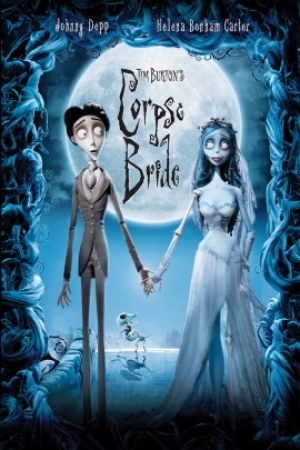
Corpse Bride (2005) Poster
CORPSE BRIDE (2005) B
dir. Tim Burton, Mike Johnson
The comparison is obvious, but Corpse Bride isn’t The Nightmare Before Christmas dressed in a new shroud. It’s more delicate, less showy—a gothic bedtime story rather than a grand, ghoulish pageant. No sprawling holiday mash-ups, no oversized set pieces—just a skeletal hand rising from the dirt, curling around a ring that was never meant for it. Victor Van Dort (voiced by Johnny Depp) is a nervous wreck in a cravat, a man who looks like he’s spent his whole life apologizing for existing. His arranged marriage to the quiet, melancholy Victoria (Emily Watson) is going about as well as can be expected—until the rehearsal, where he fumbles, stammers, makes a mess of things, and retreats into the woods to get it right. He slides the ring onto what he assumes is a root, says the words properly this time, and—unfortunately—accidentally proposes to a corpse. Emily (Helena Bonham Carter), once a bride, now a bundle of bones in a tattered wedding dress, rises from the grave, delighted to have finally been claimed. Before Victor can protest, she drags him down to the land of the dead—a world considerably more lively than the dreary town he came from. Tim Burton’s loyalties remain unchanged: the dead throw better parties. The underworld, bursting with neon blues and ghostly greens, is a jazz-fueled, raucous celebration where dancing skeletons swing their bony hips and even dead pets get a second act. The living, meanwhile, shuffle through a world of drained colors and stiff postures, as if already embalmed. Victor’s intended bride, Victoria (Emily Watson), lovely but terribly alive, spends much of the film in a state of muted despair, waiting for a groom who may or may not return. The stop-motion animation is smooth and charming, though less ambitious than Burton’s previous outings. Danny Elfman’s songs come in shades of melancholy and mischief—some ballads, some toe-tapping numbers, none especially memorable but all appropriately spectral. A Peter Lorre-sounding maggot takes up residence in Emily’s eye socket, offering dubious advice like an undead conscience. The whole thing is charming, morbid, sweet in its own ghoulish way. It doesn’t linger in the memory for long, but while it plays, it’s a fine place to visit—assuming, of course, that you don’t mind a little decomposition with your romance.
Voices of: Johnny Depp, Helena Bonham Carter, Emily Watson, Tracey Ullman, Danny Elfman, Lisa Kay.
Rated PG. Warner Bros. Pictures. UK-USA-Germany. 77 mins.
The Couch Trip (1988) Poster
THE COUCH TRIP (1988) D
dir. Michael Ritchie
A dark comedy with a pulse so faint you’d need a stethoscope to find it. The ingredients are there—Dan Aykroyd, Charles Grodin, Walter Matthau, a premise that practically throws punchlines at itself—but the movie treats comedy like an obligation rather than a goal, stumbling from scene to scene as if hoping energy alone will make up for its lack of direction. The setup gestures toward satire but never follows through. Dr. George Maitlin (Grodin), a nationally syndicated radio psychiatrist, is unraveling in real time, his own mental stability crumbling while he dispenses self-help platitudes to the masses. His producers, desperate to keep the show on the air, reach out to Dr. Lawrence Baird (David Clennon), a blandly respectable stand-in. But the call gets intercepted by John Burns (Aykroyd), a psychiatric inmate who isn’t just an opportunist but a con artist with an unusually quick mind. A few smooth words, a quick identity swap, and suddenly he’s in the studio, handing out life advice with the breezy confidence of a man who’s never doubted himself for a second. Listeners eat it up. The station, thrilled by the ratings bump, happily looks the other way. The real Baird, when he finally catches on, is outraged, though his usual weakness makes it more of a quiet whimper than a full protest. Meanwhile, Matthau, playing a grizzled, beer-marinated priest, drifts in and out, offering whiskey-soaked parables and half-heartedly assessing whether Burns is a lunatic or a prophet. The movie could have done more with Aykroyd’s improvisational energy, but instead, it settles into a broad, unfocused rhythm. Grodin, usually a master of comic irritation, is oddly restrained, never given the kind of moments that let him play off his own frustration the way he did in Midnight Run or The Heartbreak Kid. Matthau seems to be enjoying himself, though it’s hard to tell whether it’s the role or just the fact that no one’s stopping him from doing whatever he wants. Michael Ritchie, who once made comedies that knew how to be comedies (Smile, The Bad News Bears), directs this one like he’s waiting for someone to tell him where the punchline is. The humor barely flickers, the satire never sharpens, and the whole thing floats by like a radio program you tune into for five minutes before switching stations. Not quite a disaster—disasters at least have conviction. This one just slouches toward nothing in particular.
Starring: Dan Aykroyd, Walter Matthau, Charles Grodin, Donna Dixon, Richard Romanus, Mary Gross, David Clennon, Scott Thomson, David Wohl, Chevy Chase.
Rated R. Orion Pictures. USA. 97 mins.
Country (1984) Poster
COUNTRY (1984) B+
dir. Richard Pearce
The film is an act of advocacy as much as storytelling: a slow-burning, bruised portrait of the American family farm as it buckles under Reagan-era policy. It’s about what happens when federal programs, pitched as lifelines, come weighted with fine print—when short-term gain becomes long-term ruin, and families are left to weather a system built to drown them. Lange and Sam Shepard play the farmers in question—ordinary, exhausted, trying to hold the center. Their livelihood depends on a program that promises support but delivers foreclosure. One bad harvest, and they’re staring down a bureaucratic boot. Reagan, reportedly, mentioned the film in his diary with something like disdain, which almost counts as an endorsement. Country wears its politics plainly. It doesn’t editorialize; it indicts. This isn’t just a family drama—it’s a procedural on economic collapse. Sam Shepard gives one of his rawest performances: quiet rage, reluctant breakdown, a man watching decades of work peel away like paint. Levi L. Knebel, as the eldest son, registers the blow in smaller, sharper ways—tight-lipped, wide-eyed, already weathered. Lange, in the middle of it all, fights to keep the family upright with nothing but grit and desperation. Her powerlessness is the point. Her screaming into silence is the system answering back. There’s a protest scene near the end—a blocked auction, a brief disruption—but the victory is small, and the clock doesn’t stop. What the film leaves you with isn’t catharsis, just a worn-out kind of clarity. This is how systems hold. They don’t break things loudly. They let them rot in place. It doesn’t reach for poetry, and it certainly doesn’t hand out answers. It just lays the pieces down—the foreclosure notices, the silences at dinner, the government forms that feel like bad news stamped into paper—and lets them speak for themselves. There’s no tragedy in the theatrical sense, just the slow, bureaucratic suffocation of people who still think hard work ought to count for something.
Starring: Jessica Lange, Sam Shepard, Wilford Brimley, Levi L. Knebel, Theresa Graham, Jim Haynie, Matt Clark.
Rated PG. Touchstone Pictures. USA. 105 mins.
The Courier (2020) Poster
THE COURIER (2020) B-
dir. Dominic Cooke
Greville Wynne (Benedict Cumberbatch) is the kind of man no one notices—exactly why MI6 chooses him. A British salesman whose biggest skill is blending in, he’s recruited as an unwitting courier for classified Soviet intelligence. Not a real spy, just a messenger, moving secrets across the Iron Curtain under the guise of drumming up business opportunities. The Soviets won’t suspect a thing. Why would they? He barely understands what he’s involved in himself. The tension builds steadily, never rushing to an obvious payoff. Oleg Penkovsky (Merab Ninidze), a Soviet officer disillusioned with Khrushchev’s recklessness, risks everything to smuggle out nuclear secrets, hoping to prevent a crisis. He and Wynne become unlikely partners, their arrangement built on careful trust and mutual necessity. But when the net tightens and their work turns from covert to compromised, the film’s polite restraint gives way to something sharper, though never quite sharp enough to make a lasting impression. Cumberbatch plays Wynne with the nervous energy of a man who thought he was signing up for boardroom negotiations and found himself in a John le Carré novel. His gradual transformation—from bumbling businessman to desperate survivor—is well played, particularly in the latter half, when the consequences of espionage become physically and psychologically inescapable. But the real strength of the film comes from Ninidze’s performance as Penkovsky, a man who understands the cost of betrayal long before it comes due. The film insists they form a deep friendship, but their relationship exists more in dialogue than in moments that truly earn it. Cooke directs with restraint, keeping the film sleek and measured, but sometimes too much so. The espionage mechanics are well executed—the tense exchanges, the coded language, the looming sense of danger—but The Courier stays at arm’s length from real psychological tension, as if afraid of pushing too far. The Cold War atmosphere is effective, but the film never fully explores the unease that should come with it. It’s a solid, well-acted spy thriller—precise, efficient, and well-dressed—but it plays things too safely to be truly memorable.
Starring: Benedict Cumberbatch, Rachel Brosnahan, Jessie Buckley, Merab Ninidze, Angus Wright, Kirill Pirogov.
Rated PG-13. 111 mins. Lionsgate, Roadside Attractions. UK-USA.
THE COWBOY WAY (1994) Poster
THE COWBOY WAY (1994) C-
dir. Gregg Champion
The premise should’ve written itself: two New Mexico rodeo hands saddle up and head east to rattle Manhattan’s collars while solving the murder of a friend. It promises a kind of broad-stroke culture clash—Crocodile Dundee by way of the Southwest—but The Cowboy Way doesn’t know what to do with its setup or its stars. Woody Harrelson and Kiefer Sutherland are game enough, but the film gives them nothing but dead air and detours. The jokes limp, the action sleepwalks, and the plot wanders like it forgot why it came to town in the first place. The film’s idea of a showstopper is Harrelson line-dancing on a countertop to a scrubbed-clean pop song—a moment that arrives, happens, and disappears without leaving any kind of impression. Everything else drifts by. There’s a criminal subplot somewhere in the mix, but it barely registers—just noise to keep the cowboys moving. The film doesn’t fall apart so much as sag. Scenes exist, transitions occur, but nothing builds. Even the one moment that finally delivers what the poster promised—two cowboys galloping through New York traffic—has some kick, but it comes too late and goes by too quickly to matter. All in all, the film’s not incompetent—just inert. The Cowboy Way had the blueprint for something rowdy and crowd-pleasing, but it settles for flatness and aimlessness. A missed opportunity in boots and denim.
Starring: Woody Harrelson, Kiefer Sutherland, Dylan McDermott, Cara Buono, Marg Helgenberger, Tomas Milian, Luis Guzmán.
Rated PG-13. Universal Pictures. USA. 107 mins.
The Cowboys (1972) Poster
THE COWBOYS (1972) B
dir. Mark Rydell
John Wayne leading a ragtag group of schoolboys on a cattle drive goes about how you’d expect—gruff wisdom, tough love, and a whole lot of barking orders at kids who can barely see over a saddle horn. He plays Wil Anderson, an aging Montana rancher who loses his entire crew to gold fever and, in desperation, hires a dozen boys barely old enough to shave. They want adventure, he wants labor. It’s a fair deal, as long as they understand one thing: there will be no hand-holding. The story moves like a slow grind against the sun, blistering and deliberate. Anderson isn’t just teaching these kids how to rope and ride—he’s sanding them down, toughening them up, turning them into something that won’t buckle under the open sky or whatever waits at the end of the trail. And waiting for them, just out of sight, is a gang of outlaws who see a herd guarded by schoolboys as a gift-wrapped payday. Their leader, “Long Hair” (Bruce Dern), slithers onto the screen with a grin sharp enough to slice through leather, his brand of villainy so gleefully nasty that he practically reeks of sweat and gunpowder. As a coming-of-age adventure, The Cowboys works. The boys grow up fast, their youthful bravado burned away by the sun and stamped out under Anderson’s boot. The cinematography stretches wide, swallowing the horizon in raw, untamed beauty, but the real grip comes later, when the tension tightens like a cinched saddle strap. This isn’t just about boys becoming men—it’s about what they have to lose along the way, the lessons that scar as much as they shape. And here’s where it pulls no punches. The violence is unflinching, the dangers feel real, and some of the language—particularly the racial epithets—lands with an ugliness that keeps it from being easy to recommend as a film for younger audiences. It’s tough, sometimes cruel, and unmistakably of its time. But as Westerns go, it’s a well-crafted ride—brutal, sweeping, and just sentimental enough to make you feel the dust in your throat. And Dern, who could menace a houseplant into wilting, makes sure you don’t forget who the real villain is.
Starring: John Wayne, Roscoe Lee Browne, Bruce Dern, Colleen Dewhurst, Slim Pickens, Lonny Chapman, Charles Tyner, A. Martinez, Alfred Barker, Nicolas Beauvy, Steve Benedict.
Rated PG. 131 mins. Warner Bros. USA.
Coyote Ugly (2000) Poster
COYOTE UGLY (2000) B-
dir. David McNally
A dive by definition, a spectacle by design, Coyote Ugly is the kind of bar where the drinks are secondary, the bartenders are performers, and the business model runs on the laws of momentum. Women don’t just pour shots here—they stomp, they dance, they command a crowd that throws money at the stage that also happens to be the counter. The whole thing is a combustible mix of choreographed mayhem and barely controlled bedlam, where liquor ignites in midair and boots slam down with the authority of a gavel. Violet (Piper Perabo), fresh from a town where the biggest spectacle is probably the local Applebee’s, arrives in New York with a songwriter’s dream and no foothold in reality. Rent waits for no muse, and desperation leads her to Coyote Ugly, where Maria Bello’s Lil, a no-nonsense bar owner with a talent for spotting both trouble and profit, hires her despite the obvious: Violet lacks rhythm, confidence, and any discernible ability to serve a drink. No matter. A few montages later, she’s flipping bottles, working a crowd, and dodging open flames like a seasoned pro. And when Coyote Ugly gets going, it doesn’t let up. The walls shake, the bar top trembles, the crowd howls—every shift a full-throttle event where excess is the main attraction. But the film wobbles when it steps off the counter, weighed down by a romance subplot that exists purely to give Violet someone to confide in between dance numbers. The love interest, a genial placeholder, hovers at the edges, waiting for a moment that never really comes. But then again, Coyote Ugly isn’t about moments—it’s about motion. The kind that drowns out doubt, burns through logic, and stomps past its own shortcomings. Either you jump in, or you get out of the way.
Starring: Piper Perabo, Adam Garcia, John Goodman, Maria Bello, Izabella Miko, Tyra Banks, Bridget Moynahan, Melanie Lynskey, Del Pentecost, Michael Weston, LeAnn Rimes, John Fugelsang, Bud Cort.
Rated R. Buena Vista Pictures Distribution. USA. 101 mins.
Crash (2004) Poster
CRASH (2004) C
dir. Paul Haggis
Crash wants to confront racism but ends up sermonizing it—flattening a system into a series of dramatic reversals and musical swells. It’s a film that seems to believe prejudice can be solved by giving everyone one very bad day. The structure is mosaic in theory, mechanical in execution: overlapping storylines, staged confrontations, epiphanies handed out like citations. Early on, two Black men (Larenz Tate and Chris “Ludacris” Bridges) carjack a white couple—Rick and Jean (Brendan Fraser and Sandra Bullock)—moments after lamenting how society assumes they’re criminals. Jean spirals into panic, accusing the locksmith (Michael Peña) of gang ties based solely on appearance. Rick, a politician, tries to calm her without seeming to disagree. It’s the kind of scene Crash traffics in: blunt dialogue, high emotion, and a complete absence of subtlety. The carjackers don’t flee so much as detour into a walking seminar on racial dynamics. The pacing makes no sense, but it sets the tone: everyone here speaks in talking points. Even mid-felony. Elsewhere, a Black TV director (Terrence Howard) and his wife (Thandiwe Newton) are pulled over by a white cop (Matt Dillon), who gropes her under the pretext of procedure while his rookie partner (Ryan Phillippe) stares into his conscience and does nothing. Later, Dillon’s character yanks her from a burning car, and Crash treats the two scenes as cosmic symmetry. Trauma, balanced like a scale. In another subplot, a Persian shopkeeper whose store has just been vandalized wrongly blames the Hispanic locksmith and spirals into revenge. Insurance won’t cover the damages. A gun is purchased. Tensions rise. The cycle continues. It’s a lot of drama, but not a lot of insight. Now and then, a moment cuts through. One scene—involving a father, a daughter, and an “invisible cloak” of protection—is handled with such sincerity it nearly reorients the film. But it doesn’t last. Crash is more interested in orchestration than observation. It prefers symmetry over mess, payoff over discomfort. The dialogue is polished to a fault—clever in all the wrong ways. No one speaks like a person; they speak like op-eds. And when the subject is racism, that distance becomes impossible to ignore. If Crash wants to say something urgent, it might help if its characters weren’t always outlining the thesis. It’s not that the film lacks intention. But it needs less performance and more perspective.
Starring: Sandra Bullock, Don Cheadle, Thandiwe Newton, Matt Dillon, Ryan Phillippe, Terrence Howard, Brendan Fraser, Michael Peña.
Rated R. Lionsgate. USA. 112 mins.
Crimen Ferpecto (2004) Poster
CRIMEN FERPECTO (2004) A−
dir. Álex de la Iglesia
A black comedy with bite, set in a Madrid department store—specifically the women’s floor, where Rafael (Guillermo Toledo) moves merchandise by day and seduces clientele by habit. He’s slick, self-satisfied, and so used to skating by on charm that he doesn’t notice when the ice starts to crack. That is, until Don Antonio—his less-slick, more disciplined rival—gets promoted to floor manager and promptly fires him. A fight breaks out. Things escalate. Don Antonio winds up dead. Rafael panics. Enter Lourdes (Mónica Cervera), a co-worker he’s barely noticed—less glamorous, more resourceful. She helps clean up the mess, but not out of goodwill. Her price is steep: Rafael’s affection, on demand, no questions. What follows is a slow-burn nightmare dressed as domestic comedy, where the department-store Lothario finds himself imprisoned in the very kind of relationship he’s spent years avoiding—except this one comes with weaponized clinginess and a fully-stocked evidence trail. The setup would be juicy enough on its own, but what really elevates Crimen Ferpecto is the style. Álex de la Iglesia directs like someone flipping through a catalog of visual tricks: quick zooms, skewed angles, and precisely timed sight gags that make the whole film feel like it’s been dipped in cartoon logic, then air-dried with malice. It’s loud, clever, and unashamed of its own excess. What starts as a comeuppance story spirals into something weirder—part hostage thriller, part screwball farce, part moral payback. And somehow, it works. For those with a taste for nastier comedies—the kind where blood and punchlines share the same frame—this one’s a near-perfect fit.
Starring: Guillermo Toledo, Mónica Cervera, Luis Varela.
Not Rated. Warner Sogefilms. Spain. 106 min.
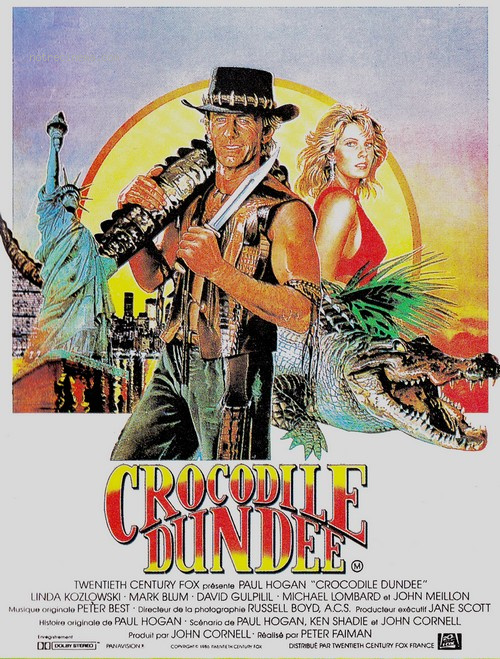
Crocodile Dundee (1986) Poster
CROCODILE DUNDEE (1986) B+
dir. Peter Faiman
There’s an easygoing charm to Crocodile Dundee that makes it feel like a vacation snapshot passed around until the edges curl—sun-bleached, probably embellished, but hard to resist. Paul Hogan, in the role that made him an international brand, plays Mick Dundee as equal parts folk hero and bush-country caricature—a leathery survivalist with crocodile scars, a machete disguised as a pocketknife, and a grin so relaxed it might as well be a worldview. Linda Kozlowski plays Sue Charlton, a New York reporter sent into the Outback to meet the man behind the legend—a so-called crocodile whisperer with a press-ready reputation and a campfire tan. She finds him living off tall tales and campfire charisma—half feral, mostly shirtless, and grinning like someone who’s never rushed anything in his life. She’s skeptical. Then charmed. Then packing him a plane ticket back to Manhattan before the campfire’s even gone out. The second half flips the premise: Mick in the wilds of the city, where cab horns replace birdcalls and social cues don’t come with subtitles. He treats escalators like moving cliffs, bidets like alien tech, and glides through cocktail parties with the social grace of a friendly golden retriever. Hogan plays it with such ease it barely feels like acting—just a man who’s never once been embarrassed by himself. The humor’s broad and good-natured, if not always airtight. One scene involving a trans woman has aged like a carton of milk left out on a humid day—sour, sloppy, and emblematic of its time. But there’s sweetness elsewhere: a romance that builds without force, two people circling each other from opposite ends of the map until they meet in a subway crowd, shouting through strangers like it’s a love song. And yes, “That’s not a knife…” still works. Not because it’s clever, but because Hogan sells it like he’s telling it for the first time—just for you. And you want him to keep telling it again and again. While this is not a profound film, it is warm, funny, and unbothered by its own simplicity. A lightweight crowdpleaser with just enough rough edges to keep it from slipping through your fingers.
Starring: Paul Hogan, Linda Kozlowski, John Meillon, David Gulpilil, Michael Lombard, Mark Blum.
Rated PG-13. Paramount Pictures. Australia-USA. 97 mins.
Crocodile Dundee II (1988) Poster
CROCODILE DUNDEE II (1988) C
dir. John Cornell
Paul Hogan returns as the laconic bush legend who once charmed New York with a smirk and a knife—and this time, he’s got a sequel to weigh him down. Crocodile Dundee II trades the original’s fish-out-of-water charm for a half-hearted action plot that forgets what made the first film fun. The premise: Mick and Sue (Linda Kozlowski, once again doing thankless duty as both love interest and plot device) are targeted by South American drug lords, which sends our hero running—first through Manhattan, then back to the Australian outback, where the second half turns into a soft-edged First Blood with kangaroos. This time, Dundee’s not just navigating escalators—he’s leaping off skyscrapers, dodging bullets, and setting jungle traps like a rugged Boy Scout with a vendetta. And while Hogan still has his easygoing charisma, there’s only so much mileage in watching him mug his way through action beats that feel borrowed from another franchise. What’s missing is the original’s offbeat sweetness. Instead of putting Dundee in fresh scenarios and watching him respond, the film keeps handing him prepackaged movie hero tasks and waiting for his shrug to sell them. It’s not character development—it’s product placement for a persona. And yet, it’s not entirely joyless. There’s a certain comfort in watching Hogan slog through the motions, like a man who knows the material’s thin but figures he’ll see it through anyway. He’s too affable to resent, and the nostalgia’s just sharp enough to keep you from reaching for the off switch. But Crocodile Dundee II plays like a keepsake from a trip you only half remember—faded, fondly mislabeled, and not quite worth the shelf space.
Starring: Paul Hogan, Linda Kozlowski, John Meillon, Charles S. Dutton, Hechter Ubarry, Kenneth Welsh.
Rated PG. Paramount Pictures. Australia-USA. 110 mins.
Crocodile Dundee in Los Angeles (2001) Poster
CROCODILE DUNDEE IN LOS ANGELES (2001) C
dir. Simon Wincer
There’s a moment early on when Mick Dundee, still in his signature hat and still baffled by American contraptions, finds himself wrangling a snake at a Hollywood party. It’s not especially funny. It’s not new. But it tells you everything: the formula hasn’t changed, it’s just been lacquered with studio gloss and shipped west. This belated second sequel doesn’t exactly strain itself—it ambles. And Paul Hogan, now in his sixties, doesn’t so much play the role as inhabit it like an old boot: well-worn, cracked, but comfortably familiar. The premise is slimmer than the original knife: Sue (Linda Kozlowski) gets a temporary assignment in L.A. to investigate a shady film studio, and Mick tags along with their young son Mikey (Serge Cockburn), who’s clearly being groomed for sidekick status. The trio settles into a borrowed house, and the film settles into a long stretch of fish-out-of-water vignettes—Mick doesn’t understand valet parking, Mick misreads Beverly Hills culture, Mick accidentally becomes a movie extra. You’ve seen this setup before. You’ve probably seen better versions of it in commercials. Eventually—almost reluctantly—the plot kicks in: there’s an art forgery scheme, a suspicious director, and a handful of corporate goons trying to pass off stolen paintings. But even the film seems only half-interested in its own intrigue. It’s not an action comedy so much as a comedy that occasionally remembers it promised a plot. Still, there’s a certain comfort in watching Hogan ease through another familiar setup, like an old vaudeville act pulled out for one more matinee. It’s not fresh, not urgent—but the rhythm’s still there. And sometimes familiarity—however faded—is its own kind of drawl.
Starring: Paul Hogan, Linda Kozlowski, Serge Cockburn, Jere Burns, Jonathan Banks, Aida Turturro.
Rated PG. Paramount Pictures. Australia-USA. 92 mins.
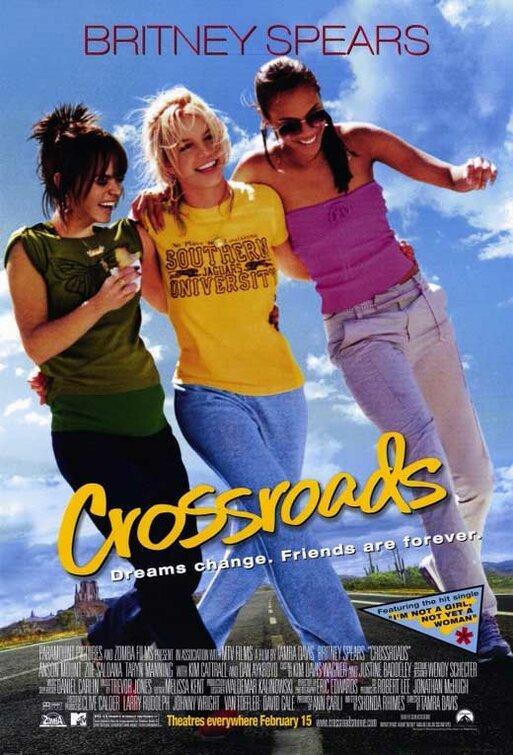
Crossroads (2002) Poster
CROSSROADS (2002) C
dir. Tamra Davis
This Britney Spears vehicle isn’t the trainwreck its reputation implies, but it’s still an odd artifact—part road trip, part pop star branding exercise. It wants to be a coming-of-age drama, but you can feel the studio fingers all over it, trying to sell vulnerability and denim midriffs in the same breath. Spears plays Lucy, a sheltered high school grad who’s smart, polite, and carries a quiet ache about the mother who left her. She reconnects with two childhood friends: Kit (Zoë Saldana), the poised perfectionist who says she’s engaged, and Mimi (Taryn Manning), a tough-talking misfit who’s pregnant and dead-set on chasing a music career in Los Angeles. They dig up a time capsule, hop into a convertible driven by Ben (Anson Mount)—a moody acquaintance of Mimi’s—and set off across the country. What follows is a stitched-together series of scenes: a karaoke contest where Spears belts out “I Love Rock ’n’ Roll” in a tank top, a reunion with Lucy’s cold, elegant mother (Kim Cattrall, gone in a blink), a hotel bathtub heart-to-heart, and a sudden, undercooked reveal about Mimi’s trauma. The shifts in tone—from featherlight to freighted—don’t really hold. The movie isn’t sure what it wants to be: sincere, swoony, issue-driven, or just another teen flick with a soundtrack placement. That said, it’s not unwatchable. Spears is limited but likable, Saldana gives the film the closest thing it has to a spine, and Manning finds something jagged under all the soft-focus gloss. It’s just that none of it adds up. Every plot beat feels pre-tested, and the story keeps fading into montage whenever things threaten to get interesting. *Crossroads* isn’t bad enough to mock, and not good enough to recommend—it’s a time capsule itself, from that brief, strange moment when Britney Spears was supposed to be everything at once.
Starring: Britney Spears, Anson Mount, Zoë Saldana, Taryn Manning, Kim Cattrall, Dan Aykroyd, Justin Long, Beverly Johnson.
Rated PG-13. Paramount Pictures. USA. 94 mins.
Crossing Delancey (1988) Poster
CROSSING DELANCEY (1988) B+
dir. Joan Micklin Silver
Crossing Delancey is that rare creature: a sweet film about reasonable adults with recognizable flaws, who say awkward things and then mean them later. Amy Irving drifts through as Isabelle, a bright but slightly adrift bookstore employee orbiting New York’s low-rent literary circles. She entertains herself mooning over a preening, vaguely European author (Jeroen Krabbé, oozing secondhand sophistication) while her grandmother—Reizl Bozyk, playing “Bubbe” with the soft force of a tank—makes other plans. Bubbe knows exactly what Isabelle needs and, without asking permission, hires a matchmaker to foist her onto Sam (Peter Riegert). Sam runs a pickle shop, has zero illusions about his place in the food chain, and carries himself with the blunt decency of someone who’s never read a bad novel and doesn’t plan to start now. Naturally, Isabelle brushes him off—he’s too ordinary, too local, too close to her grandmother’s world—while she drifts after the author who talks in cryptic half-wisdoms and forgets her name before the check arrives. Silver doesn’t weigh things down with cute shtick or forced gags. She just sits back and lets these people bump into each other, giving the silences room to say what they won’t. There’s no big confession, no slapstick meltdown—just a slow, believable shift as Isabelle starts to see that the man she keeps dodging might be the one thing in her life that’s actually true. Riegert plays Sam with a calm that verges on saintly, but never cloying. Irving lets Isabelle’s vanity peek through her nervous charm. And every scene with Bubbe is a gentle reminder that older relatives really do see straight through you—whether you like it or not. It’s a small, dryly funny film about plain people muddling through mismatched expectations. Not flashy. Not loud. Just kind, a little bittersweet, and impossible not to root for.
Starring: Amy Irving, Peter Riegert, Reizl Bozyk, Jeroen Krabbé, Sylvia Miles, David Hyde Pierce.
Rated PG. Warner Bros. USA. 97 mins.
Crouching Tiger, Hidden Dragon (2000) Poster
CROUCHING TIGER, HIDDEN DRAGON (2000) A-
dir. Ang Lee
Gravity barely gets a say in Crouching Tiger, Hidden Dragon. Warriors don’t just fight—they float, they skim, they drift through the air as if the laws of physics were written by poets. They leap from rooftop to rooftop like whispers in the wind, balance on the thinnest branches without so much as a wobble, and duel on bamboo stalks that sway but never snap. The swordplay isn’t about brute force; it’s about grace, about momentum, about the sheer exhilaration of movement. Ang Lee turns combat into choreography, violence into something almost hypnotic—less a clash of steel than a dance suspended between earth and sky. The story, set in 19th-century China, orbits a legendary sword called The Green Destiny, passed between warriors, lost, stolen, fought over with a kind of honor that seems to exist only in the realm of myth. But the sword is just the surface. Beneath the shifting allegiances and whispered betrayals, Ang Lee weaves something richer: unspoken desires, suppressed dreams, the quiet ache of choices made and lives unlived. Much of it drifts past like an intricate melody—dense, sometimes elusive, a tangle of histories and obligations that seem just out of reach. But even if parts slip away, what lingers is the poetry of it: the stolen glances, the tension in a hand that hesitates before drawing a blade, the way Jen (Zhang Ziyi), a governor’s daughter, and Lo, a desert bandit, circle each other with the kind of longing that defies words. It’s an astonishing thing to watch. The precision of every movement, the painterly composition of every frame, the sheer elegance of its world. Crouching Tiger, Hidden Dragon doesn’t just tell a story—it sweeps you into it, weightless, boundless, lost in its magic.
Starring: Chow Yun-Fat, Michelle Yeoh, Zhang Ziyi, Chang Chen, Lung Sihung, Cheng Pei Pei, Li Fa Zeng, Gao Xian, Hai Yan, Wang Deming, Li Li.
Rated PG-13. Sony Pictures Classics. China-Taiwan-Hong Kong-USA. 120 mins.
Cruel Intentions (1999) Poster
CRUEL INTENTIONS (1999) B
dir. Roger Kumble
A high-gloss remix of Les Liaisons dangereuses set in prep school Manhattan, Cruel Intentions treats aristocratic depravity like a varsity sport—equal parts seduction, sabotage, and social capital. Ryan Phillippe plays Sebastian Valmont, a designer-clad sociopath who’s never had to earn anything but still needs to win. His opponent: Kathryn (Sarah Michelle Gellar), his stepsister and co-conspirator in emotional warfare. The bet: seduce the new headmaster’s daughter or hand over the Jaguar. If he succeeds, she sleeps with him. Reese Witherspoon plays Annette, the gleaming poster girl for virginity-as-virtue, who’s written a glossy magazine essay on saving herself for marriage and seems principled enough to mean it. She arrives as both mark and mirror—Sebastian’s game is to unravel her. Hers is to find whatever’s left of his conscience. The film is bathed in money and moral rot—mahogany interiors, string quartet covers of ’90s alt-rock, and dialogue that slinks between wicked and weightless. The plot veers into slapstick when it should stay sharp, and some of the physical comedy misfires—Selma Blair’s pratfalls start to feel like a director’s nervous tic. But when it clicks, it purrs. Gellar is the standout. Her Kathryn isn’t just mean—she’s curated. Every tilt of the head, every pause before a lie, every small win filed away like a trophy. She smiles like she’s about to draw blood. She’s the villain you root for even when you know better. It’s glossy, tawdry, a little hollow—and all the more fun for it. If you’ve ever wanted Dangerous Liaisons delivered with flip phones, tube tops, and a killer use of Counting Crows, this is your ticket.
Starring: Sarah Michelle Gellar, Ryan Phillippe, Reese Witherspoon, Selma Blair, Joshua Jackson, Louise Fletcher, Christine Baranski, Swoosie Kurtz.
Rated R. Columbia Pictures. USA. 97 mins.
The Crush (1993) Poster
THE CRUSH (1993) D
dir. Alan Shapiro
A Fatal Attraction/Lolita cocktail, shaken until all the menace fizzles out. The Crush understands the shape of a pulp thriller—an illicit attraction, a fixation hardening into something dangerous, a man cornered by a force he underestimated—but it lacks the nerve to push beyond formula. Instead, it tidies itself up, smoothing out the jagged edges, dressing its scandal in a made-for-TV sheen. Cary Elwes, fumbling his American vowels like a man midway through a botched dialect lesson, plays Nick Eliot, a magazine writer so void of personality he could be mistaken for a placeholder. He rents a guesthouse in Seattle, barely registers the landlord’s teenage daughter, and suddenly, she’s obsessed. Adrian (Alicia Silverstone), 14 going on noir femme fatale, decides he belongs to her. He lets her sit on his lap, basks in the attention a little too long—then jolts awake, backs off, and assumes that’s the end of it. It isn’t. Adrian doesn’t sulk—she recalibrates. She rewires Nick’s life like a saboteur with tenure, torching his career, framing him for crimes, escalating her vengeance with the cool precision of someone testing her own limits. Silverstone gives Adrian determination, but it’s all surface-level—a performance built on stomps and glares rather than something deeper or more unsettling. Meanwhile, Elwes plays Nick with such saintly detachment that the film barely acknowledges his initial missteps, as if a few fleeting lapses in judgment aren’t worth complicating things over. He’s not a man trapped in an obsession—he’s a guy who wandered into the wrong house at the wrong time. Still, the film moves, all gloss and forward momentum, rolling from one increasingly baroque act of vengeance to the next. But it’s too self-conscious to be provocative, too sanitized to be truly sleazy, too controlled to ever feel dangerous. A movie about obsession that refuses to let itself get carried away.
Starring: Cary Elwes, Alicia Silverstone, Jennifer Rubin, Kurtwood Smith, Gwynyth Walsh, Amber Benson, Matthew Walker.
Rated R. Warner Bros. USA. 89 mins.
Cry-Baby (1990) Poster
CRY-BABY (1990) B-
dir. John Waters
John Waters, the gleeful connoisseur of kitsch, slaps together a gaudy, high-energy send-up of ’50s teen melodramas—a world where rock ’n’ roll is practically a gateway drug, juvenile delinquents are a national security threat, and dating outside your clique is cause for hysteria. It’s got the ingredients to top Hairspray, or at least match it, but the mix doesn’t quite fizz the same way. The storytelling sputters, the characters don’t quite pop, and the whole thing never fully ignites. Hairspray had Tracy Turnblad, a heroine so effervescent she could have powered a city grid; Cry-Baby has Johnny Depp whose main attribute is looking fantastic in a leather jacket. Depp, in a role that mostly requires him to smolder and croon, plays Wade “Cry-Baby” Walker, the slick, teardrop-shedding king of the “Drapes,” a gang of cartoonishly outcast misfits. His world is knocked off balance when straight-laced Allison (Amy Locaine), a prim and proper “square,” finds herself drawn to his bad-boy charm. It’s the classic teen movie setup—good girl meets rebel, social order erupts into chaos—but Waters plays it like an elaborate joke, his satire sharper than the pompadours on screen. The 1950s hysteria over rock music and juvenile delinquency is skewered with giddy enthusiasm, and when the film clicks, it’s an absolute riot. The straitlaced characters are so aggressively upstanding they seem practically psychotic, while the “Drapes” are misfits on the level of a living comic strip. The musical numbers, lip-synched and dripping with irony, add to the fevered pastiche. But for all its highlights, the film feels strangely thin—big, bright, full of camp, yet missing the depth of Waters’ best work. It’s still a great time, a lopsided but gleeful send-up of the kind of movies that once took themselves so seriously. It just doesn’t quite hit the sweet spot of an offbeat classic, though it struts awfully close.
Starring: Johnny Depp, Amy Locane, Susan Tyrrell, Iggy Pop, Ricki Lake, Traci Lords, Polly Bergen, Kim McGuire, Darren E. Burrows, Mink Stole, Patricia Hearst, Willem Dafoe.
Rated PG-13. Universal Pictures. USA. 85 mins.
The Curse of La Llorona (2019) Poster
THE CURSE OF LA LLORONA (2019) C-
dir. Michael Chaves
The film tips its hand early, then spends the rest of its runtime going through the motions. The Curse of La Llorona wastes no time revealing its ghost, its rules, and its entire bag of tricks, leaving little to do but watch characters scurry from one jump scare to the next. There’s no slow, skin-prickling buildup, no sense that something unspeakable is creeping in from the edges—just a parade of predictable jolts, each arriving on cue. La Llorona, the weeping woman of Latin American folklore, should feel like an eerie whisper at the back of your mind, something you can’t quite shake. Instead, she’s trotted out at regular intervals, another ghost in a franchise too busy following formula. She’s a stock apparition, overexposed and underdeveloped, more predictable than menacing. Her backstory is tragic—driven to drown her own children in a fit of rage, cursed to roam the earth in search of replacements—but the film treats her as just another paranormal nuisance, more interested in loud noises than psychological terror. Linda Cardellini plays Anna, a Child Protective Services worker drawn into the nightmare when she investigates a pair of missing boys. Their mother (Patricia Velasquez) is frantic, raving about a curse, and when the boys turn up dead, Anna assumes she’s failed them. Then her own children start seeing the same figure in the shadows, feeling the same cold hands reach for them in the night, and the pattern repeats. But the film never lets its terror settle. Every scare is a quick jolt, a sudden movement, an overplayed sound cue—the kind that vanishes the second the scene ends. Even within The Conjuring universe, where this film technically belongs, La Llorona feels like an afterthought. It borrows the atmosphere but not the craftsmanship, the iconography but not the weight. The legend deserved something richer, something that seeped into the subconscious and stayed there. Instead, The Curse of La Llorona is another hollow echo in a franchise running out of things to haunt.
Starring: Linda Cardellini, Roman Christou, Jaynee-Lynne Kinchen, Raymond Cruz, Patricia Velasquez, Sean Patrick Thomas, Tony Amendola, Irene Keng.
Rated R. Warner Bros. Pictures. USA. 93 mins.
The Curse of La Patasola (2022) Poster
THE CURSE OF LA PATASOLA (2022) C-
dir. Juan Diego Escobar Alzate
A bargain-bin horror outing that never quite embarrasses itself, even if it doesn’t accomplish much else. The Curse of La Patasola has all the trappings of a weekend project—four actors, one forest, and a script cobbled together from borrowed tropes and marital bickering. But for a movie this cheap, it almost gets away with competence. The premise is straight from the campfire playbook: two couples trek into a remote wooded patch with a bad local reputation and worse cell reception. A cop at the beginning gives them the usual cryptic warning, which they ignore with the enthusiasm of people who’ve clearly never seen a horror movie. Around the fire, someone floats the legend of La Patasola—a jungle-dwelling Amazonian demon who targets cheaters and feeds on their souls. Naturally, nobody takes it seriously. Naturally, they should have. What follows is a slow drip of relationship tension and mythological foreshadowing. The characters, when they’re not glaring at each other over trust issues and forgotten flings, wander into increasingly ominous shrubbery while muttering things like “what was that?” The acting never quite hits “professional,” but it doesn’t tank either. It’s the kind of fresh-out-of-acting-class sincerity that flattens under pressure but isn’t without some scrappy earnestness. The first two-thirds stick to the rails—basic suspense mechanics, a few flickers of atmosphere—but the final act wobbles, then faceplants. It’s the cinematic equivalent of a bedtime story that forgets how to end, defaulting to clunky reveals, amateur effects, and a monster that looks like someone took a wrong turn on the way to a community theater costume fitting. Still, La Patasola isn’t trying to change the genre. It’s just hoping to fill 84 minutes without completely losing credibility. And for most of its runtime, it manages that—barely. Call it a near-miss that leaves you wishing someone had just written a better ending. Or at least sprung for another flashlight.
Starring: Luciana Faulhaber, Patrick Walker, Najah Bradley, Gillie Jones.
Not Rated. Glass Jug Films. USA. 84 min.
Cutthroat Island (1995) Poster
CUTTHROAT ISLAND (1995) C
dir. Renny Harlin
A king-sized production with seawater in its veins and nothing much behind the eyes. Cutthroat Island spares no expense—massive sets, exploding ships, a full orchestra’s worth of cannon fire—and still manages to feel like a very long commercial for a theme park stunt show. (The gigantic budget and middling box office returns made this one of the most notorious box office bombs in history.) Geena Davis, mid-pivot, plays Morgan Adams—a pirate in thigh-high boots and ironclad resolve. The setup’s familiar: a shredded treasure map, a family feud, and enough rival pirates to fill a flotilla. Morgan inherits one piece of the map from her dying father. The other two belong to her uncles—one rotting in a cell, the other played by Frank Langella with a sneer and a saber and no interest in nuance. To decode the Latin scrawled on her portion, Morgan recruits a fast-talking thief named William Shaw (Matthew Modine), who’s supposed to be charming but mostly looks like he’s waiting for someone to explain the plot. Together they embark on the usual sequence: prison breaks, sea battles, double-crosses, and treasure hunts that involve more shouting than logic. The action, to be fair, is impressive. The swordfights are crisply choreographed, the explosions timed like punchlines, and the production design spares no plank or powder keg. You can tell someone spent real money here—and not just on fireballs. But the spectacle wears thin when it becomes clear that nothing underneath is working. The script is the real mutiny. The dialogue clanks like a dropped anchor—overwritten, theatrical, and impossible to sell. Davis and Modine, both naturalistic actors, are stranded. Their delivery sounds less like banter and more like two people rehearsing different plays. Langella fares better—he’s built for this kind of pantomime—but even he can’t do much with lines that feel pulled from a children’s pop-up book about pirates. The plot, meanwhile, is tangled without being clever. The map fragments. The family betrayal. The endless chasing and chasing and chasing. It’s not incomprehensible, exactly—it just stops being interesting halfway through and never regains its footing. There’s an odd effect where the extras and minor characters seem more comfortable in this world than the leads. The bit players swash and buckle like they mean it. The stars mostly flinch through the fog. Visually, it’s often dazzling. You could watch it with the sound off and assume it was fun. But if you’re after adventure with momentum—characters who spark, dialogue with bite, a story that doesn’t wheeze under its own rigging—look elsewhere. This one’s all sail, no wind.
Starring: Geena Davis, Matthew Modine, Frank Langella, Maury Chaykin, Patrick Malahide.
Rated PG-13. Carolco Pictures. USA. 124 mins.
The Cutting Edge (1992) Poster
THE CUTTING EDGE (1992) B
dir. Paul Michael Glaser
A hockey brute and a figure-skating diva, thrown together on Olympic ice—The Cutting Edge knows exactly where it’s going, but it has too much fun getting there for that to matter. Every training montage, every snide remark, every slow-dawning realization that these two might actually be good for each other plays out with the confidence of a story that understands the appeal of opposites clashing until they finally click. D.B. Sweeney plays Doug Dorsey, a cocky, hard-hitting hockey player whose career is cut short by an eye injury. Moira Kelly’s Kate Moseley, a disciplined, impossibly demanding figure skater, has gone through so many partners that her coach (Roy Dotrice) is running out of options. His solution is to take a tough guy who’s never worn toe picks, throw him onto the ice with a perfectionist who barely tolerates him, and see if they don’t kill each other before the competition does. The script follows the playbook of a classic sports rom-com—barbed exchanges give way to grudging respect, competitiveness turns to chemistry—but it’s done with enough sharp dialogue and well-timed humor to keep it engaging. Sweeney brings the right mix of swagger and self-deprecation, while Kelly sells Kate’s iciness without making her a caricature. Their dynamic works because neither one is entirely right or wrong; they push each other, break each other down, and make each other better, both as skaters and as people. The skating sequences are well-staged, capturing both the physical strain and the exhilaration of the sport. The romance, though predictable, is built with care, unfolding naturally even as the characters resist it. It doesn’t reinvent anything, but it understands exactly what it’s doing and executes it well. A sports movie, a love story, and a battle of wills, all in one slickly entertaining package.
Starring: D.B. Sweeney, Moira Kelly, Roy Dotrice, Terry O’Quinn, Dwier Brown.
Rated PG. Metro-Goldwyn-Mayer. USA. 102 mins.
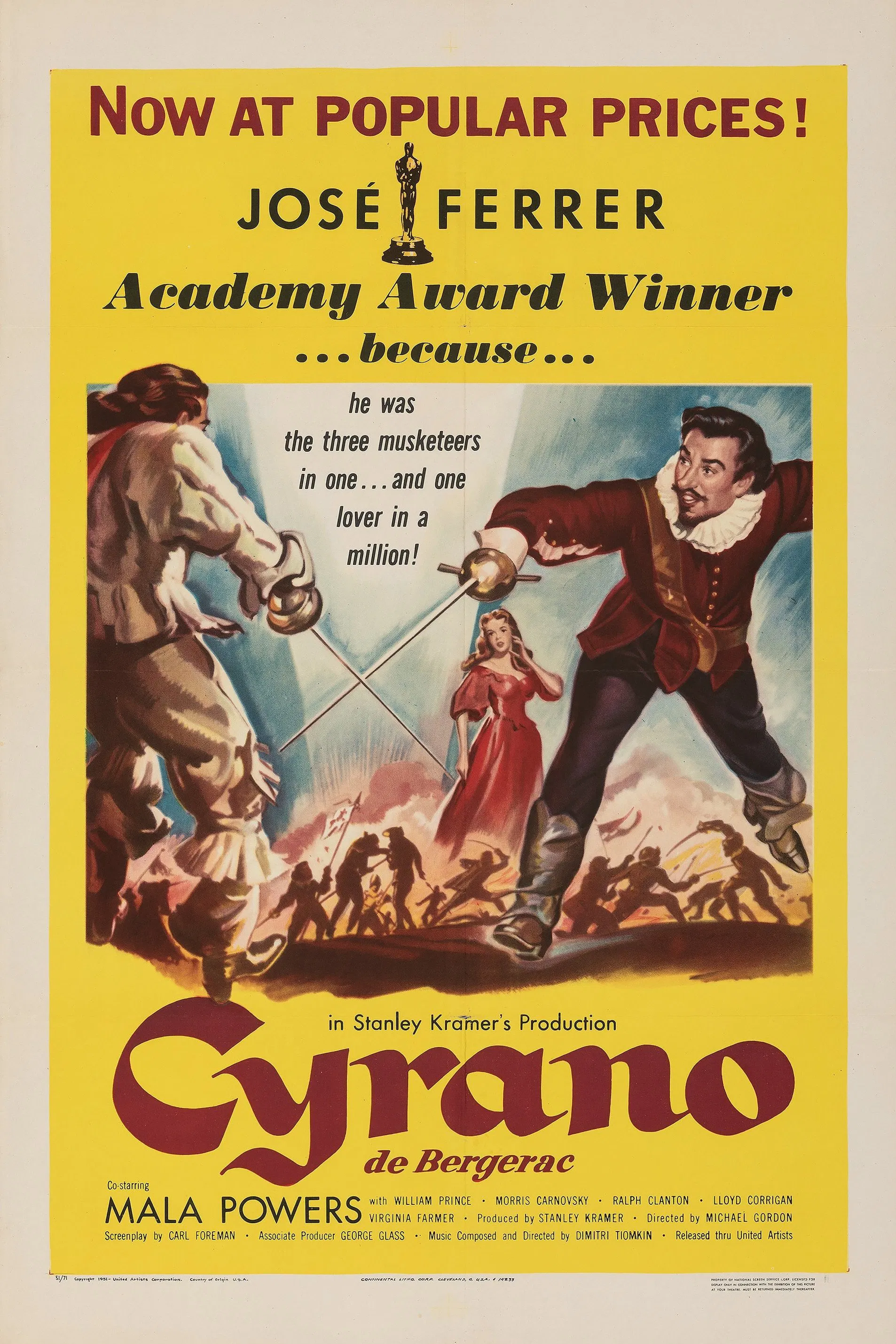
Cyrano de Bergerac (1950) Poster
CYRANO DE BERGERAC (1950) A-
dir. Michael Gordon
José Ferrer’s turn as Cyrano is one of those performances people throw the word “legendary” at, and for once it’s not an exaggeration. He makes this prickly, word-drunk swordsman with the famous nose feel alive in a way the printed play alone only hints at. Ferrer tears into Edmond Rostand’s poetry like it’s oxygen—spitting out insults, jokes, and confessions with a rhythm that’s half music, half knife fight. The swordplay helps, too. The duels here have an old-school swashbuckling charm—steel clashing, cloaks billowing, Cyrano humiliating half the town before breakfast, and still somehow finding the breath to rhyme mid-thrust. But for all the bravado, there’s that sad twist: behind the brags and bravado, Cyrano’s so convinced his nose ruins him that he talks himself out of his own happiness before anyone else can. The story’s a simple tragedy dressed as a romantic comedy—Cyrano loves Roxane (Mala Powers), his quick-witted cousin, but he’s certain she could never love him back. So when she falls for Christian (William Prince), a pretty face with no way with words, Cyrano steps in behind the scenes—feeding him lines, writing his letters, basically handing over his own soul wrapped in someone else’s smile. It’s a cruel joke, and he plays it on himself. The film itself can feel a little stagey in spots—it’s an old studio piece through and through—but none of that dents Ferrer’s work. He won the Oscar for it, deservedly, and even now, with many versions out there looking like they were duped from a VHS tape found under someone’s couch, he still blazes right through the fuzz and static. It’s faithful, stirring, and built entirely around watching a brilliant actor tear himself apart for love he’s too proud to claim. As an introduction to Cyrano, it’s hard to beat.
Starring: José Ferrer, Mala Powers, William Prince, Morris Carnovsky, Ralph Clanton, Lloyd Corrigan, Virginia Farmer.
Not Rated. United Artists. USA. 113 mins.
Load Next Page