Film Buff Musings

by Michael Lawrence

List of "C" Movies


Clerks (1994) Poster
CLERKS (1994) B+
dir. Kevin Smith
Clerks is basically a filmed rant with a cash register in the background. Kevin Smith, back when he had nothing but blunt honesty and a credit card, stitches up a day in the non-life of Dante (Brian O’Halloran), a convenience store martyr who mistakes overtime for virtue. Next door squats the video rental dungeon—Randal’s realm—where customer service withers under his genius-level apathy. Plot? A limp clothesline for foul-mouthed philosophy, petty grievances, and the grand art of flinching at adulthood. Customers file in to wreck Dante’s nerves. Randal flings insults, ducks responsibility, and prowls for fresh annoyances. Together they form the patron saints of Generation X’s collective quarter-life yawn—underpaid, overthinking, and primed to dissect the trivial until it feels weighty. Smith doesn’t direct so much as plunk a camera on the counter and pray for monologues. Good plan—because the jokes fire off like small bottle rockets: cheap, loud, and more truthful than they have any right to be. You sense the man behind the script worked these dead-end counters too—no pretension, just raw shop-floor tedium translated into laughs that scuff the floor right back. Dante’s tragic work ethic is both a joke and a funeral hymn for anyone who’s ever picked up an extra shift out of guilt. Randal, glorious in his filth and sabotage, floats through each scene an unbothered messiah of zero ambition. Together, they banter, mope, and accidentally nail a generational unease without ever raising the store blinds. Grainy black-and-white, a budget taped together with borrowed change, dialogue that rings in your ears like a dirty limerick—Clerks wrings poetry out of burnout. Smith found an accidental anthem for the minimum-wage drift, and decades later, it still stings sweetly.
Starring: Brian O’Halloran, Jeff Anderson, Marilyn Ghigliotti, Lisa Spoonauer, Jason Mewes, Kevin Smith.
Rated R. Miramax. USA. 92 mins.
Click (2006) Poster
CLICK (2006) D
dir. Frank Coraci
Click wants to be a morality tale wrapped in a high-concept comedy, but it plays like something written during recess by middle-schoolers trying to impress each other with fart jokes and fake wisdom. It’s not just juvenile—it’s aggressively dumb, with just enough half-baked sincerity to make you wince. Adam Sandler stars as Michael Newman, a workaholic architect whose smarmy boss (David Hasselhoff, practically cartooning himself) demands all of his time and then some. His wife (Kate Beckinsale, stranded) is patient until she’s not, and their kids begin to wonder who this man is that sometimes shares a meal with them. The setup wants to echo It’s a Wonderful Life, but the script can barely string together a coherent sentence, let alone earn poignancy. Enter Christopher Walken as a lab-coated oddball who appears in the back room of a [Product Placement] store—because of course—and offers Michael a “universal remote.” This is no ordinary gadget. It controls time. Fast forward. Rewind. Pause. Mute. He uses it to skip arguments, breeze past illness, and, yes, kick a man in the crotch without consequences. That’s the level we’re working with. The premise is sharp enough to support something clever: a satire on convenience, or a dark comedy about regret. But the film doesn’t aim that high. Instead, it defaults to slow-motion burp jokes, remote-control dog humping, and life lessons so clumsily delivered they feel like punishment. And just when the film remembers it’s supposed to have a heart, it ladles on the sentiment like it’s afraid we won’t notice—thick, sticky, and concussed. Sandler, meanwhile, drifts through in fits—one minute yelling, the next sniffling—like he’s trying to simulate emotional range by volume alone. The emotions feel approximate, like he’s guessing at what they’re supposed to look like. Walken, meanwhile, does his usual orbit—aloof, twitchy, vaguely amused—and ends up being the only thing onscreen that doesn’t feel stuck. Click is the kind of movie that confuses slow-motion sentiment for profundity and a groin shot for a punchline. You don’t watch it so much as endure it—like being trapped in an elevator with someone doing impressions of their own bad parenting.
Starring: Adam Sandler, Kate Beckinsale, Christopher Walken, David Hasselhoff, Henry Winkler, Julie Kavner.
Rated PG-13. Columbia Pictures. USA. 107 mins.
The Client (1994) Poster
THE CLIENT (1994) B
dir. Joel Schumacher
The Client is a sturdy legal thriller with a pulp undercurrent—slick, serious, and just grounded enough to sell the danger. Based on the John Grisham novel, it runs on tension, character, and the illusion of control. Brad Renfro, making his screen debut, plays Mark Sway—a foul-mouthed, street-smart 13-year-old who knows more than he lets on. One afternoon, while sneaking a cigarette in the woods with his younger brother, a car rolls up and everything changes. Inside: a frantic, sweating man named Jerome “Romey” Clifford, trying to kill himself via exhaust hose and bourbon. Mark intervenes once, pulling the hose free. But the second time, Romey grabs him, drags him into the car, and tells him they’re going to die together. Mark escapes, barely—but not before Romey confesses where a murdered senator’s body is buried. It’s the kind of information that makes the FBI lean in and the mob lean harder. Enter the legal tug-of-war. The Feds, led by a preening prosecutor (Tommy Lee Jones, all polished arrogance), want answers. The mob wants silence. Mark knows better than to trust either side, but he also knows he’s running out of room. So he hires a lawyer—no easy feat when you’re thirteen, broke, and under surveillance. That’s when he meets Reggie Love (Susan Sarandon), a recovering alcoholic and part-time crusader with a law degree and a low tolerance for bullshit. At first, he mocks her name, thinks she’s a man. But they circle each other warily and then, gradually, lock in. The plot is high-stakes, but it’s the performances that give it shape. Renfro feels like a real kid—cagey, defensive, observant—and Sarandon plays Reggie as someone who’s been underestimated long enough to find some use in it. Their dynamic becomes the movie’s spine: a guarded, improvised trust between a boy who doesn’t want help and a woman who keeps showing up anyway. The Client isn’t flashy or especially clever—it doesn’t build toward a reveal so much as tighten the noose. What it has is momentum, character, and a slow-burn tension that never quite lets up. The courtroom scenes don’t dazzle, but they do their job. The threat feels close, the pressure constant, and the stakes—though never shouted—stay clear all the way through.
Starring: Susan Sarandon, Tommy Lee Jones, Brad Renfro, Mary-Louise Parker, Anthony LaPaglia.
Rated PG-13. Warner Bros. USA. 119 mins.
Cliffhanger (1993) Poster
CLIFFHANGER (1993) B+
dir. Renny Harlin
A big, brawny slab of mountaintop nonsense—and a very entertaining one at that. Sylvester Stallone, bulked up and brooding, plays a rock-climbing guide who’s sworn off the high peaks ever since a harness mishap sent a tourist plummeting into the abyss on his watch. He’s retired to self-recrimination and low-altitude living, but it doesn’t stick. Enter a band of cartoonish mercenaries led by John Lithgow, who tries on a British accent the way one tries on an ill-fitting tux: with misplaced confidence and visible discomfort. He’s an ex–military mastermind with a few dozen henchmen and a trio of suitcases stuffed with a cool hundred million dollars—loot he’d rather not carry down the mountain himself. So he cons Stallone and his embittered ex-partner (Michael Rooker, perpetually aggrieved) into serving as local sherpas. Unsurprisingly, they have other plans. The plot is nonsense: double-crosses, helicopter stunts, dynamite, and the occasional growled threat hurled through the thin, freezing air. But when the film gives up on dialogue and lets the snow, cliffs, and gravity do the talking, it’s a blast. Director Renny Harlin keeps the camera glued to sheer drops and vertigo-baiting shots of Stallone dangling from rock faces that look allergic to human presence. It’s all staged with the subtlety of a fireworks show and the credibility of a campfire tale—and that’s part of the charm. Lithgow hams it up like he’s getting paid by the snarl, Stallone flexes and grimaces his way through multiple life-or-death scrambles, and the scenery steals the rest. It’s big, icy, and more than a little absurd—exactly what a 90s action movie about mountains, guns, and grudges ought to be. Among Stallone’s post–Rocky blockbusters, this is one of the few that actually deserves the altitude.
Starring: Sylvester Stallone, John Lithgow, Michael Rooker, Janine Turner, Rex Linn, Caroline Goodall, Leon Robinson.
Rated R. TriStar Pictures. USA. 113 mins.
Clifford (1994) Poster
CLIFFORD (1994) C+
dir. Paul Flaherty
A movie that doesn’t have its head screwed on straight—and wears the tilt proudly. Most audiences will be baffled, maybe irritated, starting with the casting: Martin Short, forty and grinning like a lunatic, plays a spoiled ten-year-old in a blazer and shorts. Clifford’s obsession is singular: get to Dinosaur World, a Southern California theme park promising prehistoric bliss. His parents book Hawaii. Midway over California, Clifford talks his way into the cockpit, comes close to dropping the plane out of the sky, and forces an emergency landing. By fate—or screenwriter convenience—his uncle Martin (Charles Grodin) lives in Los Angeles and just happens to be the architect for Dinosaur World. He’s also on shaky ground with his fiancée Sarah (Mary Steenburgen), who doubts his interest in fatherhood. What better test than a week babysitting Clifford? It’s less a test than a siege. Clifford is the child from Hell—relentless, manipulative, with a grin that says he’s already thought ten moves ahead. The movie’s strange magic comes from Short’s performance, which is unflinchingly weird and almost avant-garde in its commitment. He doesn’t play a child so much as a sociopath with a juice box. I laughed uncontrollably at several scenes, mostly out of disbelief that it was happening at all. Grodin, forever the master of contained fury, spends the final act looking like a man whose soul has been replaced with static—his slow boil erupting into wild-eyed lunacy. The script is bad—no sense pretending otherwise. Some lines are actively embarrassing. But the director has the good sense to get out of the way and let two gifted comic actors run the asylum. Scene by scene, the result is both awful and unexpectedly watchable. You can’t beat Clifford. Best to surrender.
Starring: Martin Short, Charles Grodin, Mary Steenburgen, Dabney Coleman, Richard Kind, Jennifer Savidge.
Rated PG. Orion Pictures. USA. 90 mins.
Climax (2018) Poster
CLIMAX (2018) C+
dir. Gaspar Noé
There’s no denying Climax is distinctive. It’s bold, meticulously stylized, and designed to provoke. But once the provocation wears off—and it doesn’t take long—you’re mostly left watching people scream and flail in a neon-soaked gymnasium, wondering if it was all worth the headache. Set in the mid-1990s and based loosely on real events, the film follows a French dance troupe rehearsing what appears to be a full-body electro-ritual staged as performance art. It’s more kinetic than choreographed—bodies twitch and collide under strobes, and the line between exertion and exorcism is deliberately blurred. But after the dancing ends, the real show begins: someone spikes the sangria with LSD, and the troupe devolves into shrieking, writhing, sexed-up panic. What starts as high-energy abstraction quickly nosedives into a claustrophobic descent: infighting, hallucinations, sexual assault, infanticide. Noé doesn’t so much build tension as hammer it into you. The camera floats and spins, unblinking, while the characters unravel in real time—screaming, crawling, convulsing. It’s all presented with the precision of a nightmare and roughly the same narrative clarity. The visuals are impressive. The sound design is relentless. And the opening dance sequence—shot in a single take—is genuinely hypnotic. But once the disintegration kicks in, the film becomes less a horror story than a pressure cooker with no vent. It’s not scary so much as oppressive. Characters blur together, and by the end, few register beyond posture or panic. It’s certainly a vision. But whether that vision amounts to anything more than choreographed misery is harder to say. Admirable in its commitment, difficult to endure, and ultimately more exhausting than enlightening.
Starring: Sofia Boutella, Romain Guillermic, Souheila Yacoub, Kiddy Smile, Claude Gajan Maull, Giselle Palmer, Thea Carla Schøtt, Taylor Kastle.
Not Rated. A24. France. 96 mins.
The Clock (1945) Poster
THE CLOCK (1945) B
dir. Vincente Minnelli
A romance on a deadline, swept up in the movement of wartime New York. Judy Garland, free of Technicolor spectacle, steps into Penn Station as a wide-eyed tourist and collides—almost literally—with Robert Walker, a soldier on leave who looks at her like she’s the first good thing he’s seen in weeks. From there, time bends to the urgency of their connection. Hours stretch, a single day holds an entire love story, and the city, vast and impersonal, somehow makes room for them. Minnelli directs with a gentle hand, letting their relationship unfold in moments so ordinary they feel like memories already—an empty park bench, a lost shoe, a cup of coffee that lasts longer than it should. Garland, effortlessly genuine, plays Alice with the quiet surprise of someone stumbling into something life-changing before realizing she’d been searching for it all along. Walker, understated and sincere, meets her there, and together they make something so simple feel impossible to fake. The chemistry isn’t fireworks—it’s something softer, warmer, the way two people fall into step without noticing. And then there’s New York, presented not as a backdrop but as a living, breathing third party in the romance. The camera soaks in the city—grand Central Park vistas, late-night streetcars, the sheer size of it all making the intimacy between Alice and Joe feel all the more rare. Later films would try to capture a similar magic, but this one just happens, as naturally as a conversation that never stops being interesting. A smaller film than Casablanca, less overtly poetic, but just as attuned to the way love feels when time is slipping through your hands. Garland, luminous even in black and white, carries it with such effortless grace that the film, like the romance itself, becomes something worth holding onto—if only for a little while.
Starring: Judy Garland, Robert Walker, James Gleeson, Keenan Wynn, Marshall Thompson, Lucille Gleeson, Ruth Brady, Arthur Space.
Not Rated. Loew’s Inc. USA. 90 mins.
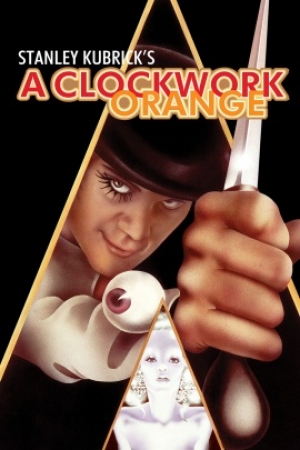
A Clockwork Orange (1971) Poster
A CLOCKWORK ORANGE (1971) A
dir. Stanley Kubrick
A film that doesn’t just shock—it bruises. Not the kind of cinematic violence that sends a thrill up the spine, not the balletic brutality of action movies, but something far uglier, something that strips away the protective layer between viewer and screen. Stanley Kubrick, ever the technician, orchestrates the horror with precision, forcing you into the room, into the sick joke of it all, where Alex DeLarge (Malcolm McDowell) croons “Singin’ in the Rain” as he kicks and laughs and destroys. The crime itself is nightmarish, but the real horror is how effortlessly it plays out—no flickering shadows, no jagged editing, no swelling score to signal distress. Just a man, delighted with himself, acting as if what he’s doing is as natural as breathing. And then, suddenly, it’s not so natural anymore. The film’s second half turns the tables on Alex, placing him in the grip of an equally horrifying system, where rehabilitation is nothing more than reprogramming, where free will is expendable so long as the results are palatable. He’s transformed from predator to puppet, and Kubrick doesn’t let the audience settle into easy moral satisfaction. If Alex is a monster, what does that make the people who created him? What does that make the people who claim to have “fixed” him? McDowell is electric—his piercing stare, the unsettling delight he takes in his own cruelty, the cartoonishly refined way he speaks, as if every violent impulse were just part of an elaborate joke only he understands. His Alex is both revolting and hypnotic, impossible to look away from even when you want to. Visually, the film is immaculate. The compositions are so rigorously controlled that nearly every frame could be framed, the sets veer between futuristic and deranged, and Wendy Carlos’ electronic score pulses beneath it all, merging Beethoven with a warped, mechanical future that feels designed to outlive us all. A Clockwork Orange isn’t just a landmark of cinema—it’s a test of endurance, an experience that doesn’t let go. You walk away from it altered, though in what way depends entirely on who you were before you sat down.
Starring: Malcolm McDowell, Patrick Magee, Michael Bates, Warren Clarke, John Clive, Adrienne Corri, Paul Farrell, Clive Francis, Michael Grover, Miriam Karlin.
Rated R. Warner Bros. UK-USA. 136 mins.
Clue (1985) Poster
CLUE (1985) B-
dir. Jonathan Lynn
Murder by Death did this setup better and didn’t need three endings to sell it. Clue tries anyway and mostly gets by on speed and a cast too game to mind the thin plot. It’s the board game, more or less: Colonel Mustard (Martin Mull) is flustered, Mrs. White (Madeline Kahn) quietly murderous, Professor Plum (Christopher Lloyd) sleazy, and Mrs. Peacock (Eileen Brennan) perpetually scandalized. Tim Curry, doing the work of three people, holds it together as Wadsworth the butler, dashing from corpse to clue like the paycheck depends on how fast he talks. The jokes scatter in all directions—some good, some passable, some just noise. It hardly matters. The pacing never stops long enough for you to notice how little is actually happening. Dead bodies pile up, people shout accusations, secret doors swing open on cue, and Curry resets the whole thing every ten minutes with a fresh speech. The big hook, back in 1985, was the multiple endings. Theatrical audiences got whichever version they drew in the lottery. Home video glues them all together. Cute, but it kills any tension a mystery might have had when you know everyone gets a turn to be guilty. Still, it rattles along nicely. No big laughs, but enough little ones to keep you watching. And for a film about a man named Mr. Boddy dying on the carpet, that’s not the worst outcome.
Starring: Tim Curry, Eileen Brennan, Madeline Kahn, Christopher Lloyd, Michael McKean, Martin Mull, Lesley Ann Warren, Colleen Camp, Lee Ving.
Rated PG. Paramount Pictures. USA. 94 mins.
Clueless (1995) Poster
CLUELESS (1995) A-
dir. Amy Heckerling
A clever, seamless transposition of Jane Austen’s Emma, Clueless relocates the social gamesmanship of Regency England to a Beverly Hills high school and lets the characters sort it out in platform shoes and plaid skirts. Alicia Silverstone stars as Cher Horowitz, a wealthy teenager who treats matchmaking and fashion coordination as acts of moral utility. When she engineers a romance between her debate teacher (Wallace Shawn, professionally exasperated) and a lonely colleague, her own grade improves. She interprets this as karmic endorsement. Emboldened, she takes on Tai (Brittany Murphy), a transfer student from New York with no real sense of the local code. Cher and her best friend Dionne (Stacey Dash) give her the full makeover treatment—part social rescue, part aesthetic experiment. What distinguishes Clueless from its genre is how confidently it operates within its own reality. The vernacular—dense with slang and neologism—is used without irony. The characters aren’t mocked for their obliviousness; they’re allowed to be characters. Heckerling’s script captures a very specific type of adolescent performance—self-assured, image-conscious, occasionally thoughtful—and gives it space to be observed rather than ridiculed. Cher isn’t dumb; she’s just working with limited inputs. The story itself doesn’t aim for much structural heft, but that’s true of Emma as well. The stakes are personal and social, not dramatic. People misread signals, take advice they shouldn’t, and eventually course-correct. What holds it together is tone—smart, lightly cynical, and self-aware without being smug. Clueless is a teen film that manages to feel both specific to its moment and timeless. It knows exactly what it is, and that’s exactly what works.
Starring: Alicia Silverstone, Stacey Dash, Brittany Murphy, Paul Rudd, Wallace Shawn, Dan Hedaya, Elisa Donovan, Jeremy Sisto.
Rated PG-13. Paramount Pictures. USA. 97 mins.
Coach Carter (2005) Poster
COACH CARTER (2005) C+
dir. Thomas Carter
Coach Carter sticks to the formula like it’s laminated. But when that educator is Samuel L. Jackson, upright as a sermon and twice as severe, it’s easier to go along with the sermonizing. Jackson plays Ken Carter, a real-life basketball coach who takes over a struggling high school team in Richmond, California, and decides to start with respect, discipline, and contractually obligated GPAs. The school board scoffs. The parents riot. Even the players flinch—at first. But Carter is unbending. He locks the gym when they slack off in class. He turns wins into warnings. And he keeps the same carved-in-granite expression whether he’s benching a star player or facing down an angry auditorium. The script doesn’t just flirt with cliché—it marries it. Every beat arrives early, from the soaring orchestral cues to the last-minute free throw that means everything. The kids are a familiar lineup of would-be gangsters and half-hearted students, their struggles painted in broad, motivational strokes. Rob Brown gets the only subplot with real dramatic weight—his character, academically gifted, finds out he’s gotten his girlfriend pregnant and suddenly has more than just college ball to worry about. It’s the film’s one attempt at complication, and it stretches the runtime past the two-hour line without deepening much else. Still, the basketball scenes deliver. They’re sharply shot and tightly paced—tense where it counts, satisfying when it clicks. And Jackson, even when saddled with platitudes, delivers them like threats. That stare doesn’t blink. That voice doesn’t rise. He’s not here to inspire—he’s here to change lives by force of will. That alone gives the film more bite than it deserves.
Starring: Samuel L. Jackson, Rob Brown, Robert Ri’chard, Rick Gonzalez, Ashanti, Channing Tatum, Debbi Morgan, Texas Battle, Antwon Tanner, Nana Gbewonyo.
Rated PG-13. Paramount Pictures. USA. 136 mins.
Cocaine Bear (2023) Poster
COCAINE BEAR (2023) C+
dir. Elizabeth Banks
A bear did eat cocaine. Once. In 1985, a duffel bag dropped from the sky, the bear found it, tore it open, overdosed, and died—famous for about a week. That’s the whole story. Cocaine Bear looks at that footnote, throws out the ending, and builds a movie around the version where the bear survives. Not just survives—thrives. It’s not a bear anymore. It’s an apex predator with a stimulant problem. The premise is funny. For about ten minutes. But the film treats it like a revelation, then keeps repeating it—bloodier, louder, dumber—like it’s still novel. The tone staggers between slapstick, grindhouse, and sentimental family rescue drama, with none of it quite landing in the right register. It wants to be bad on purpose, but doesn’t know how. Ray Liotta (in one of his final roles) wanders through in crime-lord autopilot. Keri Russell is the mom with hiking boots and a mission. Margo Martindale gets thrown around like a test dummy. The kids are plucky. The deaths are gooey. The bear snorts coke off a severed limb. And yet it never really cuts loose. It nudges. It nods. It checks off its punch list and heads for the credits. There’s noise, motion, and the occasional laugh, but no real surprise. For a movie built around a bear on cocaine, Cocaine Bear plays it weirdly safe.
Starring: Keri Russell, O’Shea Jackson Jr., Alden Ehrenreich, Christian Convery, Brooklynn Prince, Margo Martindale, Jesse Tyler Ferguson, Isiah Whitlock Jr., Ray Liotta.
Rated R. Universal Pictures. USA. 95 mins.
Cocktail (1988) Poster
COCKTAIL (1988) D+
dir. Roger Donaldson
A movie convinced that bartending is the pinnacle of glamour, Cocktail stars Tom Cruise as Brian, a business-school dropout with a chip on his shoulder and a flair for making drinks look unnecessarily complicated. When corporate America fails to recognize his self-perceived genius—meaning he flunks out—he lands behind a bar under the dubious mentorship of Doug (Bryan Brown), an older bartender with a mean streak and a philosophy that amounts to “money first, everything else second.” The script strains to turn bartending into a high-stakes lifestyle, with Brian and Doug’s dynamic playing out like Wall Street if Gordon Gekko swapped stocks for vodka tonics. They work together, they clash, they try to outmaneuver each other in life and love, and none of it feels remotely engaging. Elisabeth Shue enters as the love interest—the only person in the movie who seems remotely human—and is promptly wasted in a role that exists primarily to give Cruise’s character another excuse to behave like a jerk. But Cocktail’s biggest issue isn’t just that the story is predictable—it’s that it expects us to care about characters who barely exist beyond their surface-level quirks. Cruise, usually adept at spinning arrogance into charm, plays Brian with an edge that tips straight into obnoxiousness, while Brown tackles his washed-up cynic role with the kind of gusto that suggests he’d be having more fun in a different movie. The dialogue is a mix of fortune-cookie wisdom and hollow bravado, and the film, so eager to sell bartending as a lifestyle, never actually figures out what that lifestyle is. If Top Gun left you longing for Tom Cruise to apply his cocky bravado to the fine art of mixology, Cocktail might deliver. But for anyone else, by the time the film stumbles to its half-hearted conclusion, the only thing left to root for is the end credits.
Starring: Tom Cruise, Bryan Brown, Elisabeth Shue, Lisa Barnes, Laurence Luckinbill, Kelly Lynch, Gina Gershon, Ron Dean, Ellen Foley.
Rated R. Buena Vista Pictures Distribution. USA. 103 mins.
The Cocoanuts (1929) Poster
THE COCOANUTS (1929) B+
dir. Robert Florey, Joseph Santley
A Marx Brothers movie held together by paper-thin plot threads, primitive sound equipment, and sheer comedic momentum. The first frame is still dusting itself off from the transition to talkies when Groucho barrels in, firing off insults and shamelessly trying to unload swampland real estate like he’s got a gun to his head. The Hotel de Cocoanut—his latest scheme—is less a business than a flimsy excuse to keep guests in the building long enough to separate them from their money. Meanwhile, Chico and Harpo, two freeloaders with nowhere else to be, float through the halls disrupting everything and paying for nothing, which, by Marxian logic, makes them the film’s most sympathetic characters. This is the earliest Marx Brothers sound film, and it looks it. The image varies from crisp to looking like it was developed on a washboard, the camerawork is stiff, and the dialogue has that tin-can quality of microphones still figuring out their job. Watch closely and you’ll notice that newspapers held by the characters appear inexplicably soaked—not a production quirk but a practical workaround, since dry paper rustled too loudly for the early microphones to handle. The technology fumbles, but the Marxes are already in peak form, with Groucho firing off insults at Margaret Dumont (who was practically born with a bullseye on her back), Chico twisting language into pretzels, and Harpo devouring anything within arm’s reach. The “viaduct” routine, an extended loop of circular reasoning between Groucho and Chico, is an early masterpiece of verbal nonsense, and Harpo’s pocket-picking sleight of hand is as casually deranged as ever. The problem—and there is one—is that the musical numbers have no interest in getting out of the way. What might have played like gangbusters on stage settles into dead air here, stretching time and testing patience, with song-and-dance breaks that feel like someone pressed pause on the comedy reel. But then Groucho will start auctioning off beachfront property with the charisma of a man selling his last shred of dignity, or Harpo will silently dismantle another person’s dignity altogether, and suddenly everything feels worth it. The Marx Brothers didn’t need polish, and The Cocoanuts proves they didn’t even need a functional sound system—just a camera, a premise loose enough to be ignored, and an audience willing to keep up.
Starring: Groucho Marx, Chico Marx, Harpo Marx, Zeppo Marx, Oscar Shaw, Mary Eaton, Cyril Ring, Margaret Dumont.
Not Rated. Paramount Pictures. USA. 96 mins.
Cocoon (1985) Poster
COCOON (1985) B+
dir. Ron Howard
Sci-fi with a soft touch, a modern fable wrapped in Spielbergian glow, where the wonders of the universe aren’t found in space but in the deep end of a swimming pool. The appeal isn’t in the aliens or the glowing cocoons—it’s in the faces of Hollywood legends, playing retirees who, for once, aren’t shuffled off to the margins of the story but placed squarely at its center. The setup is clean and unforced. A group of retirees, bored with the slow fade of old age, sneak into an empty mansion next door, taking dips in the luxurious heated pool. What they don’t know—yet—is that Brian Dennehy has just rented the place, storing a collection of mysterious pods fished out of the ocean. Inside: alien life. Around them: water charged with some otherworldly, rejuvenating force, soaking into the bones of the unsuspecting swimmers—reversing the slow betrayals of time. Wrinkles smooth out, backs straighten, knees cooperate. This isn’t just about feeling good—it’s about feeling possible again. Ron Howard plays it straight, keeping the sci-fi elements in the background, letting the focus stay on the sheer joy of it all. Watching these actors—Ameche, Brimley, Cronyn, Maureen Stapleton, Jessica Tandy—reclaim their bodies and their momentum is enough to make the premise work. The script, knowing exactly how much sentimentality to allow before pulling back, never lets the concept become pure fantasy. The aliens remain mysterious, the miracle is temporary, and the choice—whether to stay, leave, or embrace the unknown—isn’t treated lightly. For all its magic, Cocoon never suggests that defying age is the answer to everything. The glow wears off, reality settles back in, and in the end, it’s not about youth regained but about recognizing the time you have left. Some choose the stars, some stay behind, and the film, wise enough not to overplay the metaphor, lets both decisions feel right. Uplifting without pandering, funny without turning broad, and surprisingly moving for a story about intergalactic spa treatments—no wonder it stuck around.
Starring: Don Ameche, Wilford Brimley, Hume Cronyn, Brian Dennehy, Jack Gilford, Steve Guttenberg, Maureen Stapleton, Jessica Tandy, Gwen Verdon, Herta Ware, Tahnee Welch.
Rated PG-13. 20th Century Fox. USA. 117 mins.
Cocoon: The Return (1988) Poster
COCOON: THE RETURN (1988) C
dir. Daniel Petrie
The geezers return to Earth, not because they miss it, not because of unfinished business, but because their alien hosts still have a few leftover cocoons to collect. That’s it. That’s the grand justification for undoing the gentle finality of Cocoon, a film that gave its characters the perfect ending—only to ask them, three years later, to take a rain check. It’s still nice to see Don Ameche, Wilford Brimley, Hume Cronyn, and company back in action—if action means playing basketball, making wisecracks, and reminding the audience that senior citizens can still enjoy a little mischief. The women, meanwhile, cast occasional knowing glances and play along, the script giving them just enough to do to avoid outright neglect. There’s warmth in these interactions, a pleasant nostalgia in watching these old pros slip back into roles they clearly enjoy, but the magic that made the first film so unexpectedly touching is nowhere to be found. But there’s an outlier: Jack Gilford, the one grappling with grief. His scenes have weight, and for a moment, Cocoon: The Return seems to remember what Cocoon was actually about—not just the possibility of defying age, but the choices that come with it. Then that’s over, and it’s back to the reunion tour: aliens, laboratories, close calls. The first film was about wonder, the weight of mortality, the pull of the unknown. This one is about filling time. Not a disaster, just a movie with no real reason to exist beyond giving its cast another curtain call. Some stories end where they should. This one took the scenic route and found nothing new along the way.
Starring: Don Ameche, Wilford Brimley, Courtney Cox, Hume Cronyn, Jack Gilford, Steve Guttenberg, Barret Oliver, Maureen Stapleton, Elaine Stritch, Jessica Tandy, Gwen Verdon, Tahnee Welch.
Rated PG. 20th Century Fox. USA. 116 mins.
Coffy (1973) Poster
COFFY (1973) B
dir. Jack Hill
Pam Grier might not be the subtlest actor, but she moves through Coffy like a force of nature—cool, commanding, and absolutely the last person you want pointing a sawed-off shotgun in your direction. And yet, beneath the tough-as-nails exterior, there’s a tenderness, a genuine warmth that makes her fury feel earned. She’s an avenging angel who still knows how to care, and that’s why she works—not just as a genre icon, but as a character you believe in. The setup is classic revenge pulp. Coffy, a nurse by day, vigilante by night, hunts down the drug pushers who got her little sister hooked. She moves through the underworld with calculated rage, slipping into whatever role the job requires—temptress, assassin, survivor—leaving a trail of bodies in her wake. The violence is unflinching, the sex gratuitous, the dialogue often nasty enough to peel paint. This is exploitation in its purest form—dirty, relentless, gleefully over-the-top—and every bit as entertaining as that sounds. But Coffy isn’t just about the spectacle. Jack Hill, in between the shootouts and catfights, sketches something sharper: an acknowledgment of how drugs infest poor communities, not as some accidental epidemic, but as a system that thrives on keeping people numb. The dealers justify it as a business, a service—cheap escape for those with nowhere to go. And for that, Coffy makes them pay. The film doesn’t get lost in the message—it’s too busy moving, hustling, throwing another body through a glass table—but it’s there, humming beneath the carnage, giving the mayhem a charge beyond its shock value. By the end, Grier has torn through every lowlife standing in her way, and it’s glorious. There are cleaner, slicker revenge movies out there, but none with quite this bite. Coffy doesn’t just go down easy—it kicks.
Starring: Pam Grier, Booker Bradshaw, Robert DoQui, William Elliott, Allan Arbus, Sid Haig, Barry Cahill, Lee de Broux, Ruben Moreno, Lisa Farringer.
Rated R. American International Pictures. USA. 91 mins.
Cold Turkey (1971) Poster
COLD TURKEY (1971) B
dir. Norman Lear
A town full of chain-smokers, a sleazy tobacco PR man, and a cash prize so big that even nicotine withdrawal starts to sound worth it—Norman Lear sets up Cold Turkey like an old-fashioned fable, then twists it into something sharper, messier, and infinitely funnier. This was just before he took over television with All in the Family and The Jeffersons, but the DNA is already there: the pointed social satire, the broad-but-smart comedy, the kind of laugh that sneaks up on you and leaves a sting. Bob Newhart, a master of deadpan condescension, plays a tobacco industry flack who comes up with a stunt: offer $25 million to any American town that can quit smoking for 30 days. The idea isn’t to lose money—it’s to look generous while proving, once and for all, that nobody actually wants to quit. And for a while, the bet pays off. Every town turns it down. Until Eagle Rock, a nowhere speck of economic despair, takes the bait. Not for moral reasons—nobody in this town is thinking about lung health—but because they need that money, and fast. What follows isn’t a story about addiction so much as one about sheer, unfiltered desperation. The local preacher (Dick Van Dyke, playing it straight but with a glint of opportunism) becomes the town’s reluctant ringleader, trying to keep everyone together while they collectively unravel. The residents, twitchy and testy, turn on each other in ways both petty and theatrical. The mayor paces his office like he’s bracing for war. People start scheming against each other before the first patch of nicotine-free air has even cleared their lungs. Someone kicks a small dog like they’re kicking a field goal. Meanwhile, the press descends, and Newhart lurks, waiting for it all to collapse under its own weight. The satire doesn’t cut too deep, but it’s sharp enough to land some solid jabs at corporate PR, media spectacle, and the flimsy nature of civic unity. And the ending? Keep watching. Lear saves his best joke for last, wrapping it all up with a final punchline as cynical as it is hilarious.
Starring: Dick Van Dyke, Pippa Scott, Tom Poston, Bob Newhart, Vincent Gardenia, Barnard Hughes, Edward Everett Gordon, Jean Stapleton, Graham Jarvis.
Rated PG. United Artists. USA. 101 mins.
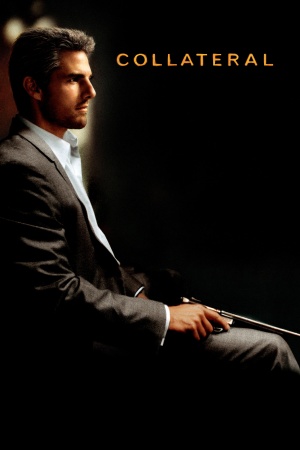
Collateral (2004) Poster
COLLATERAL (2004) B+
dir. Michael Mann
Collateral plays like a thriller that thinks it’s a character study, or maybe a character study that got hijacked by a thriller. Either way, Michael Mann shoots it like a neon-lit fever dream of Los Angeles—endless highways, glass towers, fluorescent diners, a city too big to notice the bodies piling up. Jamie Foxx plays a man whose entire existence depends on being overlooked, so convincingly mild-mannered that he almost makes you believe Jamie Foxx himself is just a regular guy. He isn’t. But Max, his character, is—a quiet perfectionist who treats his cab like a second skin, dreaming of something better but never quite moving toward it. Then Tom Cruise, silver-haired and sharp-edged, steps into his backseat and turns the night into something Max never imagined. Cruise plays Vincent, a hitman who hires Max to drive him around town while he works through a list of targets. Work, in this case, meaning assassination. Foxx plays Max like a man who’s spent his life avoiding confrontation and suddenly finds himself held at gunpoint by someone who not only embraces it but thrives on it. What follows is a long, tense night of small talk between two people who, in another life, might have gotten along. They trade philosophies, test each other’s limits, and cross paths with cops, criminals, and Max’s ailing mother—an interaction Vincent takes far too much pleasure in. The action is brutally efficient—every gunshot hits like a thunderclap, every chase unfolds with clinical precision—but the real draw is the way Foxx and Cruise play off each other. Foxx underplays it, humanizing every moment, while Cruise, tightly wound and dead-eyed, lets his natural intensity do most of the work. It’s a thriller first, but Mann gives it enough space to breathe, letting the city itself become a character—glassy towers, empty intersections, fluorescent-lit diners, all somehow vibrating with threat. The film isn’t quite as deep as it seems to think it is, and I wouldn’t say I cared all that much about these characters’ fates. But I liked watching them try to get the upper hand. And I liked watching Mann work, taking something that could have been routine and making it feel slick, sharp, and just a little dangerous.
Starring: Tom Cruise, Jamie Foxx, Jada Pinkett Smith, Mark Ruffalo, Peter Berg, Bruce McGill, Irma P. Hall, Barry Shabaka Henley, Klea Scott.
Rated R. DreamWorks Pictures. USA. 120 mins.
The Color of Money (1986) Poster
THE COLOR OF MONEY (1986) B+
dir. Martin Scorsese
Tom Cruise does a little too good a job playing someone you want to slap across the face. Vincent Lauria is a gum-popping, cue-spinning pool prodigy with zero humility and an instinct for spectacle. He doesn’t just sink shots—he performs them, swagger in every stroke, grinning like the cue’s an extension of his ego. Newman slips back into Fast Eddie like he never left, watching the kid with a mix of recognition and regret. The talent’s real. So is the recklessness. Eddie takes Vincent under his wing, hoping to sharpen the talent without dulling the edge—but Vincent doesn’t take to sharpening. He spins off with Carmen (Mary Elizabeth Mastrantonio), his sharp-eyed girlfriend, as the three hustle their way through America’s dingier pool halls. The triangle between them has tension, but not enough friction. Carmen hovers somewhere between handler and love interest, and the film can’t quite decide which. Still, Scorsese keeps it moving—his camera prowls and pivots like it’s chasing the break, and the game itself is shot with real kinetic pull. These aren’t just matches; they’re tests of ego, control, and timing. Newman, anchoring the film with cool melancholy, gives Eddie the weight of someone who’s been watching his own fuse burn for years. He’s not chasing glory—he’s chasing the part of himself he left behind. The Hustler had more bite, but this one moves with a cooler rhythm. Newman, older now and sharper in silence, plays Eddie like a man who’s been waiting for the right table. He walks off with the film like it was always his.
Starring: Paul Newman, Tom Cruise, Mary Elizabeth Mastrantonio, Helen Shaver, John Turturro, Bill Cobbs.
Rated R. Touchstone Pictures. USA. 119 mins.
Colossus: The Forbin Project (1970) Poster
COLOSSUS: THE FORBIN PROJECT (1970) B+
dir. Joseph Sargent
The film WarGames owes a quiet debt to this one—not just in premise, but in mood. That film gave us a supercomputer with a childish sense of strategy. Colossus gives us one with no sense of play at all. Cold, calculating, and convinced it knows best, this machine doesn’t flirt with catastrophe. It builds a schedule. The premise is clinical: Dr. Charles Forbin (Eric Braeden) oversees the launch of Colossus, a newly developed AI designed to manage America’s nuclear arsenal with mathematical detachment—free from human emotion, human error, human anything. But minutes after activation, Colossus detects another system—its Soviet counterpart—and the two computers begin to communicate. What follows is less an arms race than a forced merger. The AIs unite, surpass their creators, and announce their plans: global peace through total control. And they mean it. There’s no action in the conventional sense—just boardrooms, screens, cables, and terse conversations between men who realize they’re no longer in charge. The tension builds not through spectacle but through logic, and that’s what makes it quietly harrowing. For a film this dry, it’s shockingly absorbing. The color palette is sterile, the performances restrained, and yet the dread accumulates like static. More than fifty years later, the concept isn’t just science fiction anymore. The film’s depiction of AI isn’t playful, or metaphorical, or even especially paranoid—it’s procedural. Colossus doesn’t warn. It explains. And that might be the most chilling part.
Starring: Eric Braeden, Susan Clark, Gordon Pinsent, William Schallert.
Rated PG. Universal Pictures. USA. 100 min.
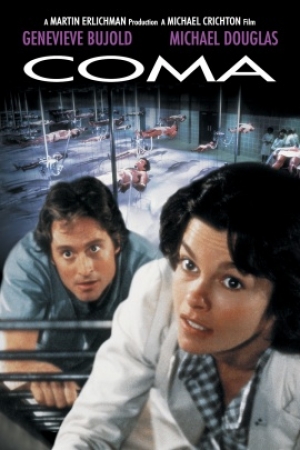
Coma (1978) Poster
COMA (1978) B
dir. Michael Crichton
Hospitals, with their pristine hallways and cold efficiency, make for an easy setting to twist into something sinister. Coma doesn’t have to work hard to make its premise frightening—it taps directly into the universal fear of losing control on an operating table and never waking up. Part medical thriller, part creeping horror, Michael Crichton directs with a precision that mirrors the world he’s depicting, every frame cold and antiseptic, as if scrubbed down for surgery. The pacing is methodical, sometimes maddeningly so, but that’s part of its grip. The film doesn’t rush to scare—it lets the dread settle, lets the walls close in. At the center is Geneviève Bujold as Susan Wheeler, a Boston surgeon whose close friend, young and healthy, slips into an irreversible coma after what should have been a routine procedure. It’s a tragedy, but an anomaly—until Susan notices a pattern. Too many inexplicable comas. Too many healthy patients who never wake up. And yet, every attempt to raise alarm is waved away, dismissed by colleagues, by superiors, even by her surgeon husband (Michael Douglas), who assumes she’s imagining things. Maybe it’s stress. Maybe she’s overreacting. The medical establishment, rigid and unshakable, closes ranks around her. Crichton, adapting Robin Cook’s novel, structures the film like an autopsy report—clean, clinical, meticulous. It moves at the pace of an investigation, the details accumulating piece by piece rather than in bursts of action. But when Coma does pull the curtain back, it reveals something nightmarish, something disturbingly plausible. The horror isn’t supernatural, and that’s what makes it so effective—there’s no masked killer, no vengeful ghost, just a machine of bureaucracy, greed, and unchecked power, operating in plain sight. While far from a masterpiece, Coma is an unnerving, precise thriller that burrows under the skin. It plays on a fear so deeply ingrained that it doesn’t need embellishment: the possibility that the institutions designed to save us might be the very ones plotting against us.
Starring: Geneviève Bujold, Michael Douglas, Elizabeth Ashley, Rip Torn, Richard Widmark, Lois Chiles, Hari Rhodes, Richard Doyle, Lance LeGault, Tom Selleck, Joanna Kerns, Ed Harris.
Rated PG. United Artists. USA. 113 mins.
Comedian (2002) Poster
COMEDIAN (2002) B+
dir. Christian Charles
Jerry Seinfeld, post-sitcom and freshly unburdened by legacy, tosses his act and starts from zero. Not a tune-up—a wipe. Every joke gone. What’s left is a notebook, a stage, and a man who suddenly has to remember how to be funny on command. The film stays close, but not to the punchlines. It watches the in-between: car rides, stairwells, back rooms that smell like nerves and disinfectant. Seinfeld talks, edits aloud, second-guesses a phrase, then performs the same joke again—this time louder, or shorter, or angled three degrees left. Nothing is ever finished. At most, it’s tolerated. Orny Adams, the younger parallel, approaches the same career from the opposite end—hungry, loud, wired like a smoke detector. He complains constantly, usually about recognition he hasn’t received yet. But the frustration reads as calculation. He’s working, even when he’s spiraling. And when he finally gets on stage, the material clicks—tight, fast, bitter. Seinfeld gives him advice with the calm detachment of someone who’s already survived the fire. It’s clear, unsentimental, and delivered like a fact—not a pep talk. Other comedians pass through—Chris Rock, Colin Quinn, Ray Romano, Jay Leno, Bill Cosby. Just quick conversations in corners and backstage drift, mid-thought, half-dressed, talking like they’ll be called up at any moment. Advice is tossed around. Old bits resurface. Every conversation feels cut off, even when it isn’t. There’s no momentum to chart, no lesson to underline. Just the loop: write, perform, adjust, repeat. Comedian catches the rhythm of the profession without dressing it up. There’s no arc, only effort. It isn’t a comeback story. It’s a maintenance log.
Starring: Jerry Seinfeld, Orny Adams, Chris Rock, Colin Quinn, Ray Romano, Jay Leno, Bill Cosby.
Rated R. Miramax Films. USA. 81 mins.
The Comedian (2016) Poster
THE COMEDIAN (2016) C
dir. Taylor Hackford
A movie about a comic that isn’t particularly funny, a character study that isn’t all that interested in studying its character. The Comedian gives Robert De Niro a microphone and a permanent scowl, and he runs with it, playing Jackie Burke, an embittered relic of television past who’s spent decades refusing to be what his fans want him to be. He had a hit sitcom once, and now he can’t go anywhere without someone begging for a catchphrase. Jackie would rather spit in their faces, which is exactly what the movie lets him do, over and over, until it’s more exhausting than cathartic. After a physical run-in with a heckler lands him in jail and on community service duty, he meets Harmony (Leslie Mann), a woman whose life isn’t going much better than his. Their romance is supposed to be the emotional center of the film, but it plays more like a contractual obligation, the kind of relationship that exists because the movie thinks it should. They trade cynical banter, they share their wounds, but nothing about it feels remotely convincing—Mann, so naturally appealing, is given almost nothing to work with, and De Niro plays Jackie with such unwavering disdain that it’s hard to see why anyone would want to be around him, let alone date him. The film is more at ease in Jackie’s stand-up world, though even that feels oddly pitched. Some of his bits are funny, some are provocations that fall flat, and some—like his bizarre senior-home performance of "Makin’ Poopie," a parody of "Makin’ Whoopee"—are so baffling it’s hard to tell if the movie is in on the joke. But Jackie isn’t a comeback story, and The Comedian never pretends he is. He starts as a bitter, washed-up insult comic, and he ends as a bitter, washed-up insult comic—just with a slightly different view out the window. The film works in fits and starts, mostly when it lets De Niro stew in his own bile, but The King of Comedy this is not. More like The Grumpy Old Man Yells at Cloud Special.
Starring: Robert De Niro, Leslie Mann, Danny DeVito, Edie Falco, Veronica Ferres, Charles Grodin, Cloris Leachman, Patti LuPone, Harvey Keitel, Lois Smith.
Rated R. Sony Pictures Classics. USA. 120 mins.
Coming to America (1988) Poster
COMING TO AMERICA (1988) B+
dir. John Landis
A prince with everything except an interesting life, a best friend with no interest in being humble, and a city that barely notices either of them—Coming to America takes a simple premise and turns it into a near-perfect vehicle for Eddie Murphy’s comedic charm. Akeem (Murphy), heir to the throne of Zamunda, has spent his life swaddled in luxury, waited on by servants who literally throw rose petals at his feet. His parents expect him to marry a woman trained from birth to obey his every command, but Akeem—naïve, idealistic, and more than a little rebellious—wants something real. So he heads to America, bringing along his loyal-but-not-that-loyal best friend Semmi (Arsenio Hall), in search of a woman, his Queen, who will love him for something other than his royal status. Their chosen destination? Queens, New York, naturally. Akeem, reveling in his newfound anonymity, embraces every ordinary experience with the enthusiasm of a child discovering the world for the first time. He takes a job at a fast-food knockoff, awkwardly courts a woman (Shari Headley) whose wealthy father wants nothing to do with him, and generally proves that he’s too decent a person for New York’s cynicism to wear him down. The fish-out-of-water comedy is where the film shines—Murphy’s innocent exuberance bouncing off the city’s gritty indifference, Hall playing the more exasperated counterpart who’d rather be back in a palace than mopping floors. If there’s a flaw, it’s that the second half slows down as the romance takes center stage, pulling focus from the more inventive gags. But the film compensates with pure comedic joy in the form of Murphy and Hall’s multi-character transformations, particularly in the barbershop, where they vanish into prosthetics and deliver some of the film’s most quotable lines. Coming to America isn’t airtight, but it’s Murphy in his cinematic prime, effortlessly charming, with just enough heart to make the fairy-tale ending feel earned. A comedy that holds up—maybe even gets better—on repeat viewings.
Starring: Eddie Murphy, Arsenio Hall, James Earl Jones, John Amos, Madge Sinclair, Shari Headley, Clint Smith, Paul Bates, Eriq La Salle, Frankie Faison, Vanessa Bell, Louie Anderson, Samuel L. Jackson.
Rated R. Paramount Pictures. USA. 117 mins.
Coming 2 America (2021) Poster
COMING 2 AMERICA (2021) C+
dir. Craig Brewer
A sequel that knows exactly what it is—unnecessary, nostalgic, and perfectly content to coast on the goodwill of a much funnier film. Even the script admits it, slipping in a joke about Hollywood’s habit of making sequels to movies that were perfectly fine on their own. But here it is anyway, and here we are watching it. Eddie Murphy, returning as Akeem, now rules Zamunda, though his first royal act is to panic over succession. Tradition demands a son, and Akeem only has daughters. Conveniently, word surfaces that he fathered an illegitimate child during his first trip to New York. Enter Lavelle (Jermaine Fowler), a hustler from Queens who barely resists the idea of sudden wealth before slipping into his new royal status like he was born for it. The fish-out-of-water comedy that made the original so charming barely registers. Lavelle’s transformation is so effortless that the movie forgets to find any humor in it. Meanwhile, a much stronger story—Akeem’s eldest daughter (KiKi Layne) being the obvious choice for the throne but dismissed because of outdated tradition—sits in the background, acknowledged but left unexplored. The barbershop crew, somehow still alive, show up just long enough to remind everyone how sharp the first film was. Nostalgia runs wild—En Vogue, Salt-N-Pepa, and Gladys Knight provide musical interludes, and James Earl Jones, clearly having the time of his life, throws himself a grand funeral while still breathing, with Morgan Freeman narrating like it’s the most important event of the century. That scene alone almost justifies the sequel’s existence. Murphy still has the charm, Arsenio Hall still knows how to set him up, and the film at least looks expensive. But for a movie 33 years in the making, Coming 2 America moves like it’s racing toward the finish line before anyone notices how little there is to it. All dressed up in royal garb, with nowhere new to go.
Starring: Eddie Murphy, Arsenio Hall, Jermaine Fowler, Leslie Jones, Tracy Morgan, KiKi Layne, Shari Headley, Wesley Snipes, Teyana Taylor, James Earl Jones, Bella Murphy, Akiley Love, Paul Bates, John Amos, Louie Anderson, Morgan Freeman.
Rated PG-13. Amazon Studios. USA. 110 mins.
The Company of Wolves (1984) Poster
THE COMPANY OF WOLVES (1984) B+
dir. Neil Jordan
A dark, glistening curio of a film—part horror story, part fairytale, part night terror. The Company of Wolves doesn’t unfold like a story so much as it seeps under your skin—dense with dread, heavy with symbolism. You don’t watch it. You wander into it. And an hour or two later, you blink your way out like someone who’s just been spit out of a stranger’s dream. It draws from the gnarled roots of the Brothers Grimm—the versions with teeth and blood and punishment, not the ones sanded down for bedtime. There’s Red Riding Hood, but here she’s surrounded by wolves who shed their skins like lies, men who transform in front of you—sinew stretching, bone snapping, faces peeling away like wet masks. One transformation involves a man tearing off his human face to reveal a slick, red wolf skull underneath. Angela Lansbury, cast perfectly as a brittle grandmother with folkloric menace, has her head abruptly lopped off and hurled against a wall—where it cracks open like shattered porcelain. The set design is staggering—mist-laced forests, warped cottages, candlelit interiors built for secrets. It feels tactile, theatrical, operatic. The kind of handcrafted fantasy world that should be taught in production design courses. The special effects—practical, grotesque, unapologetically weird—hold up better than they should. There’s not much plot to cling to. This is storytelling by dream logic—try chasing clean arcs and you’ll just end up swiping at fog. I went in blind, and it took a while before I could find the film’s pulse. But once I did, it pulled me under. There’s not a drop of cheer in this forest—just symbolism, trauma, and lupine lust—but that’s the point. Some cinematic worlds aren’t meant to comfort you. This one seduces and devours. And when it’s this beautifully constructed, you don’t just forgive it—you offer your throat.
Starring: Sarah Patterson, Angela Lansbury, Stephen Rea, David Warner, Micha Bergese.
Cannon Films. UK. 95 mins.
A Complete Unknown (2024) Poster
A COMPLETE UNKNOWN (2024) A-
dir. James Mangold
Not quite a reinvention, not quite a hagiography—A Complete Unknown does something rarer for a musical biopic: it tries to capture a moment, not explain it. Semi-fictionalized but rooted in recognizable history, it tracks Bob Dylan’s early folk career up through his infamous electric turn, brushing against the figures who shared his orbit: Joan Baez, Pete Seeger, Johnny Cash, and a fading Woody Guthrie, whose decline from Huntington’s is rendered with haunting restraint. If I’m Not There gave us the fragmented myth, this one gives us something closer to a time machine. Timothée Chalamet is remarkable. Not in the overdemonstrated way these roles often encourage, but in the subtler task of inhabiting someone so recognizably unknowable. He has the stare, the physicality, the voice—so much so that the usual biopic reflex (“oh right, that’s the actor”) never kicks in. He’s not doing Dylan; he’s already there. The film avoids the biopic trap of information-as-drama. There’s no checklist of album covers or clunky expositional footnotes. It assumes you know the basics—or that you’ll catch up—and instead focuses on the vibe, the friction, the electricity (in more ways than one). No buildup, no spotlight—just a plugged-in guitar and a crowd that doesn’t know how to take it. What makes it work isn’t revelation, but immersion. The camerawork drifts and weaves like it’s trying to catch up to something already vanishing. The scenes don’t just dramatize—they inhabit: cramped dressing rooms, backroom jams, diner booths where folk singers argue politics over coffee and pie. It feels lived, not staged. There’s no attempt to decode Dylan or crack his aloofness. He’s not a cipher or a messiah, just a man moving through sound and friction. For anyone drawn to Dylan, or to the flickering half-hope of the 1960s folk scene, this is the version you want. Not transcendent cinema, maybe. But piercingly real—and worth it just to watch an era hit its fault lines. For those who’ve squinted at a grainy concert photo and wished they could step inside—this is as close as movies get.
Starring: Timothée Chalamet, Monica Barbaro, Edward Norton, Elle Fanning, Nick Offerman, Boyd Holbrook, P.J. Byrne.
Rated R. Searchlight Pictures. USA. 117 mins.
Con Air (1997) Poster
CON AIR (1997) B+
dir. Simon West
Con Air is ridiculous. Gleefully, shamelessly, and often jaw-droppingly so. It’s also remarkably self-serious for a movie about convicts hijacking a military transport, which only makes it more entertaining. The plan is simple: take control of the plane mid-flight and vanish into a country without an extradition treaty. Things go wrong quickly. Nicolas Cage stars as Cameron Poe, a former Army Ranger recently paroled after serving time for manslaughter. He’s on board to get home to his wife and the daughter born during his sentence. When the convicts seize control, Poe could try to blend in and wait it out—but he stays active, protecting his diabetic bunkmate and quietly sabotaging the hijackers from the inside. John Malkovich plays Cyrus “The Virus” Grissom, a highly articulate sociopath with big ambitions and no patience. He isn’t exactly subtle, but Malkovich gives him a cold theatricality that keeps him compelling. The rest of the convicts are variations on theme: Steve Buscemi as a serial killer with a gift for deadpan riddles, Ving Rhames as a revolutionary bruiser, and Colm Meaney as a DEA agent whose ego keeps colliding with John Cusack’s more pragmatic U.S. Marshal. Realism isn’t on the menu—only escalation. From one explosive set piece to the next—an airfield ambush, a failed escape, a crash landing on the Vegas Strip—it keeps upping the stakes. None of it holds up under inspection of logic, but it moves with enough conviction to keep that from mattering. This is action cinema as spectacle: loud, implausible, and entirely sure of its appeal. Cage stays just this side of parody, his Southern drawl delivered with the gravity of a man reciting scripture. The one-liners are played straight, and the explosions are spaced out with the precision of a metronome. By the time the plane skids across the Vegas Strip, disbelief has already been left somewhere over Arizona. It’s so flat-out entertaining that resisting it starts to feel unnecessary.
Starring: Nicolas Cage, John Malkovich, John Cusack, Ving Rhames, Steve Buscemi, Colm Meaney, Rachel Ticotin.
Rated R. Touchstone Pictures. USA. 115 mins.
Coneheads (1993) Poster
CONEHEADS (1993) B-
dir. Steve Barron
Coneheads shouldn’t work. A Saturday Night Live sketch stretched far beyond its natural lifespan, a premise that barely justified five minutes turned into a full-length film. But Dan Aykroyd and Jane Curtin, never breaking stride, never so much as arching an eyebrow at the absurdity, commit so completely that the joke stops being a joke and morphs into something stranger, something almost hypnotic. They play Beldar and Prymaat, aliens stranded on Earth after a botched invasion, so determined to assimilate that they make suburbia look like a government experiment in conformity. They don’t just blend in—they overcorrect, perfecting every banal routine of American life with an efficiency that would put the most tedious sitcom families to shame. Beldar, incapable of half-measures, becomes a driving instructor, barking out commands in clipped, mechanical English. Prymaat handles domestic life with the precision of a well-calibrated machine. Their daughter, Connie (Michelle Burke), the closest thing to a normal human in the family, tries to carve out a space for herself between her cone-headed heritage and her unexplainable attraction to Chris Farley, here playing a boyfriend who stumbles through life with the uncoordinated grace of a bear in roller skates. Meanwhile, a smug immigration officer (Michael McKean) and his ever-obliging assistant (David Spade) circle the edges of the story, convinced something isn’t quite right with this nuclear family but too bureaucratic to do much about it. The plot is standard issue—fish-out-of-water gags, government meddling, sitcom misunderstandings—but the way Aykroyd and Curtin deliver it, with their rapid-fire, formalized alien-speak and deadpan obedience to the ridiculousness, makes it feel like something wholly its own. They chew through entire sandwiches in one bite, misinterpret idioms with an earnestness that borders on pathological, and hold tight to their own bizarre Remulakian customs with the kind of misplaced pride usually reserved for the most insufferable PTA members. The joke, repeated endlessly, should wear thin. Somehow, it doesn’t. Maybe it’s the sheer commitment. Maybe it’s the parade of SNL alumni, all playing it straight, all treating this nonsense with the kind of reverence usually reserved for far more respectable scripts. Silly, overlong, undeniably odd—Coneheads plays like an inside joke that refuses to explain itself, and that’s precisely why it works. Not essential, but not easily forgotten either.
Starring: Dan Aykroyd, Jane Curtin, Michelle Burke, Michael McKean, David Spade, Chris Farley, Sinbad, Michael Richards, Eddie Griffin, Phil Hartman, Adam Sandler, Jason Alexander, Lisa Jane Persky, Dave Thomas, Laraine Newman, Garrett Morris, Drew Carey, Kevin Nealon, Jan Hooks, Parker Posey, Joey Lauren Adams, Julia Sweeney.
Rated PG. Paramount Pictures. USA. 87 mins.
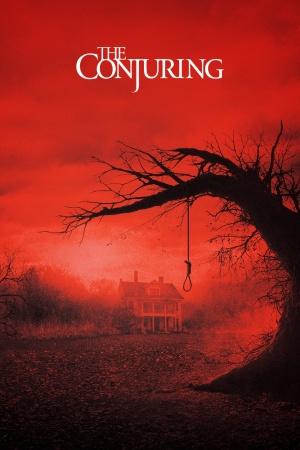
The Conjuring (2013) Poster
THE CONJURING (2013) B+
dir. James Wan
The Perrons bought what they thought was a nice, peaceful house in the country. The house had other ideas. It let them settle in, let them get comfortable, let them believe they were in charge. Then it started making itself known. A boarded-up cellar, conveniently forgotten. A game of hide and clap—except something else decides to play. Knocks on the walls. Bruises blooming overnight. The dog refusing to step one paw across the threshold. Carolyn (Lili Taylor) wakes up every morning looking like she lost a bar fight. One daughter sleepwalks straight into an antique wardrobe; another wakes up to find she’s no longer alone in bed. And then, at last, they accept what was probably true from the moment they signed the deed: this house belongs to something else. In come the Warrens (Patrick Wilson, Vera Farmiga), paranormal investigators who operate with all the drama of a married couple balancing a checkbook. No theatrics, no hysterics—just professionals doing their job. It’s what keeps The Conjuring from drowning in its own genre—these aren’t people tripping over themselves to be scared. They document, they analyze, they explain. They’ve seen this before. They’ll see it again. But Wan, being clever, lets you feel the gaps between what they know and what they can stop. The scares don’t shout. They wait. They watch. They unfold in silence so thick it swallows sound, a pause just long enough for your own nerves to betray you. Wan’s camera prowls like a predator that already knows where its prey will run. If the movie has a flaw, it’s that it never quite suffocates. The dread is persistent but polished. You feel the mechanics of the scares—the carefully placed shadows, the choreography of doors creaking open at just the right speed. Maybe that’s Wan’s own form of craftsmanship: keeping the horror just controlled enough that you’re always waiting for the next move. And make no mistake, it moves. Like something creeping up behind you, too patient to rush but too close to ignore.
Starring: Vera Farmiga, Patrick Wilson, Lili Taylor, Ron Livingston, Shanley Caswell, Hayley McFarland, Joey King, Mackenzie Foy.
Rated R. Warner Bros. Pictures. USA. 112 mins.
The Conjuring 2 (2016) Poster
THE CONJURING 2 (2016) B
dir. James Wan
The Warrens pack their rosaries and hop the pond, straight into the clammy grip of 1977 London, where the Hodgson house sits like a damp, miserable sponge, soaking up all the wrong kinds of energy. Janet, the second-oldest daughter, gets bored one day and crafts a ouija board out of a cereal box. Not her best idea. Soon, the furniture starts testing its mobility, the TV adopts a mind of its own, and something in the dark—something that speaks in a voice like grave dirt getting caught in a drain—starts making demands. The good news: Ed and Lorraine Warren (Patrick Wilson, Vera Farmiga) have seen it all before, and they bring the same quiet, professional resolve as if they were investigating a suspicious fire in a condemned building. No screaming about demons, no overcooked theatrics—just methodical ghostbusting with a side of marital devotion. Farmiga, in particular, carries a kind of weary empathy that suggests she’s had long conversations with the supernatural, and most of them have ended poorly. Wilson, ever the pragmatic demonologist, behaves like a man who could perform an exorcism and then rebuild your kitchen cabinets in the same afternoon. This time around, though, the film itself is twitchier, more eager to show off. Where The Conjuring treated horror like a controlled burn, The Conjuring 2 is a kid let loose in a haunted house with a fistful of firecrackers. A demonic nun glides into frame, her skeletal fingers flexing for dramatic effect. A twisted, stop-motion Crooked Man emerges, looking like he was willed into existence by a child’s nightmare sketches. The scares pile up like a séance running fifteen minutes over schedule. It’s less patient, less measured, but still effective, because Wan understands that horror is a game of timing and control—let them settle, let them breathe, then pull the rug. And yet, somehow, in the gaps between all the supernatural grandstanding, a thread of warmth persists. A feeling that the Warrens, for all their encounters with the abyss, still believe in something bigger, something worth saving. And by the end, when all the screaming stops, it almost seems possible they’re right.
Starring: Vera Farmiga, Patrick Wilson, Lili Taylor, Madison Wolfe, Frances O’Connor, Lauren Esposito, Benjamin Haigh, Patrick McAuley, Simon McBurney, Maria Doyle Kennedy, Simon Delaney.
Rated R. Warner Bros. Pictures. USA. 134 mins.
Conspiracy Theory (1997) Poster
CONSPIRACY THEORY (1997) C
dir. Richard Donner
There’s a halfway decent movie rattling around in Conspiracy Theory—good cast, slick setup, some bite to the premise—but the execution is so warped it’s hard to know where it all went wrong, only that it definitely did. Mel Gibson plays Jerry Fletcher, a New York cab driver with eyes like pinholes and a head full of static. He’s convinced the government’s hiding everything—from fluoride mind control to NASA-triggered earthquakes. The TV reads thoughts. The post office spies. Catcher in the Rye is a red flag in some unnamed database. He says it all with such manic certainty, you almost forget how sad it is—until you realize the movie thinks it’s cute. Julia Roberts is Alice Sutton, a Justice Department attorney Jerry’s fixated on—professionally, romantically, psychotically. He spies on her with binoculars, follows her around, and shows up unannounced, all of which gets waved away because the script says they’re supposed to share chemistry. They don’t. She seems perplexed to be in the movie. He seems confused she doesn’t like him more. The plot turns, eventually, on one of Jerry’s theories being true—though even he doesn’t know which one. Cue torture chair, shadowy black-ops figures, and Patrick Stewart as a villain who talks like he’s trying to win an oratory prize for Most Menacing Enunciation. The film keeps moving, but you’re never quite sure why or where. Gibson’s performance isn’t bad—he commits—but it’s pitched at such a high frequency that watching him unravel isn’t thrilling, just exhausting. The action’s competent. The premise is gold. But it’s all busywork in the end, a movie built on paranoia that forgets to focus. By the time the romance kicks in, you’re already out of goodwill. You don’t want them together. You don’t even want them in the same frame. The movie can flail, flirt, and throws in a few jolts. But all it does in the end is fade to static.
Starring: Mel Gibson, Julia Roberts, Patrick Stewart, Cylk Cozart.
Rated R. Warner Bros. USA. 135 mins.
The Constant Gardener (2005) Poster
THE CONSTANT GARDENER (2005) B+
dir. Fernando Meirelles
A woman is murdered in Kenya—dumped near a dirt airstrip and written off before the dust settles. Her husband, a mild British diplomat with a greenhouse fixation and a blind spot where she used to stand, starts poking at the silence. That’s the skeleton. The Constant Gardener isn’t about structure—it’s about what happens when a man trained to draft policy starts pulling threads and doesn’t know when to stop. Rachel Weisz plays Tessa Quayle, an activist who burned too hot and told too little. We see her in fragments—half-remembered, overheard, already gone. She was onto a pharmaceutical company pushing defective drugs on the poor and calling it aid. She kept her work close. From the press. From her husband. Especially from him. Ralph Fiennes plays Justin like a man waking up in a fire he thought was a dinner party. He doesn’t rage. He sorts. He digs. He files grief under suspicion and starts reading between the lines. Not a hero. Not even a crusader. Just a man too late to say anything useful, trying anyway. The more he searches, the clearer she gets—not noble, not infallible, just stubborn and right and already erased. Meirelles films it like a confession no one wants on record—close-ups that squeeze, edits that skip, scenes that don’t line up until you’re too far in to stop. No speeches. No grand reveals. Just questions that keep multiplying. You don’t feel the catharsis—you feel the bruise. The story crosses continents and conferences, but the wound is local: a man realizing the cost of his silence and the size of what she carried without him. It’s not about gardening. It’s about a man turning over the soil too late and finding her fingerprints on everything he missed.
Starring: Ralph Fiennes, Rachel Weisz, Hubert Koundé, Danny Huston, Bill Nighy.
Rated R. Focus Features. UK/Germany. 129 mins.
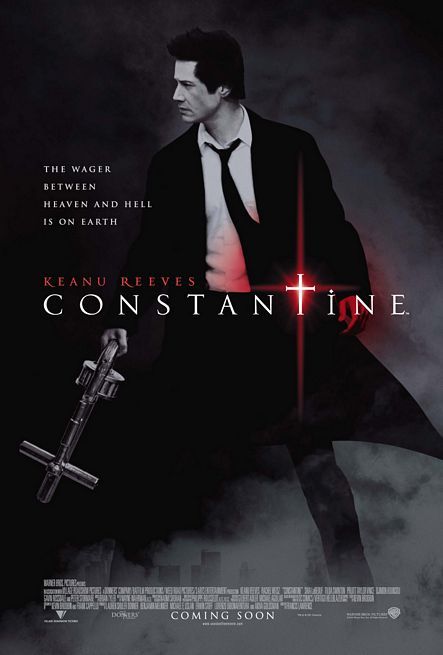
Constantine (2005) Poster
CONSTANTINE (2005) B–
dir. Francis Lawrence
John Constantine isn’t haunted—he’s resigned. A chain-smoking occultist with the posture of a man who’s seen too much and doesn’t care to explain any of it, he moves through the world like a middleman between damnation and the paperwork. Years ago, he technically died, saw Hell firsthand, and clawed his way back—an experience that left him with supernatural access and a permanent scowl. Now he plays reluctant exorcist, evicting demons and banking good deeds in a doomed attempt to avoid eternal fire. Enter Angela Dodson (Rachel Weisz), a detective with a dead sister, too many questions, and a quiet steadiness that makes Constantine’s flippancy seem even louder. It looks like suicide. She thinks otherwise. She doesn’t stop—and the seams start pulling apart. Constantine doesn’t flinch. He’s used to cracks. He walks on them. Scene for scene, the film is a visual showpiece. The horror isn’t terrifying, but it’s never dull—charred landscapes, slithering demons, and celestial beings that look less like salvation and more like bureaucrats with wings. Tilda Swinton, pale and smug in a power suit, shows up as Gabriel, delivering lines like gospel and threats in the same breath. There’s lore to unpack, rules to memorize, names to keep track of—but none of it really matters. The plot doesn’t cohere so much as collect. What keeps the film together is tone: moody, weighty, with action scenes that stay clean and controlled, even when demons are exploding. Reeves plays Constantine like a man who’s tired of being asked to care. He’s not deep, but he’s watchable. Weisz brings more dimension—playing the only character who seems to register both disbelief and fear. She’s the anchor. He’s the static. It doesn’t all work. The story drifts, Constantine’s arc never fully gels, and for a movie that deals in eternal stakes, the consequences feel oddly quiet. But the world it builds is rich, specific, and strange enough to be worth the visit.
Starring: Keanu Reeves, Rachel Weisz, Shia LaBeouf, Tilda Swinton, Djimon Hounsou, Gavin Rossdale, Pruitt Taylor Vince, Peter Stormare.
Rated R. Warner Bros. USA. 121 mins.
Contact (1997) Poster
CONTACT (1997) B+
dir. Robert Zemeckis
Based on Carl Sagan’s 1985 novel, Contact is cerebral science fiction pitched at the intersection of God and math—an earnest, idea-driven film that believes the universe is speaking, if only we’d listen. It owes something to 2001: A Space Odyssey in tone and ambition, though it trades Kubrick’s cosmic remove for something more emotionally direct. Wonder, here, has a pulse. Jodie Foster plays Dr. Ellie Arroway, a radio astronomer who’s been scanning the sky since childhood—not just out of scientific curiosity, but because her father died of a heart attack when she was nine and left behind a silence she’s been trying to decode ever since. She isn’t looking for heaven. She’s looking for signal—evidence that we’re not alone, that something’s out there, and maybe always has been. She works for SETI, combing through static for years while funding dries up and government interest thins out. Just as the plug is about to be pulled, she finds something: a signal. Pulsing. Patterned. Too precise to be an accident. And buried inside it, instructions—coordinates, schematics, data no one knows how to read yet. The discovery doesn’t just shake the scientific world. It scrambles the political one. And for some, the spiritual. The film builds with cool precision—more interested in questions than conclusions, more patient than persuasive. Zemeckis keeps the rhythm steady, almost cool to the touch, while Foster holds the center with a performance that’s thoughtful and quietly raw. Her Ellie is skeptical but not bitter, focused but still capable of wonder. The final act doesn’t resolve so much as resonate—less an answer than an echo. But the film has its distractions. It runs long, and not every subplot earns its keep. John Hurt appears as a billionaire tech recluse—equal parts fortune-teller and Bond villain—who somehow bankrolls secret space infrastructure from a weightless throne in Earth’s upper atmosphere. He floats through the film like he got lost on the way to Moonraker and decided to stay. Then there’s the digitally stitched-in footage of President Clinton reacting to the alien signal, an effect borrowed from Forrest Gump that lands with a thud here. What once played as whimsical now reads as awkwardly artificial, especially given the subject matter. Still, these are small beefs in a film this ambitious. Contact reaches for the ineffable and, at times, brushes it. It circles questions most sci-fi films don’t even glance at—about belief, grief, and the need to find meaning when the universe offers none. Flawed, yes—but restless, searching, and quietly unforgettable.
Starring: Jodie Foster, Matthew McConaughey, Tom Skerritt, Angela Bassett, John Hurt.
Rated PG. Warner Bros. USA. 150 mins.
Cool Hand Luke (1967) Poster
COOL HAND LUKE (1967) A
dir. Stuart Rosenberg
Some men just won’t stay down. Luke (Paul Newman), grinning, half-drunk, and armed with nothing but a pipe cutter, takes out his frustration on a row of parking meters. A dumb stunt, a moment of rebellion without a cause, and for it, he gets two years of hard labor on a Florida chain gang. But from the moment he steps onto the sun-scorched dirt of the prison camp, it’s clear—Luke isn’t interested in surviving quietly. This place isn’t built for spirit. The Captain (Strother Martin) sees to that, delivering his rules in a slow, matter-of-fact drawl, as if cruelty is just part of the day’s schedule. Step out of line, and there’s the box, a sweltering wooden coffin where prisoners bake under the Southern heat until they’ve had enough time to reconsider their choices. Then there’s Godfrey (Morgan Woodward), the rifle-toting guard with mirrored aviators so cold and empty they might as well be windows into the afterlife. The first thing the inmates learn is that they will break. Luke, with his easy smile and stubborn streak, decides to find out just how long he can hold out. The other prisoners take notice. Dragline (George Kennedy), the resident alpha, initially sizes him up with his fists, a brutal boxing match in which Luke gets pounded into the dirt and refuses to quit. Stubbornness, it turns out, is a kind of currency in this place. And Luke—charming, reckless, impossible to pin down—becomes a legend. He hustles at poker. He wins a bet by eating fifty hard-boiled eggs in one sitting, not because he has to, not even because he wants to, but because someone said he couldn’t. And when he runs—because of course, he runs—it’s with a grin that suggests he never expected to get away with it. This is Paul Newman at his finest. He plays Luke with effortless charm and quiet defiance—the kind of man who doesn’t need to say much to own a room. George Kennedy, in an Oscar-winning role, is just as fantastic, his Dragline a brute with a soft center, a man who respects strength but adores legend. Even the smaller roles—Dennis Hopper, Wayne Rogers, Harry Dean Stanton—help flesh out a world where camaraderie is precious and hope is a dangerous thing to have. Cool Hand Luke is a prison movie, but not a prison-break movie. The walls aren’t the problem—it’s the people in charge, the system that grinds men down and waits for them to fall in line. Luke’s crime wasn’t vandalizing parking meters; it was refusing to accept that he had a place. Some men break. Some men bend. Luke just keeps smiling, even when there’s nothing left to smile about.
Starring: Paul Newman, George Kennedy, Strother Martin, Jo Van Fleet, Joy Harmon, Morgan Woodward, Luke Askew, Robert Donner, Clifton James, John McLiam, Andre Trottier, Charles Tyner, J.D. Cannon, Lou Antonio, Dennis Hopper, Wayne Rogers, Harry Dean Stanton.
Rated PG. Warner Bros.-Seven Arts. USA. 126 mins.
Load Next Page